

Sedona has two peak seasons, spring (March and April) and fall (October and November), plus a small December bump and a sleepy stretch in July and August. Red rocks never go out of style, but guests sure do take summer vacations somewhere with a pool the size of a lake. Here is how occupancy, nightly rates and revenue move through the year, and what that means if you own, buy or sell a Sedona short-term rental.
TL;DR
- Sedona rides twin peaks: March and April, then October and November. StaySTRA data puts spring occupancy near 72% and October near 61%.
- August is the trough, at 39% occupancy and $357 ADR in that same dataset. December quietly posts the year’s highest nightly rate, $506.
- Supply keeps growing, so a seller’s “annual revenue” number means little without monthly detail behind it.
- Buyers should underwrite the lower of the seller’s number and a comp-based number, and ask for twelve months of payout statements.
Table of Contents
- The Sedona year at a glance
- Spring: the big, bright hill
- Summer: the nap
- Fall: the encore
- December and January: the holiday hop and the quiet
- Seasonal pricing: what owners should actually do
- Supply: more homes, more competition for the same guests
- Verifying a seller’s revenue claim
- Timing a sale or purchase around the seasons
- Perspective
- Get a seasonal read on your Sedona rental
- FAQ
- Sources
The Sedona year at a glance
Think of Sedona’s calendar as a roller coaster designed by someone who really loved hiking weather. Two big hills, a dip in the middle, a little holiday hop at the end.
| Period | What the data shows | Source |
|---|---|---|
| March | Best month in 2026: $12,457 average revenue, 70.8% occupancy, $526 nightly rate | AirROI |
| March and April | Occupancy around 72%, ADR $389 to $451 | StaySTRA |
| October | 61% occupancy, ADR climbing to $471 | StaySTRA |
| December | $506 ADR, 48% occupancy | StaySTRA |
| January | Soft, around 47% occupancy | StaySTRA |
| August | Slowest month in 2026: $5,067 revenue, 38.7% occupancy, $376 nightly rate | AirROI |
Different data sets measure different slices of the market, which is why the numbers do not match to the dollar. The shape, though, is the same everywhere: high in spring and fall, low in high summer.
For the year as a whole, the same AirROI page shows the average Sedona Airbnb earning $77,135 over the 12 months through October 2026, with a $463 average nightly rate and 50% occupancy. That is roughly double the Arizona average of $38,025.
Spring: the big, bright hill
March is Sedona’s headliner. Wildflowers, spring break crowds, trails with perfect temperatures. Occupancy reaches the low 70s on average, and the best-positioned homes do better still. Host Camp reports top assets exceeding 80% occupancy in peak months.
Nightly rates follow along. AirROI shows rates peaking in March and April at about $505. Spring is also when a flat pricing formula falls apart. A local owner’s guide points out that a realistic projection has to account for spring break compression in March and holiday weeks, and should show monthly numbers rather than one annual total.
What to do with that:
- Open spring calendars early and price them with confidence.
- Watch minimum-stay rules around school breaks.
- Do not let a sunny March convince anyone that every month looks like that.
Summer: the nap
July and August are the trough. Heat and monsoon season send many visitors toward cooler places, and Sedona’s occupancy shows it: August came in at 38.7% in 2026 per AirROI, with rates bottoming out around $385 in July and August.
Still, Sedona sits at roughly 4,500 feet, which keeps it cooler than Phoenix or Scottsdale, a point local property managers make about why summer softens but holds up better than most Arizona markets. Properties with good outdoor amenities still draw guests in August, according to Host Camp.
So summer is a nap, not a coma. A pool, shade, a hot tub for cool evenings and strong photos help a home catch the guests who do come. Our amenity must-haves guide covers what tends to matter.

Fall: the encore
October and November are Sedona’s second hill. The StaySTRA dataset shows 61% occupancy in October and an ADR that climbs to $471. Another local manager’s data puts fall occupancy between 53% and 58%, with ADR from roughly $302 to $427 or more, and average booking lead times of 57 to 64 days, which is why fall booking season opens sooner than owners expect.
That lead time matters. By the time August is dragging along, fall guests are already shopping. The same source warns against answering a slow August by cutting fall rates, and advises treating the two seasons as separate pricing problems. In plain words: a bad August is not a reason to give October a discount.
December and January: the holiday hop and the quiet
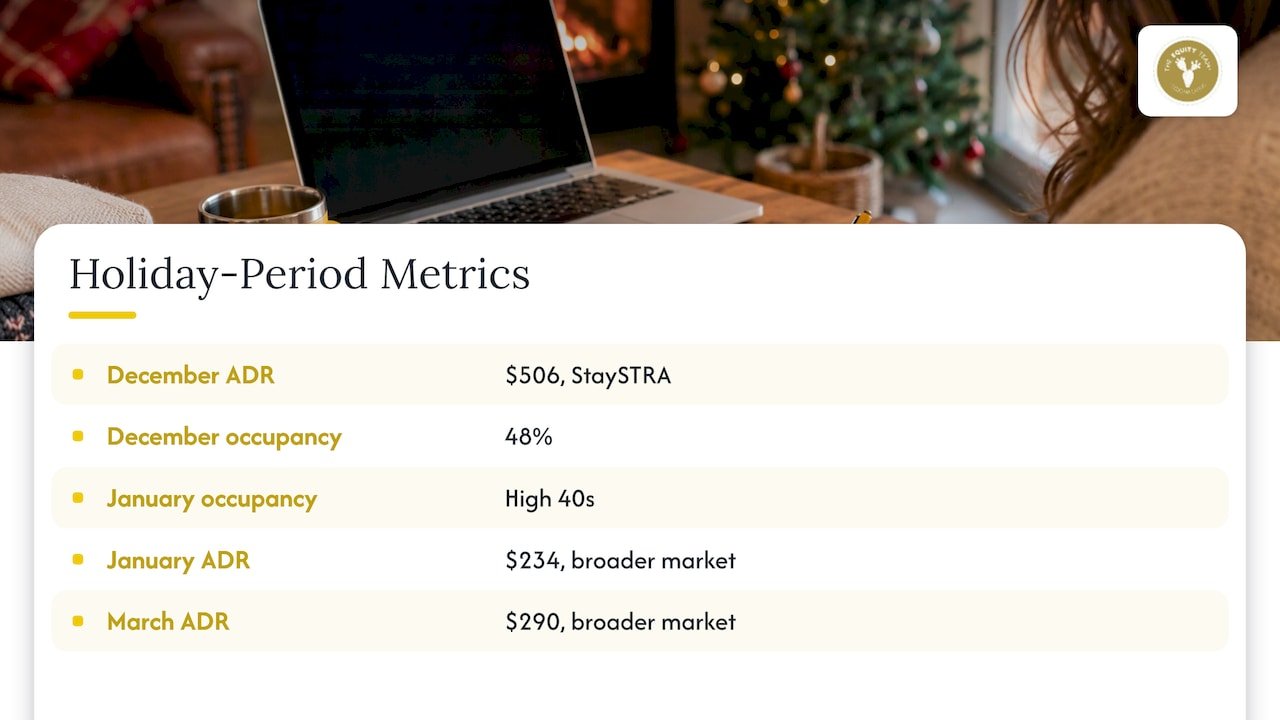
December surprises people. It carries the highest ADR of the year in the StaySTRA data, $506, with 48% occupancy. Holiday travelers pay up, especially for premium view homes. Then January arrives and occupancy drops to the high 40s. Rates also reflect it: an earlier StaySTRA reading put January ADR at $234, against $290 in March, for the broader market.
Our own peak rental season guide and occupancy data analysis go deeper on how the calendar affects investors.
Seasonal pricing: what owners should actually do
Rates in Sedona move with events, school calendars, weather and last-minute demand, so active pricing management beats a set-and-forget rate card. A few habits keep owners out of trouble:
- Price by season, not by average. AirROI shows a $463 yearly average rate, but the actual range runs from about $385 in midsummer to about $505 in spring.
- Use the lead time. The average booking window is around 56 days, per StaySTRA, which leaves runway to adjust.
- Protect fall and December. These are your premium windows.
- Respect the view premium. One manager reports that direct red rock views can command 30 to 50 percent higher nightly rates than comparable homes without them.
- Compare against the right comps. Our guide on pricing during active bookings walks through it.
Rates have also climbed over time. StaySTRA shows the average nightly rate rising from $353 in 2021 to $440 in early 2026, a 25% increase, while monthly revenue per listing settled into the $6,335 to $6,965 range through 2024 and 2025 after peaking at $8,656 in 2021.
Supply: more homes, more competition for the same guests
Seasonality is not only about demand. It is also about how many homes are splitting that demand. StaySTRA counted 1,805 active listings in Sedona as of February 2026, up from 1,113 in 2021, a 62% increase in five years. AirDNA reports a larger count, 3,990 active listings as of October 2026, with revenue up 40.4% year over year while active listings are down 8.0%. Different providers define a “listing” differently, so use the trend, not one number.
Host Camp reports 1,771 active listings making up 16.39% of the city’s housing inventory. The city’s own Sedona Sustainable Tourism Plan notes that rentals jumped after state law SB1350 passed in 2016, when the region had more than 825 listings.
More supply tends to bite hardest in the slow months, when there are fewer guests to go around. In peak months the best homes still fill. Our look at why short-term rentals dropped in Sedona has more on the local picture.
Verifying a seller’s revenue claim
Seasonality is exactly why a single “this home makes $X a year” line deserves a closer look. A flat formula like ADR times 365 times occupancy ignores everything above. Here is a sane way to check, based on underwriting advice for STR buyers:
- Build your own estimate first. Use comparable properties and RevPAN (ADR times occupancy) before looking at the seller’s figures.
- Ask for twelve months of platform payout statements and a Schedule E. Twelve months matters because it captures both peaks and the trough.
- Underwrite the lower number when the seller’s figure and your comp-based figure disagree.
- Read the fine print on “gross.” Revenue claims can include cleaning fees paid to cleaners, leave out platform commission or management fees, or leave owner-blocked nights out of the occupancy math.
- Count the whole expense stack, including management, cleaning, supplies, utilities, insurance under an STR endorsement, permit and licensing fees, lodging tax and a furniture replacement reserve.
- If there are no statements, treat the home as having no operating history.
Also confirm that a new owner can get and keep a Sedona permit under current city rules, and read the actual HOA CC&Rs, as the same owner’s guide suggests. Our walkthrough on evaluating Sedona rental income potential pairs well with this checklist.
Timing a sale or purchase around the seasons
Sedona’s rental calendar affects when a listing looks its best. A home with a full spring calendar and strong fall bookings tells a better story than one caught between hills. Sellers can let the numbers show the trend, with monthly detail rather than a single annual total. Buyers, meanwhile, can use the slow months to see how a property behaves when the crowds go home.
Our benchmarking guide for resales and our overview of the current Sedona STR climate show how we think about it.
Perspective
Most of the questions we hear boil down to one: “Will this house make money in August?” We like that question, because it forces everyone to look at the whole calendar instead of the shiniest month.
Our view is simple. Sedona has a rhythm, and the owners who do best learn it. They price spring and fall like the premium seasons they are, they plan for the quiet stretch, and they judge any property by its monthly picture. A great March can make almost any home look like a star.
That is why we focus only on short-term rental real estate in Sedona. Our job is to put the seasonal numbers next to the home, whether you are buying a property that can perform in the top tier of the rental market or selling one and want the story told properly. A good comparative market analysis shows what the home can earn month by month, not just on a brochure line.
Sedona is quirky, breathtaking and a little bit dramatic. Its rental market deserves an agent who finds that charming and still reads the spreadsheet.
Chad
Get a seasonal read on your Sedona rental
Thinking of selling? We build a Sedona vacation rental CMA that looks at your home against comparable rentals, plus a seller prep consultation to help the home show well. Thinking of buying? Our buyer representation puts the monthly numbers next to every listing you tour. Considering an exit down the road? Ask about our rental exit strategy and valuation conversation.

FAQ
What is the best month to rent out a home in Sedona?
March. AirROI shows March 2026 as Sedona’s best month, with $12,457 in average revenue, 70.8% occupancy and a $526 nightly rate. April, October and November are close behind as part of the twin spring and fall peaks.
What is the slowest month for Sedona Airbnbs?
August. The same AirROI data shows 38.7% occupancy and $5,067 in average revenue for August 2026. July is also soft, and January is a smaller dip, with occupancy around 47% in StaySTRA data.
Does Sedona have a true off-season?
Not a dead one. Summer softens, yet Sedona’s elevation keeps it cooler than Phoenix, and homes with good outdoor amenities still draw August guests. The real gaps are July, August and January, and good pricing and amenities soften them.
How should I verify a Sedona rental’s income before buying?
Ask for twelve months of platform payout statements and a Schedule E, then compare them with a figure you build from comparable homes. If the two disagree, underwrite the lower one. Ask for monthly numbers, not only an annual total.
Sources
- StaySTRA: Sedona short-term rental market 2026
- AirROI: Sedona Airbnb data
- AirDNA: Sedona short-term rental data
- Host Camp: Sedona Airbnb market guide
- Sedona property management tips for short-term rental owners
- Sedona fall booking season guide for homeowners
- Sedona vacation rental owner’s guide
- How to analyze a short-term rental before you buy
- Sedona Sustainable Tourism Plan