

Waiving a contingency means a buyer agrees to move forward even if the thing that contingency protects goes sideways. The inspection turns up a cracked foundation, the loan stalls, or the appraisal lands under the price. Without the contingency, the buyer may be stuck paying for it, or may lose the earnest money. That is the whole risk in one breath. The rest of this guide shows where each waiver bites, and how buyers can still make an offer that stands out.
In a place like Sedona, where red rock views have a way of making people sign things quickly, that pause button matters even more.
TL;DR
- A contingency is a condition that must be met before a purchase closes. Waiving one removes the buyer’s contractual way out if that condition fails.
- Waiving inspection can mean no repair requests, no price negotiation and no walking away with earnest money intact if a major issue turns up.
- Waiving financing or appraisal protection can leave a buyer covering a gap in cash, or risking the deposit.
- Middle paths exist: strong preapproval, a shorter contingency window, capped appraisal-gap coverage and an informational inspection.
- Sedona investment homes add layers, from STR income assumptions to wildfire and insurance questions, so the contract deserves a specialist’s eye.
Table of Contents
- What a contingency does, and what waiving one really means
- Why buyers waive them anyway
- The earnest money problem
- Risks of waiving the inspection contingency
- Risks of waiving the financing contingency
- Risks of waiving the appraisal contingency
- Quick comparison of the main waivers
- How to compete without waiving everything
- What changes for Sedona investment properties
- Perspective: why we treat waivers as a tool, never a reflex
- Working with the Equity Team
- FAQ
- Sources
What a contingency does, and what waiving one really means
The National Association of Realtors defines a contingency as a contractual condition that must be met before the purchase is completed. Once buyer and seller sign, those conditions become binding. Think of them as trapdoors built into the contract: if the condition fails, the buyer can step through without a penalty.
The same NAR guide lists the big three:
- Financing contingency: a set period to secure a mortgage.
- Appraisal contingency: a professional appraisal to confirm the home’s value is at or above the purchase price.
- Inspection contingency: time for a professional inspection and possible repair negotiations.
It also names title, homeowners insurance, HOA, property disclosure, home-sale and home-close contingencies as common provisions. Waiving one means welding that trapdoor shut. The house may be wonderful. The buyer simply no longer has a contractual exit if it is not.
Why buyers waive them anyway
The reason is simple: sellers like clean offers. Freddie Mac notes that contingencies can make an offer less attractive because they add complexity, may extend closing, and may make the seller responsible for repairs or at risk of losing the deal.
So waivers come and go with the market. NAR reported that members said 21% of buyers waived inspection contingencies in September 2025, up from 18% in August 2025 and 17% in September 2024. An earlier NAR report put the peak at 30% in June 2022. Waiving is a tool buyers reach for when competition heats up, and it is never free.
The earnest money problem
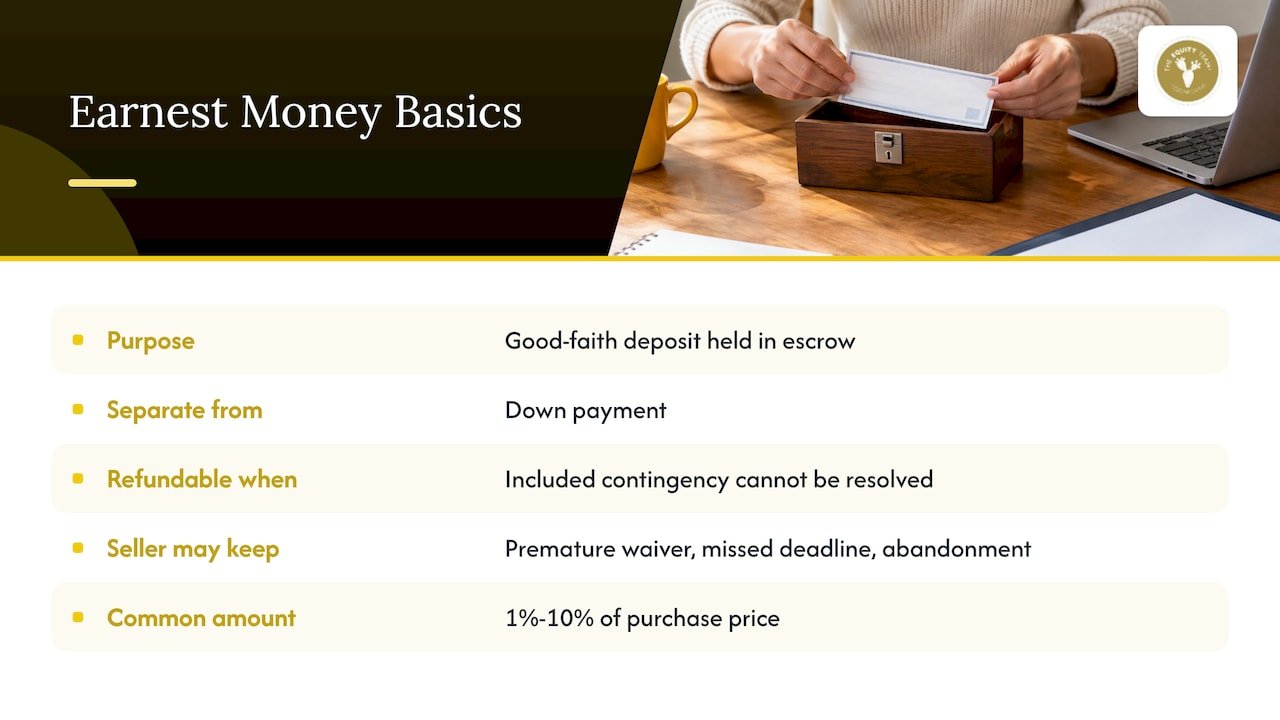
Before the individual waivers, one number sits under all of them: the deposit. NAR describes earnest money as a good-faith deposit held in escrow, separate from the down payment. It may be refunded when an included inspection, appraisal or financing contingency cannot be resolved.
Here is the catch. The same guide warns that waiving contingencies prematurely, missing contractual deadlines or abandoning the transaction can let the seller keep the deposit. Deposits are not legally required in every offer, but NAR says common amounts run from 1% to 10% of the purchase price, depending on competition, down payment, contingencies and seller preference.
On a $400,000 home, that range is $4,000 to $40,000 sitting in escrow. A contingency waiver quietly changes the question from “will I get this back?” to “under what conditions?”
Risks of waiving the inspection contingency
This is the most talked-about waiver, and for good reason. Freddie Mac explains that a buyer who waives inspection may give up the ability to request repairs, negotiate the price or walk away without losing earnest money if major issues are found. The problems tend to be the expensive kind: roof, foundation, drainage, sewer lines, HVAC.
The discovery timing is the sneaky part. A buyer can learn about underlying problems only after becoming committed. At that point the options are to close and pay for repairs, or to default and risk the deposit.
A vacation rental adds its own wrinkle. An investor underwriting a Sedona STR counts on the house being guest-ready. A surprise repair bill is not just a bill. It can also mean empty calendar nights while the work gets done. Sellers face the other side of this too, and how inspection negotiations cost sellers is a useful lens for why many sellers prefer buyers who skip the haggling.
For how repair requests are typically handled in Arizona deals, the Equity Team’s guide on the inspection repair addendum walks through the process.
The informational inspection compromise
Freddie Mac suggests a middle road for buyers who feel pressured: keep the inspection, but treat it as informational. The buyer still gets a professional’s report. The tradeoff is that the seller may not be responsible for repairs. Freddie Mac still recommends retaining the inspection contingency where possible, and buyers should confirm exactly what inspection protection the contract keeps.
Risks of waiving the financing contingency
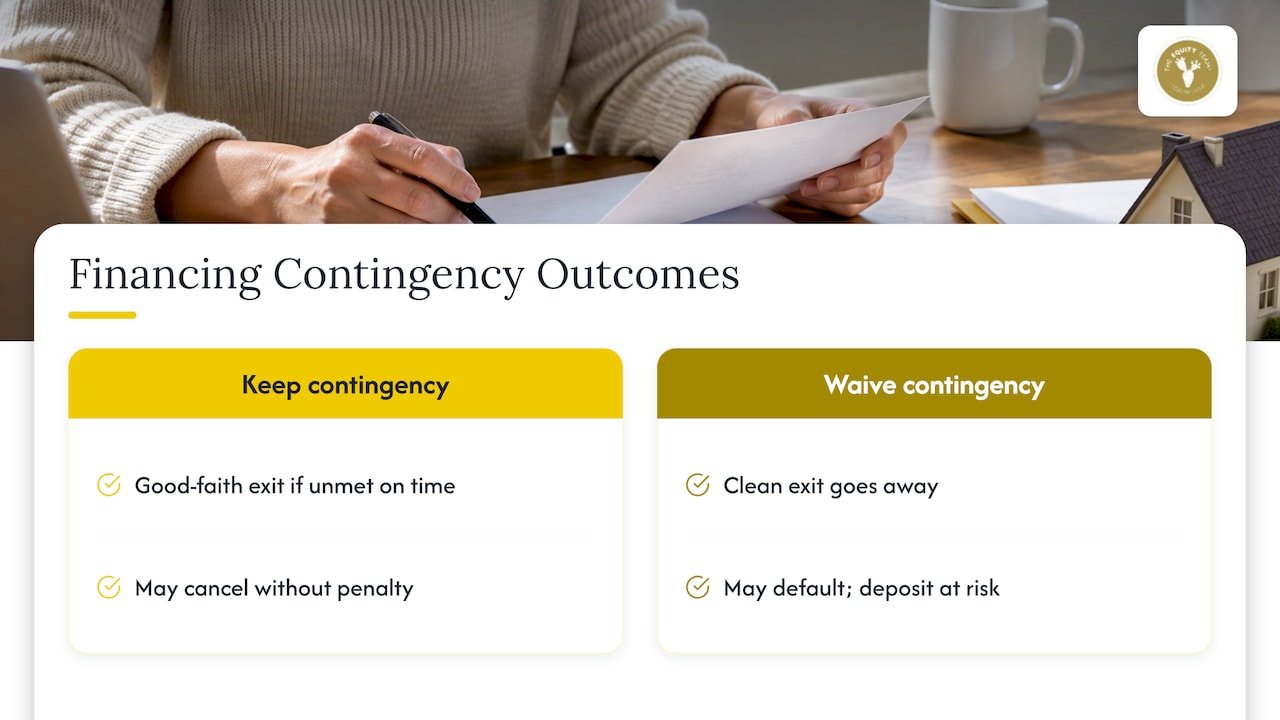
A financing contingency gives the buyer a specified period to secure a mortgage. NAR says that if a contingency is not met in the contract’s time frame, the parties may cancel without penalty if acting in good faith. Waive it, and that clean exit goes away.
The risk is not abstract. If underwriting hits a snag, a buyer without the contingency may be in default and may lose the deposit. A guide on keeping earnest money when buyer financing falls through explains how these deadlines and deposits interact.
Courts read contract wording closely, and results depend on the state. In one Washington case, Salvo v. Thatcher, the court held that a buyer who made good-faith efforts to obtain financing, but lacked approval by closing, was not in default because financing was a condition precedent under that contract and that state’s law. The lesson is not “you will be fine.” It is that the exact language and the jurisdiction decide the outcome, so an Arizona buyer should never assume another state’s result applies.
Who can reasonably waive it? Generally a buyer with a fully underwritten loan, or one who could cover the purchase another way, and who has talked through the scenario with a lender and agent first.
Risks of waiving the appraisal contingency
An appraisal contingency lets a buyer respond if the home appraises below the price. A lender typically lends against the appraised value, not the contract price, so a low appraisal leaves a hole.
The Boston Globe’s example makes it concrete. A buyer purchases a $215,000 home with 3% down. The home appraises at $200,000, so a 97% loan comes to $194,000. If the buyer waived the gap, that is $21,000 of additional cash needed at closing.
Appraisal waiver is not the same as no appraisal
The terms get mixed up constantly. The Globe’s reporting distinguishes an appraisal waiver from skipping the appraisal itself: it commonly means the buyer is willing to cover a low-appraisal gap, not that no appraisal will happen. The appraisal still occurs. The buyer simply promises to make up the difference.
Attorney commentary in that same piece treats capped appraisal-gap coverage as safer than an unlimited waiver, since a cap preserves a maximum cash exposure. A buyer can say, in effect, “I will cover up to this amount,” and know the worst case in advance.
Sedona investors face this more than most. Unique homes, view premiums and income-producing properties can be hard to compare, so appraisals can surprise. The Equity Team’s low appraisal guide for Sedona investors covers what to do when the number comes in short.
Quick comparison of the main waivers
| Contingency waived | What the buyer gives up | Worst case | Gentler alternative |
|---|---|---|---|
| Inspection | Repair requests, price negotiation, a refundable exit | Paying for major hidden problems or losing the deposit | Informational inspection |
| Financing | Time and a penalty-free exit if the loan fails | Default and possible loss of earnest money | Strong preapproval, shorter window |
| Appraisal | A way to renegotiate or cancel if value is low | Covering the gap in cash | Capped appraisal-gap coverage |
How to compete without waiving everything
Plenty of buyers win without going contingency-free. The research points to a handful of moves:
- Lead with a strong preapproval. Freddie Mac recommends using lender preapproval to strengthen an offer. A full or underwritten preapproval carries even more weight.
- Shorten the windows. A guide from a lender recommends shorter contingency windows as an alternative to full waivers.
- Cap the appraisal gap. Pick a number you can afford and write it in.
- Offer flexibility on the closing timeline. Sellers often care about when they move as much as what they net.
- Choose an informational inspection if the pressure is intense, understanding the repair tradeoff.
- Adjust the deposit with care. A larger earnest deposit signals confidence, but only with contingencies and deadlines you understand.
NAR also advises buyers to have a real estate attorney review contract terms, including contingencies. That is sensible advice any time money and deadlines are tied together.
What changes for Sedona investment properties
Sedona does not behave like a generic market. Homes here can carry short-term rental income, trails at the back door, and the occasional wildfire conversation. Each adds a question a contingency might otherwise answer.
Investors can read the Equity Team’s explainer on Sedona investment property contingencies to see how conditions apply when the buyer is underwriting rental income. Wildfire risk and insurance also tie into closing, covered in the guide to protecting escrow on Sedona STRs. And since waived deadlines are unforgiving, the Arizona escrow timeline is worth knowing before the offer goes in.
For the paperwork itself, the real estate purchase contract guide explains what the signed document actually contains.
Perspective: why we treat waivers as a tool, never a reflex
We work only with short-term rental buyers and sellers in Sedona, so we see both sides of every waiver.
Buyers sometimes arrive believing the only way to win is to strip every protection out of the offer. Our approach is different. We start by asking what the property has to earn, what it could cost to fix, and how much cash the buyer can comfortably put at risk. Then we decide which protections to keep and which to trade.
A waiver can be smart when the buyer has done the homework: a solid lender, a clear cap on any appraisal gap, and a real understanding of the house. A waiver is a gamble when it is made to chase a feeling. For STR investors, the stakes include the rental income the numbers depend on, so we like decisions made on data rather than adrenaline.
On the sell side, we know which offers carry real certainty and which only look clean. We help owners weigh a quick, tidy offer against a stronger one with sensible protections.
Chad
Working with the Equity Team
The Equity Team is a group of Sedona agents focused on short-term rental investment. Buyers get help deciding which protections to keep and how to write an offer that sellers take seriously. Sellers get guidance on pricing and on judging the offers that come in.
If you are weighing an offer, or want to understand what your own home’s offers might look like, start with our buyer and seller representation.

Sellers curious about value can request a Sedona vacation rental CMA, and buyers can read the tips for buyers and borrowers before making a move.
FAQ
What does it mean to waive a financing contingency?
It means the buyer gives up the set period and penalty-free exit that a financing contingency provides. If the mortgage is not approved in time, the buyer may be in default and could risk the earnest money. Outcomes depend on contract wording and state law.
Is waiving the inspection contingency ever a good idea?
Some buyers do it to make an offer more appealing. Freddie Mac still recommends keeping the contingency and suggests an informational inspection if pressure builds. The buyer gets professional information but accepts that the seller may not owe repairs.
What is an appraisal waiver?
It usually means the buyer agrees to cover a gap if the home appraises below the price, not that the appraisal is skipped. Capping that coverage at a set dollar amount limits the buyer’s cash exposure.
Can a buyer lose earnest money by waiving contingencies?
Yes. NAR warns that waiving contingencies prematurely, missing deadlines or abandoning the transaction can let the seller keep the deposit. Reviewing the contract with a real estate attorney before signing is NAR’s advice.
Sources
- NAR Consumer Guide: Real Estate Sales Contract Contingencies
- NAR Consumer Guide: Escrow and Earnest Money
- Freddie Mac: Should I Waive the Home Inspection?
- NAR: Buyer, Seller Agreements to Waive Inspections
- NAR: Homebuyers Are Waiving Inspections
- Salvo v. Thatcher, Court of Appeals of Washington
- The Boston Globe: What’s an appraisal waiver?
- Align Lending: How To Create A Competitive Offer On A House
- How Inspection Negotiations Cost Sellers
- Keep Earnest Money When Buyer Financing Falls Through