

Contingency removal is the moment a buyer closes a trapdoor in the contract and says the deal no longer depends on that condition. In Sedona, that usually means the inspection, the appraisal or the loan. Arizona has its own quirk: under the standard Arizona REALTORS® contract, many contingencies simply fall away once the act they require is done, with no separate removal form. California buyers fill out a form for everything. Arizona buyers, in this one respect, get to relax a little (the red rocks help).
TL;DR
- Contingency removal means the buyer stops relying on a contract condition (inspection, appraisal, loan) as a way out of the deal.
- Arizona’s approach differs from California’s: once a contingency is satisfied, no addendum is needed to remove it.
- The loan contingency has a hard deadline in the AAR contract: three days before close of escrow (COE).
- Backing out after waiving protection can cost earnest money, so every removal deserves a calm look at the calendar and the cash.
- Sedona short-term rental (STR) deals add their own layers: revenue verification, insurance, and wildfire planning.
Table of Contents
- What contingency removal actually means
- The Arizona twist: usually no removal form
- Loan contingency: the deadline everyone forgets
- Appraisal and inspection: two more hatches
- Earnest money: the part that makes removal feel real
- When the seller wants action: cure notices
- The Sedona short-term rental angle
- Perspective
- A simple removal checklist for Sedona buyers
- Work with a team that lives in the STR world
- FAQ
- Sources
What contingency removal actually means
A contingency is a clause that says: this deal only moves forward if a certain thing happens. The inspection turns up nothing scary. The appraisal lands at or above the price. The lender says yes. Think of each one as a hatch built into the contract floor. One real estate planner describes removal as closing one of those hatches, in writing, and telling the seller the deal no longer depends on it.
Contingencies are a normal and expected part of buying a home. Freddie Mac’s homebuying blog notes they give both sides a legal way out of the contract if something goes awry, and that piling on too many can make an offer less attractive to a seller.
Two things happen when a hatch is closed:
- Risk shifts toward the buyer. If the buyer later walks away, the earnest money is on the line.
- The seller gets more certainty, which is the whole reason sellers like clean offers.
Removal, satisfaction and waiver are different animals
The search results for this topic are full of California material, where the three ideas blur together. In plain terms:
- Satisfied: the condition was met (the lender approved the loan).
- Removed: the buyer formally says they will proceed regardless.
- Waived: the buyer lets the deadline pass or gives up the protection from the start, often to make an offer stronger.
In Arizona, the distinction matters because the contract itself carries so much of the weight. Deadlines are counted in days from acceptance or back from COE, and the consequences differ for each contingency.
The Arizona twist: usually no removal form
If you read national guides, you will find a lot of talk about a Contingency Removal form. That is mostly a California habit. The Arizona Association of REALTORS® explains that a contingency is a clause requiring an act before the parties must perform, and that once the act is done, the parties can proceed without an additional addendum.
So in a typical Sedona purchase:
- The appraisal comes in at value, and the appraisal contingency is effectively behind the buyer.
- The buyer delivers loan approval notice, and the loan contingency is handled by that notice.
- The inspection period ends, and what was not disapproved in writing is generally treated as accepted.
The practical lesson: in Arizona, the paperwork that matters is the notice you deliver (or fail to deliver) on time. Missing a notice is the easiest way to lose a protection by accident. Buyers also commonly use the inspection notice and seller response form to request repairs during the inspection period, and a Sedona agent will walk through exactly which form fits which moment.
For a wider look at how the contract fits together, see our guide on what a real estate purchase contract is.
Loan contingency: the deadline everyone forgets
The loan contingency is where Arizona buyers most often trip. Under the AAR Residential Resale Purchase Contract, the buyer must act no later than three days before COE. That means doing one of two things:
- Sign all loan documents and deliver notice of loan approval without prior-to-document (PTD) conditions, along with the dates the Closing Disclosures were received, or
- Deliver notice of inability to obtain loan approval without PTD conditions.
A few related timing points from the same AAR series:
- The buyer must deliver the Loan Status Update (LSU) with at least lines 1 to 40 completed within ten days after acceptance.
- The loan cannot be consummated less than three business days after the buyer receives the Closing Disclosure.
What if the loan really does fall through?
If the buyer made a diligent, good-faith effort, could not get approval, and delivered the notice on time, the contract is cancelled and the earnest money comes back. AAR also clarifies that this inability, three days before COE, is not a breach and does not trigger a curable event.
If the buyer misses the notice, the seller’s remedy is a Cure Period Notice. AAR explains that the buyer still gets earnest money back if the notice of inability arrives before the cure period expires. If the buyer stays silent through the cure period, the buyer is in breach and the seller may keep the earnest money as damages.
What the loan contingency does not cover
The standard contract language is specific about this. Failing to lock the interest rate and points by separate written agreement during the inspection period, or not having the down payment or other funds needed for approval, is not an unfulfilled loan contingency. A rate that drifts upward or a bank balance that shrinks is not a free exit. Buyers financing a Sedona home, where prices run high and jumbo or investor loans are common, do well to get this squared away with their lender early.
Appraisal and inspection: two more hatches
Appraisal
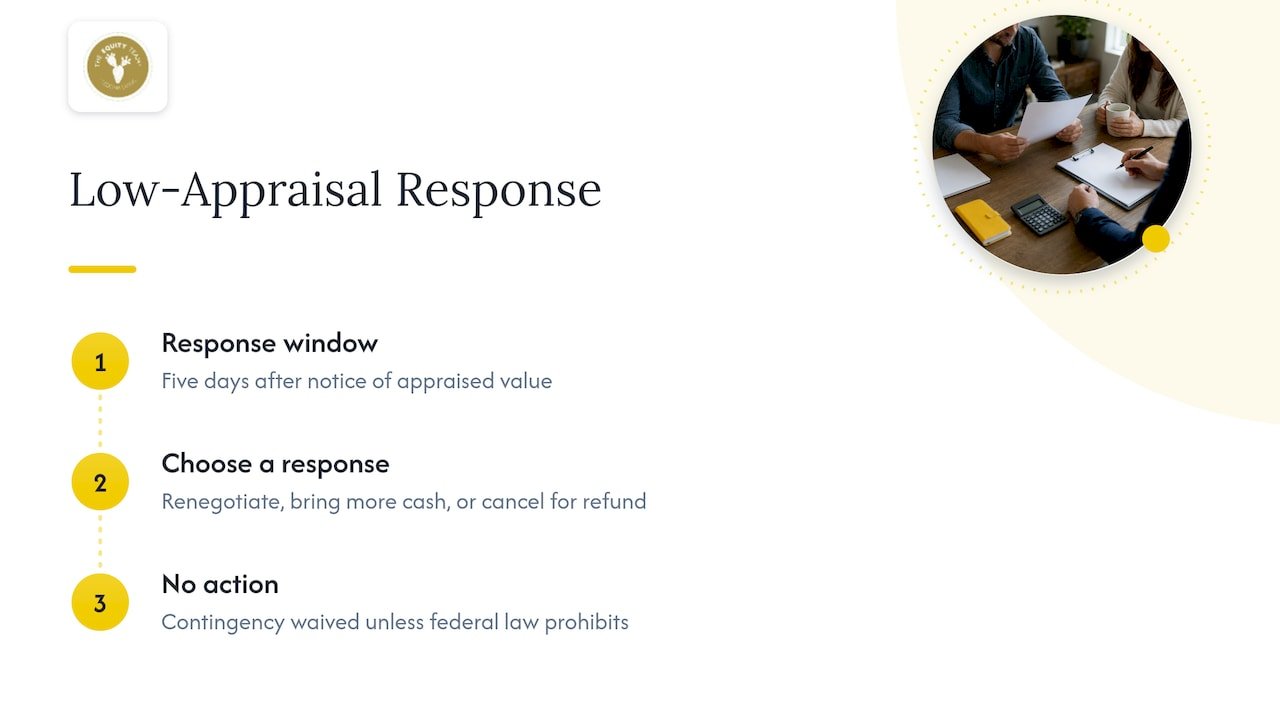
Under the AAR contract, if the home fails to appraise for the purchase price, the buyer has five days after notice of the appraised value to cancel and receive an earnest money refund. If the buyer does not act in that window, the appraisal contingency is waived, unless federal law prohibits that.
That five-day clock is easy to miss when a low appraisal arrives in the middle of a busy week. The sensible move is to decide ahead of time, with the agent and lender, how the buyer would respond: renegotiate, bring more cash, or cancel.
For readers curious about how a low appraisal plays out from the seller’s chair, low appraisal seller options lays out the paths a seller has when value and price disagree.
Inspection
Sedona homes come with personality: older builds on slopes, red dirt that moves, septic systems, well-loved decks, hot tubs that have seen things. The inspection period is the buyer’s chance to learn all of it. Under the standard contract, missing the inspection deadline is generally treated as a waiver rather than a breach, so there is no cure notice to rescue a buyer who simply ran out of time.
More on how this fits into a full Sedona purchase is in our Sedona home purchase timeline and the 30 to 45 day Arizona escrow timeline.
Earnest money: the part that makes removal feel real
The Arizona Department of Real Estate’s buyer advisory warns that waiving contractual contingencies may put buyers at risk of losing earnest money or incurring monetary damages if they decide not to purchase after acceptance.
The AAR contract’s Remedies section spells out how this works. In specified buyer-breach situations, including failure to deliver a required notice, or inability to get a loan after waiving the appraisal contingency, the earnest money may be deemed a reasonable estimate of damages and the seller’s sole right to damages.
Put simply:
| Situation | What generally happens to earnest money |
|---|---|
| Loan denied, buyer gave timely notice after good-faith effort | Returned to buyer |
| Buyer misses loan notice, cures within the cure period | Returned to buyer if notice of inability is delivered in time |
| Buyer misses loan notice and the cure period | Seller may accept earnest money as damages |
| Home fails to appraise, buyer cancels within five days | Returned to buyer |
| Appraisal contingency waived, loan fails because of it | Seller may keep earnest money as sole damages |
For Sedona investment buyers, where deposits can be substantial, the Sedona investment property earnest money guide goes deeper on how much is typical and how to protect it.
When the seller wants action: cure notices
Sellers are not stuck waiting forever. The AAR Remedies section says that when a party fails to comply with any contract provision, the other party delivers a notice specifying the problem. If it is not cured within three days after delivery (the Cure Period), it becomes a breach. Failing to allow COE on the COE date, if not cured after notice, is a material breach that makes the contract subject to cancellation.
A seller’s sensible steps when a buyer goes quiet:
- Check the contract calendar and confirm which deadline actually passed.
- Have the listing agent deliver the proper written notice, not a text or a hopeful email.
- Count the three days, then decide whether to extend, cancel or pursue earnest money.
Why sellers love clean offers
Every contingency is a spot where a deal can wobble. A cash offer with no loan contingency, or a buyer who has already finished inspections, is simpler. Freddie Mac’s blog makes the point that too many contingencies can make an offer less attractive. In a Sedona home with several suitors, that can matter as much as price. Our piece on multiple offers in Sedona looks at weighing STR value against closing certainty.
What contingencies give a buyer
The flip side: a contingent offer is a safety net. The buyer can check the house, the financing and the value before being locked in. Removing them early may win a bidding war, but it is a trade, not a freebie.
The Sedona short-term rental angle
In most towns, contingencies mean inspection, appraisal and loan. In Sedona, STR buyers add several more questions:
- Do the rental income numbers hold up? Buyers often want to review booking history and local performance before committing.
- Is the property eligible to operate as an STR under local rules and any HOA limits?
- What does insurance look like, including wildfire exposure?
- Is the price supported by comparable sales and rental performance?
Our Sedona investment property contingencies explained article covers which of these are worth building into an offer and which are worth letting go. Wildfire risk gets its own treatment in protecting escrow on Sedona STRs.
The funny cosmic contrast of Sedona is that a town known for calm energy can produce very tense escrow weeks. A clear plan keeps the vortex out of the paperwork.
Perspective
We see contingency removal as a decision about information, not a ritual. A buyer who removes a contingency should be able to say what they learned: what the inspector found, what the appraiser concluded, what the lender confirmed, and, for an STR, what the revenue picture really looks like.
Our team focuses on short-term rental investment in Sedona, so our guidance is built around high-performing homes and the particular questions they raise. We encourage buyers to line up their lender, inspector and rental data before an offer goes in, so deadlines become checkpoints instead of surprises.
For sellers, we help weigh what a strong offer really looks like. The highest number is not always the cleanest path to closing, and an STR with a proven track record deserves a careful read of every term, not only the headline price.
In short: protections are there to be used wisely. Remove them when the facts are in, and keep a calendar that does not blink.
Chad
A simple removal checklist for Sedona buyers
- Mark every deadline on one calendar the day the offer is accepted, counting forward from acceptance and backward from COE.
- Talk to the lender early. The loan notice is due three days before COE, and the LSU is due within ten days of acceptance.
- Order inspections right away. Sedona homes and their systems reward a thorough look, and the inspection window is short.
- Plan for the appraisal and decide in advance how to respond to a low number within the five-day window.
- Confirm what earnest money is exposed at each stage.
- Check STR specifics: rental history, permits or registrations, insurance and HOA rules.
- Deliver notices in writing and keep proof of delivery.
A good agent keeps this list running in the background so the buyer can enjoy the view.
Work with a team that lives in the STR world
If a Sedona purchase or sale is on the horizon, our team can walk through the contingency timeline with you before an offer is written. Buyers can start on our home page to learn how we represent STR-focused purchases and sales. Owners thinking about selling can request a Sedona vacation rental CMA to understand what their property may command.

Owners weighing a sale can also explore our rental exit strategy conversation, and our process page shows how we work from first call to closing.
FAQ
When can a loan contingency be removed?
Under the AAR purchase contract, the buyer must address it no later than three days before COE, either by delivering loan approval notice without PTD conditions or by delivering notice of inability to obtain approval. Many buyers satisfy it earlier once the lender issues final approval. Always confirm the dates in your own contract with your agent.
What happens if the buyer does not remove contingencies?
It depends on which one. Missing the inspection deadline generally means the buyer loses that protection. Missing the loan notice allows the seller to deliver a Cure Period Notice, and if the buyer still does not act, the buyer can be in breach and the seller may accept the earnest money as damages.
How do I remove a contingency in Arizona?
Often by completing the act the contingency requires and delivering the right notice on time, since no separate addendum is needed once a contingency is met. Your agent will advise which notice or form fits the specific contingency and moment.
Why don’t sellers like contingent offers?
Each contingency is a way the buyer can leave the deal, so the seller has less certainty. Offers with fewer contingencies tend to look stronger, though the best choice also depends on price and the buyer’s financing. Our seller concessions guide shows how credits can sweeten an offer.
Sources
- Contingency Removal, Real Estate Financial Planner
- Understanding Contingency Clauses in Homebuying, Freddie Mac My Home
- When a Contingency is Met, No Addendum is Needed, Arizona REALTORS®
- A Contract Series Part 3b, Arizona Association of REALTORS®
- What You Should Know About Loan Contingency and Cure Period Notice, Arizona REALTORS®
- Buyer Advisory, Arizona Department of Real Estate
- Arizona Purchase Contract, First American Title
- Residential Resale Real Estate Purchase Contract, February 2026, Arizona REALTORS®