

Yes, you can buy a Sedona foreclosure and run it as a short-term rental, but only after you confirm where the property sits in the foreclosure process, clear its title and liens, and check its eligibility for a Sedona STR permit. Skip any of those three checks and you risk buying a property that cannot legally host a single guest. Start by pulling the county recorder’s filings for a Notice of Trustee Sale, then walk through the checklist below before you bid or make an offer.
TL;DR:
- Buying a Sedona foreclosure for short-term rental use requires confirming its position in the foreclosure process, clear title, and permit eligibility before bidding.
- The foreclosure process typically takes around 7 to 9 months from missed payment to auction, allowing time to plan financing and property readiness.
- Obtaining permits involves registering for a state TPT license, applying for a Sedona STR permit at over two hundred dollars per year, and securing separate permits for ADUs.
- Unresolved liens, HOA disputes, or prior permit revocations can jeopardize a successful STR operation and should be thoroughly checked beforehand.
- Proper safety upgrades and permit compliance are crucial for approval, with safety issues potentially delaying listing for weeks or months.
Table of Contents
- Your pre-purchase checklist for a Sedona foreclosure STR
- The Sedona and Arizona rules every STR buyer has to clear
- How the Arizona foreclosure timeline affects your buying window
- Underwriting a Sedona foreclosure for Airbnb income
- Title, liens, and legal risks unique to foreclosures
- Rehab, safety, and getting permit-ready to list
- Planning your exit before you even close
- What top-performing Sedona STRs do differently
- How we help you buy or sell a Sedona foreclosure STR
- FAQ
- Sources
Your pre-purchase checklist for a Sedona foreclosure STR
Buying a foreclosure for Airbnb use is part real estate deal, part legal scavenger hunt. We treat it as a sequence, not a checklist you can shuffle.
- Watch the county recorder for a Notice of Trustee Sale. Once it’s recorded, Arizona’s 91-day trustee sale clock starts ticking under A.R.S. § 33-808.
- Order a full title and lien search before you get attached to the property. Priority matters more than the sale price.
- Check for active HOA litigation or unpaid HOA dues, since either can complicate your purchase long after closing.
- Confirm the home’s current permit status, including whether any detached unit or ADU needs its own separate Sedona STR permit.
- Run preliminary numbers on ADR, occupancy, taxes, insurance, and rehab costs before you commit capital.
- Map the realistic timeline from auction to trustee deed recording to vacancy to rehab to your first guest.
Pro Tip: Call the Sedona permitting office before you bid, not after you close. A property with a permit flag or an HOA dispute can sit vacant for months while you sort it out.
The Sedona and Arizona rules every STR buyer has to clear
Sedona treats short-term rentals as a licensed activity, not a side hustle, and the state wants its cut too. Before you list a single night, you need two separate registrations in place.
- Register for an Arizona Transaction Privilege Tax (TPT) license through AZTaxes.gov or Business One Stop before applying for a city permit.
- Apply for a Sedona short-term rental permit, which runs a little over two hundred dollars per year per dwelling unit as of 2025, according to Sedona STR permit guidance.
- Get separate permits for any ADU on the property. One permit does not cover two dwelling units.
- Post your permit number inside the unit and on every listing, and carry at least $500,000 in liability insurance.
- Budget for late renewal fees that begin in 2026, plus penalties that climb fast if you operate without a current permit.
Combined state, county, and city transient lodging tax in Sedona runs roughly eight and a half percent, according to the same Sedona permit guidance, and most major booking platforms now collect and remit a portion of that automatically. Our breakdown of Sedona STR zoning rules covers how permit requirements interact with neighborhood-specific restrictions, which matters because not every lot in Sedona is cleared for nightly rentals regardless of permit status.
How the Arizona foreclosure timeline affects your buying window
Arizona foreclosures move on two overlapping clocks, and both shape when you can actually bid. Federal law under 12 C.F.R. § 1024.41 generally requires a 120-day pre-foreclosure waiting period before a lender can even start the foreclosure process. Once that clears, Arizona’s own rule kicks in: recording a Notice of Trustee Sale under A.R.S. § 33-808 sets the sale date no sooner than the 91st day after recording.
Add the two together and you get a realistic total timeline of roughly 7 to 9 months from a borrower’s first missed payment to the actual auction, per the same Arizona foreclosure timeline analysis.

That window gives you time to line up financing and underwriting, but it also means the property you’re watching today might not hit auction for months, so plan your capital accordingly.
Underwriting a Sedona foreclosure for Airbnb income
Once a property clears title and permit checks, the real question is whether the numbers work. We build underwriting around conservative inputs rather than best-case assumptions, using local comps and our own video walkthroughs and analyses of comparable Sedona properties to sanity-check ADR and occupancy before anyone commits capital.
Your expense line needs to include more than the mortgage payment:
- Permit fees and TPT at the combined 8.65% transient tax rate layered on top of your projected revenue.
- Platform fees, utilities, and professional cleaning or turnover costs between guest stays.
- Property management, if you’re not running the calendar yourself.
- A vacancy reserve for the shoulder seasons when Sedona’s hiking crowds thin out.
- Liability insurance at or above the $500,000 city minimum.
- Debt service on whatever financing you use to close.
A simple break-even check: take your projected annual revenue (ADR times occupancy times 365 nights), subtract every expense above, and see what’s left before debt service. If a property penciled at a $267 ADR and 41.7% occupancy, as we’ve underwritten for a comparable Verde Valley investment, clears its carrying costs with room to spare, it’s worth a closer look. If it barely breaks even on paper, assume reality will be tighter.
Pro Tip: Price your rehab estimate around code and safety items first. A gorgeous kitchen means nothing if a missing smoke detector delays your permit by six weeks.
Title, liens, and legal risks unique to foreclosures
A foreclosure sale clears the foreclosing lender’s lien, but it doesn’t automatically wipe out everything else attached to the property. This is where deals quietly fall apart.
- Run a full title and lien search and pay attention to junior liens that may survive the trustee sale depending on priority.
- Check HOA lien status carefully. Arizona HOA foreclosure rules allow an HOA judicial foreclosure to extinguish certain junior interests, which can complicate your position if you buy without checking first.
- Understand Arizona’s anti-deficiency protections, which limit a lender’s ability to pursue the former borrower for the remaining balance in many residential cases, though exceptions exist depending on loan type and property use.
- Expect more limited title insurance options on trustee sale purchases than on a traditional resale, and talk to title counsel about gap coverage before you close.
Rehab, safety, and getting permit-ready to list
Most Sedona permit denials trace back to the same handful of missing items, not structural disasters. Fix the boring stuff first.
- Install smoke and carbon monoxide alarms, including supervised alarms where the permit requires them.
- Post your permit number inside the unit as required and confirm your posted occupancy limit matches your listing.
- Address any code violations flagged during the title or inspection process before you touch cosmetic upgrades.
- Only after safety and permit items are done, invest in guest-facing upgrades like a hot tub or a view deck.
- Loop in your property manager and inspector early so permit sign-off and your first listing date don’t slip by weeks.
Pro Tip: A minor cosmetic turnover can take two to three weeks. A property with structural or code issues can take two to three months, so budget your opening date accordingly.
Planning your exit before you even close
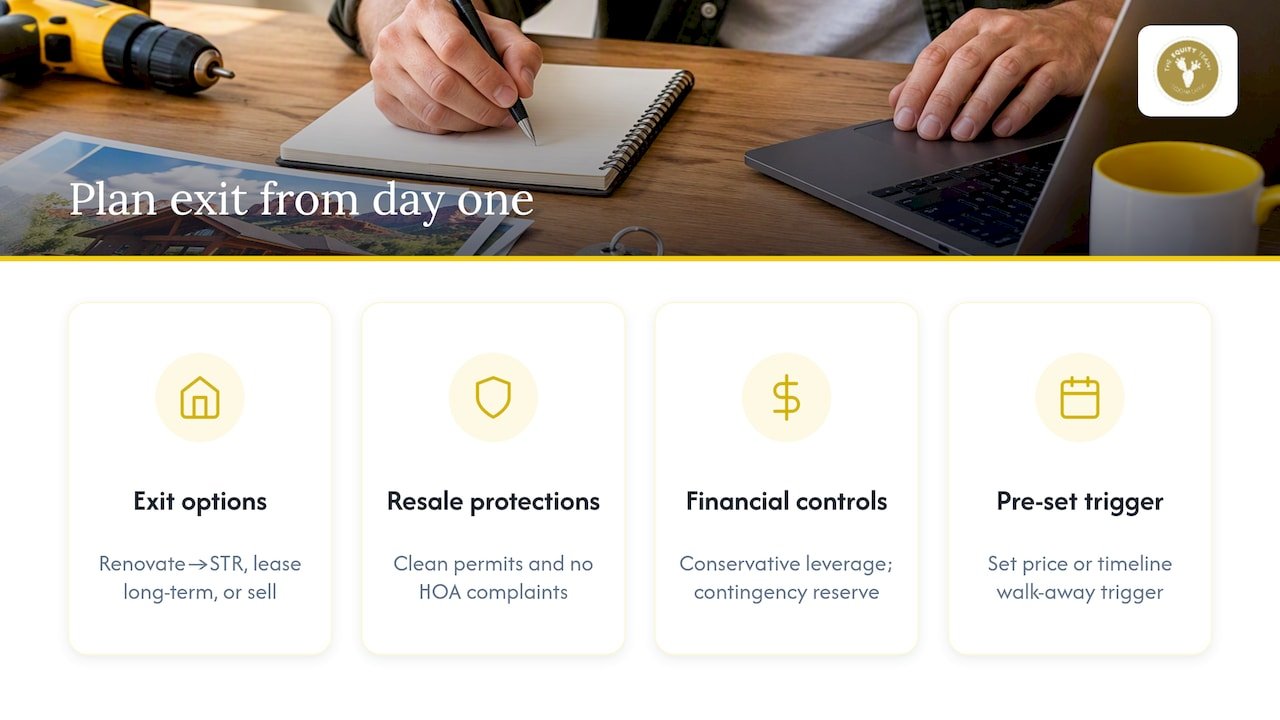
Every foreclosure-to-STR purchase should have an exit plan baked in from day one, not figured out later. Your main paths are renovating and listing as a short-term rental, converting to a long-term lease if the STR numbers disappoint, or selling with a comparative market analysis built around STR revenue rather than owner-occupant comps. A clean permit history and no HOA complaints protect resale value more than almost any upgrade. Keep leverage conservative, hold a contingency reserve, and set a price or timeline trigger in advance for walking away.
What top-performing Sedona STRs do differently
Layout, red rock views, and a guest experience that justifies a premium ADR matter more, which is why we lean on video walkthroughs and local CMAs instead of guesswork when evaluating a property.
Three red flags make us pass on a foreclosure almost every time: active HOA litigation, an unpermitted ADU, and a prior permit revocation on the property’s history. If a deal includes unresolved liens, murky title, or unclear permit status, that’s the moment to bring in a specialist rather than push forward alone.
— Chad
How we help you buy or sell a Sedona foreclosure STR
We built our practice around one niche: Sedona short-term rental investments, focusing on STR-specialized real estate. Whether you’re chasing a foreclosure to convert or deciding it’s time to sell a rental you already own, we walk you through title review, permit status, and realistic timelines before you commit.

A clear next step beats another week of spreadsheet guessing.
Our initial conversation covers document review, a timeline estimate for your specific property, and the next concrete steps, whether that’s a Sedona vacation rental CMA or a straightforward buyer representation agreement.
- Buyer and seller representation for Sedona STR transactions.
- Sedona vacation rental CMA and seller prep consultation.
- Property walkthroughs and permit or compliance advisory.
- Rental exit strategy and valuation conversations for owners ready to sell.
| Service | Best for |
|---|---|
| Buyer representation | Investors targeting a Sedona foreclosure for STR conversion |
| Sedona vacation rental CMA | Owners deciding whether to sell or keep renting |
| Rental exit strategy conversation | Owners weighing a sale against a long-term hold |
Pro Tip: Bring the trustee sale date and any title report you already have to your first conversation. It saves a full round of back-and-forth.
If you’re weighing a faster, no-repairs sale instead of a rehab project, this guide to exiting a short-term rental outlines how a direct cash sale works in other markets, though our own rental exit strategy conversation is built specifically around Sedona’s STR resale market. Ready to see what your numbers look like? Start a Sedona vacation rental CMA with us today.
FAQ
Can you legally run an Airbnb in a Sedona foreclosure property?
Yes, once you hold clear title and secure both an Arizona TPT license and a Sedona short-term rental permit, which costs a little over two hundred dollars per year per dwelling unit as of 2025. A property’s foreclosure history does not block permitting on its own, but any unresolved prior permit revocation on that address can.
How long does the Arizona foreclosure process take before I can bid?
Factor in the federal 120-day pre-foreclosure window plus the state’s 91-day trustee sale clock, which together typically add up to several months from first missed payment to auction. The clock on the 91-day period starts only when the Notice of Trustee Sale is actually recorded with the county.
What happens to liens when a foreclosure property sells at trustee sale?
The foreclosing lender’s lien is cleared, but certain junior liens and HOA claims can survive depending on priority, so a full lien search before bidding is essential. Arizona HOA foreclosure rules allow HOA action to extinguish some junior interests, which makes this a routine but critical check.
How much does a Sedona short-term rental permit cost?
The city permit runs $210 per year per dwelling unit, with ADUs requiring their own separate permit, according to Sedona STR permit guidance. Late renewal fees begin in 2026, and operating without a valid permit carries separate penalties.
Can The Equity Team help me find and underwrite a Sedona foreclosure for Airbnb use?
Yes, we work specifically with Sedona short-term rental buyers and sellers, offering property walkthroughs, local CMAs, and valuation conversations. Reach out through our buyer representation services to start reviewing a specific property.
Sources
- How Long Does Foreclosure Take in Arizona? The 91-Day Trustee Sale Timeline Explained.
- 33-808 – Notice of trustee’s sale
- Residential rental guidelines | Arizona Department of Revenue
- Sedona Short-Term Rental License: The Complete 2026 Guide – HostStarter