

Sedona does not enforce a citywide numeric cap on overnight guests today, but it absolutely requires an annual short-term rental permit before you host anyone at all. Arizona lawmakers floated 2026 proposals that would let cities set occupancy limits, but nothing is enacted yet. The move that actually protects you right now is to confirm your permit, insurance, and guest-screening paperwork are current and airtight.
TL;DR:
- Sedona’s proposed 2026 occupancy limits of two guests per bedroom plus two are not yet enacted and should be tracked before making changes.
- Current rules require each rental unit to have its own permit, with some accessory dwellings relying on their certificate-of-occupancy date, potentially impacting eligibility.
- Hosts must run and keep on file a sex-offender background check for guests at least 24 hours before check-in, a mandatory safety requirement.
- Maintaining active permits, liability insurance, and accurate guest logs is vital to prevent suspension or fines, especially as violations are often minor but cumulative.
- The emerging occupancy rules will likely reduce peak-season revenue for multi-guest listings and favor properties with separate sleeping areas and ample parking.
Table of Contents
- 1. Sedona’s current rules on permits, ADUs, and guest screening
- 2. How Arizona state law and 2026 bills shape local occupancy authority
- 3. Worked examples: estimating occupancy and spotting the daytime-visitor trap
- 4. Permits, taxes, and the violations that trigger suspension
- 5. A compliance checklist built for Sedona owners and investors
- 6. What tightening occupancy rules mean for Sedona investors
- How the Equity Team helps you navigate occupancy risk and pricing
- FAQ
- Sources
1. Sedona’s current rules on permits, ADUs, and guest screening
Before you list a single night, Sedona’s municipal code asks for a few concrete things, and they are stricter than most hosts expect. Every advertised unit, whether it is the main house, a casita, or a separate guest structure, generally needs its own permit under Sedona’s use regulations. That same code section ties accessory dwelling unit eligibility to the building’s certificate-of-occupancy date, so a quirky old guesthouse might qualify while a newer one next door does not. It is the kind of detail that turns a charming backyard casita into either a bonus income stream or a compliance headache, depending entirely on paperwork you’d never think to ask about during a home tour.

The part that genuinely surprises people: Sedona requires hosts to run a sex-offender background check on booking guests at least 24 hours before check-in, and to keep those records on file for a full 12 months. It is an unusual mandate, but it is a real one, and skipping it is one of the easiest ways to invite trouble.
Beyond that, the city layers on a handful of other expectations:
- Maintain liability insurance that meets the city’s minimum coverage standards.
- Meet sanitation and basic safety requirements for the structure.
- Notify neighboring properties as required under the permit process.
- Avoid hosting large gatherings or events, which fall outside normal overnight-stay rules.
None of this is designed to be mysterious. It is designed to be checked, which means the paper trail matters as much as the behavior itself.
2. How Arizona state law and 2026 bills shape local occupancy authority
Arizona’s short-term rental landscape sits under a state preemption law, A.R.S. 9-500.39, which blocks cities like Sedona from banning short-term rentals outright but still leaves room for plenty of operational regulation. Permits, safety rules, and background checks all live comfortably inside that space.
What is changing is the occupancy piece specifically. News coverage of the 2026 legislative session describes bill language that would let cities cap overnight occupancy using a formula commonly reported as two guests per bedroom plus two additional guests, aimed squarely at repeat problem properties rather than casual guests. The reporting is clear that this framework targets habitual violators, not daytime visitors or one-off noise complaints, and that the proposal has drawn real pushback and remains subject to change.
A few things worth holding onto:
- No enacted statewide occupancy formula exists in Sedona today, only proposed language.
- Cities still cannot prohibit short-term rentals as a category under current preemption rules.
- The safest move is tracking enacted city ordinances and official guidance, not bill drafts, and looping in local counsel or city staff before assuming any formula applies to your property.
3. Worked examples: estimating occupancy and spotting the daytime-visitor trap
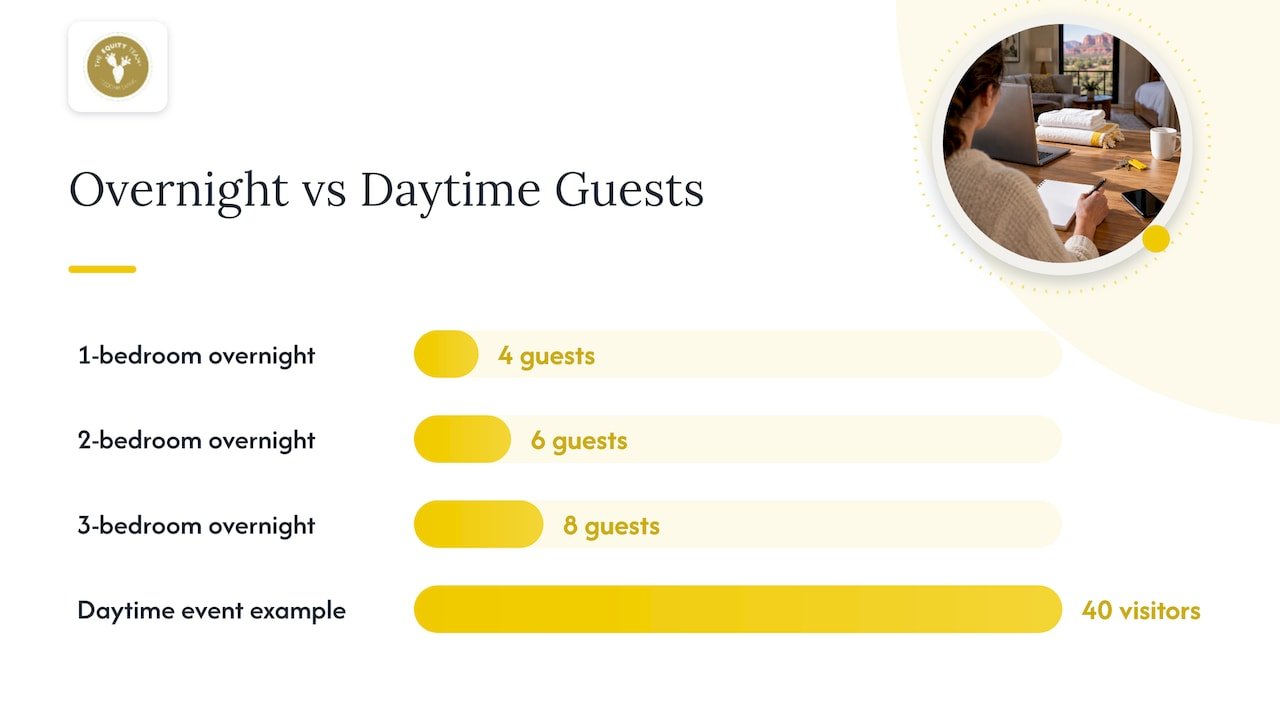
Even though Sedona has not enacted a formal cap, the “two per bedroom plus two” formula floated in 2026 proposals is worth running through your own property now, since it is the framework most likely to show up if something passes. Here is the simple math:
- A one-bedroom property: 2 guests for the bedroom, plus 2 more, lands at 4 total overnight guests.
- A two-bedroom property: 2 guests per bedroom (4 total), plus 2 more, lands at 6 total overnight guests.
- A three-bedroom property: 2 guests per bedroom (6 total), plus 2 more, lands at 8 total overnight guests.
Proposals of this kind often treat children the same as adults for counting purposes, though that detail tends to shift as bill language evolves, so never assume a family of five counts as fewer bodies than five adults would.
It is also worth separating two things that get lumped together constantly: overnight occupancy limits govern who sleeps there, while event bans and daytime-visitor restrictions govern who shows up for a few hours. A property that is fully compliant on sleeping arrangements can still violate the rules by hosting a 40-person birthday party that never stays the night.
Pro Tip: State your maximum guest count explicitly in your listing description, not just in the booking settings, so guests never have an excuse to claim confusion.
4. Permits, taxes, and the violations that trigger suspension
Running a compliant Sedona rental means treating the permit as a living document, not a one-time form. Owners typically go through an annual renewal, and the city has permit suspension authority spelled out directly in its code: under Sedona’s suspension rules, a verified violation can lead to a suspension period and real limits on how quickly you can reapply.
On the tax side, hosts need a state Transaction Privilege Tax (TPT) license and typically remit state, county, and city transient lodging taxes separately, each with its own line and its own deadline.
The violations that tend to cause the most trouble are mundane, which is exactly why they sneak past busy owners:
- Missing or incomplete background-check records for recent guests.
- Parking overflow that spills onto neighboring streets or properties.
- Unreported guest counts that exceed what was booked.
- Lapsed insurance coverage that nobody noticed until a claim came up.
Clean recordkeeping is the unglamorous habit that keeps all of this boring in the best possible way.
5. A compliance checklist built for Sedona owners and investors
Before you ever accept a booking, work through this sequence like a pre-flight check:
- Confirm your Sedona STR permit and TPT license are active and matched to the correct property.
- Verify ADU eligibility against the certificate-of-occupancy date if you plan to rent a casita or guest quarters separately.
- Secure liability insurance that meets city minimums, and consider working with a local Arizona insurance broker who understands short-term rental coverage specifically.
- Check your HOA documents, since some Sedona communities restrict or ban short-term rentals entirely regardless of city permit status.
- Stock basic safety items (smoke detectors, fire extinguishers, clear exit signage) before your first guest arrives.
Once you are operating, the habits that keep you out of trouble are just as important as the setup:
- Run and file every guest background check at least 24 hours before check-in, every time.
- Put a parking plan in writing and reference it in your listing and welcome guide.
- Log neighbor notifications so you have proof of outreach if a complaint ever surfaces.
If occupancy rules shift or you face an enforcement notice, update your listing limits immediately, pause bookings if the situation calls for it, and talk to local counsel or a short-term rental specialist agent about whether your current setup still makes sense as an investment.
Pro Tip: Keep a single folder, digital or physical, with your permit, TPT license, insurance certificate, and background-check logs in one place. When the city asks, you want minutes, not days.
6. What tightening occupancy rules mean for Sedona investors
Stricter occupancy enforcement tends to trim peak-season revenue for properties that previously leaned on squeezing in extra guests, while rewarding layouts with separate sleeping areas, ample parking, and clean ADU paperwork. Those features buy resilience. Owners whose numbers depend on maximum occupancy should start thinking now about repositioning, hiring professional management, or testing the market for a sale before rules firm up.
— Chad
How the Equity Team helps you navigate occupancy risk and pricing
If permit risk or shifting occupancy rules have you wondering whether your property still pencils out, our Sedona vacation rental CMA gives you a clear read on current value, and our seller prep consultation walks through what buyers will actually ask about compliance before they commit.

If you are leaning toward selling or just want to understand your options, our rental exit strategy and valuation conversation is built for exactly that decision. For a broader look at buying or selling in Sedona, start at our main site and tell us where you are in the process.
FAQ
What is the 80/20 rule for Airbnb?
This term usually refers to a general business principle where a large share of results come from a small share of effort or listings, not a specific Sedona or Arizona short-term rental regulation. There is no official occupancy or permit rule under Sedona municipal code.
Are short-term rentals allowed in Sedona?
Yes, short-term rentals are allowed in Sedona, but every advertised unit needs an active city permit under Sedona’s use regulations. State preemption law prevents Sedona from banning STRs outright, though the city can still regulate permits, safety, and guest screening.
How many people can live in a 2 bedroom in AZ?
Arizona does not set a single statewide number for how many people can live in a two-bedroom home, since that depends on local housing codes and lease terms rather than short-term rental rules. For short-term rental occupancy specifically, proposed 2026 legislation referenced a two-per-bedroom-plus-two framework, which would put a two-bedroom property at six overnight guests if it becomes law.
What is the 75-55 rule in Airbnb?
There is no recognized rule like this in Airbnb policy, Arizona law, or Sedona municipal code. If you encountered this term, it may be a misremembered version of occupancy formulas like the “two per bedroom plus two” framework discussed in 2026 Arizona legislative proposals.
Does Sedona require background checks for Airbnb guests?
Yes, Sedona’s municipal code requires hosts to run a sex-offender background check on guests at least 24 hours before check-in and to retain those records for 12 months under SCC 5.25.100. This applies regardless of how many guests are staying or how long the booking lasts.
Sources
- 5.25.050 Use regulations | Sedona City Code
- Arizona short-term rental bill now goes after ‘repeat bad actors’ to limit overnight occupancy