

Realty Executives is a national franchisor with a 100%-commission agent model and headquarters in Phoenix, Arizona — and it can work for Sedona short-term rental investors, but only when the specific local agent or franchise office brings verified STR experience, Sedona zoning knowledge, and a real track record of high-performing rentals. If they can’t show you that proof, skip the brand name and hire a specialist. The Equity Team is the first STR-specialized agent team in Northern Arizona, representing clients whose properties perform in the top 10% of the Sedona rental market — which is exactly the kind of track record worth asking about.
Bottom line: A Realty Executives agent can be the right call. A Realty Executives agent with no STR-specific experience in Sedona almost certainly isn’t.
Table of Contents
- What are the key facts about Realty Executives as a company?
- What does the 100%-commission model mean for Sedona STR investors?
- How do you vet a Realty Executives agent for Sedona STR deals?
- When does hiring a dedicated Sedona STR specialist make more sense?
- How does the process of buying a Sedona STR actually work?
- What should you check before submitting an offer on a Sedona STR?
- Key Takeaways
- What most investors get wrong about agent selection in Sedona
- Equity Team: Sedona’s STR-focused real estate team
- Useful sources for verification
What are the key facts about Realty Executives as a company?
Realty Executives operates as a franchisor with independent offices and local brokers who handle regional compliance. That means the corporate brand sets the culture and systems, but the individual franchise owner and their broker run the show on the ground. Quality varies — a lot.
Here are the quick facts investors need:
- Founded: Realty Executives has been operating for decades as one of the earlier franchise real estate brands in the U.S.
- HQ: 645 E Missouri Ave, Suite 210, Phoenix, AZ 85012
- Model: Franchised offices with independent local brokers; agents often operate on a 100%-commission structure
- Scale: Estimated revenue of $22.9M, approximately 477 employees (per Datanyze company profile)
| Metric | Detail |
|---|---|
| Headquarters | Phoenix, AZ (645 E Missouri Ave Ste 210) |
| Business model | Franchisor with independent local offices |
| Estimated revenue | $22.9M (Datanyze) |
| Estimated employees | 477 (Datanyze) |
| Agent compensation | 100%-commission options in many offices |
National brokerage rankings like RealTrends give useful context on brand scale, but they don’t tell you whether a specific Sedona agent knows the difference between a Yavapai County STR permit and a City of Sedona license. That’s the gap investors need to close themselves.
What does the 100%-commission model mean for Sedona STR investors?
The 100%-commission structure attracts entrepreneurial agents who run their own small businesses inside the franchise umbrella. That’s genuinely good news in some ways: these agents are motivated, often more responsive, and tend to build niche expertise because their income depends on it. The catch is that the franchisor doesn’t dictate what niche they choose.

An agent at a Realty Executives office might specialize in residential resales, luxury homes, or commercial properties — and have zero STR transactions on their record. The franchise model means the local broker is responsible for compliance oversight, but STR permitting nuances, HOA deed restrictions, and Sedona’s quirky city-versus-county zoning split are not things a broker’s compliance checklist will catch for you.
Pro Tip: Before you commit to any Realty Executives agent, ask their broker manager directly: “How many STR transactions has this agent closed in Sedona in the last 24 months?” If the answer is vague or low, that’s your signal to keep looking.
Check the current STR climate in Sedona before any agent conversation — knowing the market yourself makes vetting much easier.
How do you vet a Realty Executives agent for Sedona STR deals?
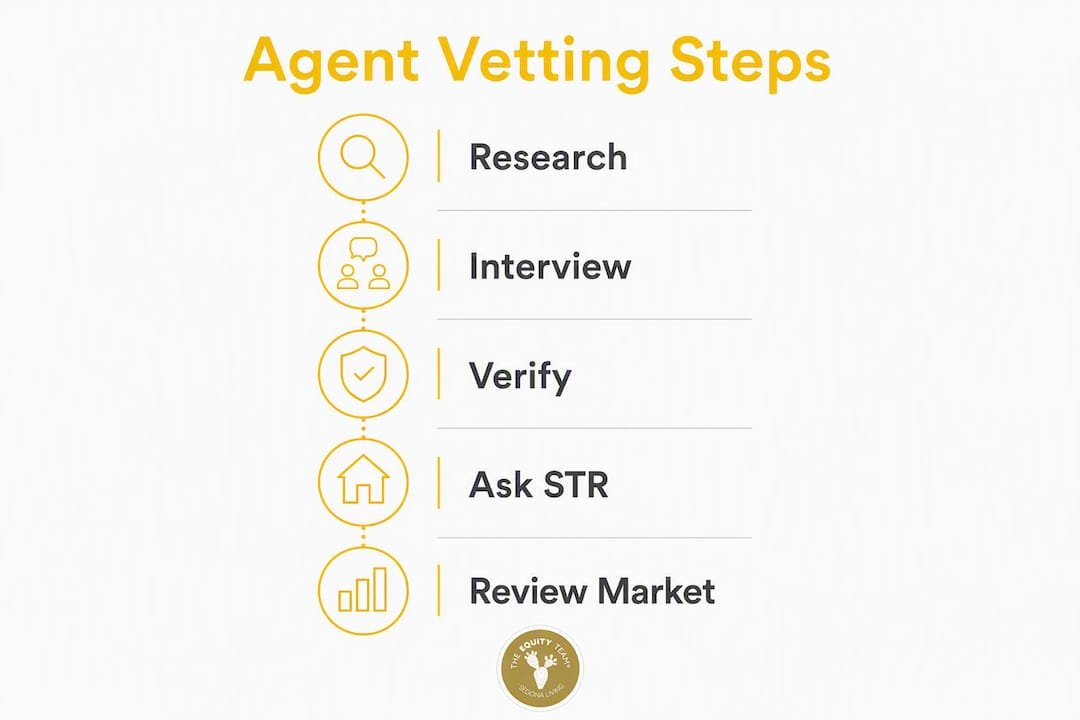
Not all agents are created equal, and in Sedona’s STR market, the wrong one costs real money. Here’s a numbered checklist to run through before signing a buyer’s representation agreement:
- Ask for STR transaction count. Request a list of STR properties the agent has closed in Sedona in the past two years. Fewer than three is a yellow flag; zero is a red one.
- Request verified revenue and occupancy data. Ask for past listings with documented gross rental revenue and occupancy rates. A good agent can pull this; a weak one will deflect.
- Test their zoning knowledge. Ask: “What’s the difference between an STR permit in the City of Sedona versus unincorporated Yavapai County?” If they hesitate, they’re not your person.
- Check HOA and deed restriction fluency. Ask how they handle HOA covenant review and whether they’ve encountered STR bans in specific Sedona neighborhoods.
- Verify with IDX evidence. Request MLS or IDX-backed comps for comparable STR properties — not just general market data.
- Ask for references. Two or three past STR investor clients who will take a call. Non-negotiable.
Red flags to watch for:
- Reluctance to share past performance metrics
- Generic market knowledge with no STR-specific examples
- No familiarity with Sedona’s agent designation and local credentials
- Inability to name specific STR permit requirements by jurisdiction
For a deeper look at what separates a sharp local agent from a generic one, the top agent red flags guide is worth a read before any interview.
When does hiring a dedicated Sedona STR specialist make more sense?
Some deals are straightforward enough that a well-qualified general agent can handle them. Most Sedona STR investments are not those deals.
Situations that genuinely call for a specialist:
- Complex permitting scenarios (city vs. county jurisdiction, recent zoning changes)
- HOA or deed restriction research where the language is ambiguous or contested
- High-yield pro forma modeling to validate purchase price against projected STR revenue
- Regulatory risk mitigation when local STR rules are in flux
- Operational handoff coordination with vetted property managers and rental marketing channels
The Equity Team goes beyond what a typical franchise agent offers: STR-specific comps, revenue modeling, permit research, and referrals to Sedona rental marketing channels that actually move the needle on occupancy. They work exclusively with investors, which means every conversation starts from an investment lens, not a lifestyle-buyer lens.
Pro Tip: If your target property is near a recent supply shift area, ask your specialist to model both an optimistic and a conservative revenue scenario before you make an offer.
How does the process of buying a Sedona STR actually work?
Whether working with a Realty Executives agent or a specialist like Equity Team, the transaction follows a predictable arc. Here’s what to expect:
- Search and underwriting (1–3 weeks). Use IDX tools to identify candidates, then run a revenue model on each. Ask your agent for STR property analyses and comparable performance data.
- Offer and negotiation (days to 1 week). Structure contingencies for STR-specific issues: permitting confirmation, HOA deed restriction review, and occupancy limit verification.
- Due diligence (10–15 business days typically). Inspection, title search, HOA document review, permit status confirmation, and utility checks (septic, access roads, occupancy limits).
- Closing (30–45 days from accepted offer). Standard Arizona residential closing timeline; budget for title, escrow, and recording fees.
- Post-close handoff. Connect with a property manager, set up STR registration where required, and activate rental marketing.
Typical cost items to budget beyond purchase price:
- Home inspection: $400–$600
- HOA document review fee: varies by association
- STR permit/registration fees: varies by jurisdiction (City of Sedona vs. Yavapai County)
- Title and escrow: typically 1%–2% of purchase price
- Agent commission: negotiated; standard Arizona practice applies
For a broader look at buyer and borrower tips specific to this market, Equity Team’s resource covers the deal mechanics in plain language. Also worth checking: Arizona building code requirements for glass railings if the property has deck or balcony features — a detail that surprises more buyers than it should during inspection.
What should you check before submitting an offer on a Sedona STR?
Run through this list before the offer goes in. Skipping any item can cost far more than the time it takes to verify.
- Zoning and permit status. Confirm the specific parcel’s STR eligibility under Sedona STR zoning rules — city and county rules differ.
- HOA and deed restrictions. Pull the CC&Rs and verify there’s no STR ban or rental cap; check the deed restriction guide for what to look for.
- Utilities and infrastructure. Confirm septic capacity for projected occupancy, road access for guests, and any utility limitations that affect guest experience.
- Historical rental performance. Request actual or modeled revenue data from your agent; cross-check against Sedona market statistics.
- Real estate sign compliance. If the property is being marketed during transition, verify local sign posting rules to avoid compliance issues.
Pro Tip: Ask your agent to pull local market trend data for the specific neighborhood, not just citywide averages. Sedona’s STR performance varies dramatically by micro-location.
Key Takeaways
Realty Executives can work for Sedona STR investors, but only when the individual agent brings verified STR experience, local permitting knowledge, and transparent performance data — otherwise, a dedicated specialist like Equity Team is the stronger choice.
| Point | Details |
|---|---|
| Franchisor structure matters | Realty Executives sets the brand framework; local brokers and agents determine actual STR expertise. |
| Vet before you commit | Ask for STR transaction count, verified occupancy data, and IDX-backed comps before signing with any agent. |
| Specialist situations exist | Complex permitting, HOA ambiguity, and pro forma modeling call for a dedicated STR specialist, not a generalist. |
| Pre-offer checklist is non-negotiable | Confirm zoning, HOA restrictions, utilities, and rental performance data before submitting any offer. |
| Equity Team’s edge | As the first STR-specialized team in Northern Arizona, Equity Team represents clients in the top 10% of the Sedona rental market. |
What most investors get wrong about agent selection in Sedona
The most common mistake isn’t picking the wrong brokerage. It’s assuming that any licensed agent with Sedona market knowledge can handle an STR investment. They can’t — and the gap shows up in the numbers after closing, not before.
Sedona’s STR market has real quirks: a city-versus-county permit split that trips up even experienced agents, HOA documents that bury rental restrictions in dense legal language, and a supply-demand picture that’s shifted meaningfully in recent years. An agent who doesn’t live and breathe this market will miss things. Not out of negligence, but because they simply haven’t seen enough STR deals to know what to look for.
The investors who come out ahead are the ones who treat agent selection like an investment decision: they ask hard questions, request documented proof, and don’t settle for “I know Sedona” as a substitute for “here are my last five STR closings and their performance data.” That discipline, applied before the search even starts, is what separates a top-performing rental from an expensive lesson.
Equity Team: Sedona’s STR-focused real estate team
Sedona STR investors who want verified expertise rather than a brand name have a direct option. Equity Team is the first STR-specialized agent team in Northern Arizona, and every client they represent operates in the top 10% of the Sedona rental market. That’s not a marketing line — it’s a filter. They work exclusively with investors, which means their process is built around underwriting, permitting, and revenue performance from day one.

Services include STR acquisition consulting, IDX-powered property search, revenue pro forma modeling, permit and zoning research, seller advisory, and referrals to vetted property managers. Whether buying or selling, the focus stays on investment outcomes, not just transaction volume.
Ready to find a property that actually performs? Start your Sedona STR property search with Equity Team. Bring the property address and your target yield — they’ll take it from there.
Useful sources for verification
| Source | What it provides |
|---|---|
| Realty Executives Franchise | Franchisor model overview, 100%-commission structure, agent entrepreneurship focus |
| Datanyze: Realty Executives Profile | Estimated revenue ($22.9M), employee count (477), HQ address |
| RealTrends Brokerage Rankings | National brokerage volume context; useful for brand-scale comparison |
| U.S. News Top Real Estate Companies | Consumer-facing brokerage rankings; industry context |
| OwnInAZ Market Statistics | Sedona local market data for rental underwriting and comps |
| OwnInAZ STR Specialization | Equity Team brand proof and STR specialization statement |
| IDX Property Search | Live Sedona property listings searchable by city |
This article is general information for educational purposes. Confirm current zoning rules, permit requirements, and tax obligations with the City of Sedona, Yavapai County, or a qualified real estate professional before making any investment decision.