
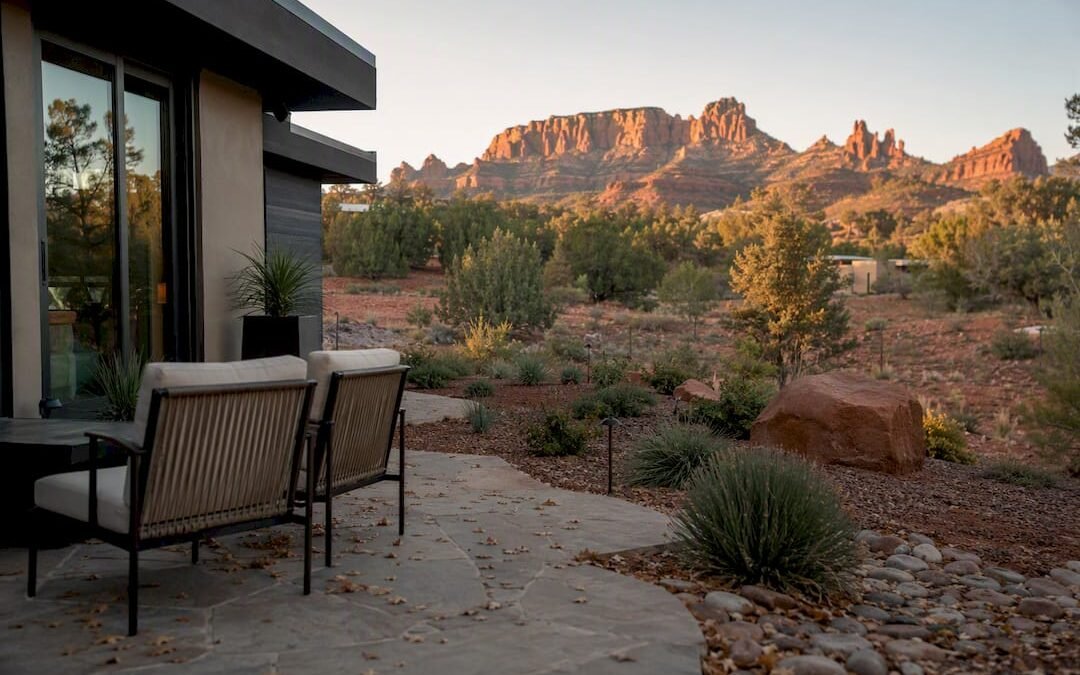
The single policy every wildfire-zone Sedona owner needs is a dedicated vacation-rental or commercial STR program with a loss-of-rents endorsement carrying an Extended Period of Restoration, plus liability limits that clear your city’s floor (verify the minimum coverage of at least $500,000 and consider higher limits such as $1 million per occurrence). Call an independent broker with specialty and excess-and-surplus market access this week, and bring mitigation photos with you.
TL;DR:
- Wildfire-exposed Sedona properties often require specialized vacation rental or commercial insurance policies with specific endorsements for loss-of-rent and extended restoration periods.
- Standard homeowners or landlord policies usually exclude business use, risking claim denials if wildfire damage relates to active STR use.
- Wildfire risk scores based on defensible space, roof age, and proximity to forest fuel heavily influence insurability, with Class 10 properties often uninsurable by admitted carriers.
- Arizona law mandates minimum liability limits of $500,000 for short-term rentals, but owners commonly opt for $1 million due to high potential claim costs.
- Proper mitigation documentation, property upgrades, and thorough underwriting preparation significantly improve insurance coverage options and pricing for wildfire-prone rentals.
Table of Contents
- Wildfire Insurance Arizona Rental: The Coverage Package That Actually Works
- Why Does Wildfire Risk Change Your Arizona Insurance Price?
- What Liability Coverage Does Arizona Require for Rentals?
- How to Shop for Wildfire-Ready STR Insurance in Arizona
- Which Property Upgrades Improve Insurability the Most?
- How Does Loss-of-Rents Coverage Work After a Wildfire Claim?
- What Sedona Owners Get Wrong About Wildfire Coverage
- How The Equity Team Helps You Buy Insurance-Ready Sedona Rentals
- Sources
Wildfire Insurance Arizona Rental: The Coverage Package That Actually Works
Here’s the part that surprises a lot of new Sedona hosts: the cozy little homeowners policy that came with the house was never built for a property that hosts strangers most weekends of the year. Standard HO forms and even basic landlord (DP) policies routinely carry business-use exclusions, and a short-term rental is, legally speaking, a business. Industry guidance for Arizona vacation rentals is blunt about this: if a wildfire claim gets traced back to active STR use on a policy that excludes it, the claim can get denied entirely, not just trimmed.
A vacation-rental or commercial STR policy fixes that gap and typically bundles in the coverage a wildfire-exposed cabin actually needs:
- Dwelling replacement cost that reflects current Sedona rebuild pricing, not the original purchase price
- Ordinance or law coverage, which pays for the gap between what burned and what current building codes now require you to rebuild
- Debris removal, often a separate limit from the dwelling itself
- Smoke remediation, frequently excluded or capped on basic forms even when the structure itself survives
Beyond the base policy, insist on four endorsements: loss-of-rents with an Extended Period of Restoration, guest property damage, amenity liability for pools and hot tubs, and equipment breakdown for the mechanical systems that keep a rental bookable. The Arizona Department of Insurance & Financial Institutions warns that wildfire benefits vary sharply from policy to policy, so ask specifically whether Additional Living Expense, debris removal, and smoke remediation are included rather than assuming they ride along with fire coverage.
Why Does Wildfire Risk Change Your Arizona Insurance Price?
Underwriters don’t look at a property near Sedona’s red rocks and see romance. They see a rating exercise. Carriers lean on ISO Public Protection Classifications and private FireLine-style scores that grade wildfire exposure block by block, and properties landing in the worst classification tiers often become effectively uninsurable through standard, admitted carriers.
Class 10 is the number to fear. Properties scored there by ISO’s protection classification system frequently can’t get bound through the admitted market at all, pushing owners toward excess-and-surplus placements almost by default, according to Arizona DIFI’s homeowners guidance.
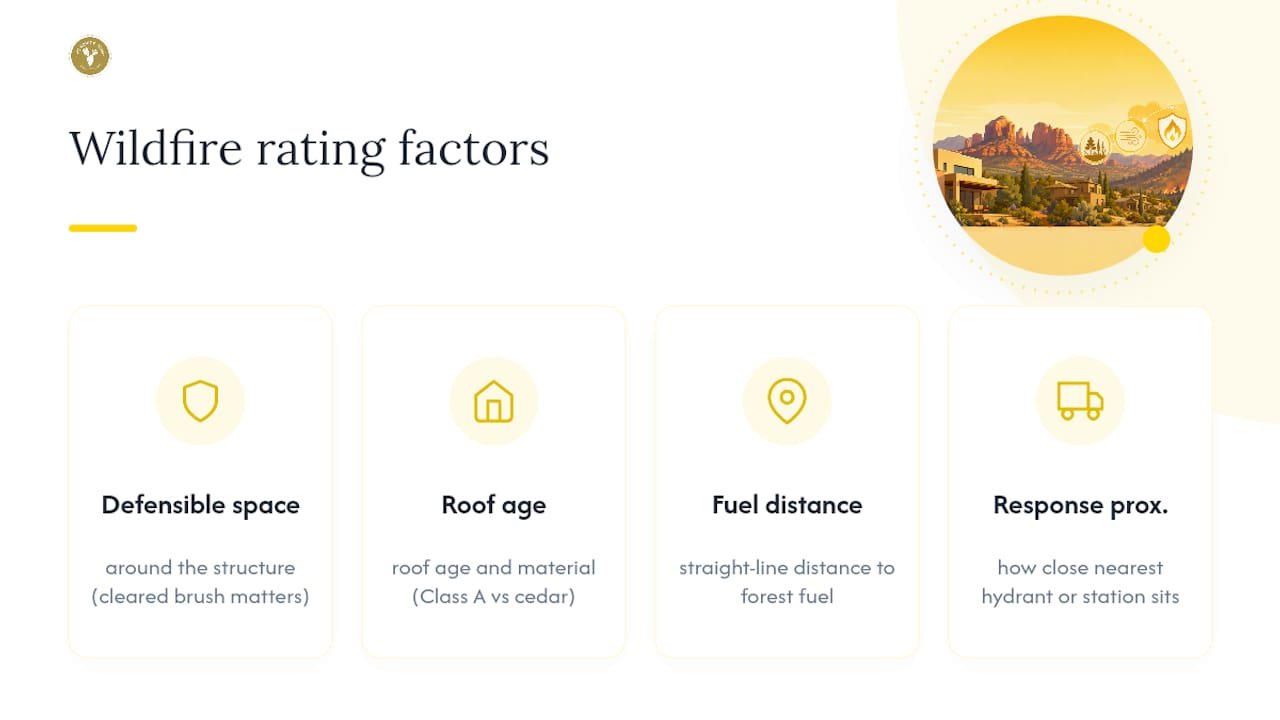
What moves the needle inside that score? Defensible space around the structure, roof age and material, straight-line distance to forest fuel, and how close the nearest hydrant or fire station sits. A property with a five-year-old Class A roof and 100 feet of cleared brush prices very differently than an older cedar-shake roof tucked against untouched pine.
Two other realities matter here. Arizona has no statewide FAIR Plan safety net for wildfire-declined homes, unlike some Western states, which is exactly why an independent broker with surplus-lines access matters so much. And even bound policies increasingly carry percentage-based wildfire deductibles rather than flat dollar amounts, so a $2,000 flat deductible you remember from years past may now read as 2% of dwelling value.
What Liability Coverage Does Arizona Require for Rentals?
Arizona doesn’t leave this to guesswork. A.R.S. § 9-500.39 authorizes cities to require short-term rentals to carry at least $500,000 in aggregate liability coverage, or to book exclusively through a platform that provides equivalent coverage on the host’s behalf. A companion statute, § 11-269.17, extends similar authority at the county level for unincorporated areas.
In practice:
- Sedona, Phoenix, and Scottsdale generally enforce the minimum coverage floor of at least $500,000 as part of permit compliance
- Paradise Valley sets a noticeably higher requirement, so never assume one city’s number applies next door
- Permit renewal typically requires proof of active coverage, and lapses can trigger fines or suspension
- Many owners buy $1 million per-occurrence limits anyway, since a single guest injury claim tied to a wildfire evacuation or a fire-pit mishap can exceed the minimum $500,000 limit fast
Treat the statutory number as a floor, not a target.
How to Shop for Wildfire-Ready STR Insurance in Arizona
Getting a fair quote on a forest-adjacent Sedona rental means walking in prepared, not hopeful. Underwriters reward owners who show up with answers already assembled.
- Gather your property file first. Roof age and material, square footage, construction type, and distance to the nearest fire station or hydrant.
- Document your mitigation work. Before-and-after photos of cleared brush, ember-resistant vent upgrades, and any fuel-break work.
- Pull your booking and revenue history. Twelve months of platform statements shows underwriters exactly what a loss-of-rents claim would need to replace.
- List every amenity. Pools, hot tubs, fire pits, and outdoor kitchens each carry their own liability wrinkle and need explicit endorsement language.
- Summarize prior claims, even minor ones, since a clean five-year history strengthens your negotiating position.
- Ask your broker the hard questions directly: Does this policy exclude business use? What’s the actual Period of Restoration on loss-of-rents, and can it be extended? Is the wildfire deductible a flat number or a percentage? Does amenity liability cover guest injury at the hot tub specifically?
- Ask how the broker accesses excess-and-surplus markets if your property scores poorly, since not every agency has that relationship in place.
Pro Tip: Bring a rebuild contractor’s name and rough timeline estimate to the underwriting conversation. A credible restoration plan on paper often does more to soften pricing than another round of photos.
Which Property Upgrades Improve Insurability the Most?
Insurers respond to specifics, not intentions. Defensible space clearance around the structure, ember-resistant foam vent screens, and Class A fire-rated roofing consistently move a property into a better rating tier. Vegetation management and fuel-breaks along the property line matter almost as much as the structure itself, since embers travel through ground fuel long before flames arrive.
Build a habit, not just a project. Scheduled brush clearing every season, participation in a local Firewise-style program, and documented maintenance logs all give an underwriter a pattern to trust rather than a one-time cleanup photo. Home-hardening investments also tend to pay off at resale, which matters if you’re building equity as much as booking revenue.
- Keep every contractor invoice tied to fire mitigation work
- Take dated before-and-after photos from the same angles
- Save permits and any fire-department acknowledgement letters
Pro Tip: Photograph your defensible space every spring before fire season, not just once. A dated photo library going back several years is worth more to an underwriter than a single glossy before-and-after set.
How Does Loss-of-Rents Coverage Work After a Wildfire Claim?
Loss-of-rents, sometimes called business income coverage, replaces the rental revenue you lose while the property sits uninhabitable. The catch almost every new owner misses: most policies cap that payout at a 12-month Period of Restoration, according to STR Guard’s coverage breakdown, and wildfire rebuilds in forested markets routinely run 18 to 24 months once permitting and contractor backlogs are factored in.
That gap is exactly why an Extended Period of Restoration endorsement matters. Payment typically triggers on direct fire damage, smoke damage that makes the home unbookable, or a civil-authority closure order during an active wildfire, and platforms will simply stop routing bookings the moment listings go dark regardless of cause.
- Keep your booking calendar exported monthly, not just at tax time
- Save every pre-paid reservation record, since those represent provable lost income
- Retain past tax filings showing average rental income patterns for a clean baseline comparison
The most common claim pitfall isn’t fraud. It’s simply running out of documented income history to prove what the property would have earned.
What Sedona Owners Get Wrong About Wildfire Coverage
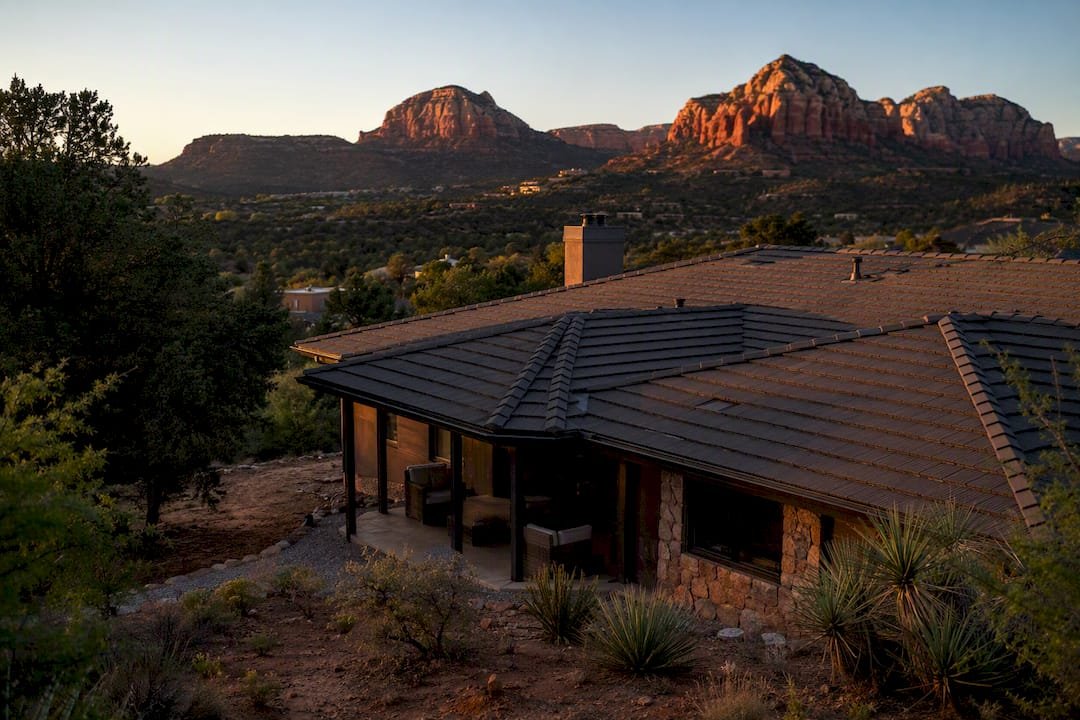
Most owners treat insurance as paperwork to finish before closing, not as a factor that shapes what a property is worth. That’s backwards in Northern Arizona right now. Wildfire exposure directly influences buyer demand and resale value, and a property that’s already insurable at reasonable terms shows better to the next buyer than one carrying an E&S placement and a nonrenewal history.
The smartest owners pair an insurance review with permit verification and documented mitigation before they ever list a property for sale or refinance it. That combination protects cash flow today and protects the exit value later, which is the only way to actually think about a rental investment in fire country.
— Chad
How The Equity Team Helps You Buy Insurance-Ready Sedona Rentals
Insurance underwriters and county permit offices ask nearly identical questions: roof condition, defensible space, distance to forest fuel, prior claims. Equity Team built its due-diligence process around exactly those data points, because we’ve watched deals stall when a buyer discovered a wildfire-score problem after closing instead of before.

We help Sedona and Northern Arizona STR buyers pull permit compliance history, flag mitigation gaps before an offer goes in, and search available inventory through direct IDX access rather than sorting through outdated listing sites. If you’re evaluating a Sedona short-term rental investment and want a property that won’t fight you at underwriting, reach out to Equity Team and we’ll walk the permit and wildfire-risk picture with you before you write an offer.
This article is general information, not a substitute for advice from a qualified financial advisor. Consult a qualified financial professional about your own circumstances before acting on anything here.
Sources
- Arizona Department of Insurance & Financial Institutions — Is my fire-related loss covered by my insurance policy?
- Arizona Revised Statutes § 9-500.39
- Vacation rental insurance Arizona (IIA Arizona)
- Loss of Rents insurance for short-term rental properties | STR Guard