

For most Sedona Airbnb purchases, an STR DSCR loan or a specialized private/portfolio lender gets you to the closing table fastest, because both underwrite the property’s income instead of your tax returns. Before you fall in love with a red rock view, though, confirm the permit status. Sedona permits don’t transfer to a new owner, and that single detail can quietly rewrite your entire financing timeline.
TL;DR:
- Sedona lenders prioritize property income over personal tax returns, but permit non-transferability and permit approval timing can significantly delay closing.
- Using an AirDNA estimate with a 75% to 85% haircut is standard, and accurate parcel-specific revenue data is crucial for reliable underwriting.
- Private or bridge loans are fastest for urgent deals or permit issues, while conventional loans offer lower costs for well-documented, stable income.
- Buyers must verify permit eligibility and jurisdiction early, as permit restrictions and non-transferability risk can cause unexpected delays or deal failures.
- Having all necessary documentation ready, including reserves based on slowest seasonal revenues, dramatically accelerates the closing process.
Table of Contents
- Quick Shortlist: The Financing Routes That Typically Work For Sedona Airbnbs
- How Sedona Lenders Actually Underwrite a Short-Term Rental
- Conventional, DSCR, or Private: How to Pick the Right Lender
- Why Sedona’s Permit Rules Change Your Financing Math
- What to Have Ready Before You Talk to a Lender
- What Financing Actually Costs on a Sedona STR Deal
- How The Equity Team Helps Sedona STR Buyers Close Faster
- The Gap Between Financing Advice and Sedona Reality
- Start Here With The Equity Team
- Sources
Quick Shortlist: The Financing Routes That Typically Work For Sedona Airbnbs
Sedona’s rental market is quirky enough that no single loan product fits every buyer. A tiny Uptown condo and a canyon-view estate in Oak Creek don’t just have different price tags. They have different insurance needs, different permit exposure, and different lender appetites. Here’s the lineup worth knowing before you start shopping listings.
- STR DSCR loans: These loans underwrite the property’s rental income rather than your personal pay stubs, which makes them the go-to when a home already has AirDNA comps or a rental history worth bragging about.
- Conventional investor mortgages: A better fit if your tax returns are clean, your credit score is strong, and you’d rather chase a lower rate than skip the paperwork.
- Portfolio and private lenders, plus bridge loans: Faster and more flexible, at a price. Useful when you’re racing another buyer or need to close before a permit issue gets sorted out.
- Furnishing and FF&E financing: Vendor financing, business lines of credit, or personal loans that cover the sofa, the hot tub, and everything else a five-star listing needs. Smaller setups can run $12,000 to $15,000 just to get the doors open.
- Seller financing: Still shows up in the Verde Valley, especially with longtime owners who’d rather carry the note than deal with a buyer’s lender.
Each of these solves a different problem. DSCR loans solve the “I can’t prove income the bank likes” problem. Bridge loans solve the “I need to move now” problem. Furnishing financing solves the “the listing photos need to not look sad” problem. Knowing which problem you actually have saved you a lot of wasted phone calls with loan officers who aren’t the right fit.
How Sedona Lenders Actually Underwrite a Short-Term Rental
DSCR stands for debt-service coverage ratio, and the math is refreshingly simple: divide the property’s expected rental income by its total monthly housing payment, including principal, interest, taxes, insurance, and any HOA dues. A ratio above 1.00 means the rental income covers the mortgage. Below that, and the lender wants a larger down payment or a stronger borrower to make up the gap.
The catch in Sedona is figuring out what “expected rental income” even means for a market this seasonal. Lenders typically blend actual operating history, when it exists, with an AirDNA parcel-level projection. If there’s no history yet, they lean entirely on AirDNA, and here’s the part almost nobody explains upfront: most STR DSCR programs apply a haircut of roughly 75% to 85% of that AirDNA projection before they count it as income. A red rock canyon view might photograph beautifully in October, but a lender isn’t going to underwrite you on peak-season numbers alone.
Sedona adds its own wrinkles on top of the standard DSCR math. Permit non-transferability means a lender has to think about whether the new owner will actually have an active STR permit by the time payments start. HOA and CC&R restrictions vary wildly between Uptown, West Sedona, and the Village of Oak Creek. And plenty of the area’s most desirable inventory sits in wildland urban interface zones or Oak Creek’s floodplain, which changes the insurance conversation entirely.
| Underwriting factor | What lenders check | Typical treatment |
|---|---|---|
| Rental income source | AirDNA report vs. 12-month operating history | Blended, weighted toward actuals when available |
| Revenue haircut | Percentage of projected AirDNA revenue counted | Roughly 75% to 85% |
| Credit / DSCR guidance | Borrower score paired with coverage ratio | Better pricing generally starts with strong credit |
| Reserves | Months of PITIA held in liquid reserves | Higher for lower-credit bands |
| Local risk factors | Permit status, HOA rules, WUI/flood insurance | Verified before clear-to-close |
Pro Tip: Pull an address-level AirDNA Market Revenue report before you even make an offer. Lenders will want one anyway, and having it in hand lets you negotiate from a position of knowing exactly what the property can realistically earn.
Working with a lender who has wholesale access to STR-friendly programs matters more than most buyers realize, since some networks flatly restrict short-term rental income while others build entire products around it.
Conventional, DSCR, or Private: How to Pick the Right Lender
Not every Sedona buyer needs the same tool. Think of it less as “which loan is best” and more as “which loan matches how I actually operate.”
A conventional investor mortgage makes sense if you have two years of clean tax returns, a credit score comfortably above 700, and you’re not in a rush. You’ll trade paperwork for a lower rate, and if your income already looks great on paper, there’s no reason to pay a premium for revenue-based underwriting you don’t need.
A DSCR specialist earns its fee when your tax returns don’t tell the real story, which describes a lot of self-employed buyers and anyone already juggling multiple rentals. These lenders skip the income verification entirely and focus on the asset. That’s also why they tend to close faster.
Private or bridge capital comes into play when speed beats cost. If you’re competing for a listing in a tight Sedona micro-market, or you’re buying a property that needs work before it can even apply for a permit, a bridge loan buys you the time a conventional underwriter never would.
| Lender type | Best for | Speed | Cost | Documentation |
|---|---|---|---|---|
| Conventional investor mortgage | Strong tax returns, lower rate priority | Slower | Lower | Full income docs |
| STR DSCR specialist | Revenue-based qualifying, no tax return hassle | Faster | Moderate | Property-focused, light borrower docs |
| Private / portfolio / bridge | Competitive bids, rehab plays, urgent closes | Fastest | Highest | Minimal, asset-driven |
A simple heuristic: if you can wait 45 days and your paperwork is spotless, go conventional. If your income doesn’t fit a standard box, or the property’s own numbers are the real selling point, go DSCR. If you’re in a bidding war or racing a permit deadline, private capital is the tool, not conventional financing dressed up with urgency you can’t actually deliver.
DSCR loans explained in more depth covers the qualifying mechanics if you want the underwriting logic from a lender’s side of the desk.
Why Sedona’s Permit Rules Change Your Financing Math
Arizona law generally protects short-term rentals from outright city bans, but Sedona still runs its own permit system, and the fine print matters enormously to a lender. City of Sedona STR permits are annual and non-transferable, which means the permit dies with the sale. You, the buyer, have to apply fresh, and every advertised unit on a property needs its own permit.
Jurisdiction adds another layer of complexity. Properties inside city limits follow Sedona’s permit process, while inventory in the Village of Oak Creek or unincorporated Yavapai County plays by a different set of rules entirely. Lenders treat these two buckets differently, and a loan officer unfamiliar with the distinction can misjudge your timeline badly.
Here’s what tends to happen in practice, and how to plan around it:
- Permit gap risk: New buyers often face a short window where the property can’t legally operate as a rental while the new permit processes, so lenders frequently ask borrowers to model that gap into their reserves.
- City vs. county checks: Confirm which jurisdiction governs the parcel before you assume the current permit rules apply.
- TPT registration: Arizona’s Transaction Privilege Tax registration needs to be active and tied to the new ownership, not left over from the seller.
- Early verification wins: Check permit eligibility during due diligence, not after you’ve already waived contingencies.
Buyers who skip this step sometimes discover, after closing, that the permit rules have shifted since the listing photos were taken. A quick call to the city, made before you write an offer, is the cheapest insurance you’ll buy all year.
What to Have Ready Before You Talk to a Lender
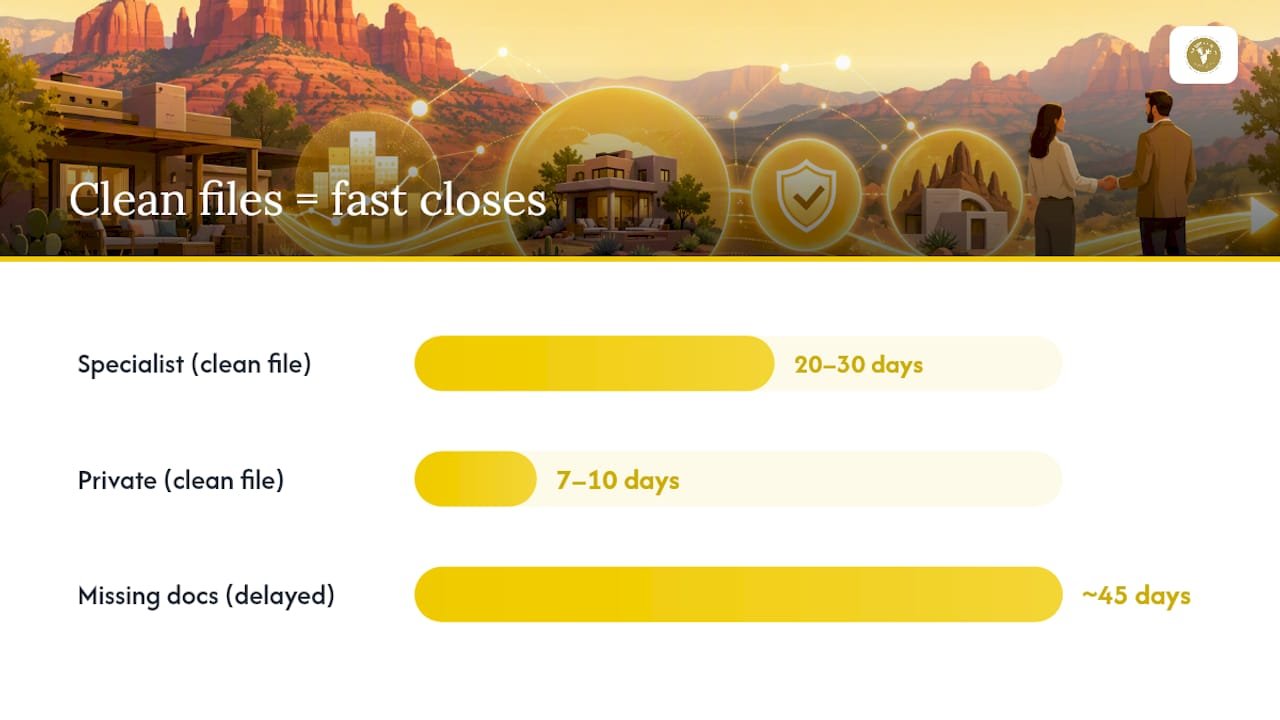
Specialist lenders move fast, but only if you hand them a complete file the first time. Missing documents are the single biggest reason a 20-day close turns into 45.
- Personal identification and entity documents, including LLC paperwork if you’re purchasing under a business name.
- Bank statements, typically two to three months, to verify reserves and down payment funds.
- The signed purchase contract, with the property address clearly listed for parcel-level underwriting.
- An AirDNA report or 12 months of actual STR operating history, whichever applies to your situation.
- Insurance quotes, especially where wildland urban interface or Oak Creek floodplain coverage applies.
- HOA and CC&R documentation, confirming the property is even allowed to operate short term.
- Evidence of permit eligibility, showing the jurisdiction and expected timeline for a new permit application.
Present the deal the way an underwriter wants to see it: conservative occupancy assumptions, not peak-season fantasy numbers, plus enough reserves to survive the permit gap. Specialist Sedona STR lenders report standard closes of 20 to 30 days, with some private lenders claiming term sheets in as little as 7 to 10 days when the file is clean.
Pro Tip: Build your reserve calculation around the slowest month AirDNA shows for that parcel, not the average. If your numbers still work in February, they’ll work fine in June.
Common delays worth planning around include HOA rental restrictions nobody checked in advance, insurance underwriting that drags on for WUI-zoned homes, and deed restrictions that surface late in title work. None of these are dealbreakers if you catch them early. All of them are painful if you catch them during underwriting.
What Financing Actually Costs on a Sedona STR Deal
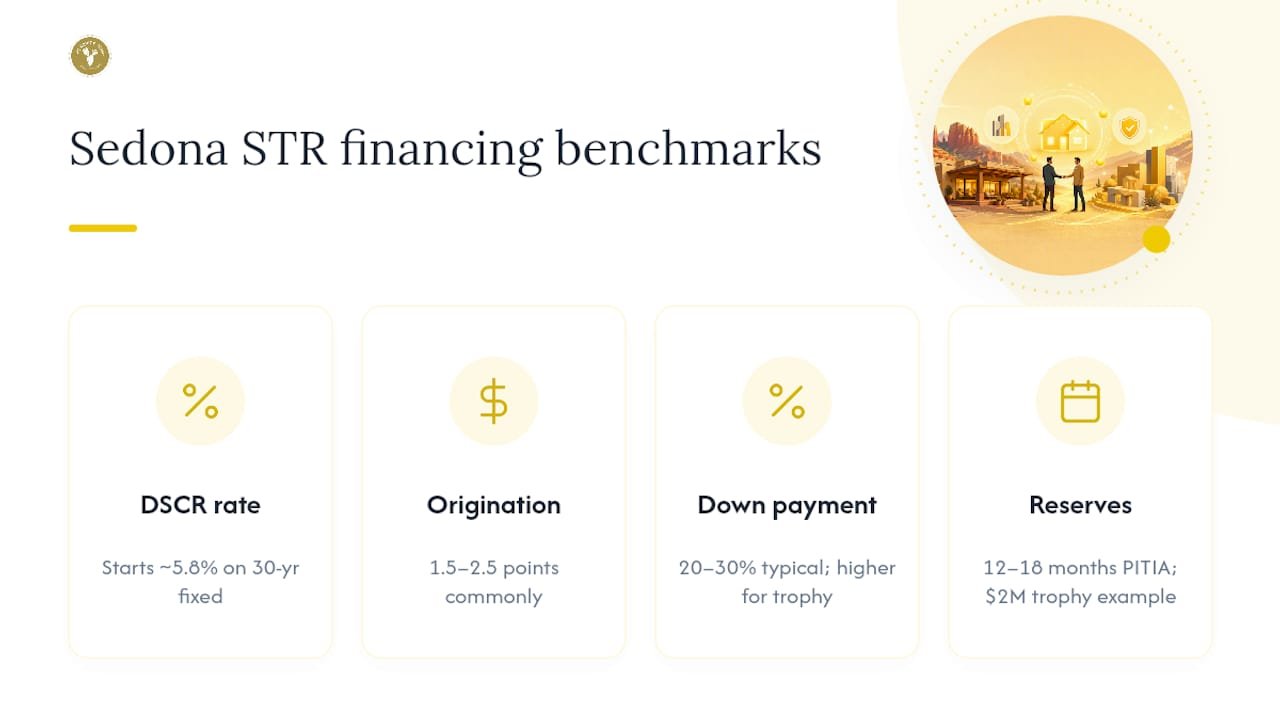
Rate headlines rarely tell the whole story, but they’re a useful starting point. Specialist lenders report DSCR pricing starting around 5.8% on 30-year fixed terms in the most competitive credit and DSCR combinations, with origination points commonly landing between 1.5 and 2.5.
Down payment expectations run 20% to 30% for most Sedona STR purchases, with trophy properties in Oak Creek Canyon or premium Uptown locations sometimes requiring even more cushion given their price tags and insurance complexity. Reserve requirements scale with credit, and borrowers in the 660 to 700 range should expect lenders asking for 12 to 18 months of PITIA held in reserve.
Two quick scenarios show how differently this plays out:
A trophy Oak Creek Canyon property in the $2 million range tells a different story. Even with excellent projected revenue, the higher loan amount and WUI insurance costs often push required reserves toward that 12 to 18 month band, and lenders scrutinize the seasonal revenue swing far more closely before settling on a final DSCR.
How The Equity Team Helps Sedona STR Buyers Close Faster
Financing is only half the puzzle. The Equity Team builds lender requirement packets and permit checklists specific to the parcel you’re eyeing, because a canyon-adjacent property and a West Sedona bungalow face genuinely different underwriting questions. Local knowledge shortens the back-and-forth: knowing which jurisdiction governs a listing, what TPT setup actually looks like, and which appraisers understand STR value drivers all trims days off a typical close.
Bring your target price range, your financing preference, and any AirDNA numbers you’ve already pulled to a first conversation. From there, expect help matching your deal to the right lender category and a realistic read on where your closing timeline actually lands, whether that’s the standard 20 to 30 day window or a faster private-capital path.
The Gap Between Financing Advice and Sedona Reality
Most financing content treats short-term rental loans as a generic product, as if a DSCR loan in Phoenix and a DSCR loan in Sedona carry the same risk profile. They don’t. Sedona’s permit non-transferability rule alone creates a cash-flow gap that generic advice never mentions, and it’s exactly the kind of detail that turns a smooth closing into a scramble.
The conventional wisdom says “get pre-approved and start shopping.” Better advice: pull the AirDNA parcel report and check permit status before you fall for a listing. Financing approval means nothing if the property can’t legally operate the day you need it to.
If there’s one priority worth putting above all others, it’s this: treat the permit question as a financing question, not a separate afterthought. Lenders already do. The reserve modeling around that permit gap is quietly one of the most important numbers in your entire deal, and it deserves more attention than the interest rate headline that usually steals it.
— Chad
Start Here With The Equity Team
There are alternatives to guessing your way through Sedona financing alone. Where a generic lender search leaves you comparing rate sheets with no context for permit rules or AirDNA haircuts, working with agents who specialize in short-term rentals means recommendations may account for local jurisdiction quirks and lender-speed tradeoffs.

A first conversation typically covers a permit eligibility check for the specific parcel, a pull of current AirDNA revenue data, and an introduction checklist for lenders who work the STR market. From there, expect a recommended funding route and a timeline estimate rather than a generic pre-approval letter.
If you’re ready to see what’s actually available, start with how to find the right Sedona short-term rental investment property or take a look at current Sedona short-term rental market conditions to see where the opportunity actually sits before you make an offer.