

Yes, Airbnb income can qualify you for a mortgage in the United States, but the route depends on your paperwork. Conventional loans usually want one to two years of Schedule E history on your tax returns. If you’re newer to hosting or want to lean on projected cash flow instead, DSCR and non-QM programs open that door. Either way, verify local legality and tax reporting before you fall in love with a property in Sedona or anywhere else.
TL;DR:
- Conventional loans require one to two years of Schedule E tax history, while DSCR and non-QM programs can qualify with little or no personal rental history.
- Proper documentation, including two years of tax returns, Airbnb Proof of Income, bank statements, and a CPA-prepared profit and loss statement, is essential for approval.
- A property’s own cash flow, calculated through DSCR, can qualify you without relying on personal income if the ratio exceeds 1.0.
- Permits, local regulations, and consistent income reporting are critical to avoid application rejections or income discounts during underwriting.
Table of Contents
- What Counts as Airbnb Income to Lenders?
- Which Loan Programs Accept Airbnb Income?
- How Do Lenders Calculate Your Qualifying Income?
- What Documents Do Lenders Actually Want?
- How Do You Get Airbnb’s Proof of Income?
- What’s the Practical Application Workflow?
- What Pitfalls Derail Airbnb Income Qualification?
- What Do Local Sedona Numbers Look Like in Practice?
- What’s the Best Path Forward for Most Hosts?
- How Equity Team Helps You Get Lender-Ready
- Where to Verify These Rules Yourself
- Sources
What Counts as Airbnb Income to Lenders?
Airbnb shows you gross payouts. Lenders care about taxable net income, which is what’s left after cleaning fees, host service fees, and deductible expenses are deducted. That difference often causes confusion, as a host may have much higher Airbnb dashboard gross totals compared to the taxable income reported.
Where that income lands on your tax return matters just as much as the amount. Most short-term rental hosts report earnings on Schedule E, the standard rental real estate form, which lenders treat as passive income and underwrite fairly smoothly. Guidance from Baselane’s accounting overview confirms that Schedule E is the default unless you’re providing hotel-like services.
Providing “substantial services” (daily housekeeping, meals, concierge-style extras) or renting for an average stay under seven nights can push you onto Schedule C instead. That reclassification triggers self-employment tax on Social Security and Medicare, which shrinks your net qualifying number even though your gross revenue stayed the same.
Then there’s the 1099 question. Airbnb issues a Form 1099-K when gross payment volume crosses federal or state reporting thresholds, and state thresholds are sometimes lower than the federal one. A few things to keep straight before you assemble your loan file:
- 1099-K reports gross transactions, not your taxable profit.
- Missing a 1099 doesn’t excuse you from reporting income you actually earned.
- Underwriters generally want two tax years, not just one clean 1099.
Which Loan Programs Accept Airbnb Income?
Your loan program choice depends almost entirely on how much tax history you have and whether you plan to live in the property. Four paths dominate the short-term rental financing world right now:
- Conventional loans. These accept Airbnb income once it shows up on Schedule E, typically averaged over one to two years. They carry the best rates and lowest fees, but they punish thin or messy tax histories.
- DSCR loans. Debt Service Coverage Ratio loans qualify you based on the property’s own cash flow, actual or projected, rather than your personal tax returns. This makes them the go-to for investors who lack rental history or who are scaling past what conventional underwriting will tolerate. Industry breakdowns of DSCR versus conventional underwriting confirm DSCR programs can qualify a purchase with zero months of personal Schedule E history, based purely on the subject property’s projected rent.
- Bank-statement and non-QM loans. These accept deposit history in place of tax returns, useful for self-employed hosts whose write-offs make their taxable income look thin. Terms and pricing vary widely by lender, so shop more than one.
- Owner-occupied house-hacking rules. If you live in part of the property and rent the rest (an ADU, a casita, extra bedrooms), some conventional programs let you count a portion of that boarder income, though the allowed percentage and required documentation differ by lender.
Pro Tip: Call your loan officer before you sign a purchase contract and ask, in plain language, “will you underwrite this as Schedule E, DSCR, or bank-statement?” Getting that answer in writing saves you from a rejected appraisal order fee later.
If you’re weighing DSCR against a conventional route on a specific Sedona-area purchase, a deeper comparison of DSCR loans versus conventional mortgages walks through the tradeoffs in more detail.
How Do Lenders Calculate Your Qualifying Income?
Most underwriters don’t take your Airbnb numbers at face value. They apply a haircut, then average, then plug the result into a debt-to-income or DSCR formula.
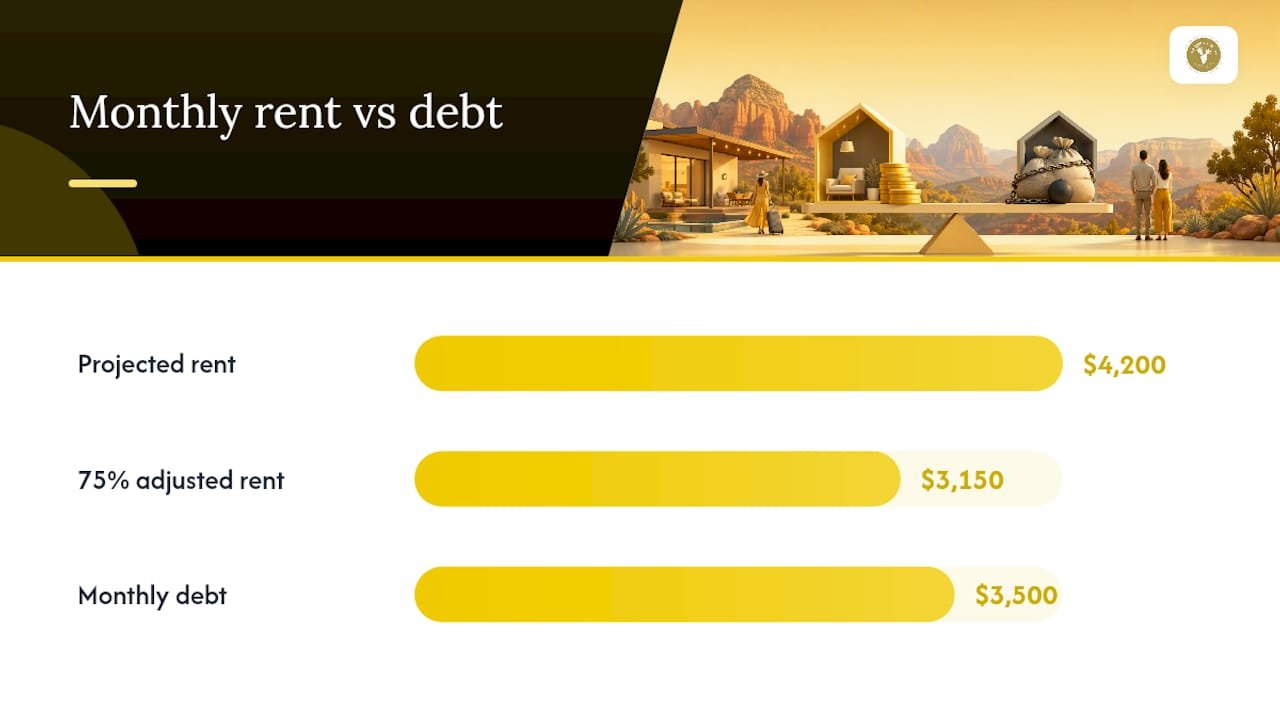
A common adjustment is the 75% rule: lenders often discount gross or projected rent by a portion to account for vacancy, maintenance, and management costs, according to STR-specific underwriting explainers from STR Specialist. If your Schedule E already shows net income after real expenses, some lenders skip the haircut and use that figure directly instead of double-discounting you.
For income averaging, expect lenders to pull 12 to 24 months of net rental income off your tax returns, average it, and add that monthly figure to your qualifying income before running your debt-to-income ratio.
DSCR loans skip your personal DTI entirely. The formula is simple:
DSCR = Gross Rental Income ÷ Total Debt Service (principal, interest, taxes, insurance, and HOA dues)
Many DSCR lenders target a ratio around 1.0 to slightly above 1.0, per the same STR Specialist underwriting guide. A quick example: if a property’s projected monthly Airbnb revenue is $4,200 and total monthly debt service (PITIA) is $3,500, your DSCR is 1.2, comfortably inside most lenders’ approval range.
- A DSCR under 1.0 means the property doesn’t cover its own debt on paper.
- A DSCR above 1.25 typically unlocks better pricing tiers.
- Some lenders will use a market-rent appraisal instead of your actual Airbnb history if you’re buying new.
What Documents Do Lenders Actually Want?
Assembling a lender-ready file before you shop rates saves weeks. Here’s the checklist that shows up in nearly every short-term rental underwriting file:
- Two years of Form 1040 with Schedule E (or Schedule C, if applicable).
- A CPA-prepared profit and loss statement that separates cleaning fees, platform fees, and maintenance from net revenue.
- Airbnb’s official Proof of Income document.
- Bank statements showing payout deposits, reconciled month by month against Airbnb’s own reports.
- A third-party market rent report or appraisal, when you’re buying and have no rental history yet on that specific property.
Underwriters trust numbers that match across sources. If your Airbnb dashboard says you grossed $58,000 last year but your Schedule E shows $31,000 in net income, that gap needs an explanation, not a shrug. A one-page letter noting a major repair, an off-season closure, or a rate change during a slow quarter often resolves it faster than you’d expect.
Pro Tip: Ask your CPA to prepare the P&L using the exact same date ranges as your tax return, not the calendar year Airbnb defaults to on its dashboard exports. Mismatched date ranges are one of the most common reasons underwriters kick a file back for clarification.
How Do You Get Airbnb’s Proof of Income?
Airbnb built a specific tool for exactly this situation, and most hosts never realize it exists until a lender asks for it.
- Log into your host account and go to Insights → Earnings.
- Look for the Request Proof of Income option, available to eligible U.S. hosts with active listings.
- Airbnb generates a document showing your monthly gross earnings and, when applicable, your prior two calendar years of payouts, according to Airbnb’s own help documentation.
- Separately, pull a CSV export from your Earnings dashboard to reconcile individual payouts against your bank deposits line by line.
- Hand both documents to your CPA before your lender sees them, so any gross-to-net gap already has a written explanation attached.
Remember that Proof of Income shows gross earnings, not taxable net. Your Schedule E remains the document that carries real underwriting weight; the Proof of Income mainly confirms that your tax return isn’t overstated or fabricated. If you never received a 1099-K because you fell under the reporting threshold, that doesn’t erase your obligation to report the income. It just means you’ll lean more heavily on bank statements and the Airbnb export to prove the number.
What’s the Practical Application Workflow?
Skipping steps here is how hosts burn appraisal fees on properties that were never going to qualify anyway.
- Confirm the property’s short-term rental legality: check city or county permit rules and, if applicable, HOA restrictions, before you write an offer.
- Run a 12-month DSCR backtest using realistic occupancy and average daily rate figures for that specific neighborhood, not a citywide average.
- Call your chosen lender and confirm, in writing, which income method they’ll actually underwrite: Schedule E, DSCR cash flow, or bank statements.
- Assemble your file: two years of tax returns, Airbnb’s Proof of Income and CSV exports, bank statements, a CPA-prepared P&L, and any third-party comps.
- Build in a contingency, either extra cash reserves or a slightly larger down payment, in case the appraiser’s market rent estimate lands under your own projection.
Pro Tip: Order the appraisal only after your lender confirms your income method in writing. A $600 appraisal fee on a property your lender was never going to finance under DSCR terms is money you can’t get back.
For a Sedona-specific version of this sequence, including realistic closing timelines, the Sedona Airbnb lender requirements checklist breaks down permit rules and typical closing windows in more detail.
What Pitfalls Derail Airbnb Income Qualification?
A handful of mistakes account for most of the rejected or discounted applications:
- Missing or inconsistent tax reporting, especially when a host only has a single year of Schedule E to show.
- Aggressive write-offs that legitimately lower tax liability but also shrink the net income a lender will count.
- One unusually strong month (a festival weekend, a rate spike) inflating an average that the rest of the year can’t support.
- Buying in a jurisdiction with permit caps, moratoriums, or unclear STR rules, which can make appraisers and underwriters refuse to credit projected rental income at all.
- Handing a lender gross platform numbers without reconciling them to Schedule E, which almost always invites a request for more documentation and delays your closing.
What Do Local Sedona Numbers Look Like in Practice?
Northern Arizona gives you a useful real-world laboratory for this math. Oak Creek’s median short-term rental revenue and Cornville’s average daily rate and occupancy figures offer realistic inputs for a DSCR backtest rather than guesswork.
That’s roughly $4,100 in monthly gross revenue. Against a $3,300 monthly PITIA payment, that’s a DSCR near 1.24, solidly within most lenders’ comfort zone.
- Local occupancy data helps you build defensible year-round projections instead of peak-season guesses.
- A documented backtest across all twelve months, not just the busy quarter, is what separates a strong DSCR case from a rejected one.
What’s the Best Path Forward for Most Hosts?
Pairing a CPA who understands Schedule E versus Schedule C with a lender who actually closes DSCR loans regularly, plus a local agent who knows Sedona’s permit landscape, cuts weeks off your timeline and kills most of the surprises before they happen.
Lean conventional if you’ve got two clean tax years and want the best rate. Lean DSCR if you’re scaling fast or buying somewhere you haven’t operated yet. Either way, confirm permits before you get attached to a listing.
— Chad
How Equity Team Helps You Get Lender-Ready
We specialize in Sedona and Northern Arizona short-term rentals and focus on helping clients build files lenders can approve to avoid delays or clarification requests. We help hosts prepare profit and loss summaries suitable for underwriting, verify local permit status before offers are made, and assist with evaluating properties using realistic DSCR calculations.

Before your first consultation, gather your Airbnb Proof of Income, two years of tax returns, and recent bank statements. We’ll walk through what a lender will actually count as qualifying income for your specific situation, whether that’s a Cornville cabin or an Oak Creek retreat. If you’re ready to see what’s realistically available in this market, start with our guide to finding the right Sedona short-term rental investment and reach out to schedule a consultation.
Where to Verify These Rules Yourself
- Airbnb’s Proof of Income request page for the exact form lenders will see.
- CFPB’s appraisal guidance for understanding why appraisals affect projected income.
- NMLS Consumer Access to confirm any lender or loan officer is properly licensed before you pay for reports or fees.
This article is general information, not a substitute for advice from a qualified financial advisor. Consult a qualified financial professional about your own circumstances before acting on anything here.
Sources
- How do I request a proof of income? – Airbnb Help Center
- NMLS Consumer Access
- What are appraisals and why do I need to look at them? – CFPB
- Complete guide to Airbnb accounting and bookkeeping — Baselane