

Airbnb house rules are the written expectations you set for guests covering noise, guest counts, smoking, pets, and property-specific hazards, and they double as both a screening tool and a legal safety net. Copy one of the three templates below (city apartment, family home, or pool/high-terrain property), swap in your max guest count and quiet hours, and paste the enforceable lines into Airbnb’s standard rules menu, saving the finer details for the “Additional rules” field.
TL;DR:
- Prioritize standard toggles for rules on parties, smoking, guest limits, and quiet hours, as Airbnb automatically enforces and documents violations for these.
- Address hazards like pools, steep terrain, and fire pits with specific instructions in “Additional rules” to ensure safety and limit liability.
- Use positive, clear language and place high-impact rules in the platform’s standard menu, reserving detailed quirks for the house manual or “Additional rules.”
- Properly document rule violations with evidence and follow a calm escalation process to Airbnb support to protect your property and reputation.
- Verify local HOA and county regulations before creating rules, especially for properties in specialized areas like Sedona, to ensure full compliance and prevent future disputes.
Table of Contents
- Why House Rules Matter (And How Airbnb’s Standard Rules Work)
- What Categories Should Your House Rules Cover?
- Copy-Ready House Rule Examples and Templates
- How to Write House Rules Guests Will Actually Follow
- What to Do When a Guest Breaks the Rules
- A Property-Specific Checklist for Local Hosts
- Why Clear Rules Protect Property Value, Not Just Your Weekend
- Get Local, Compliance-Ready Guidance from Experienced Agents
- Sources
Why House Rules Matter (And How Airbnb’s Standard Rules Work)
House rules do two jobs at once. They screen out guests who won’t respect your space before they even book, and they give you something concrete to point to when a dispute lands in Airbnb’s lap. A vague listing attracts vague guests. A listing that says “quiet hours after 10 PM, max 6 guests, no smoking anywhere on the property” attracts people who read before they book, which is exactly who you want.
Airbnb built a standard menu of rules into every listing for a reason. When you set up your listing, you’ll see toggles for pets, events and parties, smoking, quiet hours, check-in and check-out windows, and maximum guest count. These aren’t optional extras buried in fine print. Airbnb surfaces them in multiple places a guest can’t easily miss: the listing page itself, the booking confirmation screen, the “Pack Your Bags” pre-arrival email, and the digital Arrival Guide. If a guest violates one of those standard items, you have a documented trail Airbnb can act on.
That’s the key distinction most new hosts miss. Airbnb’s ground rules for guests explicitly cover pets, events, smoking, quiet hours, check-in and check-out timing, and guest counts, and repeated violations of these can lead to formal warnings or removal from the platform. But if your rule isn’t one of the standard toggles, say, “no shoes inside” or “recycling goes in the blue bin,” it belongs in the “Additional rules” text field instead. Airbnb still displays additional rules to guests before booking, but because they’re custom text rather than platform-verified toggles, Support may need to evaluate whether they’re reasonable if a dispute arises. Standard rules get automatic weight. Additional rules get a judgment call.
The practical takeaway: put your highest-stakes items (parties, smoking, guest limits) in the standard menu every time. Save the personality and property-specific quirks for additional rules.
What Categories Should Your House Rules Cover?
A complete rule set doesn’t need to be long, but it does need to touch every category where guests commonly cause friction. Miss one, and you’ll find out the hard way, usually at 2 AM via a neighbor’s angry text.
Here’s a checklist to consider before you publish any listing:
- Parties and events: State plainly whether gatherings beyond registered guests are allowed, and if so, under what conditions.
- Smoking and vaping: Specify indoor, outdoor, and near-neighbor restrictions separately since these often get treated as different questions by guests.
- Pets: Note whether pets are allowed, any breed or size limits, and extra cleaning fees if applicable.
- Maximum guests and unregistered visitors: Define the sleeping capacity and whether day visitors need advance approval.
- Quiet hours: Give exact times, not “reasonable hours,” since that phrase means something different to every guest.
- Check-in and check-out windows: Confirm the exact times and what happens with early arrivals or late departures.
- Parking: Note the number of spots, any street restrictions, and whether HOA guest permits are required.
- Off-limit areas: Flag locked rooms, private owner storage, or sections of a shared property that guests shouldn’t enter.
- Garbage and recycling: Explain pickup days and bin locations, especially in areas with strict municipal sorting rules.
- Furniture and appliance use: Cover anything fragile, antique, or expensive enough that misuse would actually cost you money.
- Property-specific hazards: Address pools, fire pits, hot tubs, or steep terrain with specific operational limits, not just a general warning.
That last category deserves extra weight. Airbnb’s own safety guidance tells hosts to disclose inherent hazards like pools and steep drops and post clear instructions to prevent accidents. Skip this, and you’re not just risking a bad review. You’re risking a legitimate injury claim.
Copy-Ready House Rule Examples and Templates
Here’s where theory turns into text you can paste directly into your listing. Below are individual one-line rules organized by category, followed by three complete templates built for different property types.
One-line rule examples by category
- “Quiet hours are 10 PM to 8 AM. Please keep noise, including outdoor conversation, low enough not to disturb neighbors.”
- “No parties, events, or gatherings beyond registered guests are permitted at any time.”
- “Smoking and vaping are not allowed anywhere on the property, indoors or outdoors.”
- “Pets are welcome with prior approval. A $75 pet fee applies, and pets may not be left unattended in the home.”
- “This home sleeps a maximum of 6 guests. Additional day visitors must be approved in advance.”
- “Check-in is after 4 PM and check-out is by 11 AM. Late check-out requests must be approved 24 hours ahead.”
- “Parking is limited to 2 vehicles in the driveway. Street parking may require a permit; check the guide for details.”
- “The owner’s storage closet and garage are off-limits to guests.”
- “Trash goes in the gray bin, recycling in the blue bin. Pickup is every Tuesday morning.”
- “Please treat the furniture and decor with care. Damage beyond normal wear will be charged to the reservation.”
- “The pool is open from 8 AM to 9 PM. Children must be supervised by an adult at all times.”
- “The fire pit may only be used with the provided screen in place and must be fully extinguished before bed.”
Template 1: City apartment or condo
A compact rental in a building with shared walls and possibly an HOA needs rules weighted toward noise and neighbor relations.
Quiet hours: 10 PM to 8 AM, no exceptions given shared walls.
Maximum guests: [X], as registered at booking.
No parties or events of any kind, including day guests beyond those booked.
No smoking or vaping anywhere in the unit or on the balcony.
Parking: [assigned spot number or garage instructions]. Guest parking passes are required; see the house manual for the HOA office location.
Trash chute is located [location]; recycling bins are on [floor/location].
Template 2: Family home with a yard
A standalone house draws bigger groups and more outdoor activity, so the rules shift toward property use and guest counts.
Maximum occupancy: [X] guests, [X] of them children under 12.
Quiet hours: 9 PM to 8 AM outdoors, 10 PM to 8 AM indoors.
Pets allowed with approval; leash required in the yard, and pet waste must be cleaned up daily.
No smoking indoors; a designated outdoor smoking area is marked near [location].
Parking: driveway fits [X] vehicles; additional vehicles must use street parking where legally permitted.
The shed and detached garage are for owner storage only and are off-limits to guests.
Template 3: Property with a pool or steep terrain
High-risk amenities demand the most specific, liability-conscious language you’ll write in the entire listing.
Pool hours: 8 AM to 9 PM only. No diving. Children under 12 must be supervised by an adult at all times.
Life preserver location: [specific location]. Pool gate must remain latched when not in use.
The property includes steep terrain near. Guests should stay on marked paths, especially after dark.
Fire pit use is permitted only with the spark screen in place, and must be fully extinguished before leaving it unattended.
No unsupervised access to the pool deck for guests under 16.
Maximum guests: [X]. Additional day guests using the pool must be registered in advance.
Notice how the specific numbers (guest counts, pool hours, parking spots) sit in the standard rules menu when Airbnb offers a toggle for them, while the hazard-specific detail (spark screens, life preserver locations) belongs in “Additional rules” or the house manual, since Airbnb’s standard menu doesn’t have a dedicated field for terrain warnings or fire pit protocol.
How to Write House Rules Guests Will Actually Follow
The best house rules read like a considerate note from a friend, not a warning label from a rental car counter. That distinction changes how guests respond to them.
Start by grouping your rules in order of importance, not the order they popped into your head. Put safety and legal items first (pool hours, smoking, max guests), then move to comfort items (quiet hours, parking), and finish with the small-but-nice-to-know details (trash day, where the extra towels live). A guest who has to scroll through 40 lines to find the checkout time will skip reading altogether, and then you’re back to square one.
Positive phrasing changes outcomes more than most hosts expect. Airbnb’s own hosting guidance recommends framing rules as helpful asks rather than prohibitions wherever it’s practical. Compare these two versions of the same rule:
-
Weaker: “Do not leave dishes in the sink.”
-
Better: “Help us keep things tidy by running the dishwasher before you check out.”
-
Weaker: “No loud noise after 10 PM.”
-
Better: “Quiet hours start at 10 PM so everyone, including the neighbors, sleeps well.”
Notice the better versions still say exactly what’s expected. Precision matters as much as tone. “Be respectful” is not enforceable. “Quiet hours are 10 PM to 8 AM” is.
Placement is its own skill. Standard, high-impact items (events, smoking, pets, quiet hours, guest count, check-in/out) belong in Airbnb’s rules menu because that’s where they show up automatically on the listing, the booking screen, and the pre-arrival email. Property quirks and preferences (shoe removal, specific trash sorting, a request to use coasters) belong in “Additional rules.” Save the long-form explanations, like exactly how the smart lock works or where the circuit breaker is, for your house manual. Rules hidden only in a manual are less visible to guests and harder to enforce if something goes wrong, so never let an important rule live there alone.
Pro Tip: Test two versions of your lead-in phrasing over a month and watch your booking rate. A slightly softer opening line (“A few friendly notes before you book”) often converts better than a blunt list header, without changing a single actual rule.
What to Do When a Guest Breaks the Rules
Rule violations happen. What separates hosts who resolve them cleanly from hosts who lose money is the sequence they follow, not luck.
- Message the guest calmly, in-thread, right away. State the specific rule broken and the remedy you need (lower the noise, remove unregistered guests, stop smoking indoors) rather than venting frustration. Airbnb reviews in-platform messages as evidence, so phone calls and texts outside the app carry less weight if a dispute escalates.
- Collect evidence as it happens. Photos of damage, screenshots of noise complaints, timestamps, and even a neighbor’s written statement all matter. Save everything inside the Airbnb message thread or upload it when you file a report, since documented attempts to resolve an issue are often what Support asks for before stepping in.
- Escalate to Airbnb Support when the guest doesn’t respond or the violation is serious. Bring your message history, photos, and a clear timeline. Airbnb’s ground rules allow for warnings or removal of guests who repeatedly violate posted rules, but Support needs the paper trail to act.
- Use your review honestly, and expect the same in return. A factual, unemotional review (“Guest exceeded the posted 6-guest maximum”) does more for future screening than a vague complaint, and it protects you if the guest disputes the review later.
This sequence matters just as much for future bookings as it does for the current one. Airbnb’s guidance for hosts ties accurate listings and honest communication directly to better ratings, and better ratings are what filter out the guests who caused the problem in the first place.
A Property-Specific Checklist for Local Hosts
Sedona’s mix of HOA communities, pool properties, and steep terrain means a generic house rules template rarely covers everything a local host needs. A few extra lines protect you in ways a standard checklist misses.
- Verify whether your property sits in an HOA with its own short-term rental restrictions before finalizing your parking and guest-count rules.
- Confirm county-level requirements, since Coconino County has specific rules for investors and hosts that can affect noise limits and local-contact obligations.
- Include a local contact line in your house rules if your jurisdiction requires one; a documented, fast response to a noise complaint often prevents a license penalty down the line.
- Add specific pool language (hours, supervision requirements) rather than a single generic “use at your own risk” line.
- Note trash day and bin locations explicitly. In tourist-heavy areas, this single line prevents more complaint calls than almost any other rule.
Hosts operating multiple properties across the Verde Valley often find these small, location-specific clauses matter more to neighbor relations than anything in Airbnb’s standard menu.
Why Clear Rules Protect Property Value, Not Just Your Weekend
Clear house rules save more than your sanity. They cut down on the damage claims, neighbor complaints, and turnover costs that quietly eat into a rental’s actual return. A property that racks up noise complaints or HOA fines doesn’t just cost you a bad review, it depresses the resale value and scares off future buyers who pull public complaint records during due diligence.
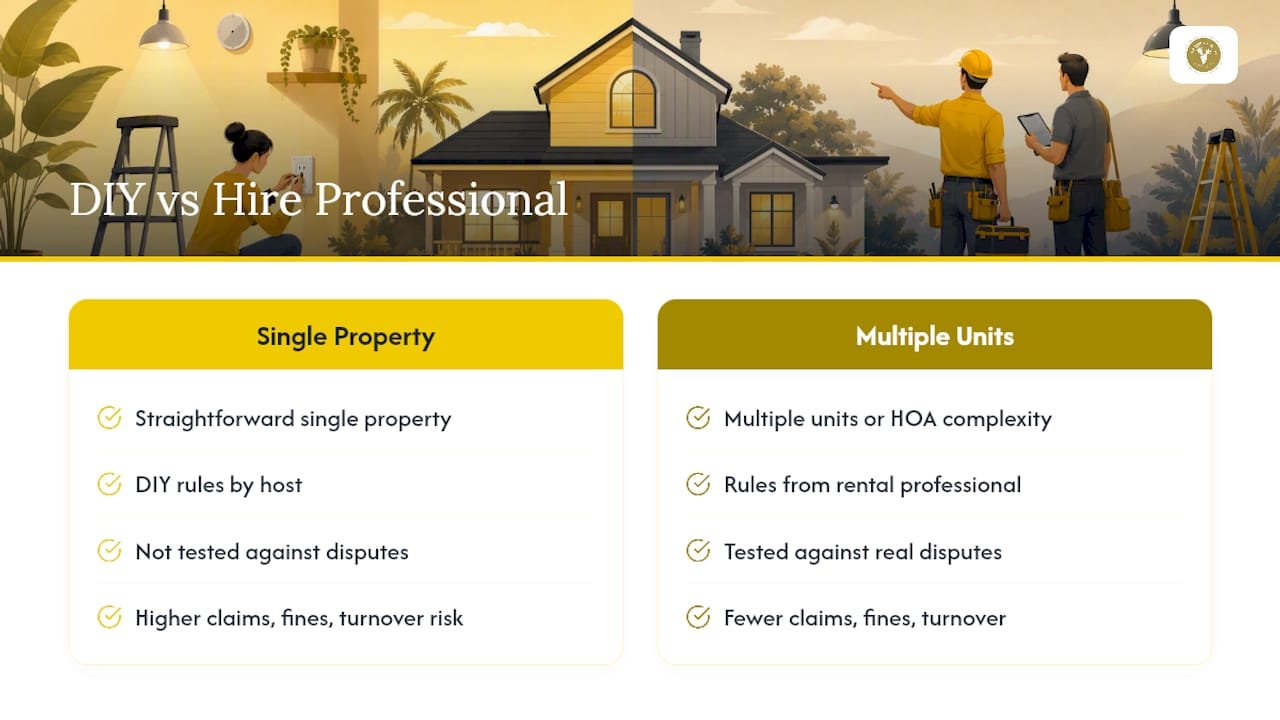
Writing your own rules works fine for a single, straightforward property. But once you’re managing multiple units, navigating a Sedona HOA, or trying to figure out whether a property’s rule history is dragging down its market value, that’s when it makes sense to bring in a professional who works in short-term rentals daily. There’s a real difference between a rule that sounds reasonable and one that’s been tested against actual disputes.
Hosts serious about long-term performance, not just avoiding this month’s complaint, should look at how rule clarity ties into maximizing ROI on an investment property before assuming a generic template is good enough.
Get Local, Compliance-Ready Guidance from Experienced Agents
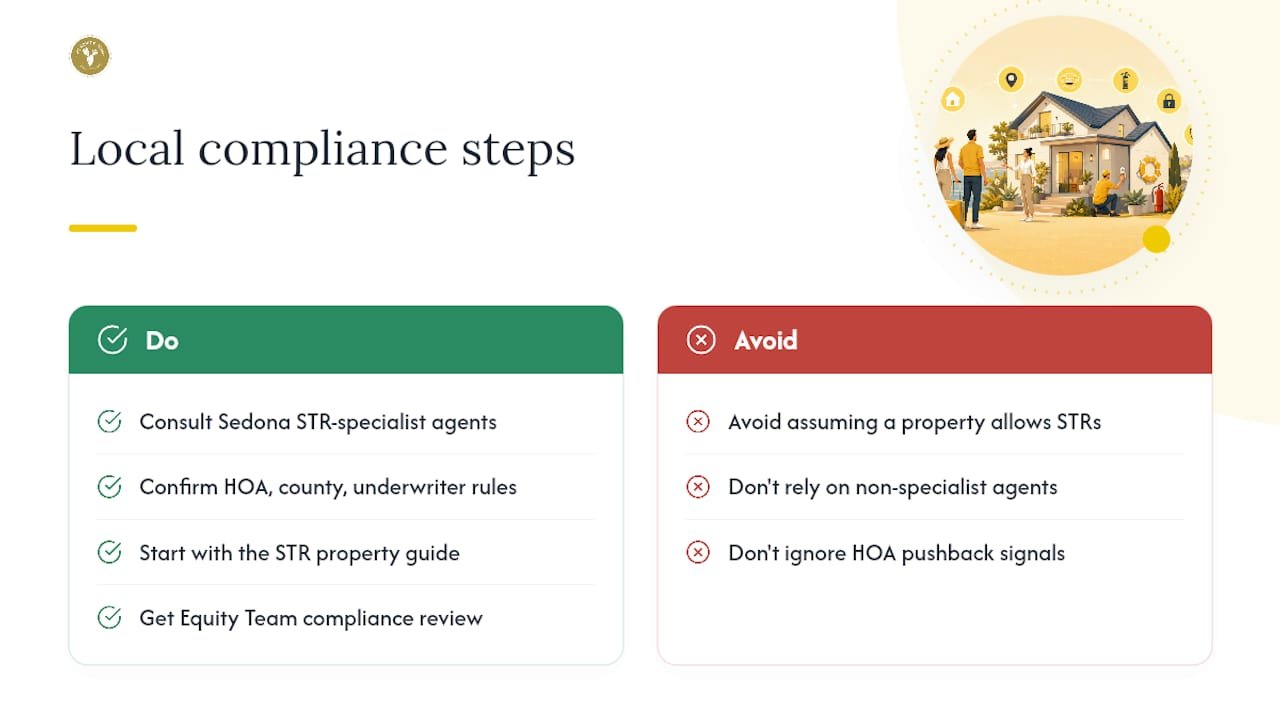
The last 10% is knowing what Sedona’s HOAs, county ordinances, and lending underwriters actually expect from a compliant short-term rental, and that’s where Equity Team fits in.

Some agents specialize in short-term rental buyers and sellers in Sedona and the Verde Valley, tracking local ordinance changes for a living rather than handling STRs as a side interest. If your rules keep triggering HOA pushback, or you’re not sure whether a property you’re eyeing even allows short-term rentals, it’s important to get answers before you buy or relist.
Hosts weighing whether to keep DIY-ing their compliance work or bring in someone who already knows the Sedona rulebook should start with how to find the right short-term rental investment property in the area. It walks through exactly what Equity Team checks before recommending a property, and it’s the fastest way to see whether your current setup, or your next purchase, is actually built for the top tier of this market.
Sources
Cross-check your rules against Airbnb’s own hosting resources and safety guidelines, plus local ordinance pages like Austin’s STR rules and a trusted property maintenance guide for upkeep-related clauses.
- Setting helpful house rules – Resource Center – Airbnb
- Ground rules for guests – Resource Center – Airbnb
- Ground rules for home hosts – Airbnb Help