

What is gross rental yield, and why does it matter?
Gross rental yield is the annual rental income a property generates expressed as a percentage of its total purchase cost, before any expenses are deducted. Think of it as the first number you check when sizing up a property, the one that tells you whether a deal is worth a second look or a polite pass. It does not tell the whole story, but it tells enough of it to save you from wasting time on the wrong properties.
As a quick screening tool, gross rental yield gives investors a fast, apples-to-apples way to compare properties across different markets and price points. A cabin in Sedona, a condo in Phoenix, a duplex in Flagstaff: the formula works the same way for all of them.
Here is what gross rental yield captures at a glance:
- Annual rental income before taxes or operating costs
- Total property cost including the purchase price, closing costs, origination fees, and any post-acquisition renovations
- The result expressed as a percentage, making comparisons easy and intuitive
- A pre-expense figure, meaning it does not reflect what you actually pocket at the end of the year
How to calculate gross rental yield
The formula is refreshingly simple. No spreadsheet wizardry required.
Gross Rental Yield (%) = (Total Annual Rental Income ÷ Total Property Cost) × 100

Getting the inputs right is where most investors slip up. Annual rental income is the total rent collected over twelve months, before taxes, vacancies, or any deductions. Total property cost is not just the purchase price. Excluding origination fees, closing costs, and planned renovations from the cost basis produces a misleadingly favorable yield number.
What belongs in each input:
- Annual rental income: gross monthly rent multiplied by 12, using realistic occupancy assumptions
- Total property cost: purchase price + closing costs + origination fees + any capital improvements made after purchase
Common mistakes that inflate the number:
- Using only the purchase price and ignoring closing costs
- Forgetting renovation budgets that were part of the acquisition plan
- Annualizing a single high-season month instead of a realistic annual average
Pro Tip: For new construction or development projects, the total project cost must include land acquisition, permits, approvals, and holding costs, not just the construction contract price. Using only the build cost inflates yield and sets unrealistic expectations from day one.
Gross yield vs net yield: what is the real difference?
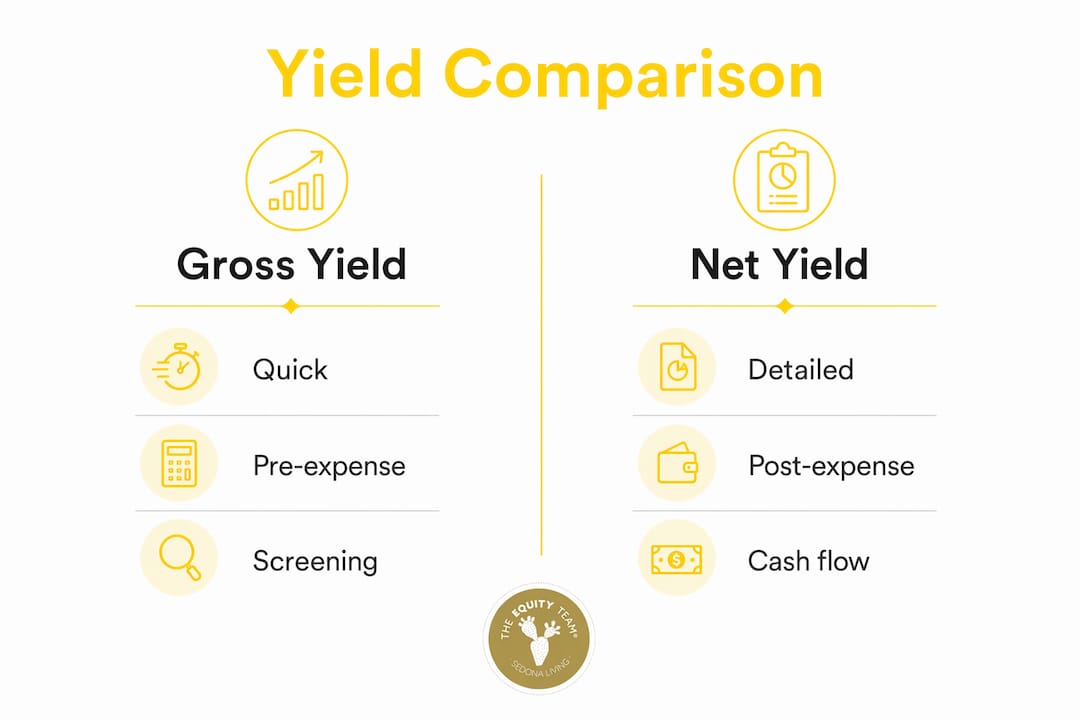
Gross yield is the headline number. Net rental yield is the honest one. Net yield deducts expenses like property management fees, maintenance, insurance, property taxes, and vacancy costs from the annual income before dividing by property cost. The result is a much clearer picture of what an investment actually earns.
Expenses that net yield accounts for but gross yield ignores:
- Property management fees (typically 20–30% of revenue for short-term rentals)
- Routine maintenance and repairs
- Insurance premiums
- Property taxes
- Vacancy periods and platform fees for short-term rentals
So why bother with gross yield at all? Because it is fast. When you are scanning twenty listings in a weekend, you do not have full expense data for every property. Gross yield lets you filter out the obvious duds quickly, so you can spend your energy running a proper net yield analysis on the three or four properties that actually look promising.
Yields around 5% are common in the U.S. market, with 7% or higher generally viewed as attractive depending on the market and property type. A word of caution: a suspiciously high gross yield sometimes signals a higher-risk property with elevated maintenance costs or management headaches, which can quietly eat the net yield down to something far less exciting.
A step-by-step example using real numbers
Walking through a concrete example makes the formula click. Here is a hypothetical investment property in a vacation market like Sedona.

An example property has a purchase price, closing costs, origination fees, and post-acquisition renovations that together make the total property cost. Monthly rental income is calculated realistically over the year to find annual rental income. Dividing annual rental income by total property cost and converting to a percentage yields the gross rental yield.
A gross yield of 9.57% on a short-term rental in a high-demand market looks attractive. But that number still does not account for platform fees, cleaning costs, property management, insurance, or the occasional plumbing surprise. Those costs can reduce the net yield considerably, which is exactly why this example is a starting point, not a finish line.
The gross rental yield formula gives you a percentage to benchmark against other properties and market averages. Once a property clears that initial screen, the deeper analysis begins.
How to use gross rental yield wisely in real investment decisions
Gross rental yield is a great opening act, but a poor headliner. The investors who get into trouble are the ones who stop at the gross number and skip the net yield and cash flow analysis that actually determines whether a property makes money.
Here is how to use it well:
- Use it as a filter, not a verdict. Run gross yield on every property you consider. Eliminate the low performers quickly and focus your deeper analysis on the top candidates.
- Always include all acquisition costs. A property with a $600,000 purchase price and $40,000 in closing costs and renovations has a $640,000 cost basis. Using $600,000 inflates your yield by a meaningful margin.
- Pair it with net yield. Once a property passes the gross yield screen, build out a full expense model. The gap between gross and net yield tells you how cost-heavy the property is to operate.
- Watch out for high-yield traps. High gross yields can reflect higher-risk properties with greater maintenance and management costs. A 12% gross yield on a property that needs constant repairs may net out lower than a 7% yield on a well-maintained one.
- Do not annualize peak-season income. Short-term rental investors sometimes make the mistake of multiplying their best month by twelve. Use a realistic annual average based on actual occupancy data for the market.
Pro Tip: For multi-unit properties like duplexes or triplexes, aggregate all unit rents before annualizing. Calculating yield on a single unit and extrapolating gives you an inaccurate picture of the whole property’s performance.
At Equity Team, working exclusively with short-term rental investors in Sedona and Northern Arizona, the team sees this play out constantly. Investors who understand the difference between gross and net yield, and who include every dollar of acquisition cost in their denominator, make far better decisions than those chasing headline numbers. A well-chosen STR investment in a high-demand market like Sedona can deliver strong yields, but only when the math is done honestly from the start. Pairing gross yield with a solid rental income projection is one of the most reliable ways to stress-test a deal before committing.
Thinking about putting these numbers to work in Sedona? Equity Team specializes in short-term rental investments and represents buyers in the top 10% of the market.

Find the right STR investment with Equity Team and get the numbers right from day one.
Key Takeaways
Gross rental yield is a pre-expense percentage that screens properties quickly, but net yield and cash flow analysis are required before any purchase decision.
| Point | Details |
|---|---|
| The formula | Gross Rental Yield (%) = (Total Annual Rental Income ÷ Total Property Cost) × 100 |
| Include all costs | Total property cost must include purchase price, closing costs, fees, and renovations, not just the purchase price. |
| U.S. yield benchmarks | Yields around 5% are common in the U.S.; 7% or higher is generally viewed as attractive depending on market and property type. |
| Gross vs net yield | Net yield deducts operating expenses and gives a more accurate profitability picture than gross yield alone. |
| Multi-unit properties | Sum all unit rents before annualizing to get an accurate gross yield for the whole property. |