

Short-term rentals are no longer barred across the Village of Oak Creek, at least not by the homeowners association that tried to ban them. An Arizona appeals court found VOCA’s short-term rental amendment unenforceable against certain owners, but Arizona statutes and Yavapai County still set the rules of the road. Before listing anything, verify your property’s governing documents, register where the county requires it, and put together house rules and an emergency contact plan. VOCA is building a registration framework of its own, but the county’s requirements stand no matter what the HOA decides.
TL;DR:
- Owners who purchased their property before the 2016-2017 amendments may have strong legal protection against VOCA’s short-term rental restrictions, depending on the foreseeability of such rules in 1981 documents.
- State law and Yavapai County require registration, compliance with habitability standards, and adherence to nuisance and safety regulations, regardless of HOA restrictions.
- Sub-associations may have enforceable rental restrictions if their original declarations or amendments were written differently than VOCA’s, making it essential to verify specific deed and record histories.
- Yavapai County limits HOA demands to basic tenant information and vehicle descriptions, with no authority to impose additional fines or requirements beyond state-mandated registration and safety standards.
- Prospective landlords should conduct thorough title, declaration, and amendment searches, and consult legal professionals if CC&R language is ambiguous or enforcement history is unclear.
Table of Contents
- The court ruling that reshuffled the rules for Village of Oak Creek
- What Arizona law and Yavapai County require of STR hosts now
- Which CC&Rs govern your lot: VOCA or a sub-association?
- Your compliance checklist for an Oak Creek Airbnb
- Due diligence before you buy or list
- What the Equity Team sees in the numbers
- Where this heads next for Village of Oak Creek
- How the Equity Team helps you navigate Oak Creek short-term rental rules
- Sources
- FAQ
The court ruling that reshuffled the rules for Village of Oak Creek
The original VOCA declarations date back to 1981, long before anyone was renting spare rooms through an app. In 2016 and 2017, the association amended its CC&Rs to restrict short-term rentals, but at least one owner had purchased their property years before that amendment existed. That timing turned out to matter enormously.
The Arizona Court of Appeals applied a legal test from an earlier case called Kalway, which asks whether a CC&R amendment was reasonably foreseeable from the community’s original governing documents. If the 1981 declarations gave no hint that rentals might later be restricted, a homeowner who bought under those original terms has a strong argument that the later amendment simply does not apply to them.
A few things worth knowing about the scope of this ruling:
- It protects owners who purchased before the restrictive amendment took effect, not necessarily everyone in the Village.
- Future buyers who purchase with the amendment already on record may face a different legal analysis entirely.
- The decision does not erase Arizona’s landlord-tenant, tax, or zoning requirements.
The Kalway foreseeability test now shapes how courts evaluate STR amendments statewide, meaning this case has ripple effects well beyond one HOA’s parking lot.
What Arizona law and Yavapai County require of STR hosts now
State law and county rules did not go anywhere just because VOCA’s ban stumbled. Two Arizona statutes frame what local authorities and HOAs can and cannot do, and Yavapai County has its own habitability rules that apply regardless of what any homeowners association decides.
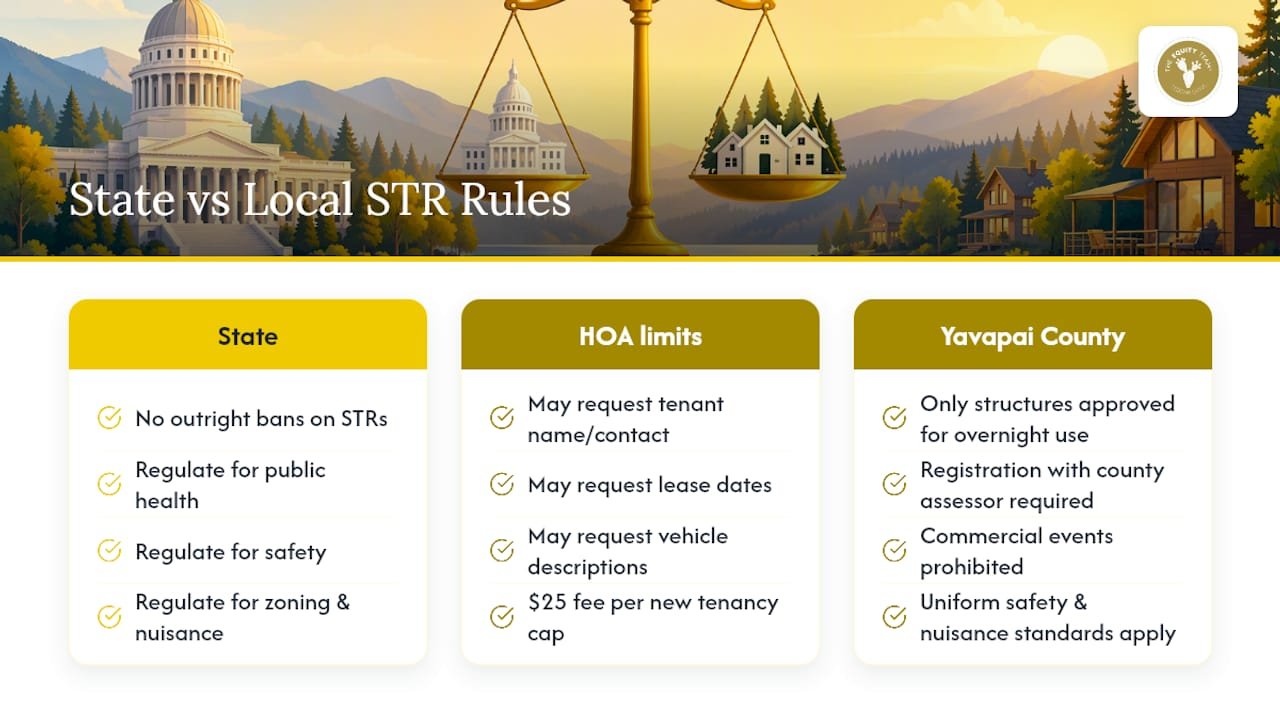
Senate Bill 1350 prevents cities and counties from banning short-term rentals purely because of their use, but it still allows regulation tied to public health, safety, uniform zoning, and nuisance behavior. In other words, the state blocked outright bans, not reasonable rules.
A.R.S. §33-1806.01 limits what an HOA can demand from a rental owner: name and contact information for the tenant, lease dates, and vehicle descriptions, capped at a $25 fee per new tenancy. Associations cannot pile extra requirements or fines onto rental properties that owner-occupied homes do not face.
Yavapai County’s planning guidance adds its own layer: rentals are only permitted in structures approved for overnight occupancy, registration with the county assessor is required, and commercial events are off the table entirely.
Owners must respect uniform safety and nuisance standards even where an outright ban is no longer legal.
Call the county planning unit directly with questions, and keep every registration document you receive back. For insights into financial support and accommodation policies similar to those impacting rental frameworks, check out the Agevolazioni per affittacamere e appartamenti per ferie – Finanzia.
Which CC&Rs govern your lot: VOCA or a sub-association?
Here’s where things get delightfully tangled, in a very Village of Oak Creek sort of way. VOCA is the parent association, but plenty of parcels sit under sub-associations with their own separate declarations, and those sub-associations were not necessarily part of this lawsuit.
- Pull your deed and check whether it references VOCA alone, a named sub-association, or both.
- Compare the dates: when was your sub-association’s original declaration recorded, and was it ever amended to add rental restrictions?
- Request the amendment history and board meeting minutes tied to any rental-related changes.
- Confirm in writing, from the association itself, whether it considers its own restrictions enforceable post-ruling.
Communities like Sedona Golf Resort, Firecliff, Pinon Woods, Canyon Mesa, and Las Piedras may retain enforceable restrictions of their own even though VOCA’s amendment failed, simply because their original declarations were written or amended differently.
Pro Tip: Order a title company printout of your recorded declarations and amendments, then call your HOA’s management company directly. A phone call gets you a straight answer faster than guessing from an old homeowner packet.
Your compliance checklist for an Oak Creek Airbnb
None of this is optional just because the HOA angle got murkier. Yavapai County’s rules apply whether your sub-association is toothless or fully armed.
- Register with the county assessor and keep confirmation records along with a current emergency contact on file.
- Handle tax registration, including transaction privilege tax and any online lodging marketplace obligations tied to your listing platform.
- Confirm habitability, meaning your structure is permitted for overnight occupancy, smoke and carbon monoxide detectors are working, and guests have clear fire-escape information.
- Write guest-facing house rules covering noise, parking, trash pickup, and check-in windows, plus a simple protocol for neighbor complaints.
- Keep records of your purchase date, any amendment history tied to your lot, guest logs, and communications with your HOA.
Yavapai County’s own guidance is blunt about the basics: structures not permitted for overnight occupancy do not qualify as short-term rentals, full stop, and sheds, RVs, and garages are specifically called out as ineligible. That single sentence probably rules out more listings than any HOA vote ever could.
Due diligence before you buy or list
Whether you already own a home in the Village or you are eyeing one, the paperwork chase looks the same.
- Order a complete title report and request every recorded declaration and amendment tied to the parcel.
- Ask the HOA or its management company for amendment voting records and written confirmation of current enforcement status.
- Contact Yavapai County Planning to confirm habitable-use status and walk through registration steps.
- Bring in a real estate attorney when CC&R language is ambiguous or when litigation risk feels real rather than theoretical.
What the Equity Team sees in the numbers
Village of Oak Creek’s median STR revenue sits around $12,700, though underwriting off aggregator averages alone tends to flatten out the difference between a well-run property and a neglected one. AirDNA-style tools are a useful starting point, never the whole picture.
Templates the Equity Team builds with clients typically include:
- House rules addressing noise curfews, parking limits, and maximum occupancy.
- A registration packet with emergency contact information ready for county or HOA requests.
- A simple neighbor-complaint response script that keeps disputes from escalating into HOA hearings.
Where this heads next for Village of Oak Creek
Expect VOCA’s board to lean toward a registration framework rather than another outright ban attempt, since the courts have made bans a losing bet twice now. Enforcement capacity will matter more than the rules themselves. A board with no real mechanism to check registrations will struggle to enforce anything beyond a strongly worded letter.
For investors, this likely means more supply entering the market as nervous owners feel freer to list, balanced against sub-associations that still hold real teeth. For neighbors, it means the operational headaches, parking, noise, turnover, do not disappear just because the legal fog cleared. Enter cautiously, and keep checking your own governing documents rather than assuming the Village-wide headline applies to your specific lot.
— Chad
How the Equity Team helps you navigate Oak Creek short-term rental rules

Sorting out which CC&Rs bind your parcel, what the county actually requires, and whether a property will perform once the paperwork clears is exactly the kind of tangled puzzle we deal with daily. The team focuses specifically on short-term rental transactions in Sedona and the Village of Oak Creek, which means it is familiar with which sub-associations enforce their own rules and which addresses come with a clean history.
- Buyer representation that includes a regulatory checklist before writing an offer.
- A vacation rental CMA that grounds your numbers in real comparable performance, not aggregator guesswork.
- Seller prep consultation and exit strategy conversations for owners considering selling.
A consultation gets you a document review, a regulatory rundown specific to your parcel, and a revenue underwriting pass before you commit to anything. Request a vacation rental CMA and get a clear picture before you buy, sell, or relist.
Sources
- SENATE BILL 1350
- Yavapai County planning FAQ (Planning unit permits guide)
- Breaking: VOCA’s Short-Term Rental Ban Deemed Unenforceable
- Laying Down The Law – Court Of Appeals Issues Ruling Further Protecting Short-term Rentals – Arizona School of Real Estate and Business
This article is general information, not a substitute for advice from a qualified lawyer. Consult a qualified legal professional about your own circumstances before acting on anything here.
FAQ
Can I stop my neighbor from running an Airbnb?
It depends entirely on which governing documents apply to their specific parcel and whether any restriction was reasonably foreseeable when they bought. If their sub-association has its own enforceable CC&Rs, a formal complaint through that association is the proper channel rather than a direct dispute.
What is the 80/20 rule for Airbnb?
This is not a term found in Arizona statute or Yavapai County guidance, and definitions vary depending on who is using it. Rather than chase an undefined rule, focus on the actual requirements: county registration, habitability standards, and whatever your specific HOA declaration states.
What are the legal restrictions on Airbnb rentals in Arizona?
Arizona’s SB 1350 prevents outright bans based solely on rental use but allows regulation for public health, safety, and nuisance concerns. On top of that, A.R.S. §33-1806.01 limits what HOAs can charge or demand from rental owners, and county-level rules like Yavapai’s still control habitability and registration.
What are the new laws in California regarding Airbnb in 2026?
California is not covered under Arizona’s statutory framework, and this article focuses specifically on Village of Oak Creek and Yavapai County rules. Readers looking into California’s short-term rental laws should consult that state’s own government sources directly.