

If you want to sell a Sedona vacation rental and walk away with the best possible number, the single smartest move is hiring an STR-specialist listing agent to run an income-focused comparative market analysis (CMA) and start packaging your short-term rental financials right now. Not next month. Now. Why? Because selling a short-term rental is really selling a business as much as a property. Buyers who pay a premium want documented income, active reservations, and a turnkey operation they can step into on day one.
Here is what that means in practice for you:
- Hire an STR-specialist Sedona listing agent before doing anything else.
- Ask for an income-focused CMA that pulls both MLS comps and STR revenue comps.
- Start assembling your trailing 12-month profit and loss statement, reservation calendar, and permit documentation.
- Decide early whether to sell furnished or unfurnished (more on that below).
- Contact Equity Team to book a CMA and seller prep consultation.
Listing without STR documentation is like selling a restaurant without showing the books. Buyers discount heavily for uncertainty, and you leave real money on the table.
Key Takeaways
Selling a Sedona vacation rental for top dollar requires treating it as an income business: documented financials, a clean operational handoff, and an STR-specialist agent who prices on earnings, not just comps.
| Point | Details |
|---|---|
| Hire an STR-specialist agent first | An income-focused CMA from a specialist captures the full value of your rental earnings, not just MLS comps. |
| Document your income thoroughly | A trailing 12-month P&L, payout statements, and reservation calendar are what investor buyers pay a premium for. |
| Verify permits and HOA status early | Unresolved STR permit or HOA issues create buyer discounts; clean compliance supports full asking price. |
| Manage the platform handoff proactively | Add the buyer as an Airbnb co-host 30–45 days before closing; VRBO requires a new listing from the buyer. |
| Equity Team runs the full process | Equity Team provides STR income CMAs, investor marketing, and booking-transfer coordination for Sedona sellers. |
Table of Contents
- How to sell a Sedona vacation rental: the step-by-step process
- How do you value a Sedona vacation rental accurately?
- What Sedona zoning and HOA rules do to your sale price
- What documents buyers expect when purchasing a vacation rental
- What does it actually cost to sell, and what will you net?
- How to market your Sedona vacation rental to the right buyers
- Why hire an STR-specialist Sedona agent and how to vet one
- How to keep bookings running while your property is listed
- What the current Sedona STR market tells sellers right now
- What sellers often get wrong about the Sedona STR market
- Equity Team gets Sedona STR sellers to the closing table
- Sources
How to sell a Sedona vacation rental: the step-by-step process
Selling a Sedona vacation rental has more moving parts than a standard home sale, but the sequence is predictable once you know it. Here is the order that keeps things from going sideways.
- Hire an STR-specialist agent (Week 1). This is not optional. A generalist agent will price your property on square footage and comps alone. An STR specialist prices it on income, which is where the real value lives.
- Run an income-focused CMA (Weeks 1–2). Pull MLS comps from ARMLS and Zillow alongside STR revenue comps from AirDNA. The CMA should show trailing revenue, ADR, occupancy, and RevPAR for comparable properties.
- Assemble your document package (Weeks 2–3). P&L, bank payout statements, reservation calendar, permits, and HOA docs. More on the full list in the documents section below.
- Address maintenance and staging (Weeks 2–4). Fix deferred maintenance, deep clean, and decide on furnishings. A well-staged, turnkey property photographs better and commands a higher price.
- Set your asking price and list (Week 4–5). Price for your target buyer type: income-based for investors, comp-based for owner-occupiers.
- Manage bookings during escrow (Weeks 5–8+). Keep the calendar active but build in a blackout window near closing. See the operations section for the co-host handoff timeline.
- Negotiate offers and address financing (Weeks 6–10). Investor buyers often use DSCR loans or cash; owner-occupiers may use conventional financing. Each type has different contingency timelines.
- Close and transfer bookings and payouts (Week 10–14). Prorate prepaid stays on the settlement statement, transfer co-host access, and hand over the operating playbook.
Typical total timeline: 10–14 weeks from first agent meeting to closing, though well-documented properties with active bookings tend to move faster.
Before the CMA: have your last 12 months of payout statements and a rough occupancy summary ready.
Before listing: finalize your document package and complete any agreed repairs.
Before closing: confirm co-host access is set up and proration is written into the contract.

Pro Tip: Selling furnished almost always expands your buyer pool and supports a higher asking price. Investors love turnkey. If you strip the furnishings, you are essentially asking the buyer to fund a startup. Keep the beds, the kitchen gear, and the quirky Sedona art on the walls.
How do you value a Sedona vacation rental accurately?
Valuing a Sedona vacation rental is a two-track exercise. Track one is the traditional real estate CMA using ARMLS and Zillow to find comparable sold properties by size, location, and condition. Track two is the STR income analysis, which is where most of the price premium lives.
The key metrics buyers and their agents will scrutinize:
- Trailing 12-month gross revenue (what the property actually earned, not projected)
- Average Daily Rate (ADR) and how it compares to the Sedona market average
- Occupancy rate and seasonal patterns
- RevPAR (revenue per available rental night, which combines ADR and occupancy)
- Channel mix (Airbnb percentage, VRBO percentage, direct bookings)
- Operating net operating income (NOI) after platform fees, management, utilities, and supplies
A simple worked example: a Sedona property earning $72,000 gross annually with $28,000 in operating expenses produces $44,000 NOI. The MLS comp might say $680,000. The income approach wins when the documentation is clean.
AirDNA’s Sedona market data is the standard starting point for STR revenue comps, but city-level averages can mislead. Address-level comps filtered by bedrooms, amenity tier, and neighborhood are the industry standard for valuation accuracy. Ask your agent to build a custom comp set, not just pull the city average.
| Valuation Input | Source | Why It Matters |
|---|---|---|
| MLS sold comps | ARMLS / Zillow | Establishes real estate baseline |
| STR revenue comps | AirDNA (address-level) | Shows income premium over baseline |
| Trailing 12-month P&L | Owner records / payout statements | Proves actual earnings to buyers |
| Occupancy trend | AirDNA / platform dashboards | Signals demand trajectory |
| Cap rate / GRM | Agent calculation | Converts income to price for investors |
Sedona STR market snapshot: AirDNA data for June 2026 shows 4,351 active Sedona STR listings, average annual revenue of $47.4K per active listing, 54% average occupancy, a $370 ADR, and a RevPAR of $199. Year-over-year, revenue dipped slightly, occupancy decreased somewhat, and ADR showed a small increase. Properties that outperform market averages command a meaningful premium when the numbers are documented.
What Sedona zoning and HOA rules do to your sale price
Sedona’s STR regulatory environment is genuinely quirky, and not always in the fun way. Permit status, HOA covenants, and transient occupancy tax (TOT) registration all affect what a buyer is willing to pay and how quickly a deal closes.
Key documents and checks that commonly affect Sedona STR sales:
- City/county STR permit: Sedona requires a short-term rental permit. Verify it is current and transferable. An expired or missing permit is a red flag that triggers buyer price discounts or deal-killing contingencies.
- Transient occupancy tax (TOT) registration: Confirm your TOT account is in good standing with the City of Sedona and the Arizona Department of Revenue. Buyers will want to see clean compliance history.
- HOA covenants: Some Sedona HOAs restrict or outright prohibit short-term rentals. Arizona state law limits HOA authority to ban STRs in many cases, but the legal landscape has shifted. A buyer’s lender may also flag HOA restrictions.
- Recent restriction changes: Local analysis shows that active STR inventory in Sedona has declined meaningfully, partly due to regulatory pressure. That supply contraction can actually benefit sellers whose permits are clean and current.
How permit problems affect price: a property with a pending enforcement action or an unresolved HOA dispute typically sees buyers apply a discount to account for the legal risk. Some buyers walk entirely. Resolving these issues before listing is almost always worth the effort.
Pro Tip: Pull your city planning records, county assessor data, and HOA documents before the first agent meeting. If anything looks murky, a local real estate attorney who knows Sedona STR rules is worth an hour of their time. Your agent should know one.
This article provides general information only. Confirm current permit requirements, TOT rules, and HOA restrictions with the City of Sedona, Yavapai County, and a qualified local attorney before relying on them for any transaction.
What documents buyers expect when purchasing a vacation rental
Think of your document package as the prospectus for a small business acquisition. A clean, well-labeled package speeds buyer due diligence and supports higher offers. A messy one invites lowball bids and extended contingency periods.
Essential documents to assemble:
- Trailing 12-month P&L (suggested filename:
STR_PL_2025_2026.xlsx) showing gross revenue, platform fees, management fees, utilities, supplies, and net income - Bank deposit / payout statements from Airbnb, VRBO, and any direct booking channels, covering the same 12-month period
- Reservation calendar showing booked, blocked, and available nights (export from your platform dashboard)
- Channel and property management agreements (Airbnb, VRBO, any third-party manager)
- Occupancy records by month and season
- Maintenance logs and receipts for the last 2–3 years
- Property inspection report (ideally recent, within 12 months)
- STR permit and TOT registration documents
- HOA governing documents and any STR-specific rules or correspondence
- Guest policies (house rules, check-in instructions) redacted of any personal guest data
On privacy: strip guest names, email addresses, and phone numbers from any reservation exports before sharing. You can prove revenue with payout statements alone; you do not need to expose guest personal information to do it.
A short-term rental income property checklist can help you organize this package systematically before your first agent meeting.
What does it actually cost to sell, and what will you net?
Sellers often focus on the list price and forget to work backward to the net. Here is a realistic cost breakdown and a simple worked example.
Typical selling costs to budget:
- Agent commission: typically 5–6% of sale price (split between listing and buyer’s agent)
- Title and escrow fees: roughly 1–2% of sale price
- Prorated TOT prepayments: any TOT collected but not yet remitted gets settled at closing
- Repairs negotiated after inspection: variable, often 1–2% of sale price on older properties
- Capital gains tax: consult a CPA. If the property has appreciated significantly and was not your primary residence, federal capital gains rates and Arizona state tax apply. This is a planning conversation, not a closing-day surprise.
Simple worked example:
Capital gains tax is not included above. Speak with a CPA before closing.
Pricing strategy by buyer type: investor buyers respond to income-based pricing (cap rate, gross rent multiplier). Owner-occupiers respond to MLS comps and lifestyle value. If your property can serve both audiences, price it on income and stage it for lifestyle. You attract more offers that way.
Negotiation levers buyers use and how to respond:
- “The revenue is declining year-over-year” → Counter with ADR growth and seasonal occupancy data showing strong peak periods.
- “The furnishings are dated” → Offer a furnishing credit rather than reducing the price; it costs less and keeps the headline number intact.
- “I need a longer inspection period” → Agree, but tie it to a non-refundable earnest money increase after day 10.
- “I want the bookings included” → Price the booking transfer as a value-add, not a concession. Active reservations reduce the buyer’s ramp-up risk.
How to market your Sedona vacation rental to the right buyers
Marketing a Sedona vacation rental to investors is a completely different exercise than marketing a primary home. Investors scan numbers first and photos second. Owner-occupiers do the opposite.
For investor buyers, lead with the income story:
- One-page investment snapshot PDF: trailing revenue, ADR, occupancy, RevPAR, NOI, and a comp set summary
- Trailing revenue chart showing 12–24 months of monthly income
- Cap rate and gross rent multiplier calculations
- Video walkthrough that shows the property’s condition and amenity quality alongside the income data
- Professional listing photography that captures the views and the guest experience, not just the floor plan
For owner-occupier buyers, lead with the lifestyle:
- Staged photos emphasizing the Sedona setting (those red rocks do a lot of heavy lifting)
- Neighborhood and lifestyle context, including proximity to trails, restaurants, and galleries
- School and neighborhood quality resources like GreatSchools ratings if the buyer has a family
Show buyers your channel distribution.
Pro Tip: Create a one-page “investment snapshot” PDF before listing. Put trailing revenue, ADR, occupancy, NOI, and the comp set on a single page. Investors will share it with their partners and lenders. It becomes your best marketing asset and it costs nothing to produce.
For more on how to present your property’s income story to buyers, video walkthroughs and expert analyses show exactly how local agents frame these presentations.
Why hire an STR-specialist Sedona agent and how to vet one
A generalist agent can list your property. An STR specialist can sell it for what it is actually worth. The difference is not subtle.
An STR-specialist agent brings:
- An income-focused CMA that combines ARMLS/MLS comps with AirDNA STR revenue comps
- Knowledge of Sedona’s STR permit landscape, TOT requirements, and HOA nuances
- A network of investor buyers who are actively looking for performing Sedona STRs
- A documented process for handling booking transfers, payout proration, and platform co-host handoffs
- Marketing materials tailored to income-producing properties, not just lifestyle buyers
Interview questions worth asking any agent before signing:
- Can you show me examples of recent Sedona STR sales you’ve represented?
- How do you build your STR income CMA, and which data sources do you use?
- How do you handle the Airbnb co-host handoff and VRBO new-listing process at closing?
- Do you have an investor buyer network, and how do you market to them specifically?
- What is your process for prorating prepaid bookings on the settlement statement?
Trust signals to look for: documented STR CMAs with AirDNA comps, a local track record of closed STR transactions, explicit written processes for booking and payout transfers, and a recognized agent designation that reflects STR investment specialization.
Equity Team is the first STR-specialized agent group in Northern Arizona. A Sedona vacation rental CMA from a specialist is the fastest way to know what your property is actually worth.
How to keep bookings running while your property is listed
Here is the part most sellers get wrong: they either cancel all their bookings the moment they list, which tanks their revenue and signals desperation to buyers, or they ignore the handoff entirely and create a closing-day disaster.
The smart path:
- Keep the calendar active during listing. Active bookings are a selling point, not a problem.
- Set a blackout window of 30–45 days before your target closing date. Stop accepting new reservations for that window so the buyer has a clean runway.
- Add the buyer as a full-access co-host on Airbnb 30–45 days before closing. At closing, transfer primary host designation. This is the recommended method for preserving bookings without canceling existing reservations.
- VRBO works differently. The platform does not support listing transfers between accounts. The buyer creates a new listing, and any existing VRBO reservations need to be honored by the seller or transferred by mutual agreement with guests.
- Prorate prepaid stays on the settlement statement. Any guest who paid for a stay that falls after closing should be accounted for as a credit to the buyer.
- Do not share passwords. Use platform-supported co-host features only. Sharing login credentials violates platform terms and creates liability.
For a deeper look at STR management best practices during a transition period, a structured operational handoff guide can help you avoid the most common platform pitfalls.
Pro Tip: Consider temporarily raising your minimum stay to 3–4 nights during the listing period. It reduces the number of check-ins and check-outs during showings, keeps the property cleaner for tours, and filters for guests who are less likely to leave last-minute reviews about construction noise or “for sale” signs.

What the current Sedona STR market tells sellers right now
Sedona’s STR market is performing in a way that rewards well-documented, high-performing properties and punishes average ones. AirDNA’s June 2026 data shows 4,351 active listings with average annual revenue of $47.4K, 54% occupancy, a $370 ADR, and a $199 RevPAR.
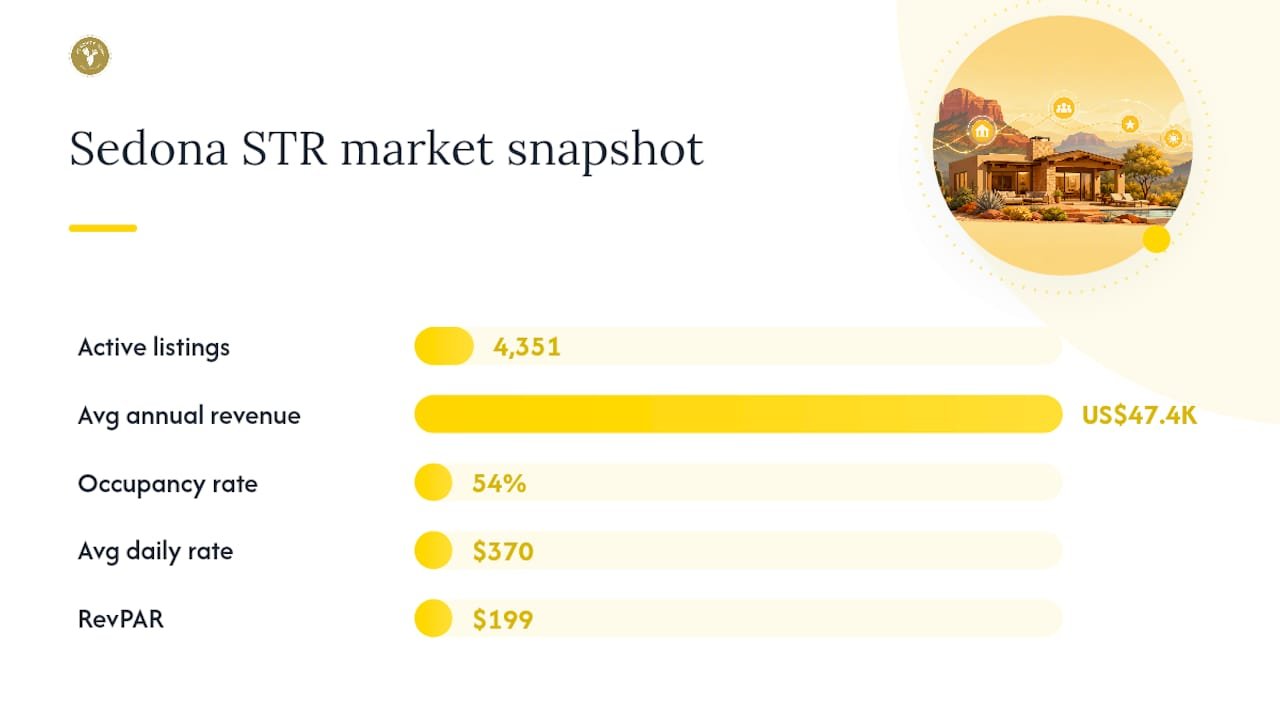
What this means for sellers: the market is bifurcating. Properties that can demonstrate above-average ADR and occupancy are pulling away from the pack. Properties sitting at or below the city average face more buyer skepticism and price pressure.
Local analysis of Sedona’s STR supply contraction provides useful context on why inventory has declined and what it means for buyer demand.
- City-level averages are a starting point, not a valuation. Neighborhood-level and address-level comps are where accuracy lives.
- Seasonal occupancy patterns in Sedona are pronounced. Spring and fall peak periods should be highlighted in your marketing.
- Sedona STR occupancy data by neighborhood shows meaningful variation across the market.
Pro Tip: Ask your listing agent to pull an address-level AirDNA comp set filtered by your property’s bedroom count, amenity tier, and neighborhood. The city average of $47.4K annual revenue may be well below or above what your specific property can justify. Know your number before you set your price.
What sellers often get wrong about the Sedona STR market
Most sellers treat their Sedona vacation rental like a house with a bonus income stream. That framing costs them money.
The buyers who pay the most for Sedona STRs are investors. They are not buying a home with a view. They are buying a cash-flowing asset, and they underwrite it like one. They want a cap rate, a trailing P&L, a comp set, and a clean operational handoff.
The second mistake sellers make is waiting too long to address the platform handoff. Airbnb’s co-host transfer process and VRBO’s new-listing requirement are not closing-day logistics. They are 30–45 day processes that need to start well before the closing date. An agent who has never sold an STR will not know this, and the deal will either blow up or the seller will end up canceling reservations and refunding guests, which is both expensive and damaging to the listing’s review history.
The third mistake is pricing on MLS comps alone. A Sedona property earning $80,000 a year in gross revenue is not the same asset as an identical-looking property earning $45,000. The income approach and the comp approach should both inform the price, and the income approach should win when the documentation is strong.
Sedona is a genuinely special market. The red rocks, the vortexes, the quirky art galleries, the hikers who show up at 5 AM with headlamps — all of it creates demand that does not exist in most markets. Sellers who understand that demand and package their property’s income story correctly will find buyers who are happy to pay for it.
Equity Team gets Sedona STR sellers to the closing table
Sedona vacation rental sellers who want top dollar need more than a lockbox and an MLS listing. Equity Team is Northern Arizona’s first STR-specialized real estate group, and every seller service is built around income documentation, investor marketing, and a clean operational handoff.

Here is what working with Equity Team looks like:
- STR income CMA combining ARMLS/MLS comps and AirDNA address-level revenue comps
- Investor buyer network actively seeking performing Sedona STRs
- Booking transfer process covering Airbnb co-host handoff and VRBO new-listing coordination
- Investment snapshot marketing targeting income-focused buyers with trailing revenue, ADR, occupancy, and NOI
- Closing and proration handling so prepaid bookings and payout transfers are written into the contract correctly
- Seller prep consultation to identify documentation gaps before listing
Ready to find out what your Sedona vacation rental is actually worth? Request a Sedona vacation rental CMA from Equity Team and get a clear, income-focused valuation before you list.
Sources
These are the data sources and references worth bookmarking before your first agent meeting.
Ask your agent to run address-level AirDNA reports rather than relying on city-wide averages. The difference between a neighborhood-specific comp set and the Sedona city average can be tens of thousands of dollars in either direction.