

Sedona short-term rental owners have five realistic exit paths: sell outright, defer taxes through a 1031 exchange or a Qualified Opportunity Zone fund, structure an installment sale, pull equity with a cash-out or DSCR refinance, or convert to a long-term rental using the city’s Rent Local incentive. The right choice hinges on one question: do you need cash now, tax deferral, or ongoing income? Start by running the cash-flow and equity tests below, then book a valuation and CPA consult before you commit to anything.
TL;DR:
- A traditional sale offers quick cash but involves paying commissions and capital gains taxes, especially if the property is occupied by short-term renters.
- Tax deferral options like 1031 exchanges or Opportunity Zone funds require strict deadlines and long-term commitments, with the latter potentially eliminating taxes after 10 years.
- Refinance strategies, such as cash-out or DSCR loans, provide liquidity without triggering taxable events but increase monthly debt obligations.
- Converting to a long-term rental may qualify for incentives but results in lower monthly income and involves regulatory considerations.
- Running detailed financial tests and consulting local experts significantly reduces execution risk and ensures the chosen exit aligns with your goals.
Table of Contents
- Sedona Rental Exit Strategies at a Glance
- What Should Sedona Sellers Expect From a Traditional Sale?
- How Do 1031 Exchanges and Opportunity Zone Funds Defer Taxes?
- Are Installment Sales a Smart Exit for Sedona Owners?
- Should You Refinance Instead of Selling?
- How Does the Sedona Rent Local Program Work?
- When Should You Sell, Hold, or Convert?
- What’s the Practical Timeline for Executing an Exit?
- How Local Expertise Reduces Execution Risk
- What I’d Tell a Friend Before They Sell
- How Equity Team Helps You Execute the Right Exit
- Sources
- FAQ
Sedona Rental Exit Strategies at a Glance
Red Rock views sell homes, but they don’t guarantee a smooth exit. Each strategy below trades speed for tax savings in a slightly different way, and Sedona’s tourism cycles make timing matter more than in most markets.
- Traditional sale: Fastest path to cash, but you lose the property and pay commission plus capital gains. Typical timeline: within a few months once listed.
- 1031 exchange: Defers all capital gains tax if you reinvest in like-kind property. Downside: strict 45 and 180 day deadlines. Timeline: matches your sale closing plus 180 days.
- Qualified Opportunity Zone fund: Defers gains and can eliminate tax on new appreciation after 10 years. Downside: illiquid, long hold. Timeline: invest within 180 days of sale, then a decade-long commitment.
- Installment sale: Spreads capital gains across multiple tax years and can command a price premium from buyers who need financing flexibility. Downside: you carry buyer credit risk. Timeline: negotiated over multiple years.
- Cash-out or DSCR refinance: Pulls equity without selling or triggering a taxable event. Downside: new monthly debt service. Timeline: about a month or so to close.
- Convert to long-term rental: Sidesteps short-term rental regulatory risk and may qualify for Sedona’s Rent Local incentive. Downside: rent drops well below STR revenue. Timeline: 1 to 2 months to re-lease.
Most Sedona owners land on one of these because they’re either chasing liquidity, chasing tax efficiency, or trying to outrun a regulatory shift. Run the numbers on your specific property before picking a lane. The next sections walk through each option’s mechanics.
What Should Sedona Sellers Expect From a Traditional Sale?
A straight sale remains the simplest exit, and Sedona’s buyer pool rewards it well when a property has a clean rental history. Budget for commission around 5 to 6% plus standard closing costs, and expect a 30 to 90 day timeline from listing to close, depending on season and price point.
Occupied short-term rentals complicate the buyer pool. Owner-occupants often want a vacant, move-in-ready home, while investor buyers care more about trailing 12-month revenue than staging. Cash-for-keys, a negotiated payment to a tenant or booking guest to vacate early, can bridge that gap if you’re targeting owner-occupant buyers during peak listing season.
Before listing, work through this sequence:
- Order a pre-listing inspection and handle deferred maintenance now, not during buyer negotiations.
- Compile 12 to 24 months of STR revenue statements to support investor pricing.
- Time your final bookings to clear the calendar 2 to 3 weeks before your target listing date.
- Stage for the buyer type you’re marketing to, not both at once.
Pro Tip: List STR-friendly homes for investor buyers in late winter, when Sedona’s shoulder season revenue data looks strongest on paper and investors are shopping for next season’s inventory.
How Do 1031 Exchanges and Opportunity Zone Funds Defer Taxes?
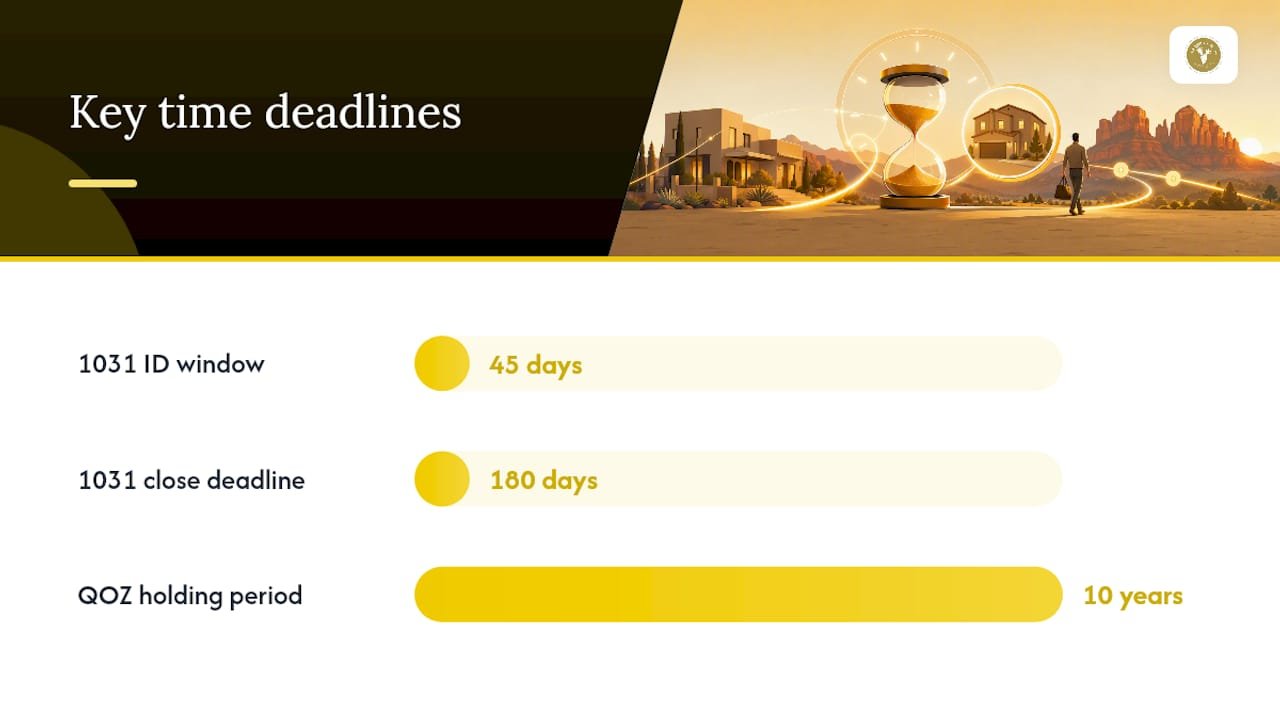
A 1031 exchange lets you defer all capital gains tax by rolling sale proceeds into another like-kind investment property, and the deadlines are unforgiving. You have 45 days to identify a replacement property and 180 days total to close, and every dollar of proceeds must pass through a qualified intermediary. Touch the money yourself, even briefly, and the exchange is disqualified.
Qualified Opportunity Zone funds work differently. You must invest your gain within 180 days of the sale, and holding the QOZ investment for 10 years can eliminate tax on the fund’s appreciation entirely. It’s a longer commitment than a 1031, with less flexibility, but the payoff can be larger for owners willing to lock up capital.
- Line up your qualified intermediary before you sign a sale contract, not after.
- Verify current legislative deadlines with your CPA. Opportunity Zone rules have shifted before and can shift again.
- Missing the 45-day identification window is the single most common way owners blow a 1031, according to iBuyer’s guide to selling rental property.
Are Installment Sales a Smart Exit for Sedona Owners?
An installment sale lets you spread capital gains recognition across the years you actually receive payments, instead of taking the full tax hit in one filing season. That can keep you out of a higher tax bracket and smooth your income over time.
The tradeoff is buyer risk. You’re essentially financing the sale yourself, collecting principal and interest on a negotiated schedule, usually 3 to 10 years. Contract terms typically specify an interest rate, a down payment, and remedies if the buyer defaults.
- Installment sales tend to work best when Sedona’s buyer pool is credit-constrained but demand is high, letting you command a price premium for offering financing.
- Interest income is taxed as ordinary income each year, separate from the capital gains portion.
- Vet buyers thoroughly. A defaulted installment sale means reclaiming a property you thought you’d already exited.
Should You Refinance Instead of Selling?
A cash-out or DSCR refinance pulls equity out of your property without triggering a sale, and because refinance proceeds are loan funds rather than income, there’s no taxable event to report. DSCR loans qualify you based on the property’s rental income rather than your personal income, which suits STR owners whose tax returns show heavy depreciation write-offs.
The case for refinancing over selling comes down to what you keep. The case against it: you take on new debt service, and if your STR income softens, that fixed payment doesn’t soften with it.
- Run a refinance analysis when you want liquidity but still believe in Sedona’s long-term appreciation story.
- Compare the new monthly payment against your trailing 12-month net operating income before signing anything.
- DSCR refinances typically close in 30 to 45 days, faster than most traditional sales.
Pro Tip: Owners who want to keep a property but need capital for a second Sedona purchase almost always come out ahead recycling equity through a DSCR refinance rather than selling and repurchasing, once you factor in commission and closing costs twice.
How Does the Sedona Rent Local Program Work?
The City of Sedona has run a Rent Local program offering cash incentives, reportedly up to around $10,000 in pilot phases, to owners who convert short-term rentals into long-term leases for local workers. Program terms and funding availability change, so confirm current eligibility and incentive amounts directly with the City of Sedona before applying.
Converting isn’t just a paperwork switch. Here’s the realistic sequence:
- Contact the city to confirm current Rent Local eligibility, incentive amount, and application deadlines.
- Draft a standard long-term lease and decide whether the unit stays furnished or gets de-furnished for a wider tenant pool.
- Market to the local workforce rather than tourists. Expect a meaningfully lower monthly rent than STR revenue, since Sedona’s STR income carries a real premium over long-term rents.
- Update your insurance policy and any HOA disclosures to reflect the change in occupancy type.
- If you’re accommodating a tenant with a disability, review your obligations under federal accessibility guidance as part of your lease terms.
Conversion tends to make sense when regulatory risk is rising faster than you’re comfortable with, or when you’d rather trade some income for predictability and lower turnover. For a fuller look at why STR premiums exist in Sedona in the first place, OwnInAZ’s investment overview breaks down the local demand drivers.
When Should You Sell, Hold, or Convert?
Run four quick tests before you decide anything, because gut feeling is a poor substitute for arithmetic when Sedona’s STR premiums can mask a property that’s quietly underperforming.
The four financial triggers: Negative cash flow for three or more consecutive months. Gross annual rent below 1% of current market value. Total expenses exceeding 50% of gross rental income. A property price above 100 times monthly rent.
These benchmarks come from a broader rental property sell/hold framework built for investors nationwide, and they translate cleanly to Sedona:
- Three months of negative cash flow usually means your STR is fighting rising costs or softening bookings. That favors a sale or a refinance to lower debt service, not patience.
- Gross rent under 1% of value signals Sedona’s appreciation has outpaced its income, which is common near red rock view lots. That favors selling and redeploying into a 1031 exchange rather than holding for yield.
- Expenses above 50% of income often points to an aging property eating cash in maintenance. That favors a sale, since a refinance just adds debt on top of rising costs.
- Price above 100x monthly rent is a valuation red flag telling you the STR premium, not the fundamentals, is carrying your equity. That favors locking in gains through a sale or installment sale while the premium holds.
None of these triggers point to one universal answer, and that’s the point. A property clearing all four tests cleanly is a strong hold. A property failing two or three is a candidate for a decisive exit rather than a slow bleed.
Once a test flags a problem, the sequence should run: analyze the numbers, plan the tax strategy with a CPA, then engage the Sedona market with a specialist like Equity Team who tracks STR performance data block by block. Skipping the middle step is how owners end up with a great sale price and a terrible tax bill.
What’s the Practical Timeline for Executing an Exit?
Whichever path you choose, the paperwork and deadlines are unforgiving if you wait until the last minute. Here’s the sequence that avoids the most common procedural mistakes.
- Now: Pull your depreciation schedule from your tax preparer. This number drives your real capital gains exposure and changes the math on every option above, since depreciation recapture can shrink net proceeds even outside a 1031 or QOZ.
- Now: Confirm your mortgage balance, any liens, and prepayment penalties with your lender.
- Before listing or applying for Rent Local: Schedule a CPA consult to model sale, 1031, QOZ, and conversion scenarios side by side. For Sedona-specific tax mechanics, OwnInAZ’s breakdown of sale tax implications is a useful starting point.
- If pursuing a 1031: Engage and fund a qualified intermediary before signing a sale contract. Do not accept sale proceeds directly.
- If pursuing an installment sale: Draft contract terms with your attorney covering default remedies and interest treatment before marketing the property.
- If converting: Give existing booking guests final notice, confirm the last reservation date, and submit your Rent Local application with the city.
- Two to four weeks before listing or conversion: Complete repairs, staging, or de-furnishing depending on your chosen exit.
- At closing or lease signing: File the correct paperwork. Installment sales require ongoing annual reporting, not a one-time form, so flag this with your CPA for future tax seasons.
How Local Expertise Reduces Execution Risk
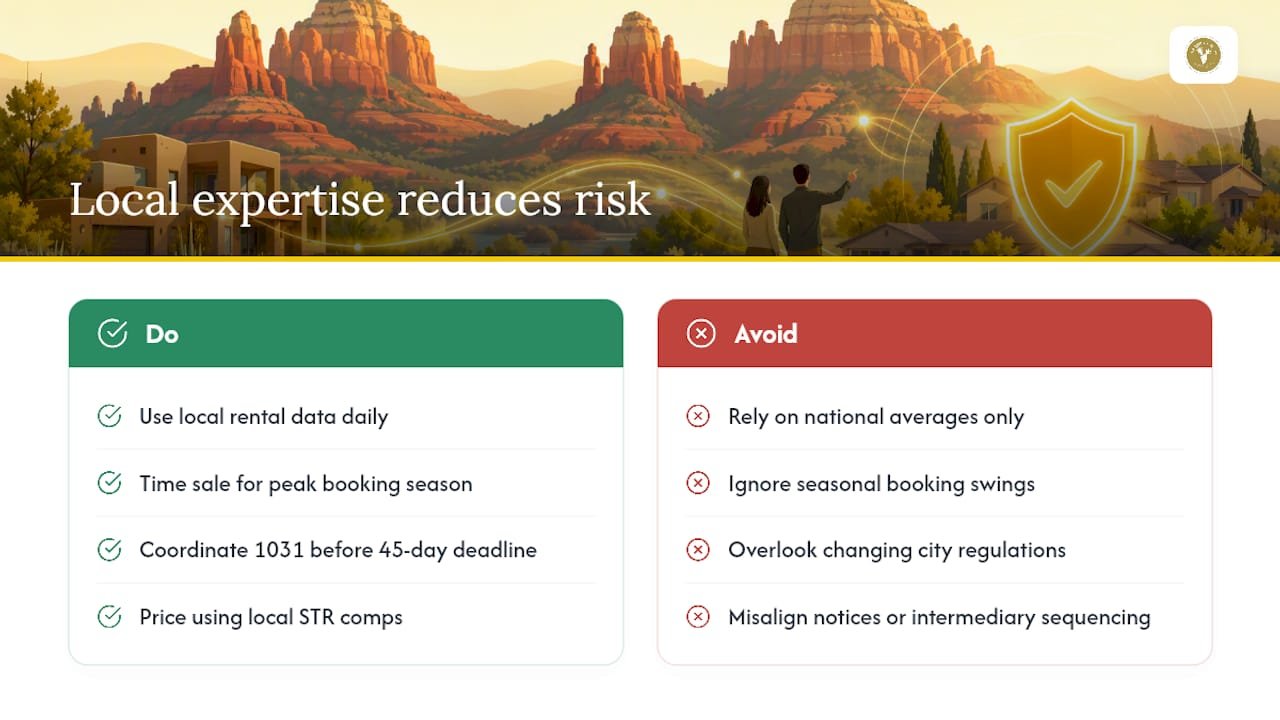
Sedona’s short-term rental math doesn’t behave like the national averages in most exit-strategy guides. View premiums, seasonal booking swings, and shifting city regulation all move the numbers in ways a generic calculator misses. That’s the gap a local specialist team in Northern Arizona was built to close, focusing specifically on short-term rental investment.
Executing any of the strategies above, whether it’s timing a sale around peak booking season, coordinating a 1031 replacement purchase before the 45-day clock runs out, or pricing a conversion against real STR comps, benefits from someone who tracks Sedona’s rental performance data daily. OwnInAZ’s video walkthroughs and property analyses show how granular that local data gets, down to individual listing performance by neighborhood.
A specialist also catches the operational details that sink otherwise sound plans: aligning tenant or guest notices with your closing date, sequencing a qualified intermediary correctly, and pricing a property that’s occupied by short-term guests without scaring off owner-occupant buyers.
What I’d Tell a Friend Before They Sell
The biggest mistake I see Sedona owners make isn’t picking the wrong exit strategy. It’s picking one before running the numbers, chasing a 1031 because a neighbor did one, or converting to long-term rental out of regulatory panic without checking whether Rent Local’s incentive actually offsets the rent gap.
Slow down and let the cash-flow and valuation tests do the deciding by following a practical seller checklist and listing preparation guide. A property that’s failing two or three of those benchmarks doesn’t care which exit strategy sounds most sophisticated. It needs a decision.
The engagements that go well start with a straight conversation about what the owner actually wants: cash now, tax deferral, or steady income, in that order of priority. Everything else follows from that answer.
— Chad
How Equity Team Helps You Execute the Right Exit
Once you know which lane fits, the harder part is execution, and that’s where a specialist agent beats a generic listing service. This agent team focuses specifically on Sedona’s short-term rental market, from pricing occupied STRs correctly to coordinating 1031 timelines with your qualified intermediary and CPA.

They help owners get valuations that reflect actual trailing revenue, not just comparable square footage, match sellers with the right buyer pool (investor or owner-occupant), and walk through conversion math against current Rent Local terms before anyone signs anything. If you’re weighing a sale, a refinance, or a conversion and want numbers specific to your property rather than a national average, start with a strategy and valuation conversation and get a clear read on which path actually pencils out.
Sources
Consult a CPA and these official resources before acting: IRS guidance and tax forms, federal accessibility guidance for conversions, and the City of Sedona’s official Rent Local program page for current incentive terms and eligibility.
- Ibuyer
- 6 exit strategies for rental real estate investors | TheRealEstateCPA
- Refinance vs Selling Rental Property: Best Exit Strategy | Lendmire
FAQ
What Is the Secret 7 in Sedona?
The “Secret 7” refers to a set of lesser-known vortex and viewpoint sites locals point to when tourist spots get crowded. It’s a folklore term, not an official city designation, and it has no bearing on rental regulations or exit strategy.
Why Is Yellow Signage Banned in Sedona?
Sedona’s sign code restricts bright colors, including certain yellows, to preserve the muted red rock aesthetic the city is known for. The rule falls under the same design ordinances that shape short-term rental exterior standards owners should check before listing or renovating.
Which Celebrity Lives in Sedona?
Sedona has drawn various celebrity homeowners over the years, though specific current residents aren’t publicly confirmed by city records. The area’s privacy and red rock views are a big part of the draw, and that same appeal drives the STR premium discussed throughout this guide.
Is Sedona Republican or Democrat?
Sedona sits in a politically mixed region of Arizona, with Coconino and Yavapai counties historically split. Local STR and short-term rental policy debates tend to cut across party lines, driven more by housing availability concerns than partisan politics.
What’s the Fastest Way to Exit a Sedona Short-Term Rental?
A traditional sale is typically the fastest exit, closing in 30 to 90 days, while a DSCR refinance can free up cash in 30 to 45 days without giving up the property. Working with a Sedona specialist like Equity Team speeds up pricing and buyer matching regardless of which path you choose.