
Sedona treats parking violations as a fast track to permit trouble, and the fix comes down to three things: post your off-street parking limits in writing, make sure guests never block driveways, neighbors, or public streets, and keep an emergency contact reachable enough to fix a problem before it becomes a complaint. Skip any one of those, and you’re gambling with a permit that took real paperwork to earn.
TL;DR:
- Posting parking limits that match your off-street capacity is mandatory, and vague rules are the leading cause of disputes and enforcement issues.
- Clear signage and photos of designated parking areas, with specific vehicle limits and prohibited blocking of driveways or streets, are essential for compliance.
- Responding promptly—within an hour for safety issues and 24 hours for general problems—is critical to prevent violations from escalating into permit suspension or fines.
- Special situations like RVs, trailers, or ADUs may alter parking rules, and homeowners must verify restrictions before listing or during permit renewals.
- Maintaining thorough, dated documentation of parking rules and compliance history helps defend your permit during city investigations or when selling property.
Table of Contents
- What Do Sedona’s Airbnb Parking Rules Actually Require?
- What Should Your Posted House Rules Say About Parking?
- How Does Sedona Enforce Parking Complaints Against Airbnb Hosts?
- How Do ADUs, RVs, and Street Parking Change the Rules?
- A Pre-Listing Checklist That Prevents Most Parking Complaints
- What Do You Do When a Parking Complaint Comes In?
- Insights on Parking and Property Value
- Let The Equity Team Handle the Parking Question Before You Buy or List
- Where to Verify Sedona’s Parking Rules Yourself
- Sources
- FAQ
What Do Sedona’s Airbnb Parking Rules Actually Require?
Sedona’s short term rental rules live in Sedona City Code Chapter 5.25, and if you operate a rental here, this is the chapter that governs your parking obligations, not some generic Airbnb policy pulled from a national blog post. The city built this code specifically because red rock views and narrow residential streets do not mix well with five cars parked bumper to bumper outside a rented house.
The core requirement is refreshingly direct: every short term rental must post house rules that spell out parking limits, and those limits have to reflect actual off-street capacity, not wishful thinking. SCC §5.25.050 folds parking into a broader compliance bucket alongside public safety, traffic control, and nuisance abatement. In plain English, the city doesn’t just care whether you posted a rule. It cares whether that rule actually kept a minivan off your neighbor’s lawn.
Here’s what the code and its companion sections expect from hosts operating in Sedona:
- Maintain an active short term rental permit and a Transaction Privilege Tax (TPT) license, both of which require annual renewal through the city’s online system.
- Post house rules inside the unit that state maximum occupancy, vehicle limits, quiet hours, trash procedures, and emergency contact information.
- Reference the city’s residential quiet hours, generally 9 p.m. to 7 a.m., since noise and late-arriving cars tend to travel together.
- Comply with general traffic control and public-right-of-way laws, meaning guests can’t treat a cul-de-sac like a private lot.
- Respond to nuisance and safety issues quickly enough that a single bad night doesn’t turn into a formal complaint.
That overlap between STR-specific rules and general traffic code is where a lot of hosts get tripped up. Sedona doesn’t need a special parking ordinance written just for vacation rentals to cite you. If your guest’s truck blocks a fire hydrant or juts into the street, that’s a traffic violation first and an STR compliance problem second, and the second one is the one that can cost you your permit.
There’s also a distinction worth understanding: some of this is explicit and non-negotiable (the permit, the TPT license, the posted rules), while other pieces are discretionary in how you execute them. The code says you must limit parking to what your property can safely hold off-street. It does not tell you exactly how to word that sign or where to hang it. That gap is where good hosts separate themselves from the ones who get a knock on the door from code enforcement.
Arizona’s own state statute limits how far cities can go in capping the number of STRs outright, which is part of why Sedona leans so heavily on nuisance and parking enforcement instead of blunt numeric restrictions. If the city can’t simply say “no more rentals on this street,” it says “no more blocked driveways on this street” instead. Parking becomes the practical lever, even when it isn’t the stated target.
What Should Your Posted House Rules Say About Parking?
Vague house rules are the single most common reason parking disputes escalate. “Please park considerately” means nothing to a guest who just drove five hours and wants to unload the car as close to the door as possible. Specificity is your defense, both against confused guests and against a city investigator asking whether you met your obligations.
Your posted rules and digital guidebook should include:
- The exact number of vehicles allowed, tied to your actual off-street capacity, not an aspirational number.
- A description of where parking is permitted, using landmarks a stranger would recognize (the gravel pad left of the garage, not “the usual spot”).
- A direct prohibition on blocking driveways, mailboxes, or any part of a public street, stated plainly rather than implied.
- A reference to quiet hours, since cars idling or doors slamming at midnight generate the same neighbor complaints as loud music.
- Emergency contact information with a stated response window, so guests and neighbors both know help is close by if something goes sideways.
CityRuleLookup’s compiled guidance suggests hosts commit to something like a one-hour response for genuine safety issues and a 24-hour window for everything else. Put that number in writing. A promise to “respond promptly” is meaningless to a code enforcement officer reviewing your file after a complaint.
Words on a page only work if guests actually read them, so back up your text with visuals. A labeled photo of the driveway, a simple floorplan showing the designated parking pad, or even a screenshot with an arrow pointing to “park here, not there” does more good than a paragraph of prose buried in your welcome book.
Pro Tip: Take a timestamped, street-level photo of your designated parking area and keep a dated copy in your files. If a complaint ever triggers a code review, that single photo proves you defined and communicated the parking area, which puts the burden back on whether the guest ignored it.
Save every version of your posted rules, including old ones you’ve updated. Permit renewal sometimes asks hosts to show evidence of compliance history, and a folder of dated house-rule screenshots is a lot more convincing than a verbal assurance that you’ve always been careful about this.
How Does Sedona Enforce Parking Complaints Against Airbnb Hosts?
Not every unhappy neighbor triggers a city investigation. A one-time overflow of guest cars during a birthday weekend is a nuisance in the everyday sense; it’s not automatically a nuisance in the legal sense the code cares about. The line gets crossed when the pattern repeats, when a vehicle blocks emergency access, or when a complaint ties directly back to a specific STR that already has a permit on file.
Enforcement generally follows this path:
- A neighbor or passerby files a complaint with the city, often through the same portal used for STR permit questions.
- Code enforcement staff review the complaint against the property’s posted rules and permit status.
- The host typically receives notice and a cure period to correct the issue before formal penalties apply.
- Repeated or unresolved violations can escalate to fines, and in more serious or repeat cases, permit suspension or revocation.
The math that should worry you: a rental permit that took months to secure can be suspended over a pattern of parking complaints that a $15 sign and a clear house rule would have prevented. That’s not a hypothetical. Recent tightening of Sedona’s STR regulations shows the city is actively using enforcement tools, including nuisance and parking violations, to manage the impact of vacation rentals on residential neighborhoods.
Speed matters more than most hosts assume. A single complaint handled within the hour, with the guest’s car moved and an apology sent to the neighbor, tends to disappear from memory fast. A complaint that sits unanswered for two days becomes the neighbor’s third call to the city that month, and by then you’re not dealing with a parking issue anymore. You’re dealing with a reputation problem in the file the city keeps on your address.
How Do ADUs, RVs, and Street Parking Change the Rules?
Special situations account for a disproportionate share of the parking complaints Sedona hosts run into, mostly because owners assume the standard rules don’t apply or don’t realize a rule changed recently.
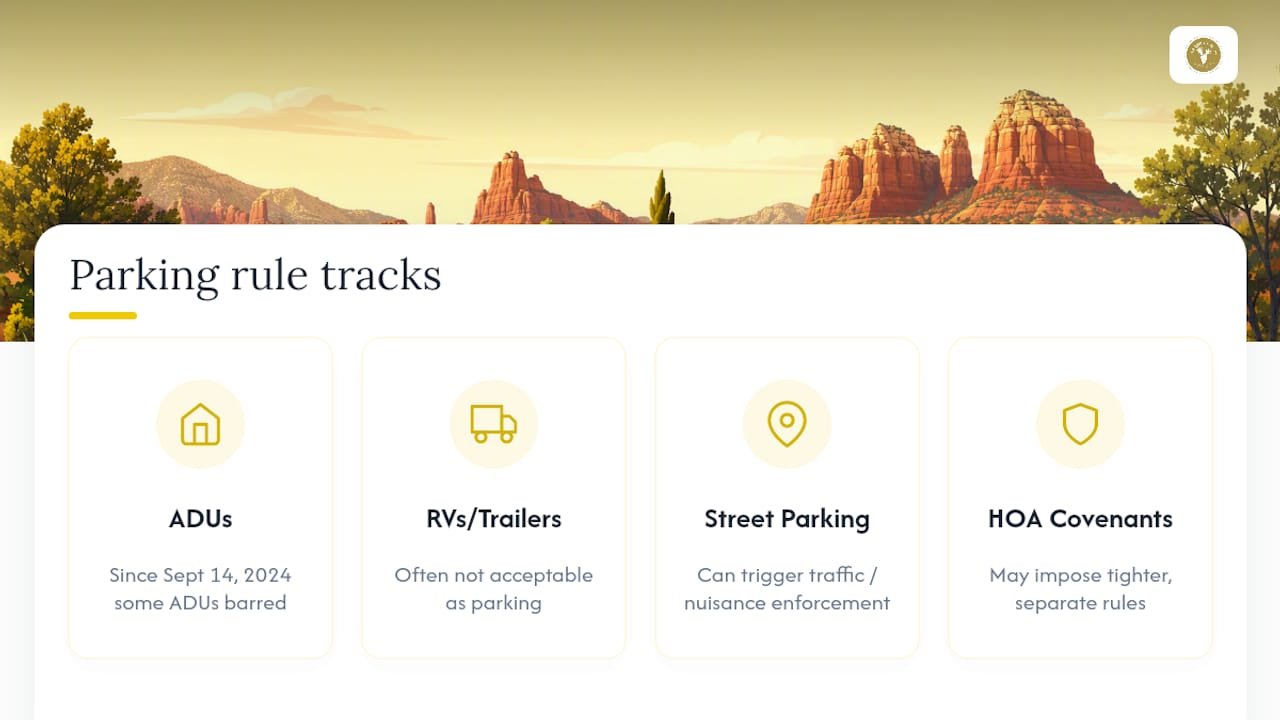
Accessory dwelling units. Since September 14, 2024, Sedona’s code has restricted the use of certain ADUs as short term rentals, which matters directly for parking because ADUs often share a driveway with the main house and have little to no dedicated space of their own. Before assuming a guest house or casita is fair game for a rental listing, confirm whether that specific structure still qualifies. If you’re evaluating a property with an ADU already in the mix, this is worth checking before you factor its rental income into your budget, not after closing.
RVs and travel trailers. Sedona doesn’t generally treat a parked RV the same way it treats a car, and in many cases a guest’s trailer or motorhome simply isn’t an acceptable substitute for standard off-street parking. If your listing regularly attracts road-trippers towing trailers, spell out explicitly whether that’s allowed and where it can go, because a trailer blocking half a residential street draws complaints fast.
Street parking. Public streets are not an extension of your driveway just because nobody’s using that stretch of curb right now. Guest vehicles parked on the street, especially ones that partially block a neighbor’s driveway or narrow the road for other traffic, are exactly what triggers the traffic and nuisance provisions layered onto STR enforcement.
HOA covenants. A homeowners association can impose parking restrictions tighter than the city’s, and HOA enforcement runs on a completely separate track from code enforcement. Understanding how city rules interact with your HOA’s covenants before you list, rather than after a fine shows up, saves a lot of frustration.
A Pre-Listing Checklist That Prevents Most Parking Complaints
Most parking disputes trace back to something that could have been fixed before the first guest ever checked in. Run through this before you list, and again before every arrival that involves a new group of guests:
- Count your actual off-street spaces, not the number you’d like to have, and measure them so you know what genuinely fits.
- Mark the parking area physically with a painted line, a small sign, or cones if the boundary isn’t obvious to someone seeing the property for the first time.
- Photograph the space from a guest’s arrival angle, then use that exact photo in your listing and in your digital check-in instructions.
- State the vehicle limit in your listing description, not just buried in the house rules guests read after they’ve already parked.
- Arrange an off-site or paid overflow option if your property regularly attracts groups with more cars than your driveway can hold.
Pro Tip: If your property is a magnet for larger groups, ranging from weddings to reunions, negotiate a standing arrangement with a nearby paid lot before the busy season hits, and put that alternative address directly in your check-in messaging. A guest who knows where to send extra cars never becomes a complaint statistic.
Clear arrival copy does more heavy lifting than most hosts expect. A simple line like “park only in the gravel pad to the left of the garage, maximum two vehicles, do not use the street” removes almost all the ambiguity that leads guests to improvise.
What Do You Do When a Parking Complaint Comes In?
The window between a neighbor’s first complaint and a guest quietly moving their car is usually short, and how you use it determines whether this becomes a one-time annoyance or a mark against your permit.
- Contact the guest immediately and ask them to move the vehicle, offering the designated alternative spot or overflow location if the primary spot is already full.
- Reach out to the complaining neighbor if you have contact information, acknowledging the issue and confirming you’re addressing it right now, not “soon.”
- Document everything with timestamps, including photos of the vehicle’s original position, your messages to the guest, and the resolution time.
- Escalate only if necessary. If a guest refuses to cooperate or the vehicle is blocking emergency access, involve code enforcement or local law enforcement, and expect them to ask for the same documentation you should already have on hand.
That timestamped log is not busywork. If the city ever opens a review of your permit, a clear record showing you resolved a complaint within your stated window is the strongest evidence you have that you’re operating in good faith.
Insights on Parking and Property Value
Parking capacity isn’t a footnote when you’re buying or selling a Sedona short term rental. It’s one of the first things we check, because a property with generous, well-defined off-street parking almost always generates fewer complaints and holds its permit with less drama than one where guests are left guessing.
We’ve seen the pattern play out enough times to trust it: a driveway that comfortably fits three vehicles without spillover onto the street tends to run quieter, both literally and in terms of neighbor relations, than a property where two cars already feels tight. That’s not a minor detail buried in an inspection report. It affects occupancy limits, guest experience, and how confidently you can market the listing.
When we walk a property for a buyer, parking gets evaluated the same way square footage or view corridors do, because it directly shapes what that property can earn as a rental. If you’re weighing whether a listing’s driveway situation is a dealbreaker or a minor fix, a Sedona vacation rental CMA puts real numbers behind that judgment call instead of leaving you to guess.
— Chad
Let The Equity Team Handle the Parking Question Before You Buy or List
Figuring out whether a property’s parking setup will pass Sedona’s scrutiny, or hold up under a full season of guest turnover, is exactly the kind of detail that’s easy to miss from a set of listing photos. This practice specializes in Sedona short term rentals, so parking capacity, permit history, and nuisance risk get checked before you’re emotionally attached to a property, not after you’ve already closed.

If you’re selling, the same logic runs in reverse. A rental with clearly defined, well-documented parking is an easier sale, and a Sedona Home CMA will show you exactly how that feature stacks up against comparable properties currently on the market. If you’re buying, our team walks every property with STR compliance in mind, which means parking gets evaluated alongside cash flow projections, not treated as an afterthought once the inspection period is already ticking.
Ready to see what a compliant, well-positioned Sedona rental actually looks like on paper? Start the conversation with The Equity Team and get a straight answer about whether a property’s parking, permit status, and layout will actually work for the kind of rental income you’re expecting.
Where to Verify Sedona’s Parking Rules Yourself
Everything above traces back to primary sources you can check directly. Sedona City Code Chapter 5.25 is the full ordinance governing short term rentals, while SCC §5.25.050 covers use regulations, nuisance rules, and the ADU restrictions enacted in 2024. CityRuleLookup’s Sedona parking summary translates the code into host-friendly language, and Arizona Daily Press covers the city’s recent regulatory tightening. For accessibility requirements affecting guest parking, Ada remains the federal authority.
Sources
- Sedona
- Sedona officials move to restrict short-term rentals after neighborhood complaints and tourism pressure – Arizona Daily Press
- Ada
FAQ
Is street parking free in Sedona?
Most public street parking in Sedona is free, but that doesn’t make it fair game for short term rental guests to use as a substitute for off-street parking. City code still applies traffic control and nuisance rules to any vehicle blocking a driveway, narrowing a residential street, or parking somewhere posted as restricted.
What is the 80/20 rule for Airbnb, and does it apply to parking?
It has no direct connection to parking compliance, though a property with clear, adequate parking generally books more reliably because it avoids the complaints that can suppress reviews.
What happens if my Airbnb guest gets a parking complaint filed against them in Sedona?
The city typically investigates the complaint against your posted house rules and permit status, often issuing notice with a cure period before any penalty applies. Repeated or unresolved violations can lead to fines and, in serious cases, permit suspension or revocation, so resolving the first complaint quickly matters.
Can I list my Sedona ADU as a short term rental?
It depends on when the ADU was permitted and how it’s classified, since restrictions enacted in September 2024 limit STR use of certain accessory dwelling units. Check your ADU’s specific status before listing, because parking and permit eligibility are often tied together for these units.
Why does Sedona care so much about parking and nuisance rules instead of just capping rentals?
Arizona state law restricts how far cities can go in capping the number of short term rentals outright, which pushes Sedona toward managing impact through nuisance and parking enforcement instead. That’s why parking compliance carries more weight in Sedona than in cities that simply limit permit numbers.