
Three things stand between you and a legal short-term rental in Cottonwood: a city registration number displayed on every ad, an Arizona TPT license from AZTaxes.gov, and proof you notified your neighbors while keeping an emergency contact reachable within 60 minutes. Skip any one of these and you’re operating outside Ordinance No. 731, the city’s short-term rental law. Get all three in place before your first guest checks in, not after.
TL;DR:
- Hosts must display their city registration and Arizona TPT license numbers together on all advertisements to avoid violations and fines.
- Neighbor notification and proof of delivery must be completed and documented before accepting any bookings, as neglecting this step leads to frequent compliance issues.
- Filing monthly or quarterly TPT returns accurately and keeping all documentation is crucial, since repeated neglect can trigger audits or suspension of operating rights.
- Violating key requirements such as advertising without registration, failing to post emergency contacts, or ignoring neighbor complaints can result in escalating fines and potential one-year suspension.
- Preparing a complete compliance packet, including house rules aligned with city ordinances, can prevent delays in approvals and protect property resale value.
Table of Contents
- What Cottonwood and Arizona Law Actually Require
- How Do You Register an Airbnb in Cottonwood?
- Understanding TPT and Local Lodging Taxes
- What Happens If You Don’t Comply?
- A Printable Checklist and Copy Ready House Rules
- Why Compliance Protects More Than Your License
- Buying or Prepping a Compliant Cottonwood Rental
- Sources
- FAQ
What Cottonwood and Arizona Law Actually Require
Cottonwood didn’t write a vague suggestion box. Ordinance No. 731 spells out exactly what a host needs, and Arizona’s state law backstops it. Under ARS 9-500.39, cities can’t ban short-term rentals outright, but they can absolutely regulate them for health, safety, and nuisance reasons. Cottonwood took that permission and ran with it.
Here’s what actually shows up on the checklist:
- City registration: You’ll submit an application with property details and owner contact info, pay an annual fee (Cottonwood’s guide cites an example fee of $50, prorated for mid-year registrations), and receive a registration number. That number goes on every advertisement, no exceptions.
- Arizona TPT license: Apply through Aztaxes, where the application fee runs about $12. Your TPT number needs to appear on your listing right alongside the city registration number.
- Neighbor notification: Adjacent property owners get formal notice before you start renting, and the ordinance requires an attestation confirming you delivered it.
- Emergency point of contact: Someone reachable within 60 minutes for emergencies, with a 24-hour window to respond to general complaints. This isn’t a suggestion. It’s written into the code.
- Posted contact info: Your registration number and emergency contact details need to be visibly posted inside the property, not buried in a welcome book nobody opens.
- Insurance and safety devices: Smoke detectors, a working carbon monoxide detector, a fire extinguisher, and a clearly marked address. Liability coverage is recommended but without a specified minimum, but any host operating without it is gambling with a lot more than a fine.
Registration expires December 31 every year and doesn’t transfer if you sell. That detail trips up a surprising number of buyers who assume the seller’s paperwork carries over.
How Do You Register an Airbnb in Cottonwood?
Getting compliant isn’t complicated, but the order matters. Do these in sequence and you’ll avoid the backtracking that eats up weeks.
- Apply for your Arizona TPT license at Aztaxes. The fee is small, roughly $12, but processing takes time, so start here first.
- Complete Cottonwood’s short-term rental registration form and pay the city fee. Save the registration number the moment you get it.
- Deliver neighbor notification and file the attestation before you accept a single booking. Keep copies of everything, ideally for at least three years.
- Set up your emergency contact workflow. Test it. Call the number yourself at 11 p.m. and see if it actually rings through.
- Update your listing to show both numbers, your posted safety disclosures, and any required occupancy or parking notes.
Pro Tip: Print your registration number and TPT number on a small placard by the entryway. Guests rarely look for it, but code enforcement officers always do, and having it visible on arrival saves you an argument later.
Hosts who skip step three regret it fastest. Neighbor complaints are the single most common trigger for a compliance review in small Arizona towns, and an attestation on file is your best defense.
Understanding TPT and Local Lodging Taxes
Every Cottonwood host owes Transaction Privilege Tax, and that combines a state rate with city and county add ons. Some booking platforms remit portions of this automatically, but that doesn’t excuse you from filing.
Returns are typically due monthly or quarterly, with payment owed by the 20th of the following month. Miss that window repeatedly and you’ll draw the kind of attention that leads to an audit.
- File through AZTaxes.gov using your TPT license number.
- Download your platform’s monthly tax remittance report and reconcile it against what you actually filed.
- Keep every return, receipt, and platform report on hand. Auditors ask for documentation going back years, not months.
A gap in the paperwork is the fastest way to turn a routine filing into a real problem. Reconciliation takes ten minutes a month. Skipping it can cost you far more.
What Happens If You Don’t Comply?
Cottonwood’s enforcement has teeth, and they escalate. A first violation might draw a warning or modest fine. Repeat offenses climb fast, and the ordinance treats each unregistered advertisement as its own separate violation, meaning fines can stack per platform, per listing.
Serious or repeated breaches can trigger administrative suspension of your operating rights for up to 12 months. That’s not a slap on the wrist. That’s a year of lost income on a property you’re still paying the mortgage on.
Common triggers include:
- Advertising without a visible registration number
- Failing to post emergency contact info at the property
- Nuisance complaints from neighbors that go unresolved
- Ignoring the 60 minute emergency response window
Municipalities increasingly rely on automated tools to scan listing platforms for unregistered properties, which means the odds of a compliance gap going unnoticed keep shrinking every year.
A Printable Checklist and Copy Ready House Rules
Paperwork multiplies fast once you’re juggling city forms, state tax IDs, and neighbor notices. A one-page checklist organized into four buckets, registration, taxes, neighbor notification, and postings, keeps you from missing a step buried in fine print.
For neighbor notification, a defensible packet includes the notice letter itself, the addresses you notified, proof of delivery (a signed receipt or certified mail slip works), and the city’s attestation form. File it and keep it for years, not months.
Your house rules should map directly to what Cottonwood expects:
- Quiet hours matching any local noise ordinance windows
- A stated maximum occupancy that matches your registration
- Parking limits specific to your driveway or street
- A no-events clause, since unpermitted gatherings are a top nuisance complaint source
Airbnb’s own ground rules framework covers pets, quiet hours, and occupancy, and you can layer Cottonwood-specific language on top through your listing’s custom rules field. Some real estate agents work with Cottonwood-area investors to build these packets before a property ever goes live, which tends to save weeks of back-and-forth with the city.
Pro Tip: Store your entire compliance packet, registration certificate, TPT license, neighbor attestations, and insurance proof, in one shared folder. If you ever sell, the buyer will ask for exactly this, and having it ready can shorten escrow by days.
Why Compliance Protects More Than Your License
Compliance isn’t paperwork for its own sake. It’s what keeps your listing active and your resale value intact near Sedona’s tightening market. Before registering, check your HOA or CC&Rs: private covenants can block short-term rentals even when the city says yes. Handle the paperwork before you list, not after a forced delisting.
— Chad
Buying or Prepping a Compliant Cottonwood Rental
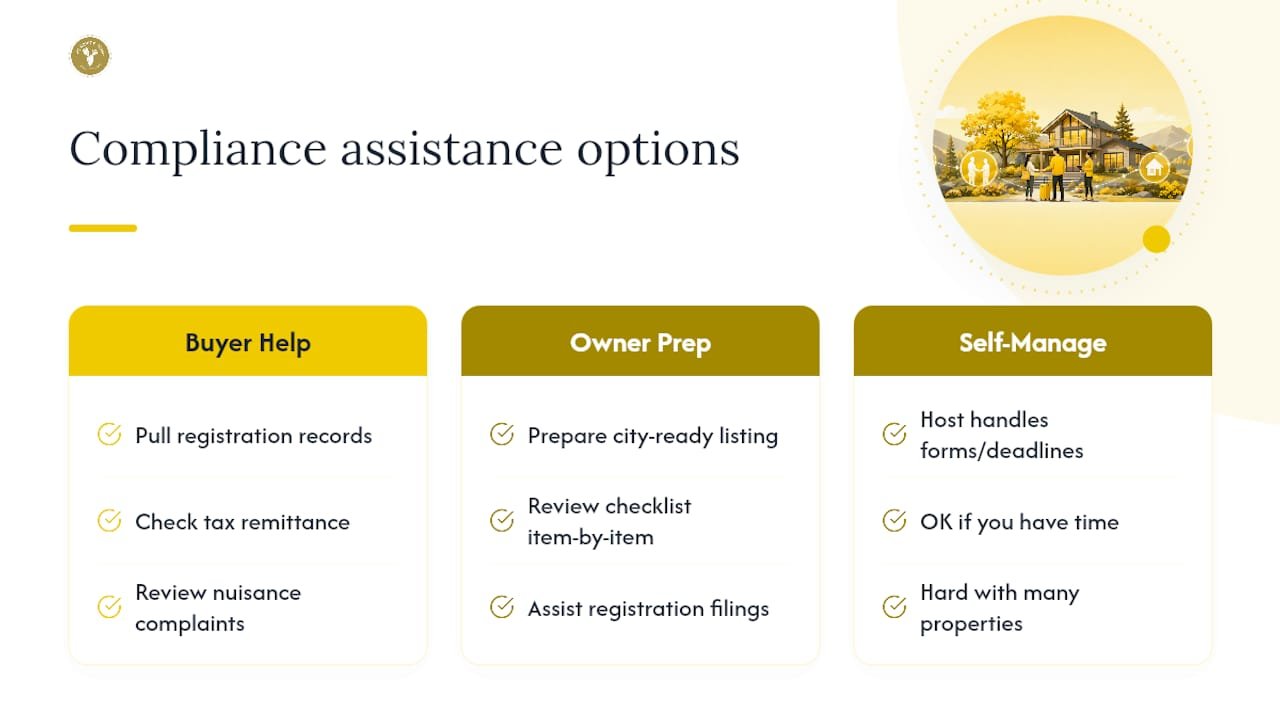
Some real estate teams specialize in short-term rental properties in Sedona and the Verde Valley and can help buyers vet a property’s compliance history before closing and assist sellers in preparing listings that pass city review the first time.

If you’re shopping for a Cottonwood or Sedona area rental, we can pull the seller’s registration records, tax remittance history, and any past nuisance complaints before you make an offer, because buyers inherit whatever compliance gaps the previous owner left behind. If you already own the property and need help getting registration-ready, some agents can assist you in reviewing your checklist item by item.
Self-managing compliance works fine for hosts with the time to chase down forms and filing deadlines. It can be more difficult when juggling multiple properties or closing a purchase on a tight timeline, making professional assistance valuable.
Ready to talk through your situation? Start a rental exit strategy and valuation conversation with Equity Team, or reach out through Owninaz to review your registration checklist together.
Sources
- AN ORDINANCE OF THE MAYOR AND CITY COUNCIL OF THE CITY OF COTTONWOOD (Ord.731)
- Aztaxes
- Arizona Revised Statutes § 9-500.39
- Airbnb: Ground rules for guests
FAQ
Do I Need Both a City Registration and a TPT License?
Yes. Cottonwood’s ordinance requires the city registration number, and Arizona law separately requires a TPT license through AZTaxes.gov. Both numbers must appear on your advertising.
How Much Does Cottonwood Airbnb Registration Cost?
The city cites an example annual fee of $50, prorated for registrations completed mid-year, plus roughly $12 for the state TPT application. Fees can change, so confirm the current amount directly with the city and AZTaxes.gov before applying.
What Happens If I Don’t Notify My Neighbors?
Skipping neighbor notification violates Ordinance No. 731 and can trigger fines or a registration review. Keep signed proof of delivery and the city’s attestation form on file for years, not months.
Can My HOA Block My Airbnb Even If the City Allows It?
Yes. HOA covenants and CC&Rs operate independently of city ordinances, and a private restriction can prohibit short-term rentals even where Cottonwood permits them. Check your HOA documents before you register anything with the city.
Does Equity Team Help With Cottonwood Registration Paperwork?
Equity Team focuses on buyer and seller representation for short-term rental properties near Sedona and the Verde Valley, including reviewing a seller’s compliance history before purchase. Reach out through Owninaz to discuss your specific registration checklist.