

Start with DSCR loans. That’s the financing route most Sedona Airbnb buyers should chase first, with conventional investor loans as a solid backup if you have strong personal income or plan to owner-occupy part of the year. The single biggest gate isn’t your credit score, it’s whether the parcel already carries a valid short-term rental permit. Before you call anyone, grab the property address and either an AirDNA report or 12 months of platform statements, plus proof of reserves. That packet alone will get you a real term sheet, not a guess.
TL;DR:
- DSCR loans are the optimal financing choice for Sedona Airbnb purchases because they qualify based on the property’s rental income, not personal income.
- Lenders typically require 12 to 18 months of reserves, and loan approval heavily depends on permit validity and transferability, especially inside Sedona city limits.
- AirDNA projections are accepted directly for new purchases with no rental history, but lenders apply a 65% to 75% occupancy discount to conservative rental income estimates.
- Permit status, HOA restrictions, flood zones, and WUI insurance requirements significantly influence loan approval and closing timelines in Sedona.
- Preparing a complete documentation package, including parcel-level AirDNA data and permit verification, can shorten closing times to 20 to 30 days on ideal files.
Table of Contents
- Sedona Airbnb Financing Options: Which Loan Type Fits Your Deal
- What Are the Actual Sedona Airbnb Lending Criteria?
- How Do Lenders Underwrite Airbnb Income in Sedona?
- Why Do Permits and Jurisdiction Matter So Much for Sedona Loans?
- How Long Does It Take to Close a Sedona STR Loan?
- What Should You Ask a Lender Before Signing?
- The Equity Team’s Local Perspective: Parcel-Level Diligence Wins Sedona Deals
- Getting Lender-Ready Without the Guesswork
- Sources
Sedona Airbnb Financing Options: Which Loan Type Fits Your Deal
Sedona’s red rock views draw buyers who want a rental that pays for itself, and lenders have built entire programs around that reality. But not every loan product treats short-term rental income the same way, and picking the wrong one wastes weeks.
DSCR loans are built for exactly this scenario. DSCR stands for debt service coverage ratio, a fancy way of asking one question: does the property’s rental income cover its own mortgage payment? Lenders qualify the deal on the property’s cash flow, not your W2 or tax returns, which is why DSCR loans have become the default for STR buyers with self-employment income or multiple properties already on the books. According to Alison Rucker’s DSCR loan overview, this property-first qualification is precisely what makes them attractive to investors who’d otherwise get buried in income documentation.
Conventional investor loans still make sense if you have clean W2 income, a modest down payment saved, and you’re buying something that could plausibly work as a second home too. They tend to price better than DSCR programs when your personal debt-to-income ratio is strong, but most conventional underwriters won’t count projected Airbnb income toward qualification. That’s a dealbreaker for buyers who need the rental income to make the math work.
Portfolio lenders, usually local banks or credit unions that keep loans on their own books instead of selling them, offer more underwriting flexibility. They can sometimes stretch on reserves or entity structure in exchange for a relationship or a slightly higher rate. The tradeoff is availability. Not every portfolio shop actively wants short-term rental exposure in a tourism-dependent market like Sedona, and the ones that do often want you to already bank with them.
FHA and VA loans rarely fit an Airbnb purchase directly, but they matter if you’re planning to live in part of the property while renting the rest, or converting a primary residence into a short-term rental down the road. These programs come with owner-occupancy requirements that most pure investment purchases can’t meet.
A few things stand out once you line these up side by side.
- DSCR programs are the only category built to accept AirDNA projections and platform statements as qualifying income out of the gate.
- Conventional loans price better on paper but effectively disqualify buyers who need rental income to carry the mortgage.
- Portfolio lenders are worth a call if you already have a Sedona-area banking relationship, but don’t count on them as a first stop.
- Reserve requirements swing the widest of any variable in this table, from two months to eighteen, depending entirely on loan type and lender comfort with STR risk.
Lender familiarity with Sedona’s permit rules matters more than most buyers expect. A DSCR lender who’s closed a dozen deals in the Village of Oak Creek already knows which HOA covenants tend to block permits and which don’t. A lender who’s never touched a Sedona file will ask more questions, take longer, and sometimes decline a deal that a specialist would approve without blinking.
What Are the Actual Sedona Airbnb Lending Criteria?
Numbers matter here more than opinions, so let’s get specific about the thresholds lenders actually apply.
Credit score sets your pricing tier before anything else gets discussed. Programs will sometimes accept credit scores in the low to mid 600s, but lower scores usually mean paying more in rate. Higher credit scores unlock better pricing and lighter reserve requirements, according to HonestCasa’s Sedona DSCR breakdown.
Down payment and LTV move in tiers based on the property itself, not just your finances. Pinnacle Funding Network’s Sedona STR program notes show LTV up to 80% for inventory under $1 million, dropping to roughly 75% for the $1 million to $2 million range, and tightening further for trophy properties with red rock views or creek frontage. That last tier isn’t really about the price tag. It’s about the lender’s comfort insuring against a niche buyer pool if they ever have to foreclose and resell.
DSCR minimums are the actual math test. The calculation is gross rental income divided by total mortgage payment (including principal, interest, taxes, insurance, and HOA dues). A DSCR of 1.00 means the property breaks even on paper. Most programs prefer a DSCR ranging from about 1.00 to 1.25 for favorable pricing, with some accepting ratios somewhat below 1.0 for premium properties at the cost of more restrictive loan terms.
Quick math check: If your projected annual rental income is $60,000 and your total annual mortgage payment (PITIA) is $55,000, your DSCR is roughly 1.09, comfortably inside the range most lenders price favorably.
Reserves are where Sedona diverges from a lot of other STR markets. Local seasonality and regulatory uncertainty push lenders toward larger cushions, and 12 to 18 months of PITIA reserves isn’t unusual on files with lower credit or complicated jurisdiction questions, per Pinnacle’s program data. Compare that to Rucker’s broader observation that many DSCR programs nationally ask for something closer to 6 to 12 months, and you can see the local premium clearly.
Pro Tip: If your reserves are insufficient, check with your lender whether certain assets like retirement or brokerage account funds may partially count toward reserves at a discounted value to help meet requirements.
Here’s the documentation checklist that gets a file moving instead of stalling:
- Property-specific AirDNA report pulled at the parcel level, not a neighborhood average
- 12 months of Airbnb or VRBO payout statements if the property already operates as an STR
- Fully executed purchase contract with the closing date and earnest money terms
- Bank or brokerage statements proving the required reserve months are actually liquid
- LLC or entity formation documents if you’re purchasing under a business structure
- Appraisal addenda request, specifically the market-rent addendum, flagged early with your lender
Miss any one of these and you’re not disqualified, but you are adding a week or two to your timeline while someone chases down what should have been ready on day one.
How Do Lenders Underwrite Airbnb Income in Sedona?
This is where DSCR lending gets interesting, and where most first-time buyers get surprised. Lenders don’t just take your projected Airbnb revenue at face value. They apply a discount, and understanding how that discount works can mean the difference between qualifying and not.
For a new purchase with no rental history, lenders lean on AirDNA’s parcel-level projections, a data set built specifically to estimate what a given address could earn based on comparable nearby listings, seasonality, and local occupancy patterns. But they don’t use the raw number. OGJW’s DSCR guide describes lenders applying an occupancy or discount factor, commonly in the 65% to 75% range, shaving the optimistic projection down to something more conservative before it counts toward your DSCR calculation. Some underwriters push that haircut even further, down toward 65% of the raw AirDNA figure, depending on the program and how volatile the local market looks.
Refinances work differently. If the property already has 12 or more months of actual booking history, lenders generally prefer that real track record over a market projection, since it removes the guesswork entirely. A property that’s already earning what AirDNA predicted (or beating it) gets a much smoother underwriting path than one still relying on hypotheticals.
| Underwriting scenario | Income source used | Typical discount applied | Best for |
|---|---|---|---|
| New purchase, no rental history | AirDNA parcel-level projection | 65–75% occupancy factor | First-time STR buyers |
| Refinance with 12+ months history | Actual platform statements | Minimal or none | Established STR owners |
| Missing platform history, existing home | Appraisal market-rent addendum (Form 1007) | Varies by appraiser | Bridge cases between the two above |
| Mixed history (6 months) | Blended actual + projected | Weighted average | Recently converted properties |
When a property has some rental history but not the full year lenders want, many programs will blend the two data sources rather than reject the file outright. That usually means weighting the actual months more heavily and filling the remaining gap with a discounted AirDNA figure. It’s not a perfect science, but it beats an automatic denial for a property that simply hasn’t hit its first full year of operation yet.
- Appraisers use Form 1007 or a similar market-rent addendum when a property has no rental history at all, essentially estimating fair market rent the way they would for a traditional long-term rental appraisal.
- The occupancy factor a lender applies often depends on how established the specific submarket is. A Uptown Sedona condo with dozens of comparable STR listings usually sees a friendlier discount than an outlying Cornville property with thinner data.
- Ask upfront which discount factor a lender applies to AirDNA numbers. A five to ten point swing in that factor can be the difference between a DSCR of 0.95 and 1.10.
Why Do Permits and Jurisdiction Matter So Much for Sedona Loans?
Here’s the part that trips up out-of-state buyers every single time: Sedona isn’t one jurisdiction, it’s several, and where your parcel sits changes the entire lending conversation.
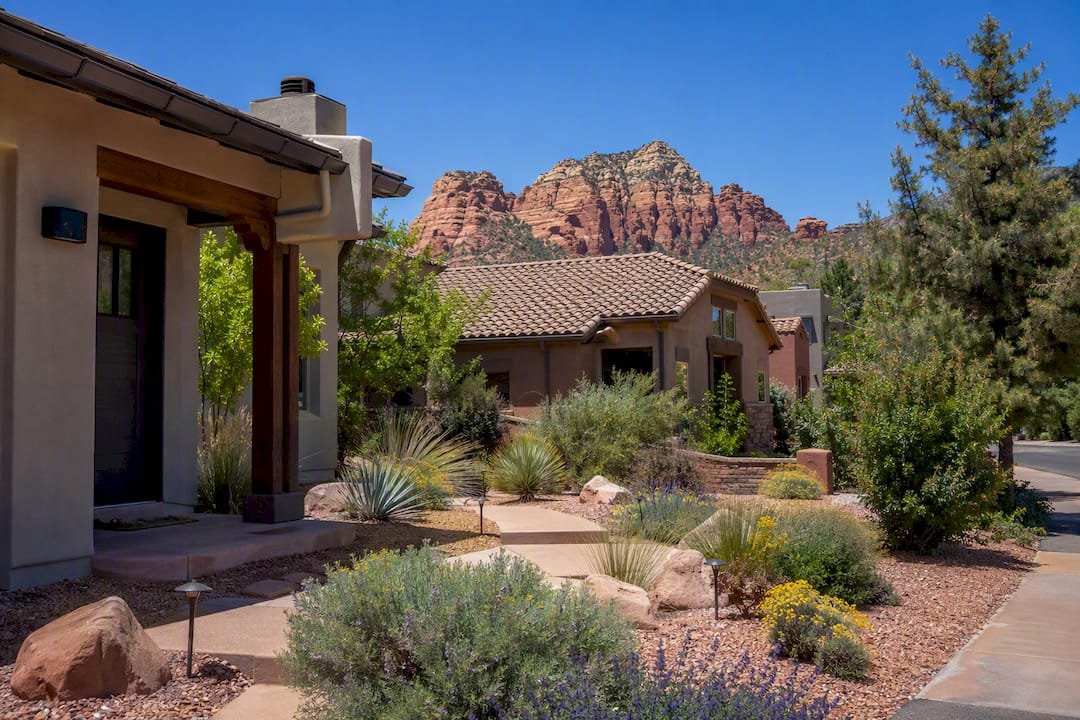
Property inside City of Sedona limits falls under a stricter STR permit framework, with caps and registration requirements that have tightened over recent years. Head south into the Village of Oak Creek or unincorporated Yavapai County, and the rules loosen considerably, though they’re not permit-free. Pinnacle’s underwriting notes single out this jurisdictional split as the single largest variable affecting whether a Sedona deal gets easy lender acceptance or a lengthy manual review.
Permit transferability is the detail that catches people off guard. Some Sedona permits attach to the owner, not the property, meaning a sale can trigger a fresh application rather than a simple handoff. A lender who doesn’t know this might issue a term sheet assuming rental income continues uninterrupted, then discover mid-escrow that the buyer needs a brand-new permit before the property can legally operate as an Airbnb.
Insurance adds another wrinkle. Parts of Sedona sit near Oak Creek Canyon’s flood-prone zones, and the surrounding Coconino National Forest boundary means some properties fall inside wildland-urban interface, or WUI, insurance requirements. Lenders will often require a bound policy addressing both before closing, not just a quote.
- Confirm current permit status and whether it’s transferable to a new owner, not just whether one currently exists.
- Pull HOA covenants early. Some Sedona HOAs restrict or outright ban short-term rentals regardless of what the city or county permits.
- Verify TPT (Transaction Privilege Tax) registration status, since Arizona treats short-term rental income as taxable and lenders increasingly want to see it in order.
- Get a flood zone determination and WUI insurance quote before you’re deep into an appraisal contingency.
Pro Tip: Order your permit and zoning check the same week you go under contract, not after the appraisal comes back. Permit issues take longer to resolve than almost any other closing delay, and starting early buys you leverage to renegotiate or walk away cleanly.
How Long Does It Take to Close a Sedona STR Loan?
Set your expectations early, because Sedona timelines vary more than a lot of buyers anticipate. A same-day preliminary term sheet is realistic once you hand a lender the address plus an AirDNA report, according to Pinnacle’s published turnaround data. Getting to an actual closing table is a different story.
- Clean files with an existing permit, established rental history, and no HOA surprises typically close in 20 to 30 days.
- Files with permit questions, a pending appraisal addendum, or an insurance binder still in progress often stretch to 30 to 45 days or longer.
- Trophy properties needing specialized appraisal comparables can add another one to two weeks simply because fewer comparable sales exist to support the value.
Several tasks run in parallel once you’re under contract, and any one of them can become the bottleneck: title work, the appraisal itself, the AirDNA parcel report, permit verification with the city or county, the insurance binder, and HOA document review if applicable.
- Submit your AirDNA report and permit status alongside your initial contract, don’t wait for the lender to request it.
- Confirm HOA rental restrictions before the appraisal is even scheduled, since a restriction discovered late can force a re-scope of the entire file.
- Order flood and WUI insurance quotes in week one, not week three, since binding coverage sometimes takes longer than buyers expect in wildfire-adjacent zones.
A tight initial packet, address, AirDNA report or platform statements, proof of reserves, and permit documentation is the single biggest lever you have over your own timeline.
What Should You Ask a Lender Before Signing?
Preparation beats improvisation on every Sedona STR file. Here’s the sequence that keeps you moving instead of scrambling.
- Pull a parcel-level AirDNA report for the exact address, not a neighborhood average.
- Gather 12 months of Airbnb or VRBO payout statements if the property has an operating history.
- Confirm current permit status directly with the city or county, not through a listing agent’s assumption.
- Assemble proof of reserves and, if buying under an entity, your LLC formation documents.
- Get quotes from at least two DSCR lenders or brokers so you can compare terms apples to apples.
Once you’re comparing quotes, ask each lender the same set of questions: Do you accept AirDNA projections, or do you require platform history? What occupancy factor do you apply? What are your reserve requirements at my credit tier? What LTV tiers apply to this price range? Is there a prepayment penalty, and for how long?
Pro Tip: Normalize every quote against the same variables, rate, points, reserve months, prepayment terms, and LTV, on one sheet before deciding. A slightly higher rate with no prepayment penalty and lighter reserves often beats a lower headline rate buried in fine print.
Watch for red flags: opaque fee structures that only surface at closing, pressure to lock a rate before you have a written term sheet in hand, and vague answers about how a lender handles permit-in-progress properties. A lender who can’t clearly explain their permit policy on a Sedona file probably hasn’t closed many of them.
The Equity Team’s Local Perspective: Parcel-Level Diligence Wins Sedona Deals
Equity Team spends its days inside Sedona’s short-term rental market specifically, which means permit status and HOA fine print get checked before a buyer ever falls in love with a listing photo. That habit has saved more than one deal from unraveling mid-escrow.
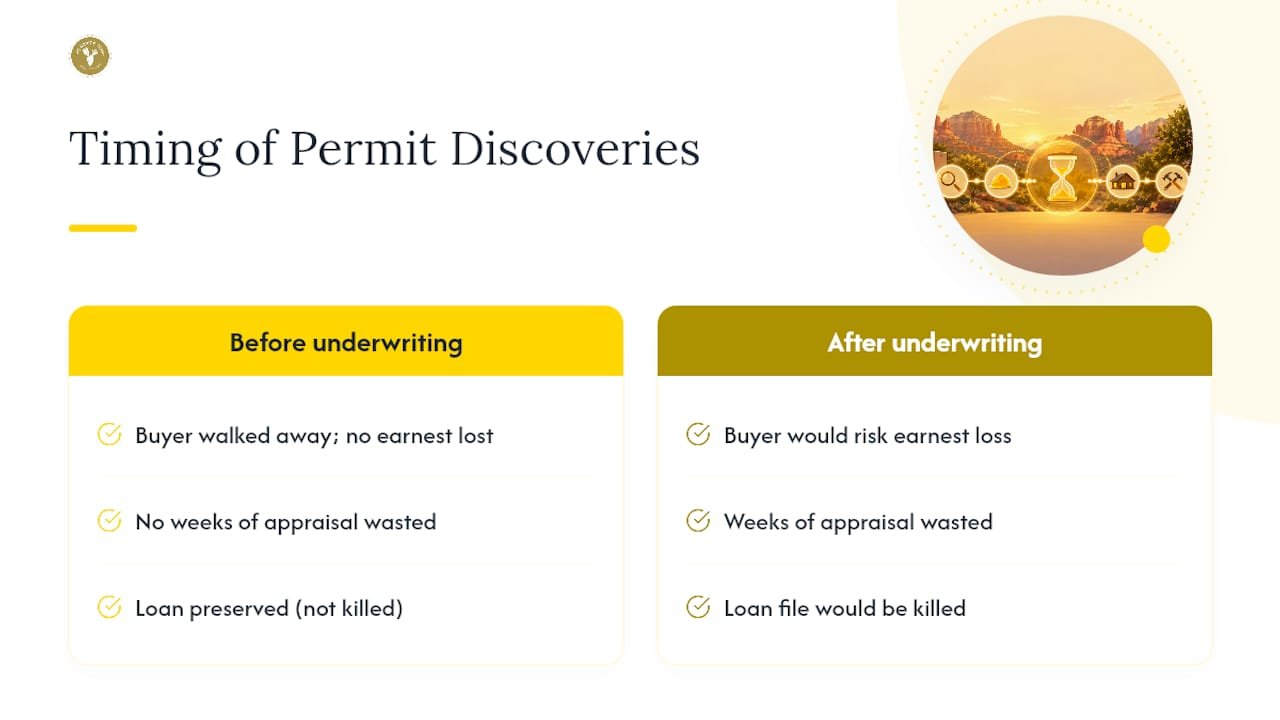
One case involved a property that looked flawless on paper until a title and HOA review turned up a covenant restriction the seller’s own agent hadn’t flagged. Discovered before the lender started underwriting, the buyer walked away without losing earnest money or weeks of wasted appraisal work. Discovered after, it would have killed the loan file outright.
If you’re buying a Sedona property specifically to run as a short-term rental, bring in a broker who specializes in this exact niche before you write an offer, not after you’re already under contract.
— Chad
Getting Lender-Ready Without the Guesswork
Equity Team exists for exactly the friction points this article just walked through. Instead of you chasing down permit status, pulling parcel-level AirDNA numbers, and hoping a random lender happens to know Sedona’s jurisdiction quirks, Equity Team pre-packages that homework before you ever submit a loan application.

That means a parcel-level permit check before you write an offer, an AirDNA pull specific to the address (not a neighborhood estimate), and warm introductions to DSCR lenders who already understand the difference between a City of Sedona file and a Village of Oak Creek one. The practical payoff is faster term sheets and far fewer appraisal or permit surprises showing up mid-escrow, the exact delays that stretch a 25-day close into a 45-day scramble.
If you’re ready to see what’s actually available and lender-ready right now, start with Equity Team’s guide to finding the right Sedona short-term rental investment and let a specialist walk the permit and financing details alongside you from the first showing.
Sources
- Vacation Rental Loans in Sedona 2026: STR DSCR
- DSCR Loans for Airbnb & Short-Term Rentals: The Complete 2026 Guide | OGJW