

An escalation clause is a line in a purchase offer that says, in effect, “I’ll pay more than the other guy, up to a limit.” It raises the buyer’s price by a set increment above a competing offer, and it stops at a maximum the buyer picks in advance. In Sedona, where red rocks, vortex lore and a limited supply of homes can make a listing feel like a mini auction, it’s a tool worth understanding before the Wi-Fi at the trailhead cuts out and a deadline arrives.
It’s also a tool that gets oversold. Sometimes it wins the house. Sometimes it simply hands the seller a map to the buyer’s wallet. Here’s how it works, how to draft one, and when a plain, strong offer is the smarter move.
TL;DR
- An escalation clause raises a buyer’s price by a fixed step (say $2,000) above a competing offer, up to a hard cap, and only after the seller shows proof of that competing offer.
- It works best when multiple offers are truly likely. With no competition, it can reveal the buyer’s ceiling and cost money.
- A written cap, a proof requirement and a plan for the appraisal gap are the three things that keep a clause from turning into a runaway bid.
- Sellers can and do ask for “highest and best” instead, which can make the escalator moot.
- For Sedona short-term rental purchases, price is only half the story: contingencies, timing and rental income documents matter just as much.
Table of Contents
- What an escalation clause actually says
- A worked example with Sedona-sized numbers
- Why sellers sometimes like them (and sometimes don’t)
- When an escalation clause earns its keep
- When to leave it in the garage
- Three drafting mistakes that cost real money
- The Sedona twist: rental income changes the math
- Alternatives to an escalation clause
- Where an STR-focused agent helps
- Our perspective
- FAQ
- Sources
What an escalation clause actually says
The Arizona Association of REALTORS describes it as a clause where the buyer says they’ll pay a stated price, but if the seller receives a higher offer, the buyer will raise theirs. Some people call it an escalator. Same creature, shorter name.
Three moving parts make up every clause:
- The base price. What the buyer is offering if nobody else shows up.
- The increment. How far above the best competing offer the buyer will go. Market practice often runs from roughly $1,000 to $5,000, depending on the price point and how heated the competition is, according to the same Arizona REALTORS guidance.
- The cap. The absolute maximum. Past this number, the buyer is out, no hard feelings.
Freddie Mac’s consumer site frames the clause the same way: it’s worth considering when the buyer and agent are confident there will be competing offers. Confident is the operative word. Hope doesn’t count.
A worked example with Sedona-sized numbers
Picture a three-bedroom home near Uptown, listed at $1,100,000. A buyer wants it, suspects the listing will draw interest, and writes:
- Base offer: $1,100,000
- Escalation: $2,500 above the highest bona fide competing offer
- Cap: $1,180,000
- Condition: the seller provides a copy of the competing offer (identifying details may be redacted) before the price rises
Now three things can happen.
| Scenario | Competing offer | Buyer’s final price | Result |
|---|---|---|---|
| No competition | None | $1,100,000 | Buyer pays base price |
| Moderate competition | $1,125,000 | $1,127,500 | Buyer beats it by the set increment |
| Heavy competition | $1,190,000 | Cap exceeded | Escalator doesn’t win; buyer decides whether to raise the cap |
Notice what the clause never does: it never pays more than needed up to the cap, and it never pays beyond the cap. That is the whole charm. A buyer can compete while a spreadsheet, not adrenaline, sets the limit.
The example is hypothetical, built only to show the arithmetic. Real numbers depend on the home, the season and who else is circling.

Why sellers sometimes like them (and sometimes don’t)
From a seller’s chair, an escalator signals a serious buyer. Realtor.com notes that the clause can help an offer stand out because it shows how committed the buyer is. A built-in bump also saves a round of back-and-forth.
But sellers have reasons to groan:
- Verification is awkward. The clause depends on showing proof of a competing offer, and sharing another buyer’s terms raises confidentiality questions. The North Carolina Real Estate Commission’s bulletin, The Pitfalls of Using Escalation Clauses, digs into exactly that tension for agents in its state. Local rules differ, so Arizona buyers should ask their own agent how the Arizona forms and professional standards handle it.
- Comparing offers gets messy. Three offers with three different escalators and three different caps is a math puzzle nobody ordered.
- Sellers may prefer a flat number. If a seller calls for “highest and best,” every buyer simply submits their strongest terms, and an escalator can be neutralized or forced into the open early. The Arizona REALTORS guidance flags this possibility.
Sellers weighing several bids in Sedona may find the trade-offs of value versus certainty useful, and the Equity Team has written about them in Sedona sellers and multiple offers.
When an escalation clause earns its keep
The clause shines in a few specific conditions:
- Multiple offers are very likely. A fresh, well-priced listing in a desirable pocket, with a showing schedule that looks like a concert line.
- The buyer has firm financial limits. The Arizona REALTORS describe the clause as a tool, not a guarantee, and best for buyers who want to stay disciplined.
- The buyer can’t be on call. If a deadline is tight and the buyer can’t revise the number in real time, the clause does the revising for them.
- The rest of the offer is strong. Solid financing, a reasonable timeline and a clean contract matter. A fancy escalator on a shaky offer is a sports car with flat tires.
When to leave it in the garage
The same guidance cautions against using a clause in low-competition situations: the buyer discloses their maximum budget without gaining an edge, and the seller may counter right at that maximum. Putting a ceiling in writing for a lone bidder is a bit like announcing your bedtime to a raccoon. Helpful to the raccoon.
Skip the clause when:
- The home has sat on the market for weeks and nobody’s lining up.
- The listing agent won’t confirm any other interest. The research behind this piece notes that experienced buyers often treat a refusal to confirm competing bids as a reason to hold their ground. That’s a judgment call, not a rule, and an agent can help read the room.
- The seller has already requested highest and best offers.
- The buyer’s cap is the real budget limit and they’d be sick paying it. Better to offer what the home is worth to them, cleanly.
When it’s not a hot situation, a simple, strong, clean offer often beats the complexity of an escalator, which is the Arizona REALTORS’ own take.
Three drafting mistakes that cost real money
1. No ceiling
A clause without a cap could in theory chase competing bids upward indefinitely. A New York State REALTORS-affiliated guide on proper use describes the clause as a pre-established term that increases the original offer; the safe version always names the maximum in writing.
2. No proof requirement
The clause should say the seller must provide documentation of the competing offer before any increase kicks in. LegalClarity points to built-in verification as the key feature of a well-built escalation clause. Without it, a buyer is trusting a verbal “we have a higher offer” with real money.
3. Ignoring the appraisal
This one bites hardest in Sedona, where unique homes can be tricky to appraise and where income potential doesn’t always show up in an appraiser’s comparison set. If escalation pushes the price past appraised value, the buyer needs to know who pays the difference. Waiving the appraisal contingency outright is risky. A narrower approach is to agree to cover a specific dollar amount over the appraised value, using the right Arizona REALTORS addendum. The association’s Legal Hotline Q&A is the sort of material agents check when sorting out how offers and counters interact. Arizona REALTORS forms also get updated; the current Residential Resale Real Estate Purchase Contract is listed with a February 2026 revision date, so buyers should have their agent confirm which version is in play.
For the bigger picture on what a buyer can protect and what they give up, see this explainer on Sedona investment property contingencies.
The Sedona twist: rental income changes the math
A typical homebuyer asks, “What will I pay?” A short-term rental buyer also asks, “What will it earn?” Those two questions pull in opposite directions when an escalator is on the table.
Say the cap is $1,180,000. If the underwriting works at $1,100,000 but the numbers get thin at $1,180,000, then the cap is the real budget, not a suggestion. A buyer who treats the cap as the break-even point, and not the point of maximum thrill, has the right instinct. The Equity Team’s guide to finding the right short-term rental investment walks through how to size up a property before the offer even starts.
A few Sedona-specific habits help:
- Underwrite before writing. Pull comparable performance for the exact property type and location, not an area average.
- Set the cap from the income model. If the property stops making sense at a number, that’s the cap.
- Think about the other terms. Closing speed, inspection timeline and concessions can sway a seller as much as a few thousand dollars. A guide to the 30 to 45 day Arizona escrow timeline shows how much timing can matter, and seller concessions in Sedona shows how credits shift the real net price.
Also worth a thought: Sedona is a place where wildfire season, remote closings and disclosures can each shape a deal. Out-of-state buyers in particular may want to read about closing Arizona deals remotely before a tight offer window arrives.
Alternatives to an escalation clause
Not every competitive situation calls for the same tool. Some options:
- A strong flat offer. The buyer picks a number they can live with and goes in clean.
- A highest-and-best letter. When the seller asks for it, buyers submit one final figure. No ladder, no cap games.
- Better terms instead of more money. Flexible closing dates, a larger earnest money deposit, fewer contingencies where the buyer is truly comfortable.
- A short personal note. Sedona owners often love their homes. A kind letter will not fix a low price, but it doesn’t hurt a fair one.
- Pre-inspection. Inspecting before offering lets a buyer remove uncertainty without waiving protections blindly.
An agent can mix and match these. Often the best offer is a modest escalator plus clean terms, or no escalator at all and a sharp number.
Where an STR-focused agent helps
The hard part of an escalation clause isn’t drafting the sentence. It’s knowing whether competition is real, what the property will earn at each possible price, and what the listing agent is quietly signaling. An experienced agent knows how to probe the listing side for signs of real competition without undercutting their own client, a point echoed in the LegalClarity discussion of competing bids.
The Equity Team is a Sedona-based team that specializes in short-term rental purchases and sales. Buyers who want a second set of eyes on a cap, an offer structure or an income estimate can start at owninaz.com. Owners thinking about selling a rental and wondering how offers might stack up can look at the vacation rental CMA and seller prep consultation.
Our perspective
We see escalation clauses the way a hiker sees a trail marker: handy, but not the whole hike. They’ve got their place, and that place is a genuinely competitive listing where a buyer has done the math and knows the number.
The mistake we watch for most is the clause written from emotion. A buyer falls for a view of Cathedral Rock, sets a cap high enough to buy the whole formation, and forgets that a rental has to pencil out. The cap should come from the income model and the buyer’s comfort, not from how much they love the patio.
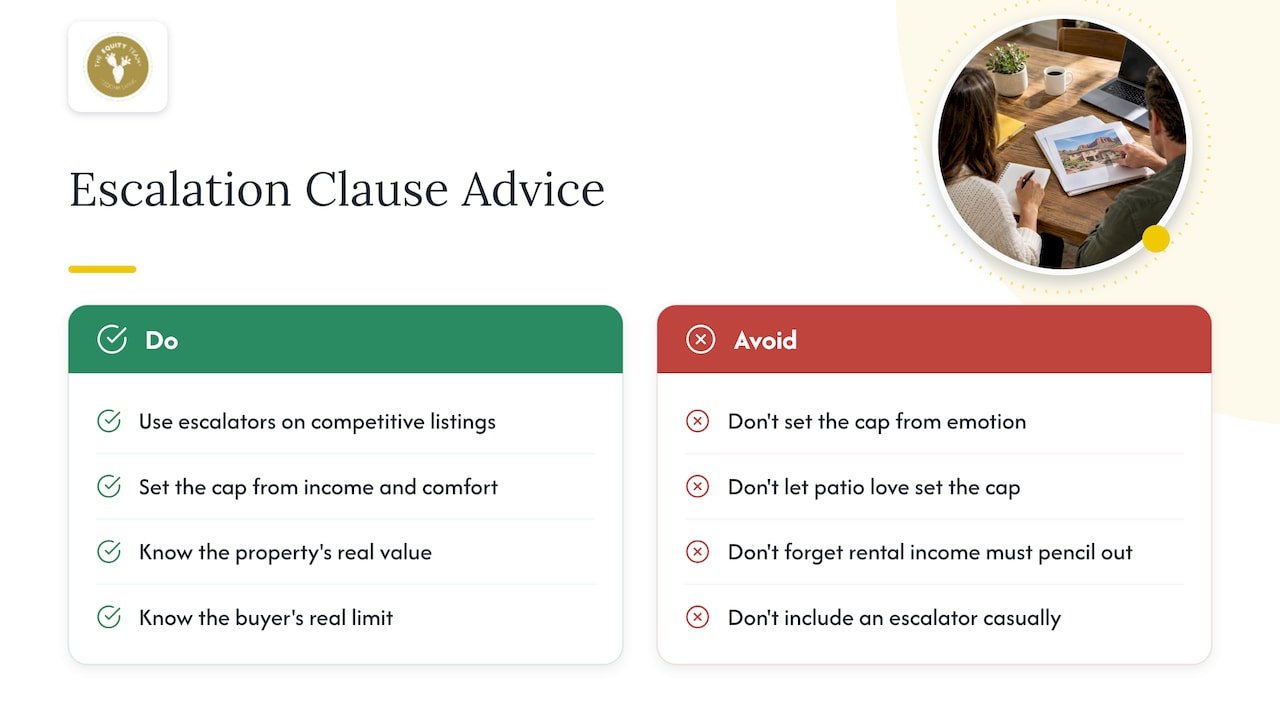
We also like to remind sellers that an escalator is information. It reveals where a buyer’s ceiling sits. On the buying side, that’s exactly why we think hard before including one, and on the listing side, it’s why we think about how to compare offers fairly and whether to ask for highest and best.
Our best advice is simple: know the property’s real value, know the buyer’s real limit, and let the contract say so plainly.
— Chad
FAQ
Can an escalation clause backfire?
Yes. If the buyer is the only bidder, the clause can reveal their maximum price and invite a counteroffer near it. A missing cap or missing proof requirement can also cause trouble, which is why both belong in writing.
What happens if my offer is escalated?
Once the seller provides proof of a higher competing offer, the price rises by the stated increment above it, up to the cap. If the competing offer is above the cap, the clause doesn’t win the house on its own, and the buyer chooses whether to raise the limit or walk.
Is an escalation clause a good idea in Sedona?
It can be when a listing is likely to draw several offers and the buyer has firm financial limits. It’s a weaker choice when a home has been sitting or when the seller has asked for highest and best offers, as the Arizona REALTORS point out.
Should I remove the escalation clause when I offer?
If there’s no sign of competing offers, many agents would. In that case, a simple, strong, clean offer is often the better play. A local agent can help gauge whether competition is real before the offer goes in.
How big should the increment be?
Market practice often falls between $1,000 and $5,000, according to Arizona REALTORS guidance. Higher-priced, more competitive properties tend to call for bigger steps, but the cap matters far more than the increment.
Sources
- What Is an Escalation Clause and When Should You Use One? (Arizona Association of REALTORS)
- The Pitfalls of Using Escalation Clauses (NCREC Bulletins)
- Should My Offer Include an Escalation Clause? (My Home by Freddie Mac)
- What Is an Escalation Clause in Real Estate? (Realtor.com)
- Can a Real Estate Agent Lie About Other Offers? (LegalClarity)
- Proper use of an escalation clause (NYSAR guide)
- Legal Hotline Q&A (Arizona Association of REALTORS)
- Residential Resale Transaction Forms (Arizona Association of REALTORS)