

Oak Creek is a workable short-term rental play for a hands-on operator willing to chase revenue, but it is not the passive cash machine some listings promise. AirDNA pegs the market at roughly 50% occupancy and a $118 average daily rate, landing typical annual revenue near $12,700. That number favors owners who manage aggressively and treat pricing as an active job, not a set-it-and-forget-it hobby.
TL;DR:
- The small market size of 19 listings makes the average revenue highly sensitive to single property performance and new competition.
- Proper management and active pricing strategies can push annual revenue above $16,000 for top performers, but occupancy drops sharply in off-season.
- Location near Milwaukee’s employment hubs and the airport provides an advantage over purely vacation-focused properties in attracting business travelers.
- Initial furnishings and ongoing costs, including cleaning and replacements, significantly impact profitability in this thin market.
- Market risks include seasonal demand fluctuations, regulatory changes, weather impacts, and the entry of new competitors, requiring careful planning and realistic assumptions.
Table of Contents
- What Does Oak Creek Airbnb Investment Data Actually Show?
- Earnings, ADR vs Occupancy, and What Drives Revenue in Oak Creek
- When Do Oak Creek Short-Term Rentals See Peak Demand?
- Which Property Types Perform Best for Airbnb Investment in Oak Creek?
- Finance and Cash-Flow Checklist for a Realistic Oak Creek Deal
- Local Expert Perspective: What the Equity Team Sees on the Ground
- How Property Management Choices Affect Your Returns
- Which Oak Creek Locations Matter Most for Airbnb Success?
- What Should You Budget for Startup and Ongoing Costs?
- What Risks Should Oak Creek Airbnb Investors Watch For?
- Author Perspective: When Oak Creek Makes Sense for a Buyer
- How Equity Team Helps You Vet the Right Short-Term Rental
- Sources
What Does Oak Creek Airbnb Investment Data Actually Show?
Anyone weighing an Oak Creek Airbnb investment needs to start with three numbers: how many listings exist, what they charge, and how often they book. AirDNA counts 19 active short-term rental listings in the market, which is a small enough sample that any single new listing can shift the average meaningfully. That is a double-edged detail. A tiny inventory means less competition for a well-run property, but it also means the market-wide averages are shakier than they’d be in a bigger city.
Here’s the snapshot investors should model against:
- Active listings: 19 (small, thin market)
- Average daily rate (ADR): $118
- Occupancy: 50%
- RevPAR: approximately $67 per available night
- Median annual revenue: around $12,700
- AirDNA Market Score: 66 out of 100
That Market Score of 66 lands in a middling zone. It is not a red flag, but it is far from the 80+ scores AirDNA assigns to top-tier vacation destinations. Airbnb’s own listing pages for the area show nightly rates starting as low as $40 in slower stretches, which drags the annual average down and confirms this is a rate-sensitive market rather than a premium one. Treat the score as a screening tool, not a verdict. It only means something once you have unpacked what is driving it.
Earnings, ADR vs Occupancy, and What Drives Revenue in Oak Creek
Revenue per available night, or RevPAR, is simply ADR multiplied by occupancy.
Three scenarios show how sensitive that math is to small changes:
- Low performer: $95 ADR at 40% occupancy. RevPAR lands near $38, pushing annual revenue toward $13,800 before expenses, assuming a modest rate premium offsets weak booking pace.
- Typical performer: $118 ADR at 50% occupancy, matching the market average, roughly $12,700 a year.
- Top-tier performer: $150 ADR at 60% occupancy, the kind of result a sharply managed, well-reviewed listing can chase, pushing RevPAR past $90 and annual revenue well above $16,000.
The takeaway: a 10-point occupancy gain moves the needle more than a modest rate hike. If new listings flood the market, occupancy compresses first, and ADR tends to follow as hosts undercut each other to fill calendars.
When Do Oak Creek Short-Term Rentals See Peak Demand?
Seasonality in Oak Creek follows a familiar Midwest pattern: warmer months draw more travelers, and winter slows bookings to a crawl. Hosts who ignore that rhythm end up with empty calendars in January and underpriced calendars in July.
Practical seasonal moves that matter:
- Raise minimum-night requirements during peak months to reduce turnover costs and attract longer, higher-value stays.
- Drop minimum stays and offer weekly discounts in the off-season to keep occupancy from collapsing entirely.
- Adjust nightly pricing weekly, not seasonally, since demand can swing with local events even inside a slow month.
- Expect cleaning frequency, and therefore cleaning cost per booked night, to rise during peak season simply because more guests cycle through.
Pro Tip: Build a 12-month pricing calendar before you buy, not after. If the off-season math doesn’t work without heroic occupancy assumptions, the deal probably doesn’t work at all.
Which Property Types Perform Best for Airbnb Investment in Oak Creek?
Bedroom count and layout matter more than square footage in a market this size. A two-bedroom home that comfortably sleeps a family tends to book more consistently than an oversized single-family house that only appeals to larger groups passing through less often.
What tends to move the needle on performance:
- 2BR properties: the sweet spot for small families and short business trips, usually the easiest to keep booked.
- 3BR+ houses: higher ceiling on nightly rate, but occupancy can lag unless the group-travel demand is there to fill it.
- Full kitchens: a near-mandatory amenity for guests staying more than a night or two, especially business travelers avoiding restaurant costs.
- Dedicated parking: a small detail that removes friction and shows up in guest reviews more often than owners expect.
- Reliable Wi-Fi: table stakes now, not a bonus, particularly for the corporate and long-stay travelers this market attracts.
Given Oak Creek’s proximity to Milwaukee’s general aviation and commercial corridors, listings marketed toward business travel and extended stays often outperform ones pitched purely as vacation getaways. That’s a meaningfully different strategy than chasing tourist dollars, and it should shape how you furnish and photograph the property.
Finance and Cash-Flow Checklist for a Realistic Oak Creek Deal
Before making an offer, run the numbers past a checklist that goes beyond the sale price. Oak Creek’s median home value sits around $419,000, and average monthly long-term rent nearby is about $1,682, both useful anchors when you’re deciding whether short-term or long-term rental makes more sense for a given property.
A basic pro forma should include:
- Mortgage principal and interest, taxes, and insurance
- Property management fees if you’re not self-managing (commonly 15% to 25% of revenue)
- Cleaning and turnover costs per booking
- Furnishing depreciation and periodic replacement
- Utilities, internet, and streaming subscriptions guests expect
- HOA dues or short-term rental permit fees, where applicable
- Vacancy buffer, typically 10% to 15% of gross projected revenue
Statistic Callout: Repit’s data puts Oak Creek’s cap rate near 3.1%, which in many financing scenarios sits below prevailing mortgage rates. That gap means positive cash flow often depends on a larger down payment, a rate buy-down, or real operational outperformance versus the market average.
A comparison of landlord insurance options is worth reviewing early, since coverage gaps for short-term rental use can quietly erode your margin.
Local Expert Perspective: What the Equity Team Sees on the Ground
That vantage point matters when a market like Oak Creek gets compared to Arizona submarkets investors actually ask about.
For context, Equity Team’s own Camp Verde data shows average annual revenue between $14,500 and $16,300, a useful yardstick for anyone weighing Oak Creek against a Sedona-area alternative. Before recommending any acquisition, the screening process includes:
- Verifying zoning and HOA rules permit short-term rental use in writing
- Pulling comparable listing performance, not just neighborhood averages
- Reviewing at least 12 months of occupancy history where available
- Stress-testing revenue against a realistic, not best-case, occupancy scenario
How Property Management Choices Affect Your Returns
The decision to self-manage or hire a property manager changes your return profile more than almost any other single choice.
Self-managing preserves that margin, but it comes at a real cost in time. In a thin market with only 19 active listings, guest communication response time and listing quality directly affect where you rank in search results and, ultimately, how often you book. An owner living out of state, or juggling a full-time job, will likely underperform a dedicated local manager who adjusts pricing weekly and responds to guest messages within the hour.
The middle path many owners choose is a hybrid: dynamic pricing software handles rate adjustments automatically, while the owner or a part-time local contact handles cleaning coordination and guest messages.
Whatever structure you pick, model it before you buy, not after. Run both numbers through your pro forma and see which one still works.
Which Oak Creek Locations Matter Most for Airbnb Success?
Location inside a market this size works differently than it does in a big city. With only 19 active listings scattered across Oak Creek, proximity to specific draws, rather than a single “best neighborhood,” tends to decide who books and who sits empty.
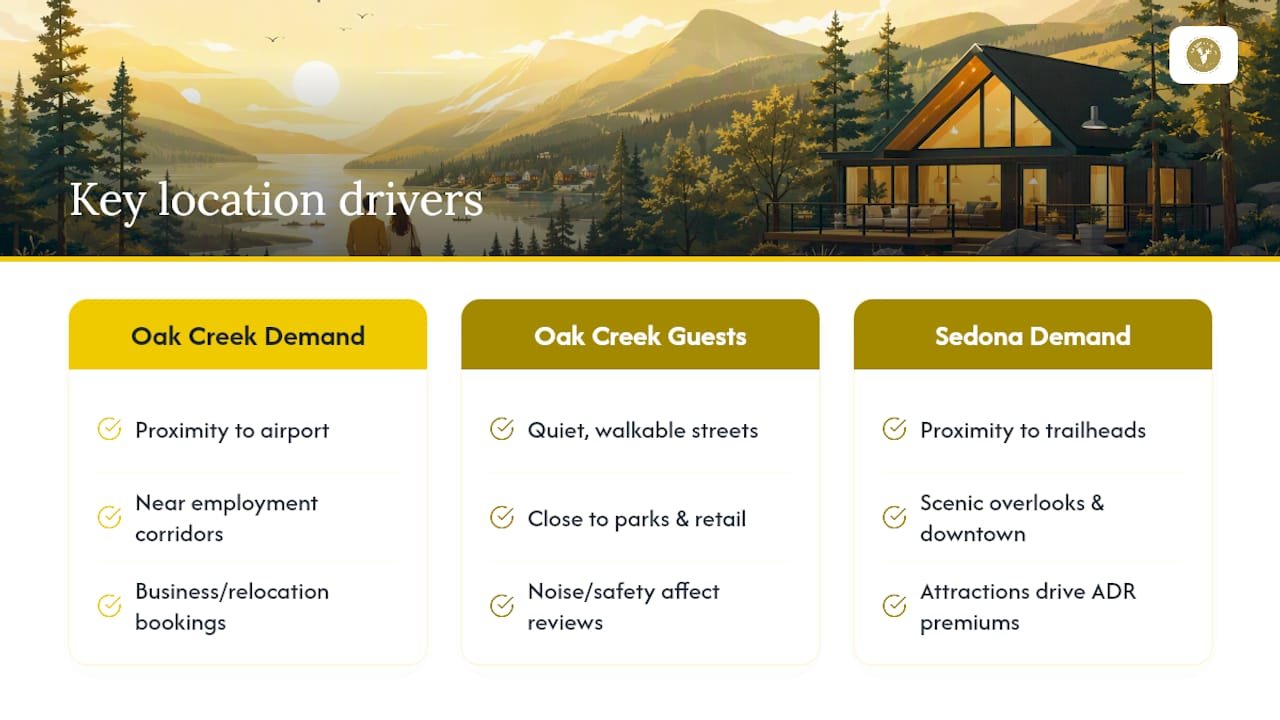
Distance to Milwaukee’s employment corridors and General Mitchell International Airport matters more here than typical tourist attractions, since a meaningful share of demand comes from business travel and short-term relocation rather than vacationers. A listing that’s a quick drive from the airport or major employers has a built-in advantage over one buried in a purely residential pocket with no obvious draw.
Quiet, walkable streets near local parks and retail still help with guest satisfaction and review scores, even if they are not the primary booking driver. Guests notice noise, safety, and convenience regardless of why they’re traveling, and a bad review over a noisy street can quietly suppress your ranking for months.
If you are instead comparing Oak Creek against an Arizona submarket, the location calculus flips entirely. In Sedona and the Verde Valley, proximity to red rock trailheads, scenic overlooks, and downtown dining drives ADR premiums that dwarf anything a Midwest suburban market can produce. That’s the core reason Sedona short-term rental investments get modeled so differently from a market like Oak Creek.
What Should You Budget for Startup and Ongoing Costs?
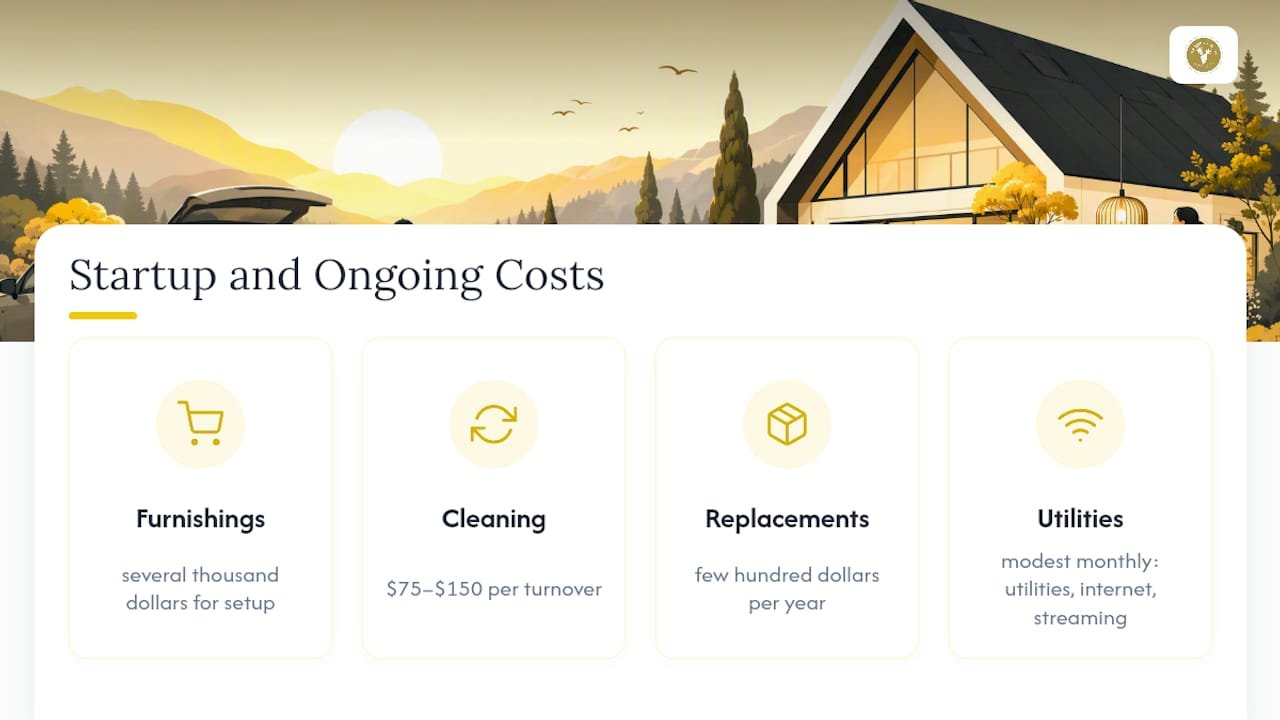
Furnishing an Oak Creek short-term rental to a competitive standard typically runs several thousand dollars for a modest two- or three-bedroom home, covering furniture, linens, kitchenware, and the small appliance package guests expect (coffee maker, microwave, and a decent television). Skimping here shows up fast in reviews, and reviews are the cheapest marketing tool you have in a thin market.
Ongoing costs break into predictable categories. Cleaning between guests usually runs $75 to $150 per turnover depending on square footage, and that cost scales with how often the property books, so a strong occupancy month is also a higher cleaning-expense month.
Don’t forget replacement cycles. Linens, towels, and small kitchen items wear out faster under guest turnover than they would in a long-term rental, and budgeting a few hundred dollars a year for replacements avoids the slow creep of a property that looks tired in photos. Utilities, internet, and any streaming subscriptions guests expect add a modest but steady monthly cost that’s easy to underestimate when you’re building your first-year projections.
What Risks Should Oak Creek Airbnb Investors Watch For?
Weather is the most predictable risk and the easiest to underestimate. Wisconsin winters suppress travel demand hard, and a property that leans entirely on summer bookings can sit largely empty for months, which is exactly why the seasonal pricing and minimum-stay tactics covered earlier matter so much.
Market thinness is the second risk, and it cuts both ways. With just 19 active listings, a single new competitor entering with an aggressively priced, well-furnished property can meaningfully dent your occupancy, but so can one bad review on your own listing, since there simply aren’t enough bookings flowing through the market to dilute a rough patch quickly.
Regulatory risk deserves a hard look before closing. City and county short-term rental rules can change, and an HOA that currently allows rentals can vote to restrict them. Confirm current zoning and any pending ordinance discussions directly with the municipality rather than relying on a listing agent’s assurance alone.
Finally, financing risk compounds everything else. Build a vacancy and repair buffer into your numbers before you ever make an offer, not after the first slow month arrives.
Author Perspective: When Oak Creek Makes Sense for a Buyer
Oak Creek fits a specific buyer: someone comfortable actively managing pricing, targeting business travelers over vacationers, and treating the property as a side operation rather than a passive asset. If that’s not your appetite, or if the cap rate versus mortgage rate gap makes you nervous, look at markets with stronger seasonality and higher ADR ceilings instead. My honest read is that Sedona-area properties solve the passive-income question far better than a thin Midwest suburb ever will. Before you commit capital anywhere, run a real pro forma against local, listing-level data, not just the market average.
— Chad
How Equity Team Helps You Vet the Right Short-Term Rental
Equity Team is the local alternative to guessing your way through a spreadsheet, we run the market analysis, zoning checks, and comparable-property vetting before you ever write an offer.

If Oak Creek’s numbers left you wondering what a stronger-performing Arizona market actually looks like on paper, that’s exactly the conversation we have every day. We’ll walk you through comparable revenue data, zoning realities, and HOA restrictions specific to the property you’re considering, the same screening checklist we apply to our own top-performing client listings. Start with a look at how to find the right short-term rental investment and get a realistic read on what your budget can actually earn in Sedona and the Verde Valley.
Sources
- Oak Creek, WI Airbnb & Short-Term Rental Data (2026) | AirDNA
- Oak Creek, WI: Housing Data, Rent & Market Trends (2026) | Repit
- Oak Creek, WI Vacation Rentals – Airbnb