

Cost segregation and bonus depreciation aren’t rivals fighting for a spot in your tax strategy. They’re a package deal. Cost segregation is the study that finds the shorter-life pieces of your property, and 100% bonus depreciation under IRC §168(k), permanently restored by the One Big Beautiful Bill Act (OBBBA), is what lets you write most of them off in year one. Pairing the two makes the most sense for investors with real taxable income to offset, a hold period long enough to absorb recapture risk, and a property, like a Sedona short-term rental with granite counters and a hot tub, stuffed with reclassifiable assets.
TL;DR:
- Cost segregation typically reclassifies 20% to 40% of a property’s basis into shorter depreciation categories, making bonus depreciation more effective.
- A study should be ordered before filing the first tax return to maximize benefit and avoid IRS forms later.
- Bonus depreciation applies only to assets with a recovery period of 20 years or less, and some states do not conform to federal bonus rules, reducing potential savings.
- Properties like Sedona short-term rentals often qualify for higher reclassification percentages due to IRS nonresidential treatment, boosting deductions.
- If planning to sell soon or with low taxable income, bonus depreciation benefits may be limited, and careful modeling is necessary to determine worth.
Table of Contents
- What Is Cost Segregation vs Bonus Depreciation, Exactly?
- How Cost Segregation and Bonus Depreciation Work Together
- When Does Cost Segregation Plus Bonus Depreciation Make Sense?
- State Conformity Gaps and Tax Traps That Change the Math
- A Worked Example: Cost Segregation on a Sedona Short-Term Rental
- How a Cost Segregation Study Actually Gets Done
- Why Sedona STRs Are Built for This Strategy
- The Real Lesson Buried in This Tax Strategy
- Let Equity Team Help You Plan the Purchase Around the Tax Strategy
- Where to Verify the Rules Yourself
- Sources
What Is Cost Segregation vs Bonus Depreciation, Exactly?
These two terms get tossed around like synonyms, and that’s where a lot of confusion creeps in. They’re not the same thing. One is a method of analysis. The other is a tax election.
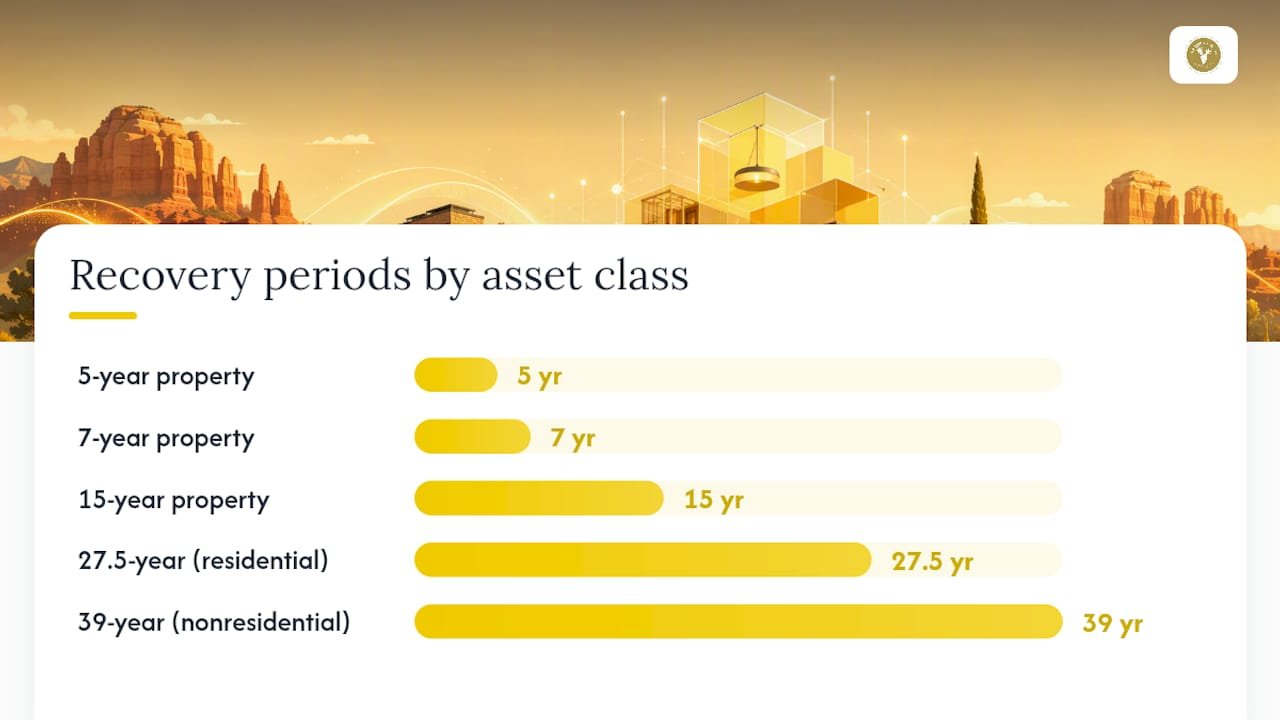
Cost segregation is an engineering-based study that breaks a building’s purchase price into its component parts and reclassifies whichever ones qualify into 5-year, 7-year, or 15-year MACRS categories instead of leaving everything lumped into the standard 27.5-year (residential) or 39-year (nonresidential) bucket. Carpet, cabinetry, decorative lighting, and certain electrical work built specifically for appliances can often move into the faster classes. Land improvements like driveways, irrigation, and fencing usually land in the 15-year bucket. The building’s structural shell, the roof, the foundation, and the framing generally stay put on the long depreciation schedule.
Bonus depreciation under IRC §168(k) is the rule that decides how fast you can deduct those reclassified assets. OBBBA permanently restored 100% first-year bonus depreciation for qualifying property placed in service after January 19, 2025, and it covers any asset with a MACRS recovery period of 20 years or less, including certain used property.
Property that qualifies for bonus depreciation includes:
- Personal property identified through a cost segregation study (appliances, carpet, specialty electrical)
- Land improvements with a 15-year recovery period (fencing, parking areas, landscaping features)
- Qualified used property that meets OBBBA’s acquisition requirements
Property that does not qualify includes the building structure itself, since it carries a recovery period well beyond the 20-year threshold that bonus depreciation requires.
How Cost Segregation and Bonus Depreciation Work Together
Here’s the sequence in practice, and it explains why so many investors leave money sitting on the table.
- You acquire or substantially improve a property. The clock on eligibility starts at the placed-in-service date.
- A cost segregation study gets performed. Engineers and cost analysts walk the property, review closing documents, and produce a detailed allocation schedule.
- Assets get sorted into 5, 7, and 15-year classes. This is the step that actually creates something for bonus depreciation to act on.
- You confirm bonus eligibility. Anything with a recovery period of 20 years or less, placed in service after January 19, 2025, generally qualifies under OBBBA.
- You elect bonus depreciation, or elect out at the asset-class level. Some investors choose to opt out of bonus for a specific class if they’d rather spread deductions across future years.
Buy a rental property and skip the study, and bonus depreciation has almost nothing to grab onto. Everything sits inside the 27.5 or 39-year bucket, which isn’t eligible for the 100% first-year treatment at all. Practitioners describe cost segregation as the analysis that “creates the assets bonus depreciation can touch,” and industry guidance backs that framing up: without a study, a whole-building purchase typically yields little in the way of accelerated, bonus-eligible deductions.
A common misconception is that bonus depreciation is some kind of blanket writeoff for real estate. It isn’t. It only reaches assets with a short enough recovery period, and cost segregation is usually the only practical way to identify which parts of your building qualify.
Pro Tip: Order your cost segregation study before you file your first tax return on the property, not after. You can still catch up later with an accounting method change, but doing it upfront saves you an extra IRS form and a year of guessing.
When Does Cost Segregation Plus Bonus Depreciation Make Sense?
Not every acquisition deserves a study. Here’s a quick checklist to run through before you spend money on one.
- Expected reclassification percentage. Studies typically move 20% to 40% of a property’s basis (excluding land) into shorter-life categories. Below this range, the juice may not be worth the squeeze.
- Taxable income to absorb the deduction. A massive first-year loss does you little good if you don’t have income for it to offset. If your current-year ordinary income is thin, the value of accelerating depreciation drops, and you should model the future recapture hit too.
- Hold period. A multi-year hold gives the deduction room to work and gives you time to plan around eventual recapture.
- State conformity. Some states decouple from federal bonus depreciation rules entirely, which shrinks your net benefit.
- Study cost versus expected tax savings. A study running $5,000 to $15,000 needs to be measured against your actual marginal tax bracket and the dollar amount reclassified.
Cost segregation studies typically reclassify 20% to 40% of a property’s basis into 5, 7, or 15-year assets, according to Baselane’s analysis, and that range is the single number worth memorizing before you call a specialist.
Red flags that suggest you should hold off: you’re planning to sell within a year or two and haven’t thought through recapture, your taxable income is too low to use the deduction, or you’re buying a property with minimal personal property and land improvements to begin with (a bare-bones long-term rental with no finishes to speak of, for instance).
A rough rule of thumb: multiply your purchase price (minus land) by an assumed 25% reclassification rate, then multiply that by your marginal tax rate. If the resulting tax savings clears the cost of the study by a healthy margin, it’s usually worth commissioning.
State Conformity Gaps and Tax Traps That Change the Math
Federal law is only half the picture. A good number of states don’t conform to federal bonus depreciation rules, which means they require you to “add back” some or all of that accelerated deduction on your state return, even though the IRS is fine with it. This is, according to one industry analysis, the single most overlooked trap in this whole strategy. Always confirm your specific state’s treatment with a CPA before you assume the federal number is what you’ll actually keep.
Beyond state add-backs, a few other issues deserve attention before you accelerate anything:
- Depreciation recapture. Section 1245 property (personal property) generally recaptures as ordinary income upon sale. Section 1250 property (real property) has its own, gentler recapture rules, but the distinction matters enormously for exit planning.
- Passive activity and material participation. If you’re a passive investor rather than someone who materially participates in operating the property, passive loss limitations can restrict how much of that shiny new deduction you can actually use in the current year.
- Timing mismatches. Front-loading deductions now means less depreciation available later, which can sting if you sell sooner than planned.
A few mitigation options worth discussing with your CPA: elect out of bonus depreciation at the asset-class level if you’d rather smooth deductions over time, use Section 179 selectively where it fits your income situation, or route a future sale through a 1031 exchange to defer the recapture hit entirely. A Sedona 1031 exchange, including a reverse 1031 exchange structure for investors who find their replacement property before selling, is a common tool for STR owners who’ve depreciated aggressively and want to roll gains forward without an immediate tax bill.
A Worked Example: Cost Segregation on a Sedona Short-Term Rental
Numbers make this real. Say you buy a Sedona STR for $750,000. Land typically runs 15% to 25% of value in this market, so assume $150,000 in land value, leaving a depreciable basis of $600,000.
A cost segregation study comes back showing 30% of that basis, or $180,000, qualifies for reclassification into 5, 7, and 15-year property. That’s squarely inside the 20% to 40% range typical for well-furnished investment properties, and short-term rentals often land at the higher end of that range because furnishings, decor, and specialty electrical add up fast.
| Item | Amount |
|---|---|
| Purchase price | $750,000 |
| Estimated land value | $150,000 |
| Depreciable basis | $600,000 |
| Reclassified (5/7/15-year assets, 30%) | $180,000 |
| Remaining building basis (39-year) | $180,000 |
| First-year bonus depreciation (100%) | $180,000 |
| Illustrative tax shelter at typical marginal rate | $57,600 |
If your state doesn’t conform to federal bonus depreciation, you’d add that $180,000 back on the state return and depreciate it on the state’s own schedule instead, which is exactly why the conformity check above isn’t optional. Reclassification percentages and typical study costs in this example reflect figures reported for residential investment properties generally.
How a Cost Segregation Study Actually Gets Done
A real study is not a spreadsheet guess. It’s a documented engineering analysis meant to survive an IRS exam, and it typically includes three deliverables: a detailed engineering report describing the methodology, an asset-by-asset allocation schedule assigning dollar values to each MACRS class, and supporting documentation like site visit photos, blueprints, and cost records.
- Gather your documents first. Closing statement, property appraisal, any renovation invoices, and floor plans all speed up the process.
- Engage a qualified provider. Expect a fee in the $5,000 to $15,000 range for most residential investment properties, with timelines running 4 to 8 weeks from engagement to final report.
- Review the allocation with your CPA. This is where you decide whether to take full bonus depreciation or elect out at the class level.
- File accordingly. If the property is newly acquired, the study feeds directly into that year’s return.
Missed the window on a property you’ve owned for a few years? You don’t need to amend every prior return. Filing Form 3115 lets you request an accounting method change and capture the missed depreciation through a catch-up adjustment on your current-year return, a pathway many owners overlook entirely.
Pro Tip: Ask any cost segregation provider whether their report includes site-specific photos and a signed engineer’s certification. A generic percentage-based estimate without that documentation is far weaker if the IRS ever asks questions.

Why Sedona STRs Are Built for This Strategy
Short-term rentals in Sedona tend to punch above their weight here. When a property averages guest stays of seven days or less, the IRS often treats it as nonresidential for depreciation purposes, which paradoxically works in your favor: that classification can shift a larger share of the basis into reclassifiable 5, 7, and 15-year categories, improving the first-year math.
Timing matters locally too. Furnishing and finishing work completed around your closing date can affect which assets are “placed in service” and when, so coordinate that timeline with your closing rather than treating it as an afterthought. Document your hours managing the property carefully if material participation is part of your tax strategy. For deeper background on how depreciation applies specifically to Sedona vacation properties, our depreciation resource walks through additional local considerations. Before committing to a study, model the numbers with your CPA, request a cost-seg proposal against your actual purchase price, and settle furnishing and closing timing well before you sign.
The Real Lesson Buried in This Tax Strategy
The conventional advice treats bonus depreciation like the headline and cost segregation like a footnote. That’s backwards. It removed the phase-down uncertainty that made investors hesitant to spend money on a study in the first place, since nobody wants to pay for an engineering report only to have the bonus percentage shrink before they can use it.
What gets underestimated is how much the property type shapes the outcome. A bare rental with minimal finishes and a heavily furnished Sedona short-term rental can produce wildly different reclassification percentages, even at similar price points, and too many investors run the numbers on a generic example instead of their actual property. Model your specific deal.
If there’s one priority, it’s this: get the study done before you file, not after, and confirm your state’s conformity rules before you count the federal savings as real cash in hand.
— Chad
Let Equity Team Help You Plan the Purchase Around the Tax Strategy
Running the numbers on cost segregation and bonus depreciation is only half the job. The other half is buying a property built to make that math work, and that’s where local knowledge earns its keep. Equity Team is the Sedona-based alternative to working with a generalist agent when short-term rental tax strategy shapes your purchase, since we specialize exclusively in STR acquisitions and know which properties carry the furnishings, finishes, and layouts that push reclassification percentages toward the higher end of that range.

We help investors coordinate the pieces that actually matter before closing: identifying high-performing Sedona STR candidates, connecting you with CPAs and cost segregation providers who know this market, and timing furnishing and placed-in-service decisions so nothing falls through the cracks. Reach out before you close, while you’re still modeling tax outcomes, or when you need help documenting material participation on a property you already own. If you’re ready to see what’s currently available, start your search for a Sedona short-term rental investment property and let’s talk through the numbers together.
Where to Verify the Rules Yourself
Bring these to your CPA conversation: IRS Publication 946 for depreciation mechanics, the Congress for the legal basis of 100% bonus depreciation, and a broader tax planning guide for real estate investors for additional context. State conformity varies, so confirm your specific state’s treatment before filing.
This article is general information, not a substitute for advice from a qualified financial advisor. Consult a qualified financial professional about your own circumstances before acting on anything here.
Sources
- Cost segregation and bonus depreciation (Baselane)
- Bonus depreciation updates for 2026 filing season (Center for Agricultural Law and Taxation, Iowa State)
- Congress
- IRS Publication 946 (How to Depreciate Property)