

Yes, you can run an Airbnb in Arizona. The state protects your right to operate a short-term rental under A.R.S. § 9-500.39 and 11-269.17, but that protection comes with strings attached. Register for a Transaction Privilege Tax license at AZTaxes.gov, check your city or county’s permit rules, and post your permit or TPT number on every listing before you take your first booking.
TL;DR:
- Register for a Transaction Privilege Tax license before listing your property and ensure the correct business code is used to avoid penalties.
- Local governments can regulate health, safety, and zoning but cannot ban short-term rentals or treat them as a nonresidential use.
- Display your permit and TPT number on all advertisements and listings, and have an emergency contact available at all hours.
- Failure to comply with permit, notification, or reporting requirements can lead to penalties up to $1,000 every 30 days and possible permit suspension.
- Checking HOA restrictions and submitting applications promptly are crucial, as delays or violations significantly increase legal and financial risks.
Table of Contents
- Arizona Statutes and What “State Preemption” Means for Owners
- Taxes and TPT Licensing: How to Register and Report Correctly
- Local Permits and Examples: What Cities and Counties Actually Require
- Operational Rules Owners Must Follow Day to Day
- Enforcement, Penalties, and What to Do After a Violation Notice
- Step-by-Step Compliance Checklist for 2026
- Sedona Lessons: What Equity Team Sees Investors Miss
- Ready to Buy or Sell an Arizona Short-Term Rental?
- An Editorial Take on Arizona’s STR Rules
- Sources
Arizona Statutes and What “State Preemption” Means for Owners
Here’s the part most new hosts get wrong: they assume their city can simply outlaw short-term rentals if enough neighbors complain. It cannot. Arizona’s legislature settled that question years ago, and the rule still holds in 2026.
Under A.R.S. § 9-500.39, a city or town cannot prohibit vacation rentals or short-term rentals outright. The companion statute, A.R.S. § 11-269.17, applies the same protection at the county level for unincorporated areas. Together, these two laws form what attorneys call state preemption: the state, not the local government, sets the baseline rule that STRs are a legal use of residential property.
That doesn’t mean cities have no say. Municipalities can still regulate for health and safety, require permits, set noise and nuisance limits, demand an emergency contact, and enforce zoning boundaries. What they cannot do is ban the use category itself or single out short-term rentals for a blanket prohibition dressed up as “regulation.”
The statutes also define what actually counts as a short-term or vacation rental (generally, a dwelling rented for fewer than 30 days) and make clear the property still has to function as a residence. You cannot use your STR permit to run a wedding venue, a nightclub, or a corporate event space out of a house zoned residential. That distinction between short-term lodging and outright nonresidential commercial use is where a surprising number of enforcement actions start, especially in scenic areas like Sedona, where “just one small event” tends to attract the wrong kind of attention from neighbors and code enforcement alike.
Taxes and TPT Licensing: How to Register and Report Correctly
Every dollar of short-term rental income in Arizona is subject to Transaction Privilege Tax, and the Arizona Department of Revenue treats a stay under 30 days as taxable lodging, full stop. Register through AZTaxes.gov before your listing goes live, not after your first guest checks out.
When you register, you’ll select a business code. Short-term lodging generally falls under code 025 for state and county reporting, with codes 044 or 144 applying where a city imposes its own hotel/lodging tax on top of the state rate. Get the code wrong and you’ll either underpay (triggering penalties later) or file in a category that flags an audit.
If you list through an online lodging marketplace like Airbnb, the platform often collects and remits certain taxes on your behalf using deduction code 775. That does not let you off the hook for registration. You still need your own TPT license, and you still need to keep your own records, because ADOR holds the property owner responsible if the marketplace’s remittance doesn’t match what your license shows.
One change worth flagging for 2026 planning: as of January 1, 2025, owners of long-term residential rentals (30 days or more) no longer have to collect and remit city TPT on those units. That rule doesn’t touch your short-term rental income. If you run a hybrid property, part long-term lease and part nightly rental, keep the two revenue streams separated in your books. For a deeper walkthrough of the filing mechanics, our guide to Arizona Airbnb taxes breaks down the filing calendar and common mistakes.
Local Permits and Examples: What Cities and Counties Actually Require
State law sets the floor, but your city or county sets the paperwork. Most Arizona municipalities that regulate STRs ask for a fairly consistent set of items:
- A completed permit application with the property address and owner information
- A permit or licensing fee (amounts vary by jurisdiction)
- An emergency contact who can respond within a reasonable window, day or night
- Proof of neighbor notification, in jurisdictions that require it
- Confirmation the permit number will be displayed on every advertisement
Phoenix runs one of the more established examples. The city’s short-term rental registry walks owners through registration, required documentation, and renewal. If you’re operating outside Phoenix, don’t assume the rules transfer. Coconino County, home to Sedona, has its own permit structure and penalty schedule that trips up more than a few out-of-state investors. Our breakdown of Coconino County Airbnb rules covers what’s different there.
Timelines matter here, too. Once you submit a complete application, the jurisdiction generally has seven business days to issue or deny the permit, which is faster than the approval process in a lot of other states. But there’s a catch that catches people off guard: if a city opens up a permit application process and you don’t apply within 30 days of your rental becoming available, the statute requires you to stop operating until you get compliant. Waiting it out is not a strategy.
Operational Rules Owners Must Follow Day to Day
Getting licensed is step one. Staying compliant is a daily habit, and it comes down to a short list of non-negotiables.
- Display your local permit number or TPT license number on every listing, on every platform, including Airbnb, Vrbo, and any personal website
- Keep an emergency contact reachable at all hours who can respond to a nuisance or safety complaint
- Carry liability insurance that meets or exceeds statutory minimum aggregate coverage, or confirm your marketplace’s coverage actually applies to your situation
- Never advertise or use the property for events, parties-for-hire, or any nonresidential commercial activity
The advertising rule isn’t a suggestion. Arizona law requires the permit or TPT number on every ad, and an online lodging operator that lists a property without a current TPT license is itself violating state law. If you list on multiple platforms, check each one, because it’s easy to update Airbnb and forget the number is missing from a Vrbo listing or your own site.
Pro Tip: Don’t rely solely on marketplace insurance. Airbnb’s host guarantee and similar programs have exclusions that surprise owners after a claim, not before. A standalone landlord or short-term rental policy, layered on top of marketplace coverage, closes most of the gaps. Sedona and the surrounding Verde Valley carry wildfire exposure that a generic homeowner’s policy often doesn’t address well; our guide to wildfire insurance for Arizona rentals is worth a read before you bind a policy.
Enforcement, Penalties, and What to Do After a Violation Notice
Arizona’s enforcement structure is more predictable than a lot of states, which is either comforting or alarming depending on how far behind you are on paperwork.
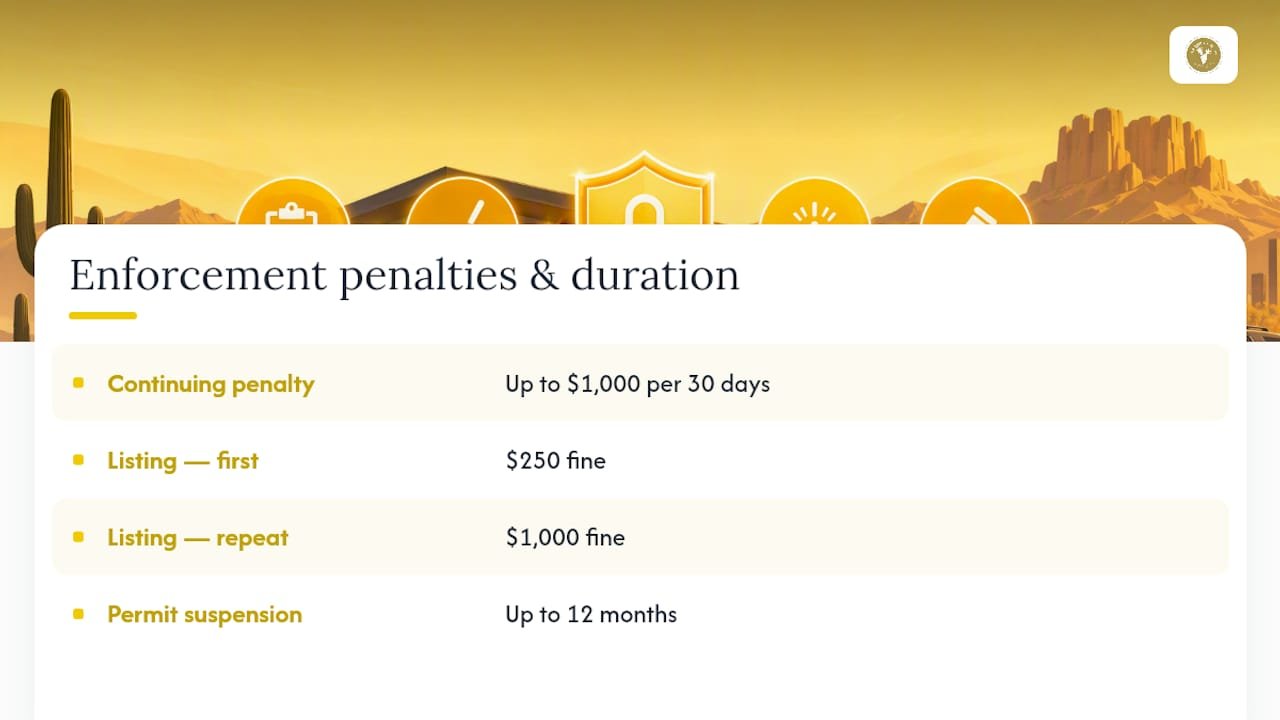
Failing to provide a working emergency contact, or failing to apply for a required permit, can draw a civil penalty of up to $1,000 for every 30 days the violation continues, though local authorities must give 30 days’ notice before the first penalty lands. Online lodging operators face their own fine schedule for listing without a valid TPT license: $250 for a first offense, $1,000 for repeat violations. In serious or repeated cases, a jurisdiction can suspend your permit for up to 12 months, which functionally shuts down your rental income for a full year.
If a notice shows up, don’t panic and don’t ignore it. Document the alleged violation with photos and dates, fix whatever triggered it (missing contact info, an expired permit, a listing without the license number posted), and notify your insurer if the notice references an incident rather than paperwork. For anything involving a suspension threat or a disputed fine, loop in an attorney before you respond in writing. Arizona also allows administrative appeals in most jurisdictions, and that window is usually short.
Step-by-Step Compliance Checklist for 2026
Getting from “thinking about it” to “fully compliant” follows a fairly linear path.
- Register at AZTaxes.gov for your TPT license and select the correct business code (025 for state and county transient lodging, plus 044/144 if your city taxes hotels separately).
- Check your municipal and county rules and apply for any required local permit, gathering neighbor notices or assessor documentation the application demands.
- Post your permit and TPT number on every advertisement and confirm your emergency contact can actually be reached, not just listed on paper.
- Secure liability insurance that covers short-term rental use specifically, and keep documentation of the policy on file.
- Document your tax responsibilities if you use a property management company or online lodging marketplace, and retain records in case ADOR or your city requests an audit trail.
| Step | Action | Where to Do It |
|---|---|---|
| 1 | Get TPT license, pick business code | AZTaxes.gov |
| 2 | Apply for local permit | City or county office |
| 3 | Post permit/TPT number on listings | Every booking platform |
| 4 | Confirm insurance coverage | Your carrier or marketplace policy |
| 5 | Retain tax and compliance records | Owner’s files, PMC records |
Sedona Lessons: What Equity Team Sees Investors Miss
Sedona’s STR market rewards owners who treat compliance as part of the investment, not an afterthought. Because Equity Team works exclusively with short-term rental buyers and sellers in the Verde Valley, we see the same three mistakes surface repeatedly.
The first is skipping neighbor notice requirements because a buyer assumes state preemption means “no local rules apply.” It doesn’t. The second is misreporting the business code on a TPT registration, which either overpays taxes for months or invites a correction notice later. The third, and the costliest, is discovering after closing that an HOA’s CC&Rs restrict rentals under 30 days, something a title search alone won’t catch. Our piece on running an Airbnb in a Sedona HOA covers how to check before you’re under contract, and Sedona’s recent short-term rental restriction changes explain how local ordinances have shifted even as state law stayed put.
Ready to Buy or Sell an Arizona Short-Term Rental?
Compliance is table stakes. The bigger question for most owners we talk to isn’t “can I legally run an Airbnb here,” it’s “did I buy the right property in the right zip code to make the compliance worth it.” Sedona’s top-performing STRs often sit on the same street as underperforming ones, and the difference usually comes down to permit history, HOA terms, and zoning that a buyer never checked before closing.
That’s the work Equity Team does every day. If you’re weighing whether to buy your first Sedona short-term rental or sell one that’s already outgrown your goals, our guide to finding the right short-term rental investment walks through exactly what to check before you write an offer, permit history included.
An Editorial Take on Arizona’s STR Rules
The conventional advice on Arizona short-term rentals treats state preemption as the whole story: “Arizona protects hosts, so you’re fine.” That framing undersells the risk. Preemption stops your city from banning STRs outright, but it does nothing to protect you from a missed permit deadline, a wrong business code, or an HOA clause your title company never flagged. The statutes matter, but they are the floor, not the ceiling.
What actually determines whether an Arizona STR succeeds in 2026 is unglamorous paperwork discipline: the right TPT code, the permit number visible on every listing, the emergency contact who actually answers. Hosts who treat these as afterthoughts eventually meet the $1,000-per-30-day penalty clock, and it runs whether you noticed the notice or not.
If you take one thing from this, prioritize the permit and tax registration before you prioritize furnishing the guest room. Compliance is boring. It is also the difference between an asset and a liability.
— Chad
Sources
- 9-500.39. Limits on regulation of vacation rentals and short-term rentals; state preemption; civil penalties; transaction privilege tax license suspension; definitions
- Short-Term Lodging | Arizona Department of Revenue
- Phoenix short-term rental registry (City of Phoenix)