

A high ADR (average daily rate, the average nightly price guests actually paid) is the shiny red rock of short-term rental investing: gorgeous from the highway, worth a closer hike. Sedona is a textbook high-ADR market, and the buyers who do well there read the rate alongside occupancy, seasonality and the rules, then match it to the right house. That last step is what we do at Equity Team, a Sedona team that works only on short-term rental buying and selling.
TL;DR
- ADR counts only booked nights. RevPAR (ADR × occupancy) shows what a calendar really earned, so read the two together.
- AirDNA’s October 2026 figures for Sedona: a $336 average daily rate, 58% occupancy and $63.4K average trailing-twelve-month revenue per active listing.
- Trackers disagree on Sedona’s ADR because they count different listings. Use market numbers as a starting point, then build the real estimate from comparable homes.
- Weekday demand, shoulder-season strength and permit status separate a durable high-ADR house from a pretty spreadsheet.
- Sedona requires a permit for each rental unit, so confirm permit status before you write an offer.
Table of Contents
- What a high ADR actually tells a buyer
- Sedona’s headline numbers, and why they differ
- Five checks before trusting any ADR
- From ADR to a purchase price that makes sense
- Sedona’s rules belong in the spreadsheet
- Where the rate comes from: the house itself
- Perspective
- Promo: a Sedona STR buyer’s agent
- Quick scorecard for a high-ADR house
- FAQ
- Sources
What a high ADR actually tells a buyer
ADR is the average price paid per booked night. Unbooked nights are left out, according to AirDNA’s definitions. Occupancy is the share of available nights that got booked. Neither number alone says how much money a house made.
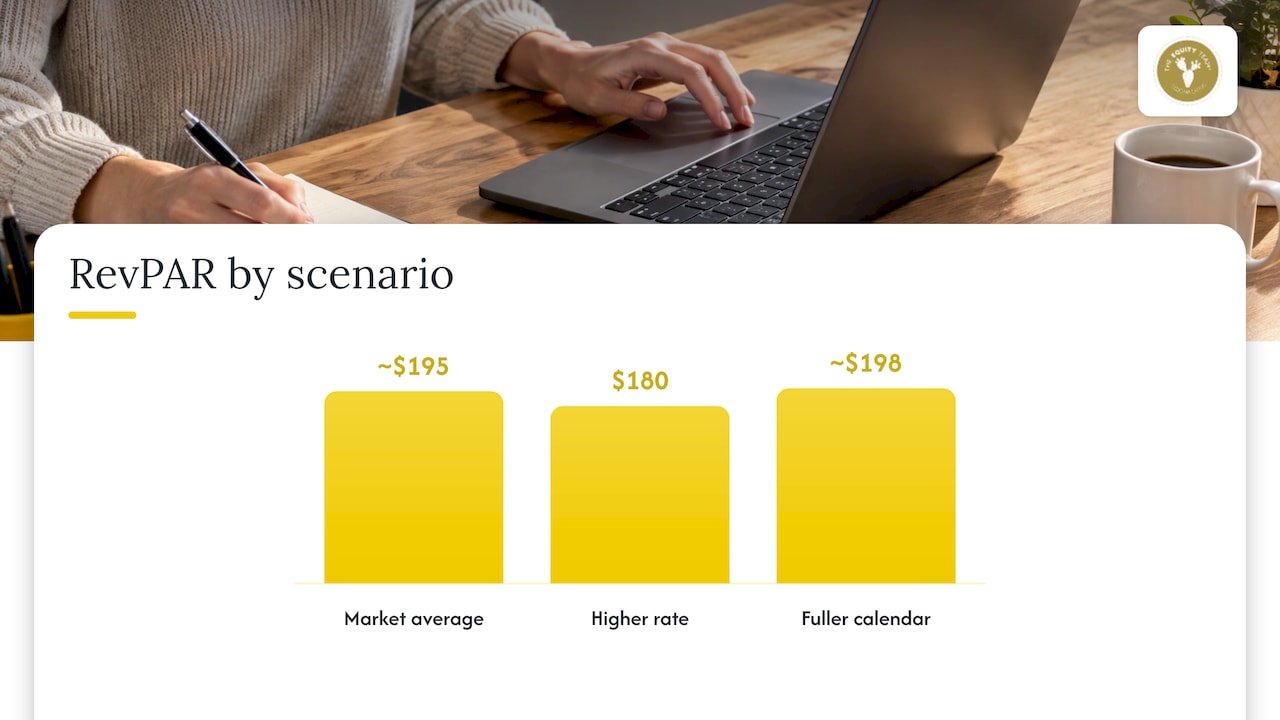
That is why a high ADR can sit next to soft occupancy and still produce a mediocre year. Rate and occupancy can move in opposite directions, so ADR has to be read with occupancy, and ideally with RevPAR. RevPAR is ADR multiplied by occupancy, and because it counts empty nights it is the fuller revenue measure.
A quick example, using Sedona’s AirDNA numbers as a base:
| Scenario | ADR | Occupancy | RevPAR (ADR × occupancy) |
|---|---|---|---|
| Market average (AirDNA, Oct 2026) | $336 | 58% | about $195 |
| Higher rate, thinner calendar | $400 | 45% | $180 |
| Lower rate, fuller calendar | $300 | 66% | about $198 |
The middle row has the brag-worthy nightly price. The bottom row has the better year. Same town, same red rocks, different bank balance. The last two rows are our own illustration of the math, not market data.
Sedona’s headline numbers, and why they differ
As of October 2026, AirDNA reports 3,989 active short-term rental listings in Sedona, a $336 average daily rate, 58% average occupancy and $63.4K in average trailing-twelve-month revenue per active listing. These figures move as the data refreshes, so treat them as a snapshot of that month.
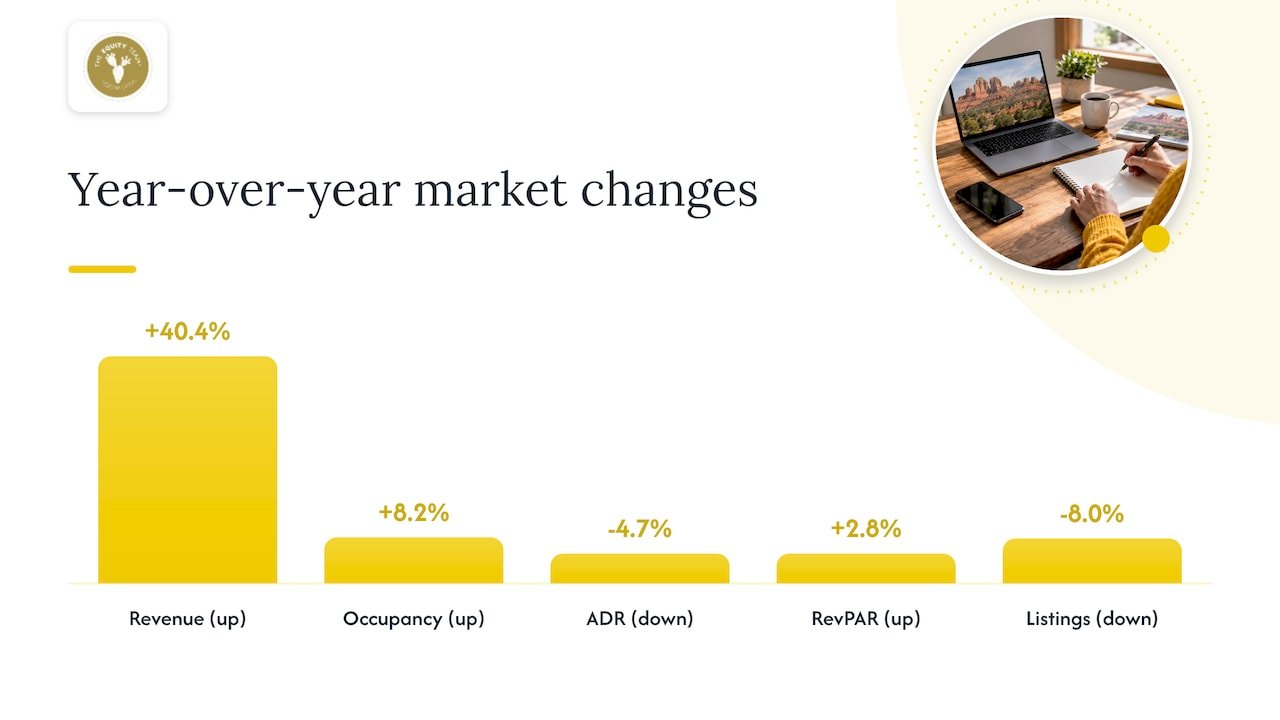
The same source shows how the market shifted between October 2025 and October 2026: revenue up 40.4%, occupancy up 8.2%, ADR down 4.7%, RevPAR up 2.8% and active listings down 8.0%. In plain terms, Sedona guests booked more nights while the average nightly price eased, and fewer listings shared the demand.
Other trackers publish different Sedona ADRs, from roughly $300 to well over $400. That is normal. Each tracker counts a different mix of listings, treats blocked nights differently and uses a different time window. A tracker heavy on luxury homes will show a higher rate than one that includes every studio and casita. The lesson for a buyer: no single market ADR is the number for the house in front of them.
Five checks before trusting any ADR
1. Match the comps to the house
A market-median ADR is only a starting point, because property mix and submarket differ materially. Comparable listings should match on bedroom count, neighborhood and amenity tier. A four-bedroom with a hot tub and red rock views in West Sedona does not borrow its rate from a two-bedroom near the Village of Oak Creek.
This is where a local comparative market analysis earns its keep. Our Sedona vacation rental CMA and the Sedona Airbnb valuation guide show how we line up comparable homes rather than lean on a town-wide average.
2. Look at the shape of the calendar
Sedona’s calendar is not flat. One tracker’s Sedona page describes a March peak and an August trough, which fits the pattern many owners describe: spring and fall shine, midsummer is quieter. A high annual ADR that depends on six great weeks is a different asset from one that holds up across shoulder months.
Ask for the monthly breakdown of ADR and occupancy, not the annual average. For more on Sedona’s seasonal rhythm, see our Sedona STR occupancy data analysis.
3. Test weekday depth
A simple trick: divide Monday through Wednesday occupancy by Friday and Saturday occupancy. Across 1,026 U.S. markets through May 2026, the median ratio was 0.676, and the top-decile threshold was above 0.840. A higher ratio means demand leans less on weekends. Sedona’s hiking, spa and wellness crowd often stays midweek, which is one more reason to look at the house’s own calendar rather than assume.
4. Compare booking pace to last year
Check how far ahead the house is booked compared with the same point last year. A gap far out can simply mean guests are booking later. The point is to see whether bookings arrive in time for the stay dates, so ask the seller for the booking history by month.
5. Look at supply as well as demand
High rates attract new listings. Sedona’s active listing count fell 8.0% in the AirDNA year-over-year data, which helps existing homes share the demand. Watch that number over time. If supply grows faster than bookings, rate pressure usually follows.
From ADR to a purchase price that makes sense
A market number becomes a purchase decision only after the house-level math. The routine we use as a guide:
- Build revenue from comps first. Start with comparable homes and annualize ADR × occupancy.
- Compare it with the seller’s pro forma. Underwrite with the lower of the two. Pro formas may include or leave out cleaning fees, platform commission, management fees and blocked nights.
- Add the full expense stack. Property management if used, platform fees, turnover cleaning that guest fees do not cover, utilities, supplies, maintenance, furniture and soft goods replacement, permit and licensing costs, property taxes, and an insurance quote written for rental use.
- Add debt service. Use your lender’s actual quote, not a rule of thumb.
- Check cash flow at a lower occupancy. Cleaning, wear and tear, utilities and supplies track how often the house turns over rather than the nightly rate, so a high-rate, low-occupancy plan can still strain cash flow.
Our Sedona Airbnb investment playbook walks through the earnings side with local numbers, and the Sedona vacation rental comparative market analysis page explains how a CMA pins the value of a rental-ready home.
Sedona’s rules belong in the spreadsheet
In Sedona, the permit is part of the asset. According to reporting on the city’s amendments, each rental unit needs a permit, accessory dwelling units cannot be used as rentals unless the primary residence is owner-occupied, and units with certificates of occupancy issued before Sept. 14, 2024 are grandfathered. Before offering on any house, confirm with the city and the seller what permit exists, whether it can transfer to a new owner, and whether the property falls under the grandfathered category. A house without a transferable permit sells as an ordinary house, and its ADR history no longer applies.
On the state side, Arizona HB 2429, as engrossed in the House, would let a city or town cap occupancy at two adults per sleeping area plus up to two additional persons, excluding minors, with an effective date after December 31, 2026. Bills change as they move, so check the Legislature’s page for the current status. Buyers underwriting a large-group house should keep the occupancy cap in mind when they set the expected rate.
For a wider view of how Sedona’s market is moving, read our Sedona Airbnb market trends and Sedona real estate market trends pages.
Where the rate comes from: the house itself
In a market where guests pay premium prices, the house decides which part of the market it earns. Views, outdoor living, privacy, and well-chosen amenities push a listing toward the top of its comp set. Our Sedona vacation rental amenity must-haves guide covers the features that fit Sedona guests, and our piece on luxury rental investing explains why even a high-occupancy luxury home still needs a local CMA.
Perspective
Sedona is one of those places where the nightly rate gets all the attention, and the calendar quietly does the work. We represent owners who operate in the top 10% of the rental market, and what sets them apart is rarely a single big number. It is a house that fits what Sedona guests want, a permit that is in order and a purchase price that matches the income the house can actually earn.
That is why we focus on short-term rentals alone. A buyer who walks into a listing with a marketing ADR and no context is guessing. A buyer who sees the comps, the monthly shape of the year and the permit status is deciding. We want every client in the second group, and we build our CMAs and buyer conversations around that.
Sedona is also a market where a house can be a wonderful place to own and a wonderful place to sell later, if the numbers were right on day one. We think of every purchase as a purchase and an exit in one plan.
Chad
Promo: a Sedona STR buyer’s agent
Buying in a high-ADR market goes smoother with an agent who reads rental data for a living. Our team handles buyer representation for Sedona short-term rentals, and if you already own one, our rental exit strategy and valuation conversation puts a local number on what it could sell for.

Thinking of selling a rental? The Sedona vacation rental CMA and our seller prep consultation are built for that, and our buyer process page shows how a purchase unfolds step by step.
Quick scorecard for a high-ADR house
| Question | A strong answer looks like |
|---|---|
| Is the ADR from matching comps? | Same bedrooms, area and amenity tier |
| Is occupancy healthy outside peak months? | Solid spring and fall, reasonable summer |
| Is weekday demand there? | Midweek share above the market median |
| Is the permit clear? | Issued, documented and transferable |
| Does cash flow hold at lower occupancy? | Yes, with real expenses included |
| Is there an exit? | Comps show buyers who value STR income |
FAQ
What is a good ADR for a Sedona short-term rental?
There is no single good number. AirDNA’s October 2026 market-wide average was $336, but the right benchmark is the ADR of comparable homes with the same bedrooms, location and amenities. A CMA for the specific house gives a realistic range.
Is a high ADR better than high occupancy?
Neither wins alone. RevPAR, which is ADR multiplied by occupancy, shows how much a calendar earned, and expenses that scale with turnover mean both numbers matter. Look at the pair, month by month.
Why do different sites show different ADRs for Sedona?
Each tracker counts a different set of listings, treats blocked nights its own way and uses a different time window. That is why published Sedona ADRs range widely. Use them to frame the market, then underwrite the specific house with comps.
Can I run any Sedona house as a short-term rental?
Not automatically. Sedona requires a permit for each rental unit, and accessory dwelling units face extra limits. Confirm the permit and whether it transfers before making an offer.
Sources
- AirDNA: Sedona, Arizona short-term rental data
- Revenue metrics explained: RevPAR, ADR and occupancy
- How to analyze an Airbnb market: thresholds from 1,026 markets
- Nightly rate in short-term rentals
- ADR vs. occupancy: which drives STR cash flow
- Sedona planning board limits on hotels and short-term rentals
- Arizona HB 2429 bill text