

Short-term rental due diligence is the homework that happens before closing: confirm the home can legally host guests, verify the income with real statements, price every recurring cost, inspect the building like a guest would, and know the tax bill waiting at the exit. In Sedona, where red rocks are free but permits are not, skipping any one of those steps can turn a dream rental into a very scenic mistake.
TL;DR
- Legality comes first. Zoning, HOA rules and the city permit can end a deal before an inspector ever opens the electrical panel.
- Real payout statements beat seller projections. Revenue without paperwork is a story, not a number.
- Gross revenue and net income are different animals. Fees, cleaning, management, insurance and taxes take a big bite.
- Build the exit into the purchase. Capital gains, depreciation recapture and 1031 rules shape what a sale actually pays.
- Check the address, not just the town. Nearby parcels can follow very different rules.
Table of Contents
- Why the checklist order matters
- Gate one: Can the home legally operate as a rental?
- Sedona’s permit, insurance and tax basics
- Gate two: Proving the income
- Gate three: The expense stack
- Gate four: The building, inspected like a guest
- Gate five: Stress-testing the deal
- Capital gains on a vacation rental: Planning the exit on day one
- Perspective: What we see from the Sedona side of the table
- Work with a Sedona STR specialist
- FAQ
- Sources
Why the checklist order matters
Most checklists dump forty items in a pile. The smarter way is to treat the purchase as a series of gates. One published Airbnb checklist frames it as four separate decisions a rental must survive: the use must be legal, guest demand must support a realistic revenue estimate, the building must fit the operating plan, and the deal must still pay after every recurring cost.

The same guide stresses working at the property address instead of the city or ZIP-code level, since zoning overlays, permit caps, association rules, insurance availability and flood exposure can differ between neighboring parcels. Sedona is a town where one street can feel like a different planet from the next, so that advice fits nicely.
The order saves money, too. A legal due diligence guide points out that zoning and HOA questions can end the deal entirely, which makes it wasteful to pay for inspections and appraisals before settling them. Ask the legality questions first, and spend inspection money second.
Gate one: Can the home legally operate as a rental?
This is the deal-killer gate. A home that cannot host guests is just a home, however many Instagram-ready sunsets it has.
Worksheets built for this stage tell buyers to record the governing jurisdiction, the current license, and the zoning approval or grandfathering record. They also ask for the holder’s name, the expiration date, what happens to the license when ownership changes, any caps, and any private restrictions such as covenants, HOA rules, lease limits, or lender and insurer conditions.
For Sedona buyers, the local pieces to run down are:
- Zoning and vacation rental zones. Our guide to what a Sedona vacation rental zone is explains how location drives what is allowed.
- Recent rule changes. City rules have shifted over time, and we track them on our page about Sedona short-term rental restriction changes.
- HOAs. An association ban can end legal operation and may carry fines, liens or legal action, which is why one checklist says to check association restrictions before paying for inspections. Our explainer on running an Airbnb in a Sedona HOA covers the local angle.
- ADUs. Guest houses are tempting, and the answer is not always yes. See the rules that matter for an ADU Airbnb.
- Occupancy limits. These cap how many guests the income model can assume. We lay them out in Sedona Airbnb occupancy limits.
A note from the world of regular real estate contracts: a South Carolina REALTORS article advises buyers of properties with rental tenants or rental plans to investigate before contract or during a due diligence period, so there is a way out, and to involve legal counsel for rental terms and contract addenda. The state differs, but the logic travels well. Make sure the contract timeline leaves room for the permit and rule questions.
Sedona’s permit, insurance and tax basics
A local owner’s guide to Sedona lays out the essentials. Every rentable unit needs its own City of Sedona permit tied to the property, permits are not transferable, the permit number must appear in every listing, and owners must carry at least $500,000 in liability insurance and meet neighbor notification requirements. The same guide lists the permit fee at $210 per unit annually, with late renewal fees of $50 and $100 depending on how late.
Those figures can change, so confirm them with the City of Sedona before relying on them. Our page on Sedona Airbnb permits walks through the one-permit-per-unit, every-year idea in plain language.
Taxes come next. The same guide says Arizona transaction privilege tax on short-term rentals is around 5.5%, plus Sedona’s city portion of 3.5% and a county portion that depends on whether the property sits on the Yavapai or Coconino side. Marketplaces collect and remit for their own bookings, but owners still have filing and registration duties, especially for direct bookings. A buyer’s due diligence should include a call to a local CPA before closing, not after the first tax notice.
Gate two: Proving the income
Here is where optimism goes to meet arithmetic.
One diligence guide calls 12 to 24 months of actual Airbnb and VRBO payout statements the only verifiable revenue figure for underwriting. These should be reservation-level exports or payout histories, not seller-made projections or tidy summary spreadsheets. If the seller cannot or will not produce them, that guide says to treat the stated revenue as zero for underwriting. Harsh, but it keeps buyers honest.
If a management company runs the place, ask for its monthly or annual statements showing gross revenue, management fees and net owner distributions with transaction-level detail.
Two more habits help:
- Use a long window. One checklist advises pulling 12 to 24 months of historical occupancy because occupancy data has a shelf life, and a single recent quarter can flatter or scare.
- Think in months. AirDNA’s walkthrough builds a month-by-month estimate, where its example property swings from around $10,000 at the summer peak to under $1,000 in the slowest winter months. It also says to use a defensible comparable set and verify regulation with the local authority.
Sedona has its own rhythm: spring and fall are lively, and the shoulder weeks behave like their own weather system. Our write-up on the current Sedona short-term rental climate and the post on the drop in Sedona short-term rentals give useful context for what the supply side looks like.
Gate three: The expense stack
Revenue is the headline. Net income is the story.
AirROI describes the classic error as treating gross revenue as net income: a listing showing $65,000 in annual revenue can shrink to roughly $32,000 to $38,000 in net operating income after platform fees, cleaning ($85 to $150 per turnover in its example), management at 20% to 25%, utilities, maintenance, insurance and property taxes.
A vacation rental investing guide lists the full expense stack: mortgage, property taxes, insurance, utilities, internet, cleaning, laundry, supplies, repairs, landscaping, pool service, pest control, software, platform fees, payment processing, management, and legal, license and tax costs, plus furniture replacement and capital improvements. It also warns that projections often underestimate maintenance and replacement, and that a buyer should not assume the home is rentable the day after closing.
Insurance deserves its own line. One checklist notes that standard homeowner’s policies often do not cover short-term rental use, so get a quote for the actual rental use before the due diligence period ends.
| Line item | What to verify before closing |
|---|---|
| Revenue | 12 to 24 months of payout statements or management statements |
| Platform and payment fees | Current fee structure for the platforms in use |
| Cleaning and laundry | Per-turnover cost from the actual cleaner |
| Management | Contract terms, and whether fees come off gross revenue |
| Insurance | A written quote covering rental use and the $500,000 liability minimum |
| Taxes | Property tax, Arizona TPT, city and county portions |
| Permits and licenses | Sedona permit status, renewal and ownership-change rules |
| Reserves | Roof, HVAC, plumbing, electrical, furniture refresh |
Gate four: The building, inspected like a guest
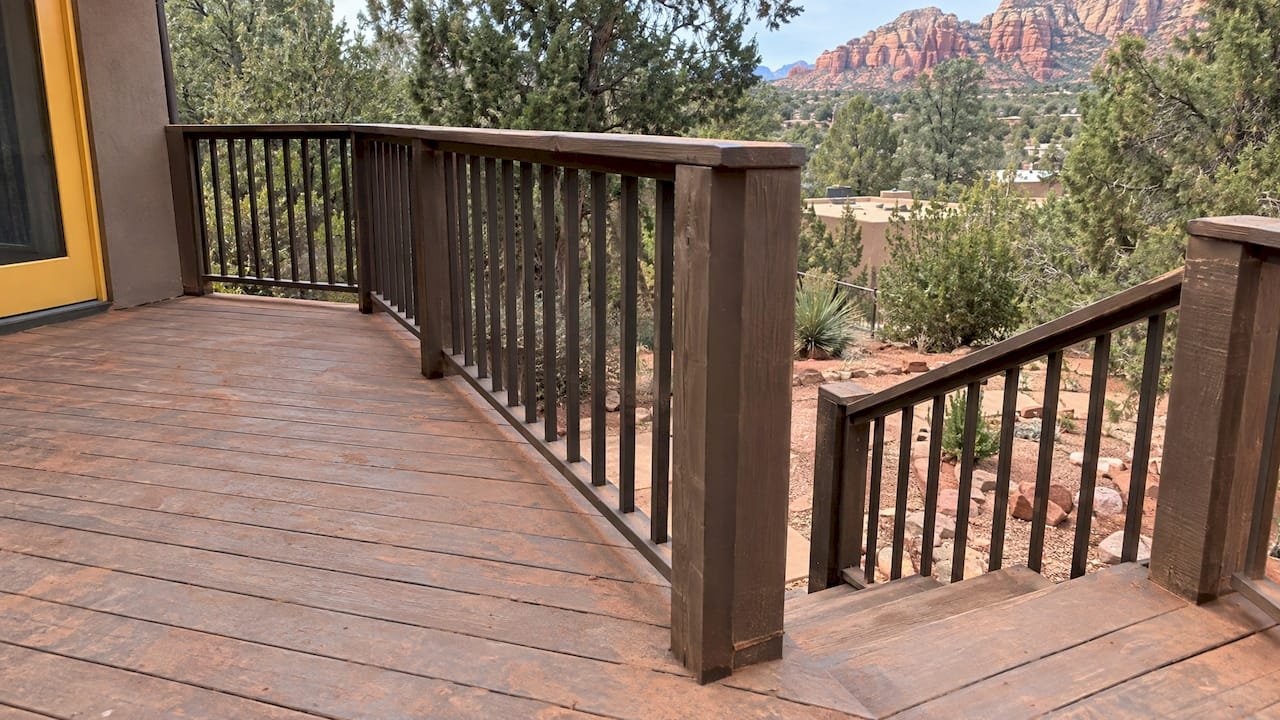
A standard inspection looks at the roof, HVAC, plumbing and electrical systems. Rentals add a guest-experience layer. One checklist adds pool or hot tub condition, deck and patio safety, railings and stairs, fire safety features, security features and noise transmission.
Sedona adds its own quirks: red-dust-covered decks, hot tubs facing the stars, and steep driveways that rental guests will test with enthusiasm. Wildfire season matters for escrow and insurance, so read our wildfire steps for buyers and sellers.
Guest comfort also drives pricing. Details like workspaces, bedding and outdoor spaces are part of the story on amenities that earn higher rents, and our own list of Sedona vacation rental amenity must-haves is tuned to what Sedona guests look for.
Gate five: Stress-testing the deal
The last buying-side step is to poke the model until it complains. For financed deals, AirROI puts the debt service coverage ratio (DSCR) thresholds at 1.25x minimum for most DSCR lenders, 1.35x or more for preferred rates, and 1.50x or more for a strong margin of safety in seasonal markets. Another checklist calls a deal fragile if DSCR drops below 1.0 in a stress case.
Sensible stress cases include lower occupancy, a slower first season, higher repair costs and a rate change. One investing framework also suggests modeling a conventional long-term rental floor, since a short-term strategy rides on a single regulatory and demand regime.
For Sedona luxury homes, high occupancy still needs local comparables, a point we make in Sedona luxury rental investing.
Capital gains on a vacation rental: Planning the exit on day one
Buyers rarely want to think about selling while they are still picking out towels. They should, because the exit bill shapes the real return.
One tax guide explains that the portion of gain from genuine appreciation is taxed as long-term capital gains at 0%, 15% or 20%, depending on taxable income. Depreciation changes the picture: unrecaptured Section 1250 gain, which comes from building depreciation, is taxed up to a 25% maximum rate, while accelerated depreciation on personal property components can be recaptured under Section 1245 as ordinary income without that ceiling.
Two more levers matter:
- Passive loss rules. Legal due diligence guidance says a property with an average guest stay of seven days or fewer is not treated as a rental activity under passive activity rules, and loss treatment then depends on material participation.
- 1031 exchanges. Section 1031(a)(1) allows an exchange of qualifying real property held for business or investment into like-kind property without recognizing gain, but doing it incorrectly can make the entire gain taxable in the year of sale.
Records help. One accountant’s guide to 1031 exchanges says to keep the exchange agreement with the Qualified Intermediary, identification notices, contracts and closing statements, depreciation schedules and Form 8824. Treat all of this as a conversation for a CPA or tax attorney before listing, since the outcome depends on your own numbers. Our piece on preparing a Sedona rental for sale covers the tax traps owners meet.
Perspective: What we see from the Sedona side of the table
Most of the buyers who come to us have already seen the shiny listing photos. What they usually have not seen is the paperwork behind them. We are a team that works only on Sedona short-term rental investment, and that focus shapes how we guide a purchase.
Our approach is simple: legality first, statements second, spreadsheet third. A Sedona rental can be a wonderful business, but the best ones are chosen with local knowledge of zones, permits, HOAs and the quirks of each street, not just a pretty view.
We also like to talk about the exit before the offer. Sellers who planned ahead tend to have cleaner records and stronger conversations, and buyers who understand resale value make steadier choices. That is why we offer a vacation rental CMA and an exit strategy conversation alongside buyer and seller representation.
Chad
Work with a Sedona STR specialist
Due diligence goes faster when the person beside the buyer already knows the zones, the permit process and what top-performing Sedona rentals look like. The Equity Team represents buyers and sellers of Sedona short-term rentals and high-performing homes. For a buyer, that starts on our home page. Owners thinking about selling can ask about a Sedona vacation rental CMA and seller prep consultation.

Not sure whether to hold or sell? The rental exit strategy and valuation conversation is a good place to start.
FAQ
When should short-term rental due diligence happen?
Before the contract’s due diligence period runs out, and ideally before an offer for the legality questions. Zoning, HOA and permit issues can end a deal, so they go ahead of inspections. Financial checks and inspections then fit inside the contract window.
What is the difference between vacation rental and short-term rental due diligence?
In practice, nothing. Both mean verifying legality, income, costs, building condition and exit taxes. In Sedona, the details are the city permit, the zone, HOA rules, and Arizona and local tax filings.
How is capital gains tax on a vacation rental figured?
Appreciation is generally taxed as long-term capital gains at 0%, 15% or 20% depending on income, and depreciation recapture can be taxed separately, up to 25% for building depreciation. A 1031 exchange may defer gain if done correctly. A CPA can run the real numbers for a specific sale.
Does a Sedona short-term rental permit transfer to a new owner?
According to a local owner’s guide, Sedona permits are tied to the property and are not transferable, and each unit needs its own. Confirm the current process with the City of Sedona before making an offer.
What documents should a seller provide?
Ask for 12 to 24 months of Airbnb and VRBO payout statements, or management company statements if the home is managed. Summary spreadsheets and projections are not a substitute for reservation-level records.
Sources
- Airbnb Due Diligence Checklist: Evaluate the Property
- STR Legal Due Diligence: 7 Legal Questions
- STR property due-diligence worksheet
- The Short-Term Rental Due Diligence Checklist: 12 Things
- Buyers and Investment Rental Properties and Vacation Rental Properties
- The Honest Sedona Vacation Rental Owner’s Guide
- STR Due Diligence: What Your Buyer’s Agent Doesn’t Know
- How to Analyze a Short-Term Rental Before You Buy
- Evaluate an Airbnb Before You Buy
- Vacation Rental Investing: A Practical Due-Diligence Guide
- The Essential Short-Term Rental Due Diligence Checklist
- Short-Term Rental Due Diligence Checklist
- How to Analyze a Short-Term Rental Before You Buy It
- Taxes When Selling a Short-Term Rental in 2026
- You Can Do a 1031 Exchange With an STR Property
- 1031 Exchanges in 2025: 45/180-Day Rules
- Top Rental Suite Amenities That Earn Higher Rents