

A fixed-rate mortgage keeps the same interest rate for the whole loan. An adjustable-rate mortgage (ARM) starts with a fixed stretch, then the rate moves with an index, so the payment can climb or fall. For a Sedona short-term rental buyer, the deciding question is usually not “which rate is lower today?” but “how long will this house stay in the portfolio, and can the cash flow survive the worst-case payment?”
Sedona is a town where red rocks change color by the hour, so it seems only fair that some mortgages change too. Here is how the two loan types work, what the math looks like, where portfolio loans fit, and how to keep a closing from drifting past its date.
TL;DR
- A fixed rate locks principal and interest for the life of the loan. An ARM is cheaper at the start, then adjusts, within caps, after its introductory period.
- Holding period is the first filter. Short plans can suit an ARM. Long plans and low tolerance for payment surprises favor fixed.
- Test an ARM against its maximum possible payment, not its teaser rate. Never count on a refinance or a sale to bail it out.
- Portfolio loans are kept on a lender’s own books, so terms vary widely, and many investment versions are ARMs with a balloon.
- Rental-income rules are tightening: Fannie Mae’s new short-term-rental income requirements apply to applications dated on or after November 1, 2026.
Table of Contents
- How the two loans actually work
- What a payment swing looks like
- Which one suits which plan
- Portfolio loans vs conventional loans
- Short-term rental income and the new underwriting rules
- Keeping a closing on schedule
- Our perspective
- Talk to a Sedona short-term rental specialist
- FAQ
- Sources
How the two loans actually work
The Consumer Financial Protection Bureau puts it plainly: with a fixed rate, the interest rate is set at the start and does not change for the loan term, so the principal-and-interest payment stays steady. An ARM has an initial fixed period, then adjusts based on an index plus a margin, subject to caps.
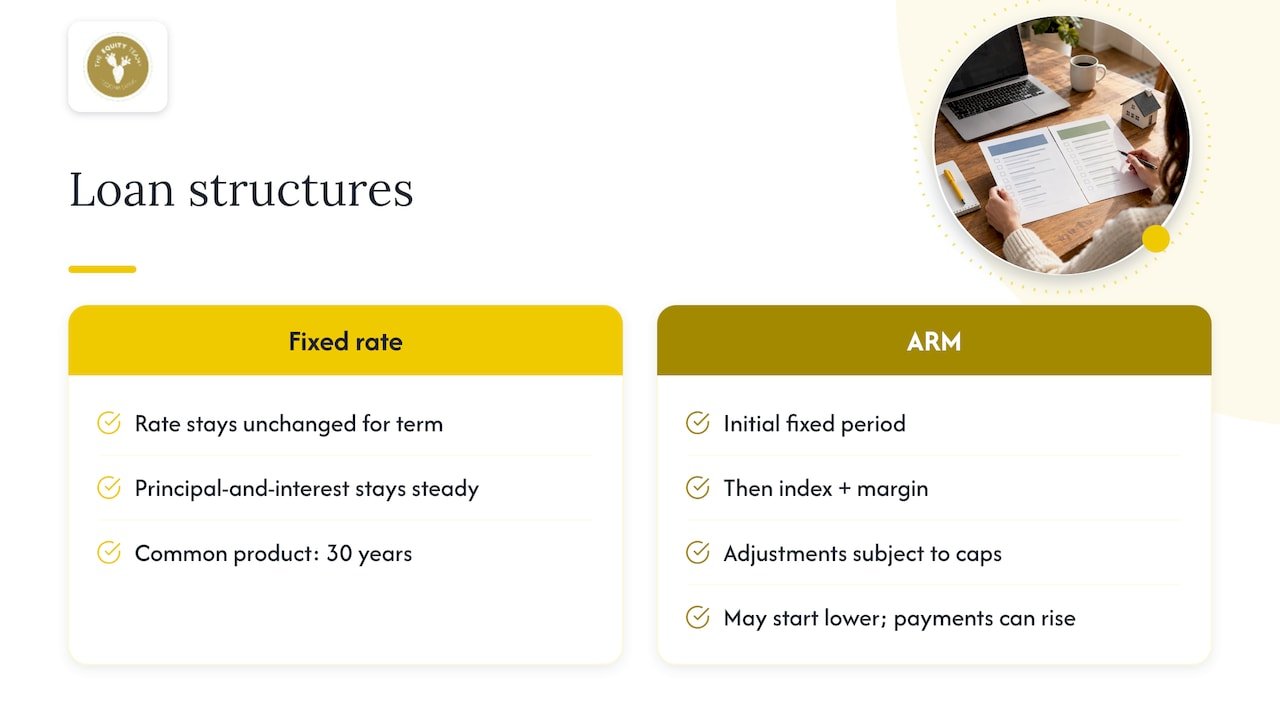
The FDIC describes the most common fixed product as a 30-year loan with level principal-and-interest payments for its entire life. An ARM, it notes, can begin with a lower rate, but payments may increase significantly later.
Reading an ARM name
The numbers in an ARM’s name are a little code. In the CFPB’s ARM booklet, the first number is the length of the initial rate period and the second is how often the rate adjusts afterward. A 5/6m ARM, for example, holds for five years and then adjusts every six months.
Three pieces decide what happens next:
- Index: the benchmark the lender follows.
- Margin: the lender’s add-on, which is added to the index to produce your rate.
- Caps: limits on how far the rate can move at each adjustment and over the life of the loan. The CFPB notes caps limit some increases, but the payment can still rise substantially.
The 30-year fixed vs ARM snapshot
| Feature | 30-year fixed | ARM (for example 5/6m) |
|---|---|---|
| Rate during the first years | Set at closing, never changes | Set at closing, usually lower, changes after the intro period |
| Payment predictability | Principal and interest stay level | Can rise or fall at each adjustment |
| Biggest risk | Paying a higher rate for years if rates fall and you cannot refinance | Payment jumps if the index rises, even with caps |
| Best match | Long holds, tight cash flow, low tolerance for surprises | Short holds, or a budget that survives the maximum payment |
What a payment swing looks like
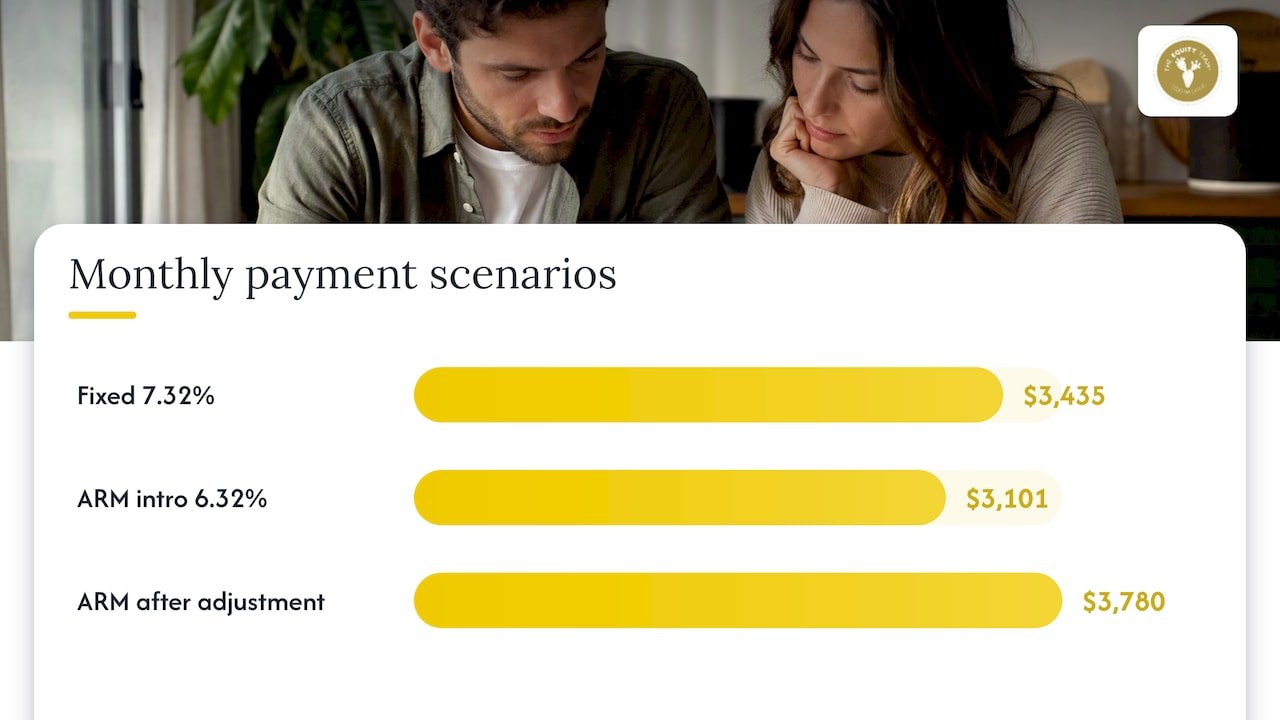
Numbers beat adjectives here. The most recent weekly survey from Freddie Mac put the 30-year fixed average at 7.32% as of October 22, 2026, up from 6.19% a year earlier. That figure moves every week, so treat it as a snapshot, not a quote.
Now an illustration. The rates below are assumptions chosen to show the mechanics, not offers from any lender, and the figures are rounded principal-and-interest payments on a $500,000 loan over 30 years.
| Scenario | Rate | Monthly principal and interest |
|---|---|---|
| Fixed for 30 years | 7.32% | about $3,435 |
| ARM introductory rate (assumed one point lower) | 6.32% | about $3,101 |
| ARM after a 2-point first adjustment | 8.32% | about $3,780 |
The ARM saves roughly $334 a month at the start. If the rate then adjusts up two points, the payment lands about $345 above the fixed payment. The last row ignores the small amount of principal paid down in the meantime, which would trim it slightly, but the shape of the story holds: a modest head start, then a real risk.
That is why the CFPB’s central advice is to judge an ARM by the maximum payment you could be asked to make, not by the introductory rate. And the agency is clear that borrowers should not assume they can simply refinance or sell their way out.
Which one suits which plan
The FDIC suggests starting with how long you expect to own. Borrowers who expect to sell within a few years may benefit from a lower initial ARM rate. Borrowers who expect to keep the property for a long time should check that they could afford the ARM’s highest possible payment, per the FDIC’s first-mortgage guidance. The CFPB says much the same: fixed rates fit people who want predictable payments or long ownership, while ARMs fit those who can afford the maximum payment or plan to sell within a short period.
For a Sedona short-term rental, translate that into three questions:
- How long is the hold? A buyer planning to renovate, stabilize bookings and sell in three to five years sits in a different spot than one building a long-term cash-flow machine.
- What does the property earn in a slow month? Sedona’s calendar has its shoulder seasons, and the mortgage does not take a vacation. Underwrite the payment against a soft winter, not a spring-break week. Our guide to finding the right short-term rental investment walks through that kind of stress test.
- What happens at the cap? If the worst-case payment turns a profitable rental into a monthly donation to the bank, the ARM is not a bargain, it is a bet.
When fixed wins
A fixed rate is the calmer choice for a buyer who wants the numbers on the spreadsheet to stay put for years. If rates later fall, refinancing is a possible route, not a promise. If they rise, the fixed borrower never has to care.
When an ARM can make sense
An ARM can earn its keep when the holding period is short and well defined, or when income is strong enough that the maximum payment is still comfortable. A planned exit helps too. If an owner is thinking about selling, our rental exit strategy conversation is a good place to line up the timeline with the loan.
Portfolio loans vs conventional loans
A conventional loan is typically written to standard guidelines so it can be sold on to investors. A portfolio loan is the opposite: the lender keeps it on its own books, so it sets its own rules. That flexibility is the appeal, and it is also why terms differ so much from one lender to the next.
To see how different they can be, look at one credit union’s published wholesale guideline. Its portfolio ARM uses a 30-year amortization and, for investment properties, a 15-year balloon. Its examples include 3/1, 5/1 and 7/1 structures with 2/2/6 caps. It allows investment properties up to 75% loan-to-value and permits LLC title, subject to its own borrower and title requirements. That is one lender’s program, not an industry standard, which is exactly the point.
Portfolio loan pros
- Flexible underwriting: lenders can look at the whole borrower, including several properties, rather than a single checklist.
- Possible LLC ownership: some programs allow it, as the guideline above shows.
- Tailored structures: terms, caps and balloons are set by the lender, so a good match can be genuinely useful.
Portfolio loan cons
- Balloon risk: a 15-year balloon means a large balance comes due and must be paid or refinanced.
- Adjustable rates: many portfolio products are ARMs, so everything above about payment caps applies.
- Inconsistent terms: there is no standard menu. Comparing offers takes more work.
- Prepayment terms: read the fine print before signing. A prepayment penalty can complicate a later sale.
For investors who also look at debt-service-coverage products, which qualify on a property’s rental income rather than personal income, our breakdown of the DSCR loan vs conventional mortgage lays out the trade-offs. For a wider look at financing options for investment property, that article covers other routes investors weigh.
Short-term rental income and the new underwriting rules
Here is a date worth circling. Fannie Mae’s Selling Guide announcement SEL-2026-08, dated September 2, 2026, introduces new requirements for short-term-rental income, including alternative documentation and conservative treatment of qualifying income. They apply to applications dated on or after November 1, 2026.
In plain terms, buyers who plan to count projected Airbnb revenue toward qualifying should expect lenders to ask for more paperwork and to credit less of it. A buyer with a well-documented rental history will have an easier time than one pointing at a hopeful projection. Individual lenders may layer their own rules on top, so ask early how your loan officer will treat short-term rental income.
Appraisals add another wrinkle. Revenue does not always show up as value, which we unpack in why $47,600 in average Airbnb revenue rarely raises appraised value. Financing and valuation tend to arrive at the same table.
Keeping a closing on schedule
Investment purchases have more moving parts than a plain-vanilla home loan, and delays usually come from a few predictable places. The CFPB’s rules give a useful map.
The paper timeline
- Loan Estimate: a lender generally must provide it within three business days after receiving six application items: name, income, Social Security number, property address, estimated value and requested loan amount, per the CFPB’s disclosure FAQs.
- Closing Disclosure: it must be received at least three business days before closing, so there is time to compare final terms against the Loan Estimate, as the CFPB explains in its guide to the two forms.
- Corrections: per the same FAQs, a corrected Closing Disclosure restarts the three-business-day wait if the APR becomes inaccurate, the loan product changes or a prepayment penalty is added.
That last one matters when buyers swap loan types late. Moving from a fixed loan to an ARM, or the reverse, in the final week can reset the clock.
The human timeline
The CFPB also warns that slow documentation of income, assets or other requested items can delay closing, let a rate lock expire and, if the contract has a deadline, put the purchase and the deposit at risk. The same page recommends collecting Loan Estimates from three or more lenders and telling your chosen lender within ten business days that you intend to proceed, because terms may be revised after that.
A short checklist to dodge delays:
- Gather tax returns, bank statements and rental records before the offer, not after.
- Choose the loan type before the contract deadline, not during the final week.
- Ask whether a rate lock covers the full closing window, with a cushion.
- For portfolio or LLC deals, confirm title and entity paperwork at the start.
- Respond to lender requests the same day. Underwriters have long memories and short patience.
More pointers live in our tips for real estate buyers and borrowers.
Our perspective
We work only with short-term rental properties in Sedona, and the loan conversation comes up in nearly every deal. Our view is simple: the best mortgage is the one the property can carry on its worst month, not its best one.
We tend to treat a fixed rate as the default for an owner who plans to hold, and an ARM as a deliberate tool with a plan attached, never a hopeful guess about future rates. We also like to see the exit mapped out before the purchase, because a sale or a refinance is an event with its own timing, costs and market, not a guarantee.
The paperwork matters as much as the rate. A buyer with clean income records, a lender who understands short-term rental income and a realistic hold period will outrun a buyer with a slightly lower rate and a messy file. Sedona is a quirky little market, and it rewards people who read the fine print before the red-rock sunset distracts them.
— Chad
Talk to a Sedona short-term rental specialist
Picking the loan is one decision. Picking the right house is the other. If you are buying, our buyer representation is built around short-term rental performance, so the property, the numbers and the financing conversation line up. If you are weighing a sale, a Sedona vacation rental CMA shows what the home may fetch before you decide how to handle the loan.
FAQ
Is a fixed or adjustable mortgage better for a short-term rental?
It depends on the hold and the cushion. A fixed rate suits owners who plan to keep the property and want a steady payment. An ARM can suit a short, defined hold, as long as the property still works financially at the loan’s maximum payment.
Is a 30-year fixed better than an ARM?
A 30-year fixed offers level principal-and-interest payments for the whole loan, which makes budgeting simple. An ARM usually starts lower but can rise after its introductory period, so it makes more sense when you expect to sell or can comfortably absorb the highest possible payment.
What is the difference between a portfolio loan and a conventional loan?
A conventional loan follows standard guidelines, while a portfolio loan is held by the lender and follows its own. That can mean more flexibility, such as LLC ownership or multi-property lending, but also less uniform terms, and sometimes an adjustable rate or a balloon.
Can closing on an investment property be delayed by the loan?
Yes. Slow paperwork, an expired rate lock or a corrected Closing Disclosure can push the date. The CFPB says certain changes, such as a new loan product or an added prepayment penalty, restart a three-business-day waiting period.
Sources
- CFPB: difference between fixed-rate and adjustable-rate mortgages
- CFPB: Adjustable Rate Mortgages booklet
- FDIC: Mortgages
- FDIC: Applying for Your First Mortgage Loan
- Freddie Mac: Primary Mortgage Market Survey
- Advancial: wholesale detailed guideline
- Fannie Mae: Selling Guide Announcement SEL-2026-08
- CFPB: TILA-RESPA integrated disclosure FAQs
- CFPB: Loan Estimate and Closing Disclosure guide
- CFPB: Intent to proceed