

Yes, we can help you find privately marketed Sedona deals, and the fastest route runs through an STR specialist agent like our team paired with targeted owner outreach and creative financing. The two channels that move fastest are agent pocket listing networks and owner-motivated seller leads tied to seller carry terms. Your next move: get on a coming-soon alert list before the red rocks beat you to it.
TL;DR:
- Prioritize a short term rental specialist’s pocket listings, which are typically more vetted and faster to close than leads from cold owner outreach.
- For owner outreach, name the property, give a realistic timeline, and include proof of funds or preapproval rather than sending a generic inquiry.
- Seller carry can bypass lender approval delays on rural or unconventional properties, but verify mortgage payoff, title history, and liens before making an offer.
- Before closing, confirm short term rental eligibility in writing, then check county rules, homeowners association restrictions, septic capacity, water rights, wildfire risk, and road access.
- Choose a private deal when speed, privacy, or flexible terms outweigh price discovery; an open market sale better supports competition for the highest price.
Table of Contents
- What Counts as an Off Market or Coming Soon Deal in Sedona
- Channels That Actually Surface Sedona Off Market Deals
- Creative Financing Options That Help Close Off Market Sedona Deals
- Step by Step Checklist to Pursue and Close an Off Market Sedona Purchase
- Timeline and Cost Expectations for Sedona Private Deals
- Due Diligence and Sedona Specific Checks for STR Investors
- How The Equity Team Accelerates Access and Structures Off Market STR Deals in Sedona
- Author’s Take: When Off Market Is the Right Move for Sedona Investors
- Work With The Equity Team on Your Next Sedona STR Purchase
- FAQ
- Sources
What Counts as an Off Market or Coming Soon Deal in Sedona
Sedona’s off market world runs on a few flavors of quiet. A pocket listing lives only in an agent’s phone, never touching the open market. A private listing might get a flyer and a handshake but skips the MLS entirely. Coming soon status means a property is almost ready for daylight, often used to build buyer interest before the official debut. And then there’s the classic owner-to-owner deal, which is exactly what it sounds like: no agent, no sign, just two people and a surprising amount of trust.
Sedona sellers lean toward these quieter paths for reasons that make sense once you know the terrain. Privacy matters a lot here, especially for STR owners who would rather not announce their rental income to every curious neighbor. Luxury and raw land transactions also tend to stay private simply because there are fewer buyers who qualify, so broad marketing rarely pays off.
- Pocket listings: shared only within a trusted agent network, never publicly posted.
- Coming soon: a preview window before the official MLS launch.
- Owner-to-owner: direct deals with no broker involved at any stage.
- Land and luxury parcels: often marketed privately due to a thin buyer pool.
Sedona’s population sits at roughly 9,619 residents, a small enough number that word of mouth genuinely moves real estate. In a town this size, scarcity isn’t a marketing buzzword. It’s math.
Channels That Actually Surface Sedona Off Market Deals
Finding these listings takes more than refreshing Zillow at midnight. It takes relationships, a bit of persistence, and knowing exactly where Sedona’s quiet deals tend to surface.
- Cultivate an STR specialist agent relationship. Agents who work exclusively with short-term rental buyers hear about pocket listings before anyone else because sellers trust them to bring serious, qualified buyers.
- Reach out directly to absentee owners. Many STR properties are owned by people who live elsewhere, and a polite, specific letter asking about their plans can open doors that public listings never will.
- Track probate and estate leads. Properties moving through probate often sell quietly to avoid delay, making them a reliable source of motivated sellers.
- Connect with builder and land pipelines. Local builders and land developers frequently know about parcels months before they’re ready for public marketing.
- Join investor networks and vetted private groups. Sedona has a tight community of STR investors who trade leads, but vet any group carefully since not every “private marketplace” is what it claims to be.
Outreach only works if the message gets read. Skip the generic “Are you interested in selling?” opener. Mention the specific property, a realistic timeline, and proof you’re a serious buyer, whether that’s proof of funds or a pre-approval letter. Short, specific, and respectful beats long and salesy every time.
Pro Tip: Lead with a specific detail about the property, not your offer; owners respond to buyers who clearly did their homework.
Our own Sedona real estate market trends page tracks which neighborhoods tend to produce these quiet deals most often, which helps narrow where outreach actually pays off. Pair that with insight from a resource like YH Luxury Homes, which works a similar private sale playbook in the Las Vegas luxury market and offers a useful outside reference for how concierge level buyer representation operates.
Creative Financing Options That Help Close Off Market Sedona Deals
Off market sellers often want flexibility just as much as they want a number, and that’s where creative financing earns its keep. Seller carry, also called seller financing, lets the owner act as the bank: the buyer makes payments directly to the seller under agreed terms instead of going through a traditional lender. A typical structure might include a meaningful down payment, a fixed interest rate, and a balloon payment after several years. Sellers like the steady income and the tax spread; buyers like skipping a slow underwriting process on a unique property that a bank might hesitate to appraise.
- Subject-to financing: the buyer takes over existing loan payments without formally assuming the loan, useful when a seller needs a fast, clean exit.
- Lease options: a trial period where the buyer rents with the right to purchase later, often used when financing needs more time to line up.
- Joint venture equity splits: a seller and buyer share ownership and proceeds, common on raw land or development parcels.
- Short-term hard money bridges: fast, higher-cost financing meant to close quickly before refinancing into a standard loan.
Our seller carry seller financing in Sedona resource breaks down how these terms typically get structured locally, since Sedona’s unique land and STR properties sometimes slow down conventional bank appraisals. Seller carry financing is a practical bridge in Sedona specifically because bank underwriting on unconventional or rural parcels can stall a deal for months.
When presenting a creative offer, come prepared. Ask for the payoff balance on any existing mortgage, a clear title history, and documentation of any liens. A well-organized offer with real numbers, not vague promises, is what turns a curious seller into a closed deal.
Step by Step Checklist to Pursue and Close an Off Market Sedona Purchase
Chasing a quiet deal without a plan is how good opportunities slip away. Here’s the sequence that keeps things moving.
- Define your target filter. Decide on price range, property type, and whether you’re buying cash or arranging financing before you start outreach.
- Line up financing and backup exits. Know your ceiling, your preferred structure, and what you’ll do if your first choice falls through.
- Prioritize agent-sourced leads first. A specialist agent’s pocket listings tend to be more vetted and faster to close than cold outreach.
- Follow with targeted owner contact. Reach absentee owners and probate leads directly once your agent channel is warmed up.
- Run full due diligence. Pull title history, verify survey boundaries, check HOA or deed restrictions, and confirm STR compliance with the county.
- Schedule inspections early. Septic, roof, and structural inspections matter even more on older or rural Sedona parcels.
- Submit your offer with clear protections. Include earnest money terms, inspection contingencies, and realistic escrow timelines in writing.
- Finalize escrow instructions. Confirm who holds funds, how disbursement works, and what triggers release at closing.
- Close and record the deed. Double check recordation with Yavapai County to confirm the transfer is official.
- Set up STR operations if renting. Register with the county, set occupancy limits, and get your listing live only after compliance is confirmed.
Our guide to finding the right Sedona short-term rental investment walks through real underwriting examples that pair well with this checklist once you’re evaluating a specific property.
Timeline and Cost Expectations for Sedona Private Deals
Private deals in Sedona can move faster than MLS sales since there’s no public listing period to wait through, but the timeline still depends heavily on financing. A cash purchase with simple seller carry terms can close in a matter of weeks. A deal requiring traditional bank financing on a unique rural parcel often takes considerably longer, since appraisals on nonstandard properties tend to need extra scrutiny.
Expect a few categories of out-of-pocket costs regardless of how the deal is financed.
- Inspection costs for structural, septic, and well systems where applicable.
- Title search and insurance fees to confirm clean ownership.
- Short-term financing interest if using a hard money bridge before refinancing.
Sedona’s land is genuinely scarce. At about 535 people per square mile across roughly 18.3 square miles, the city has little room left for new inventory, which keeps private and coming-soon deals in steady demand.
Seller carry financing can also shift the cost picture by lowering the upfront cash needed and spreading the down payment across negotiated terms, which sometimes shortens the time to close since there’s no lender approval to wait on.
Due Diligence and Sedona Specific Checks for STR Investors
Buying off market doesn’t mean skipping homework, it means doing it carefully since there’s no agent-vetted listing sheet to lean on. A few checks matter more in Sedona than almost anywhere else.
- Confirm current short-term rental permitting rules with Yavapai County or the City of Sedona before assuming a property can operate as a vacation rental.
- Review HOA and deed restrictions closely, since some communities around Sedona explicitly prohibit or limit short-term rentals.
- Check septic system capacity and maintenance history, since many properties outside city limits rely on them instead of municipal sewer.
- Verify water access and well rights where applicable, particularly on rural or larger parcels.
- Assess wildfire risk and road access, since some of Sedona’s most scenic properties sit on unpaved or seasonally limited roads.
Pro Tip: Always confirm STR eligibility in writing from the county before closing, verbal assurances from a seller are not the same as a permit.
How The Equity Team Accelerates Access and Structures Off Market STR Deals in Sedona
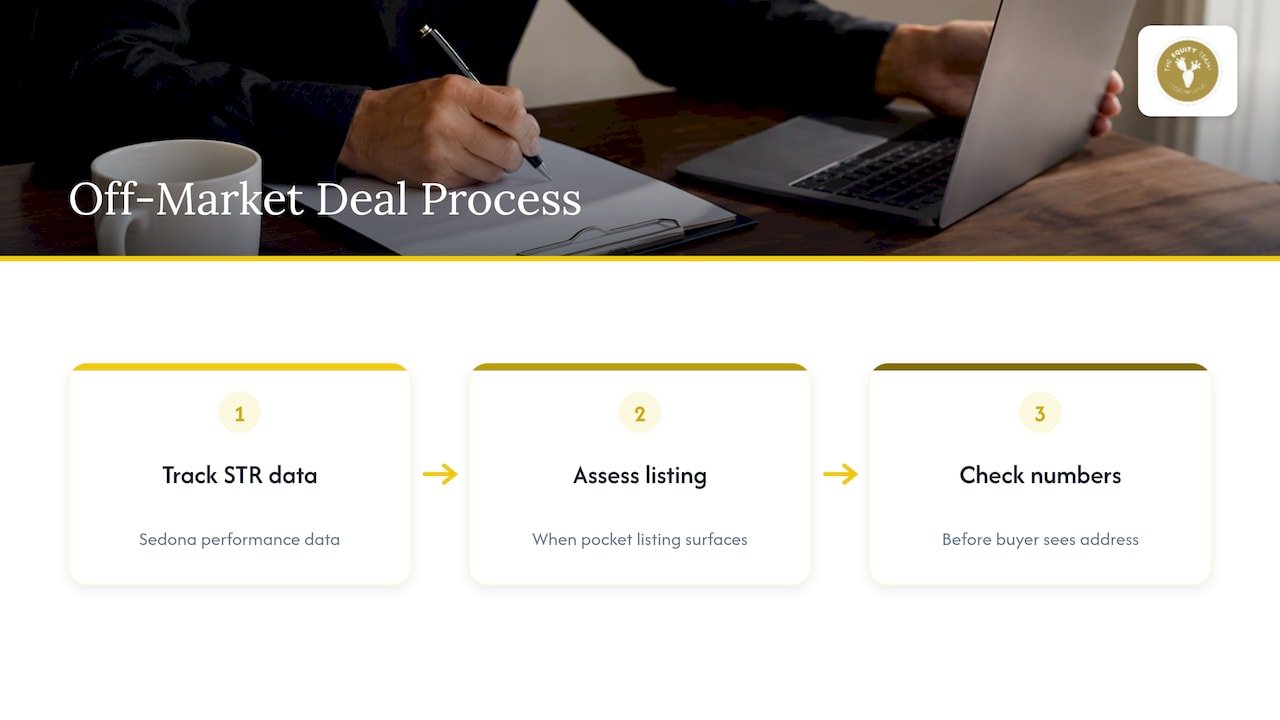
We built our team to be a dedicated short-term rental specialist group, and that focus is exactly what opens doors to listings that never make it to the public market. We track Sedona STR performance data closely, which means when a pocket listing surfaces, we already know whether the numbers work before you ever see the address.
Our services line up directly with what off market buying requires: buyer representation built around STR underwriting, a Sedona Home CMA to pressure test pricing, and hands-on guidance structuring seller carry terms when a traditional loan would slow things down. We also help sellers price and prep STR properties, which means we often know about a coming-soon listing well before it reaches anyone else.
If you’re ready to start, send your target price range, financing preference, and whether you’re open to seller carry terms. From there, guidance can be provided on what’s currently quiet on the market and how fast a realistic timeline looks for your situation.
Author’s Take: When Off Market Is the Right Move for Sedona Investors
Off market makes the most sense when privacy, speed, or a creative financing structure matters more to you than squeezing out the absolute highest price. If a seller needs a fast, quiet exit and you’re ready with real numbers, that’s a strong match. An open MLS sale still wins when maximum price discovery is the goal, since competition among buyers tends to push value upward in a way a quiet deal rarely can.
My rule of thumb: chase off market when speed and terms matter more than price ceiling, and let the open market do its job when you want the highest possible number.
— Chad
Work With The Equity Team on Your Next Sedona STR Purchase
We specialize in exactly the kind of deal this article covers: STR-focused buyer representation, Sedona CMAs that reflect real rental performance, and seller carry structuring when a bank loan would slow you down. If you want access to listings before they go public, this is the lane we live in.

Ready to move? Request a Sedona Home CMA or start a conversation through our main site to get on our coming-soon alert list.
- Have proof of funds or a pre-approval letter ready.
- Know your target price range and financing preference.
- Decide whether seller carry terms fit your plans before reaching out.
FAQ
Is Sedona Cheap to Live in?
Sedona is not a budget destination. Its small size and high demand, with a population around 9,619 people, keep housing costs well above the national average.
Are There Any Ghost Towns for Sale in Arizona?
Arizona does have several historic ghost town sites that occasionally change hands, though these are specialty transactions far outside typical residential or STR buying. Anyone interested should work with an agent experienced in unusual land transfers rather than a standard residential search.
What Towns Are Close to Sedona, Arizona?
Sedona sits near the Verde Valley communities, including Cottonwood and Cornville, both popular with STR investors looking for lower entry prices than Sedona itself. These towns often share similar tourism demand while offering more accessible inventory.
Does Sedona Have a Homeless Problem?
Sedona faces housing affordability pressures common to small, high-demand tourist towns, though specific homelessness figures are not part of the Census data referenced here. Local housing cost pressure is more directly tied to limited inventory and high demand than to any uniquely Sedona issue.