

As of January 1, 2025, Arizona law ended city transaction privilege tax on residential rentals of 30 days or longer, thanks to A.R.S. § 42-6004(H). Short stays under 30 days still trigger transient lodging tax and city bed or hotel levies, so Sedona hosts running Airbnb or Vrbo listings aren’t off the hook. Owners should check their Notice of Value classification, confirm any prior-period TPT returns are filed, and keep every online marketplace remittance record close at hand.
TL;DR:
- Long-term rental owners no longer need to collect or remit city transaction privilege tax for stays of 30 days or more starting in 2025, but unpaid past liabilities still must be settled.
- Short-term rentals under 30 days remain fully taxable, and changing booking classifications retroactively does not eliminate previous tax obligations.
- Properly identifying your property’s legal class and keeping detailed records of marketplace and direct bookings are essential to avoid costly audit penalties.
- Estimating your property tax bill involves using the limited property value from the Notice of Value and adding local levies, with median taxes typically in the low thousands annually.
- Owners should review their notices, confirm filings, and reconcile pre-2025 liabilities to prevent surprises, especially since canceled licenses do not erase past debts.
Table of Contents
- 1. Quick Sedona property-tax snapshot: how assessed value sets your bill
- 2. What changed in Arizona law effective January 1, 2025 and what it means for Sedona owners
- 3. Short-term rental tax duties in Sedona: licensing and who remits
- 4. Yavapai County: Notice of Value, appeals, and payment deadlines
- 5. How to estimate your Sedona rental property tax step by step
- 6. Practical compliance checklist for registrations and filings
- 7. The Equity Team perspective on managing rental tax risk
- 8. What the compliance rush gets wrong
- 9. How The Equity Team supports Sedona rental owners through a sale
- Sources
- FAQ
1. Quick Sedona property-tax snapshot: how assessed value sets your bill
Sedona’s property tax bill starts with two numbers that sound like twins but aren’t. Full Cash Value is roughly what your home could sell for on the open market, while Limited Property Value is the smaller, capped figure the county actually taxes. Yavapai County uses the Limited Property Value, and that’s the number worth memorizing.
Local levies stack on top of the base county rate, which is why two nearly identical homes in different school districts can carry oddly different bills.
- Full Cash Value reflects market value; Limited Property Value is the taxable base, and it usually grows more slowly.
- School district, fire district, and community facilities district (CFD) levies all ride along on the same bill.
- Common exemptions cover primary residences, veterans, and seniors, though eligibility narrows fast for a purely rental property.
- Your ZIP code and school district boundary can shift your effective rate more than the size of your house does.
Sedona’s median effective property tax rate runs well below the national median, which helps explain why so many owners find the tax line item smaller than expected compared to the mortgage or insurance line.
2. What changed in Arizona law effective January 1, 2025 and what it means for Sedona owners
The short version: Arizona stopped letting cities tax long-term residential rentals. Under A.R.S. § 42-6004(H), a residential rental means 30 or more consecutive days in the same unit. Anything shorter stays classified as transient lodging, and transient lodging remains fully taxable.
That distinction matters because the calendar didn’t reset anyone’s old debts. If a property generated taxable rental income before December 31, 2024, that liability doesn’t vanish just because the rule changed on January 1.
- Long-term rentals (30+ days) no longer require city TPT collection or remittance starting in 2025.
- Short-term stays under 30 days remain taxable, and no amount of paperwork reclassifies them retroactively.
- Canceling a TPT license doesn’t erase unpaid returns from earlier periods, those still need to be filed and settled.
- Owners who used deduction code 775 for online marketplace bookings must still report any income from direct bookings that bypassed the platform.
Pro Tip: Pull your TPT filing history from AZTaxes.gov before you cancel any license, so you know exactly what’s settled and what’s still open.
3. Short-term rental tax duties in Sedona: licensing and who remits
Running a short-term rental in Sedona means juggling a few more moving parts than a long-term lease, and getting the business codes wrong is one of the most common ways owners end up with a surprise notice. The Arizona Department of Revenue’s short-term lodging guidance lays out the framework, and the City of Sedona’s tax profile fills in the local rate.
- Use business code 025 for transient lodging at the state and county level, and 044 or 144 for city hotel classifications where they apply.
- Check whether your booking came through an online lodging marketplace: those platforms generally collect and remit TPT on your behalf.
- If you take direct bookings outside a marketplace, you remain personally liable for remitting that TPT yourself.
- Confirm Sedona’s hotel and hospitality TPT rate, currently 3.5% per the city’s published tax table, applies to your listing.
- If a property management company handles your rental, make sure it files separately for each property and hands you proof.
4. Yavapai County: Notice of Value, appeals, and payment deadlines
Every February, Yavapai County mails a Notice of Value, and it’s the single most important envelope a rental owner will open all year. It shows your proposed Limited Property Value and your Legal Class, and both directly shape your tax bill.
- Review your Legal Class the day the notice arrives: a rental misclassified as owner-occupied can quietly overstate your exemptions or misstate your rate.
- File a Petition for Review promptly if the value or classification looks wrong, since the appeal window closes fast after the February mailing.
- Taxing authorities submit their levies in August, and the treasurer issues bills shortly after.
- Look up your parcel and current bill anytime through the county’s online tax inquiry tools.
First-half taxes become delinquent after 5:00 PM on November 1, and second-half taxes become delinquent after 5:00 PM on May 1, and Yavapai County cannot extend either statutory deadline.
5. How to estimate your Sedona rental property tax step by step
Estimating your own bill isn’t complicated once you know where to look. It just takes pulling the right number off the right document and doing one multiplication.
- Find your Limited Property Value on your most recent Notice of Value, not the Full Cash Value.
- Add up your combined effective rate: county base rate plus school district, fire district, and any CFD levies for your parcel.
- Subtract any exemption you legitimately qualify for, keeping in mind that a straight rental property usually won’t qualify for a primary-residence exemption.
- Multiply the adjusted taxable value by the combined effective rate to get your estimated annual bill.
Say a typical Sedona rental has a Limited Property Value in the mid-hundreds of thousands of dollars and no exemptions apply. Using a median effective rate reported for Sedona, the rough annual estimate lands in the low thousands range. Your actual bill will shift with your specific school and fire district levies, so treat this as a planning figure rather than a final number.
6. Practical compliance checklist for registrations and filings
A little paperwork discipline now saves a lot of stress later, especially with a tax rule change still settling in across Sedona.
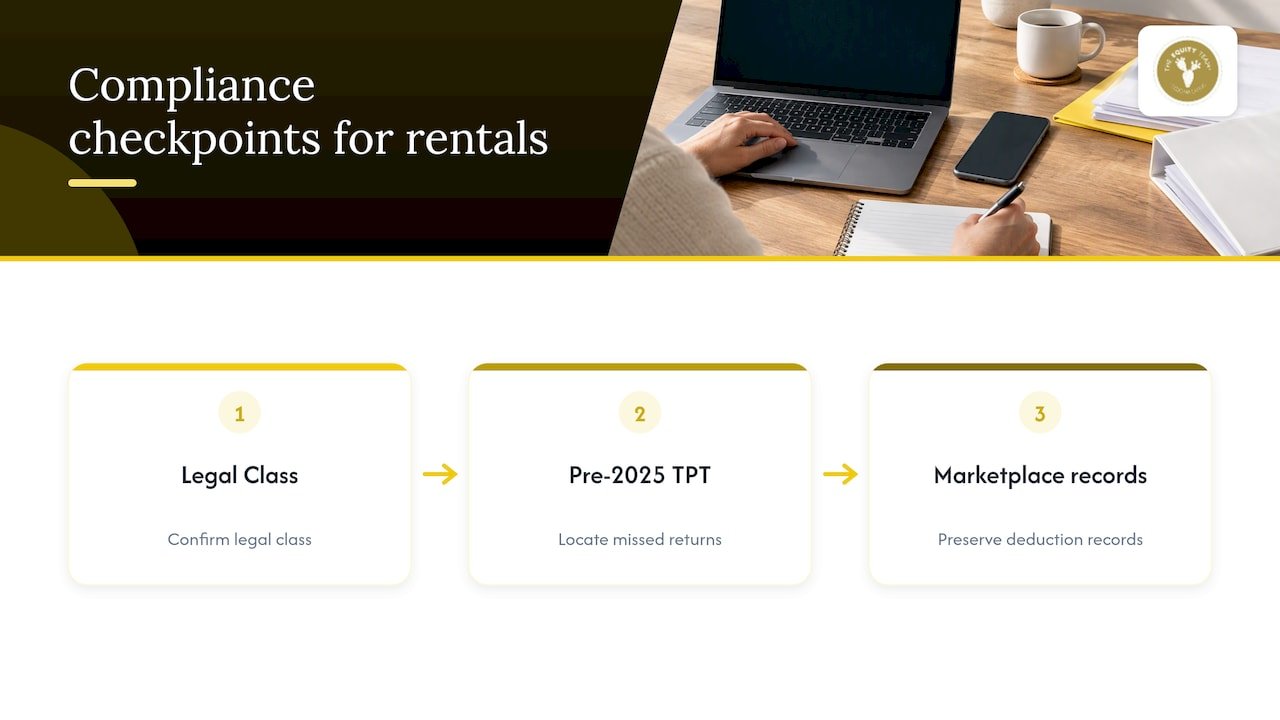
- Confirm your Legal Class with the Yavapai County Assessor and correct it immediately if it’s wrong.
- Verify that any TPT returns owed for stays under 30 days, or for any period before 2025, are filed and paid through AZTaxes.gov.
- Hold onto marketplace booking records, fee statements, and deduction code 775 documentation in case of an audit.
- Contact the city directly about local business license status, and keep written confirmation of any license you’ve canceled.
Pro Tip: Store your Notice of Value, TPT filings, and marketplace statements in one folder each tax year, future you will be grateful during an audit or a sale.
7. The Equity Team perspective on managing rental tax risk
That vantage point means seeing the same tax missteps repeat: misclassified Legal Class, missed TPT returns from before the 2025 change, and thin recordkeeping around marketplace deductions.
The team’s rental market analyses and valuation conversations build tax exposure into the picture from day one, alongside seller prep guidance that catches classification issues before they become a buyer’s negotiating point.
8. What the compliance rush gets wrong
Most of the noise around the 2025 change treats it like a tax cut for every Sedona rental owner, and that’s the part worth pushing back on. It’s a tax cut for long-term landlords specifically, and short-term hosts who read the headline without reading the 30-day threshold are the ones most likely to under-collect and get a letter later.
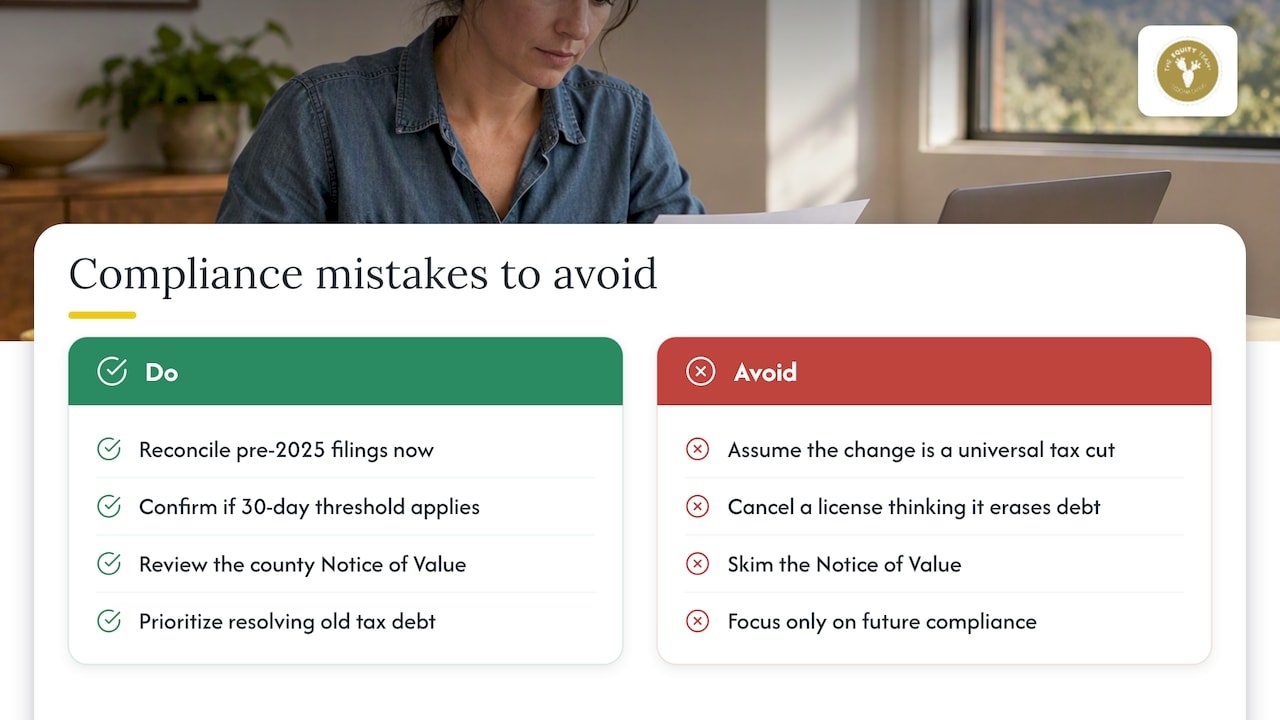
The bigger blind spot isn’t the new law, it’s the old debt. Owners fixate on getting compliant going forward and forget that canceling a license doesn’t erase what was owed before January 1, 2025. If you’re prioritizing one thing this year, make it reconciling your pre-2025 filings before you worry about anything new.
The county’s Notice of Value gets far less attention than it deserves, given that it’s the one document most likely to change your bill and the one owners are most likely to skim.
— Chad
9. How The Equity Team supports Sedona rental owners through a sale

If you’re weighing whether to hold, sell, or reposition a Sedona short-term rental, understanding your tax picture is only half the job. This approach pairs local short-term rental market knowledge with coordination alongside your tax professional and the county offices, so nothing about your classification or filing history surprises you mid-transaction.
- Get a Sedona vacation rental CMA to see what your property is worth in today’s market.
- Talk through a rental exit strategy and valuation conversation if you’re considering selling.
- Reach out for buyer or seller representation built specifically around Sedona’s short-term rental market.
This isn’t a substitute for tax advice, it’s a second set of local eyes when the stakes are high.
Sources
- Residential Rental Guidelines | Arizona Department of Revenue
- Frequently Asked Questions (FAQs) – Yavapai County
FAQ
Is there a property tax on rental properties in Arizona?
Yes, rental properties in Arizona are subject to the same county property tax as any other property, based on assessed value. This is separate from transaction privilege tax, which applies to rental income rather than property value.
How much are property taxes in Sedona, Arizona?
Sedona’s median effective property tax rate runs well below the national median, and the exact bill depends on your parcel’s Limited Property Value plus local school, fire, and CFD levies. Checking your Notice of Value from the Yavapai County Assessor gives the most accurate figure for your specific property.
Is Arizona a good state for landlords?
Arizona is generally considered landlord-friendly, and the 2025 change eliminating city transaction privilege tax on long-term residential rentals under A.R.S. § 42-6004(H) reduced the tax burden further for owners renting 30 days or more. Short-term rental hosts still face transient lodging tax, so the landlord-friendly reputation applies most clearly to long-term leases.
What is the current short-term rental tax rate in Sedona?
Sedona’s city transaction privilege tax rate for hotel and hospitality classifications is 3.5%, according to the city’s published tax profile. This applies on top of any state and county transient lodging tax owed on stays under 30 days.