
Yes, but only for buyers willing to clear three gates first: permit and ADU eligibility, parking and HOA rules, and a debt service coverage ratio that pencils without heroics. Sedona rewards disciplined house-hackers who check the municipal code before they check the listing photos. Skip the gates and even a gorgeous casita with red-rock views can turn into an expensive paperweight. Use the checklist below before you write an offer.
TL;DR:
- Buyers must verify permit history and owner-occupancy restrictions, especially for ADUs permitted after September 14, 2024, which cannot operate as short-term rentals unless the main residence is occupied.
- Achieving top-quartile revenue requires dynamic pricing, professional marketing, and clear neighbor rules, as median operators often struggle to meet debt service coverage ratios.
- Adequate off-street parking, privacy separation, scenic outdoor spaces, and dependable utilities significantly influence a property’s success as a Sedona house-hack.
- Confirming the legal status of guest quarters, including the certificate of occupancy date and permit amendments, is crucial before making an offer.
- Investing in turnkey properties with a verified operational history typically reduces risk compared to converting marginal properties with uncertain permit statuses.
Table of Contents
- Quick Pre-Offer Checklist for Sedona House Hacking Airbnb Deals
- What Does Sedona’s Municipal Code Say About ADUs and Airbnb?
- How Much Can a Sedona Airbnb Actually Earn?
- Which Property Features Actually Predict Success in Sedona?
- Buyer Due Diligence: What to Verify Between Offer and Closing
- What Separates Top-Quartile Sedona Airbnb Hosts From Everyone Else?
- A Local Perspective on When to Buy and When to Walk Away
- How Equity Team Helps You Buy or Sell a Sedona House Hack
- Sources
- FAQ
Quick Pre-Offer Checklist for Sedona House Hacking Airbnb Deals
Sedona is oddly split between two counties, and that single detail changes your permit path, your tax filing, and sometimes your zoning options entirely, which is common in multi-unit dwellings. Before you fall in love with a floor plan, run every property through this filter.
- Confirm whether the parcel sits in Yavapai County or Coconino County, since each handles permitting and assessor records differently.
- Pull the ADU or casita permit history and confirm a valid certificate of occupancy exists.
- Read the HOA’s CC&Rs and ask for enforcement records, not just the rulebook.
- Walk the property and count real, legal off-street parking spaces, including guest loading room.
- Verify the seller’s TPT license status, current annual STR permit, and liability insurance minimums.
Pro Tip: Ask the listing agent for the property’s actual permit file, not a summary. Sellers sometimes describe a casita as “STR-ready” based on a conversation with the city years ago, not a current certificate.
What Does Sedona’s Municipal Code Say About ADUs and Airbnb?
This is where most house-hacking dreams die or get confirmed, and it comes down to one code section: SCC 5.25.050. Under this rule, any ADU or guest quarters that received its certificate of occupancy on or after September 14, 2024, cannot operate as a short-term rental unless the owner’s primary residence is the main structure on that same parcel. In plain terms, you cannot buy a bare casita, permit it after that date, and rent it out while living somewhere else. Owner-occupancy of the main house is the deal.
Older guest quarters have more breathing room. Units permitted before that cutoff may qualify as legal nonconforming uses, meaning they can keep operating even though they would not be approved under today’s rule.
Before you write an offer, request:
- The certificate of occupancy date for the ADU, stamped by the city
- Any permit amendments or additions made after the original build
- Written confirmation from Sedona’s planning office on whether the unit qualifies as legal nonconforming
Sellers rarely volunteer this paperwork unprompted. Ask directly, and treat silence as a red flag rather than an oversight. For a deeper walk-through of how these restrictions play out on real listings, see Sedona’s ADU rules for Airbnb hosts.
How Much Can a Sedona Airbnb Actually Earn?
The average Sedona Airbnb pulls in $47,600 a year, according to local investment analysis. That number is your starting benchmark, not your ceiling and not your floor. Sedona’s market splits sharply between median performers and a top quartile that runs professional-grade operations, and the gap between the two groups often runs into several thousand dollars a month, according to seasonal market data.
The underwriting math follows a simple chain:
- Estimate gross annual revenue using local comps, not national averages.
- Subtract an expense allowance, typically around 25% of gross revenue, for cleaning, utilities, platform fees, and maintenance.
- That leaves net operating income (NOI).
- Divide NOI by annual debt service to get your DSCR.
Statistic Callout: Sedona’s dual-peak seasonality means a median-revenue operator on a high-priced home can land below a 1.0 DSCR, while a top-quartile operator on the same property clears it comfortably, based on Sedona market data.
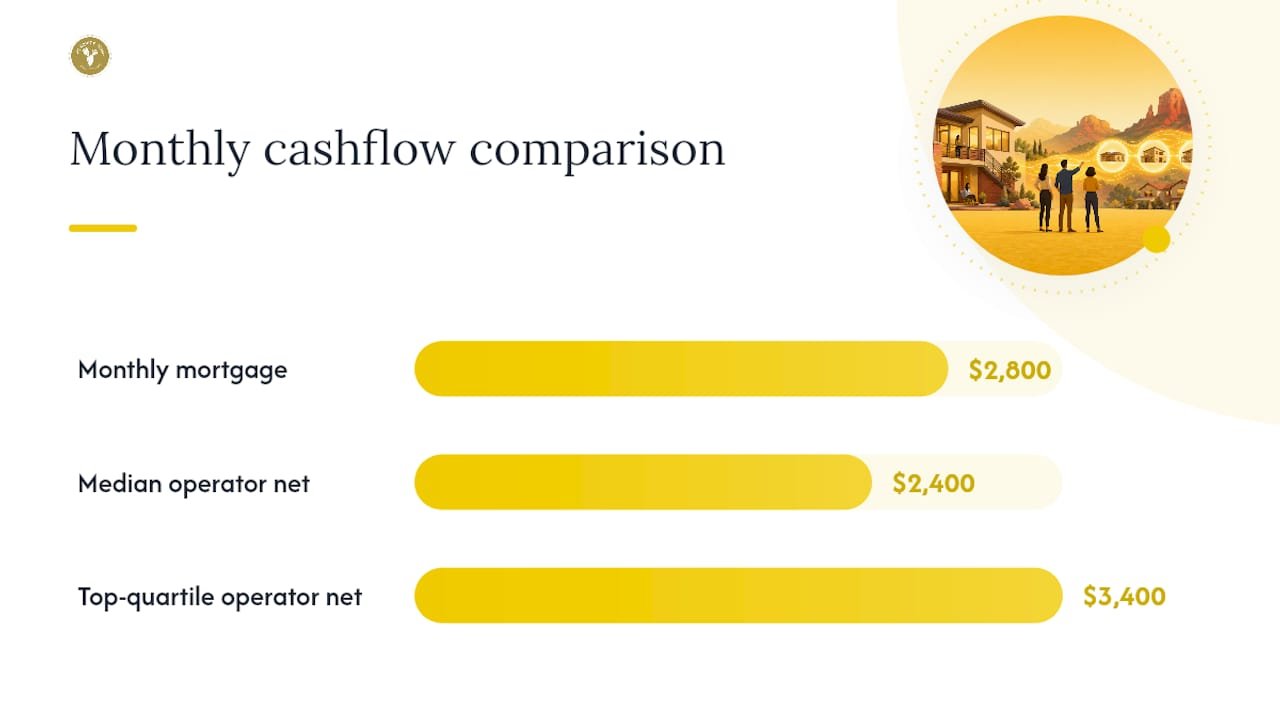
Say two identical properties both carry a $2,800 monthly mortgage payment. A median operator nets $2,400 a month after expenses, a DSCR under 1.0. A top-quartile operator on the same property, running dynamic pricing and professional photography, nets $3,400, comfortably above break-even. The difference is not the house. It is the operation.
Which Property Features Actually Predict Success in Sedona?
Parking sounds boring until it becomes the reason your permit gets flagged. Sedona enforces complaints about blocked driveways and street parking aggressively, and a property with only one legal off-street space caps your effective guest count regardless of bedroom count.
A few physical features separate strong Sedona house-hacks from headaches:
- Parking capacity and guest loading room. Confirm exact vehicle capacity and whether guests can unload without blocking a public way.
- Separate entry and circulation. Co-occupied setups need genuine privacy between the owner’s space and the rental unit, not just a locked door.
- Outdoor space and view exposure. Red-rock views and usable patios lift average daily rate meaningfully in a market built on scenery.
- Utility durability. Septic systems, private wells, and older HVAC units carry real inspection and maintenance risk in Sedona’s terrain, so budget for them upfront.
Buyer Due Diligence: What to Verify Between Offer and Closing
Once you are under contract, the clock starts on a specific sequence of checks. Skip one, and you risk closing on a property that cannot legally do what you bought it to do.
- Pull assessor and parcel records in the correct county to confirm zoning and tax classification.
- Request the certificate of occupancy and full permit history from the seller, and independently confirm it with the planning department.
- Review HOA documents and board minutes for STR complaints or rule changes in progress.
- Test the parking flow physically and inspect septic, well, and structural systems tied to city safety codes.
- Confirm your TPT license path and STR permit timeline, and remember that permits are typically non-transferable at sale.
Pro Tip: Order the HOA’s last 12 months of board minutes, not just the current CC&Rs. Minutes reveal whether STR complaints are rising, which the rulebook alone will never show you.
For examples of how these checks play out on actual Sedona listings, local video walkthroughs show common permit and layout pitfalls buyers miss.
What Separates Top-Quartile Sedona Airbnb Hosts From Everyone Else?
Getting a permit is table stakes. Getting top-quartile revenue is a separate job, and it rewards owners who treat their listing like a small hospitality business rather than a side hustle.
- Adjust pricing weekly through spring and fall to capture Sedona’s dual peak seasons, not just holidays.
- Lead your listing photos with outdoor shots and view angles, since that is what sells a Sedona stay before anyone reads a word of the description.
- Set clear, neighbor-friendly house rules on noise, parking, and events to reduce complaint risk before it starts.
- Choose durable, easy-clean finishes that hold up to inspection cycles and cut your ongoing maintenance costs.
Pro Tip: Dynamic pricing tools that adjust nightly rates based on demand consistently outperform static seasonal pricing in Sedona’s uneven booking calendar.
A Local Perspective on When to Buy and When to Walk Away
The threshold Equity Team applies is simple: permit clear, parking sufficient, and a DSCR that pencils with realistic operator improvements, not fantasy occupancy numbers. If a casita needs permits it cannot legally get, we say walk. If the numbers only work assuming top-quartile performance from day one, we ask hard questions before recommending it.
Sometimes the smarter move is buying a turnkey STR with a clean operating history instead of converting a marginal property. Clients working with us get straight answers on which path fits their risk tolerance, backed by permit-history checks most buyers never think to request.
— Chad
How Equity Team Helps You Buy or Sell a Sedona House Hack
Choosing a specialized real estate agent can help you navigate Sedona’s permit code more confidently. Expertise in short-term rental investment often shows in the thorough permit documentation reviewed before offers are made.

If you are buying, our buyer representation includes coordinating due diligence, checking permit history against the city’s own records, and running realistic revenue scenarios instead of best-case ones. If you are selling an existing STR, a Sedona vacation rental CMA gives you an income-based valuation rather than a generic home comp, and our seller prep consultation helps you present permit and revenue documentation buyers now expect to see upfront. Thinking about timing an exit instead? Our rental exit strategy conversation walks through valuation and timing before you list. Reach out to request a CMA or book a consultation, and get a straight answer on your specific property before you spend another weekend touring houses that were never going to qualify.
FAQ
Can I Airbnb an ADU I Just Built in Sedona?
Only if you live in the primary residence on that same property. Sedona’s code bars ADUs permitted on or after the code’s effective date from operating as short-term rentals unless the owner occupies the main house, according to SCC 5.25.050.
What Is the Average Airbnb Income in Sedona?
Local analysis puts average annual revenue at $47,600, though top-quartile operators running professional pricing and marketing earn considerably more than that median figure.
Does Sedona Require a Special License for Short-Term Rentals?
Yes, hosts need an Arizona transaction privilege tax (TPT) license before applying for the city’s annual STR permit, along with minimum liability insurance and written neighbor notification. Permits are typically issued per rental unit and are not transferable when a property sells.
How Do I Know if a Guest Quarters Is Legally Grandfathered?
Request the certificate of occupancy date directly from the seller and confirm it independently with Sedona’s planning department. Units permitted before September 14, 2024 may qualify as legal nonconforming uses even without current owner-occupancy.
Should I Buy a Fixer Casita or a Turnkey Sedona STR?
It depends on your risk tolerance and how confident you are in the permit history. Equity Team typically recommends turnkey properties with clean operating records for buyers who want predictable cash flow, and reserves conversions for buyers prepared to underwrite permit and construction risk carefully.