
Most Sedona short-term rental buyers put down a significant percentage of the purchase price, plus enough cash for closing costs and reserves, which means the total cash-to-close can be substantial on a median-priced red rock property, often securing their investment with a secured loan. DSCR loans set most of these terms, since they qualify buyers on the property’s rental income rather than a paycheck. Permits and reserve requirements can push that number higher fast, so the percentage on paper rarely tells the whole story.
TL;DR:
- DSCR loans typically require a down payment of 20% to 25% on properties under $1 million and up to 30% for properties above $1 million, with rates increasing as down payments decrease.
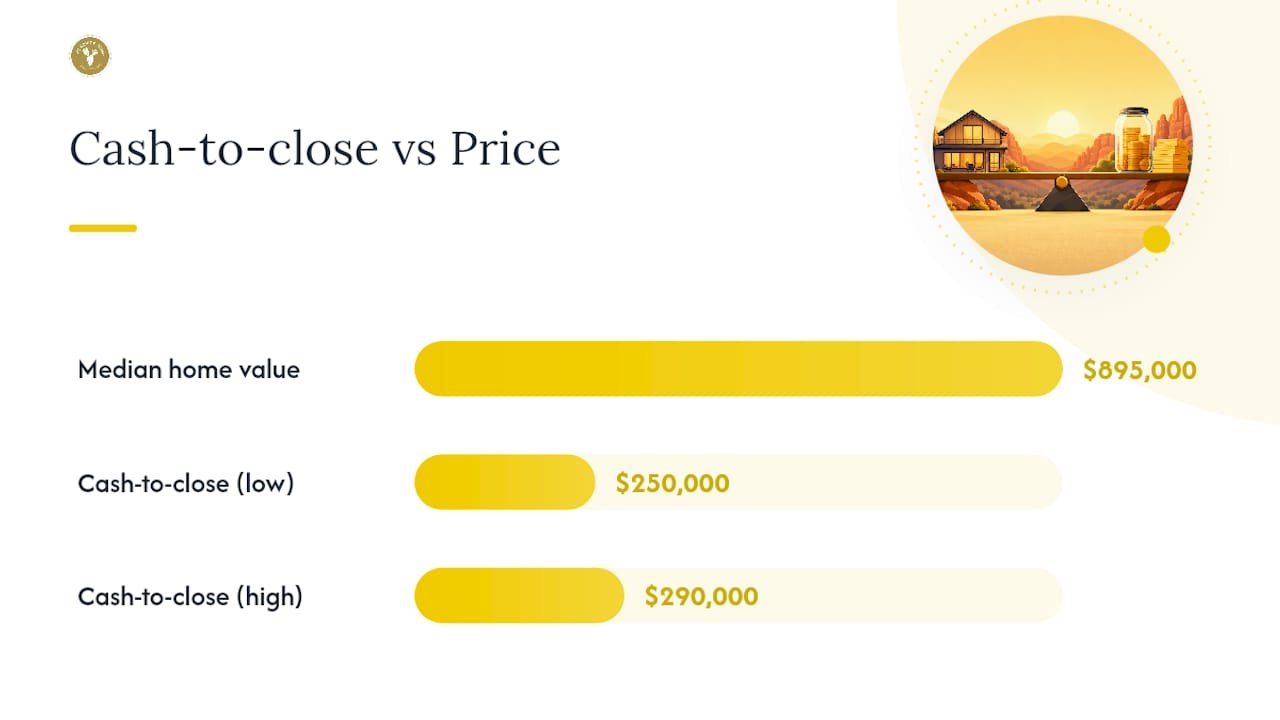
- Total cash-to-close for median-priced Sedona properties often ranges between $250,000 and $290,000 once closing costs, reserves, and extras are included, depending on the property and lender.
- Lenders usually demand two months of seasoned reserves and have higher requirements in permit-restricted zones, which can significantly increase the initial cash needed.
- Buyers’ credit scores influence down payment requirements, with scores above 720 unlocking the best terms, while lower scores may incur higher rates or larger deposits.
- The permit status and local zoning restrictions can impact property value and financing, making early permit verification critical to avoid deal delays.
Table of Contents
- How Do DSCR, Conventional, and Cash Financing Compare for Sedona STRs?
- What Cash-to-Close Looks Like at Sedona Price Points
- What Credit Score and Income Rules Change Your Down Payment?
- How Many Months of Reserves Do Sedona Lenders Actually Require?
- Why Sedona’s Zoning Map Changes Your Required Down Payment
- The Buyers Who Actually Close in Sedona
- Planning Your Down Payment? Here’s Where to Start
- Sources
- FAQ
How Do DSCR, Conventional, and Cash Financing Compare for Sedona STRs?
DSCR loans (short for Debt Service Coverage Ratio) dominate the Sedona Airbnb financing conversation, and for good reason. They qualify a buyer using the property’s projected or actual rental income instead of tax returns or W2s, which is exactly what most self-employed investors and out-of-state buyers need. Pinnacle Funding Network reports DSCR down payments running 20% to 25% on standard inventory, climbing to 25% to 30% once the after-repair value crosses $1 million.
Conventional investment mortgages sit in a similar range but demand full personal income documentation, which slows things down for buyers whose income comes from multiple sources. Cash purchases skip financing costs entirely, but tying up $900,000 or more in one property carries its own opportunity cost that DSCR buyers avoid.
| Financing Option | Typical Down Payment | Income Documentation |
|---|---|---|
| DSCR | 20%–30% | AirDNA projections or trailing 12-month STR history |
| Conventional Investor | 20%+ | Full personal tax returns and W2s |
| Portfolio/Private | 25%+ | Flexible, lender-specific underwriting |
| Cash | 0% financed | None required |
A few patterns show up across every lender we’ve reviewed:
- Lower down payments almost always trigger rate premiums or added points.
- Weaker DSCR ratios (below 1.00x) get priced higher or capped at lower loan amounts.
- Projected income from AirDNA speeds up approval but often gets discounted before it’s used in underwriting.
What Cash-to-Close Looks Like at Sedona Price Points
The math changes meaningfully as the purchase price climbs, and Sedona’s price tiers make that obvious fast:
- Under $1 million: down payments tend to be lower on DSCR programs and around 20% on conventional loans.
- $1 million to $2 million: down payments generally increase moderately.
- $2 million and above, particularly for premium inventory, loan-to-value ratios often cap around 70%, requiring larger down payments.
Additionally, buyers should plan for closing costs, furnishing and setup expenses, and lender-required reserves.
Here’s the math that matters: Sedona’s median home value sits around $895,000. Once those extras stack on, the total cash-to-close on a median Sedona STR frequently lands between $250,000 and $290,000, depending on the lender and property condition.
What Credit Score and Income Rules Change Your Down Payment?
Lenders don’t apply one flat rule to every DSCR applicant. Your credit profile and how you document rental income both move the needle on price and required cash.
- Most STR-focused DSCR programs set a floor around 660 to 680 FICO, with CMRE requiring 680 for certain products.
- Buyers with 720 or higher typically unlock the best available pricing and the lowest points.
- A DSCR of 1.00x or better (meaning rental income covers the mortgage payment) usually earns standard terms; some programs go as low as 0.75x but tack on rate and point penalties.
- Lenders may accept rental income documentation from sources like AirDNA projections, appraiser schedules, or trailing 12-month platform histories, often applying conservative discounts to projected income before underwriting.
Weaker credit or a thin income history doesn’t necessarily kill a deal. It just means a bigger down payment or a rate bump usually buys back the approval.
How Many Months of Reserves Do Sedona Lenders Actually Require?
Reserves are where a lot of buyers get caught off guard, because the down payment isn’t the only cash a lender wants to see sitting in an account. Most programs ask for several months of PITIA (principal, interest, taxes, insurance, and association dues) reserves, with Sedona often requiring amounts toward the higher end of this range for STR-specific DSCR loans.
For a property valued around $1 million with significant monthly PITIA costs, reserve requirements can amount to a sizable sum held in addition to the down payment and closing costs. That’s real money sitting idle, and it’s a common reason buyers get pre-approved for less than they expected.
A few practical notes worth knowing before you apply:
- Reserves can typically sit in a personal account or an LLC/entity account, but lenders usually want two months of seasoning before closing.
- Cash-out refinance proceeds from another property can sometimes count toward reserves for a new purchase.
- Buying at 20% down without healthy reserves has left some Sedona investors cash-flow negative in year one, while buyers who put down 40% to 50% see meaningfully better early cash flow, according to Awning’s analysis of Sedona vacation rental investments.
Pro Tip: Get your reserve funds seasoned in the account you plan to use at least two months before you start shopping. Lenders flag fresh deposits, and explaining a sudden $80,000 transfer mid-underwriting slows everything down.
Why Sedona’s Zoning Map Changes Your Required Down Payment
Sedona isn’t one market. Uptown, West Sedona, and the Village of Oak Creek each handle short-term rental permits differently, and permit-limited zones tend to command higher prices simply because supply is capped. That scarcity pushes up the after-repair value of permitted properties, which means the down payment dollar amount climbs even when the percentage stays flat.
A property with an active STR permit in a tightly zoned pocket of Sedona often sells at a real premium over an identical unpermitted home nearby. Buyers who skip verifying permit status before making an offer sometimes discover the lender’s appraisal and the seller’s asking price were built on two different assumptions about rental legality.
Equity Team’s practical advice: run the permit check and the lender pre-approval in parallel, not sequentially. Waiting until after you’re under contract to confirm permit eligibility is how deals fall apart in week three.
The Buyers Who Actually Close in Sedona
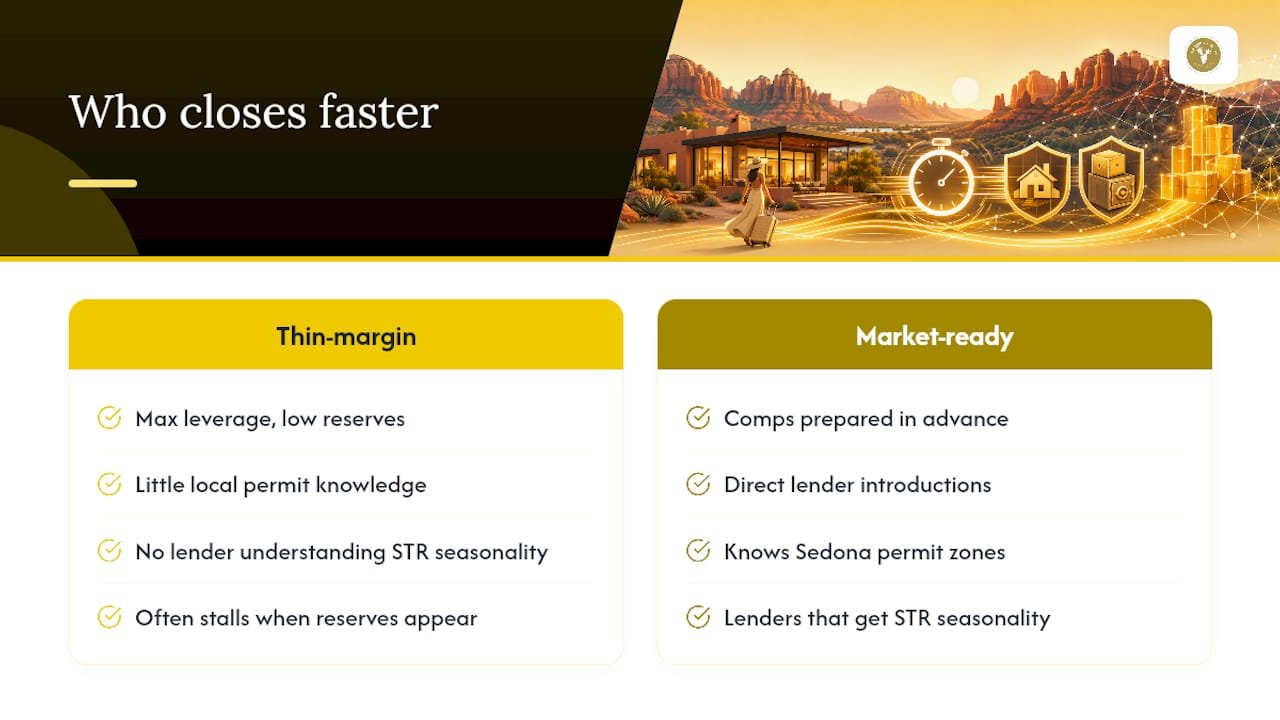
Thinner-margin buyers relying on maximum leverage tend to stall out once reserve requirements surface.
A local real estate team speeds this process by pairing market-ready comps with direct lender introductions and a working knowledge of Sedona’s permit landscape. Knowing which zones still issue permits, and which lenders actually understand STR seasonality, cuts weeks off a typical closing timeline.
— Chad
Planning Your Down Payment? Here’s Where to Start
This local team offers an alternative to piecing this process together from national lender websites and generic listing platforms. Their practice focuses specifically on Sedona’s short-term rental market, which means every comp, permit note, and lender introduction provided is calibrated to this town, not a national average.
Before a consultation, bring your target purchase price, proof of funds, your preferred financing path (DSCR versus conventional versus cash), and a rough timeline for closing. We’ll walk through Sedona market analysis, connect you with lenders who already understand STR underwriting, and flag permit considerations before you write an offer. If you’re ready to see what fits your budget, start with a guide to finding the right Sedona short-term rental property and consider booking time with a local real estate team.
This article is general information, not a substitute for advice from a qualified financial advisor. Consult a qualified financial professional about your own circumstances before acting on anything here.
Sources
- Vacation Rental Loans in Sedona 2026: STR DSCR
- Sedona, AZ Airbnb ROI Calculator – STR Market Data 2026 | STR ROI Calculator
FAQ
Why Is Yellow Not Allowed in Sedona?
Sedona’s design guidelines restrict bright, high-contrast exterior colors, including yellow, to keep buildings blending into the red rock landscape rather than standing out against it. This is a zoning aesthetic rule, not a financing factor, but it’s worth knowing before you plan any exterior renovation on a permitted STR.
What Is the 80/20 Rule for Airbnb?
Like the 75-55 reference, there’s no standard, lender-recognized “80/20 rule” specific to Airbnb financing. It may be a confused reference to the general 80/20 principle used loosely in business, but it doesn’t map to any documented Sedona lending or permit standard.