

For most single-property owners, an LLC won’t change a dime of federal tax owed. It changes something else entirely: who can come after your other assets if a tenant sues. Individual investors still own [58.9% of U.S. rental properties](https://www.census.gov/library/newsreleases/2026/20260219rhfs.html), while entity ownership through LLCs, LPs, and LLPs has increased. The real question isn’t “LLC or personal?” It’s whether your equity, portfolio size, and risk tolerance justify the paperwork. The decision framework below sorts that out fast.
TL;DR:
- An LLC does not reduce federal tax obligations on rental income, which still lands on your personal Schedule E regardless of ownership structure.
- Liability protection from an LLC depends on maintaining proper separation, such as dedicated bank accounts, signed contracts, and compliance with state formalities.
- Transferring property into an LLC without lender approval can trigger the due-on-sale clause, but obtaining written consent or using specific loan types can mitigate this risk.
- Proper LLC setup in the property’s state, including a registered agent, operating agreement, and updated insurance, is essential to ensure liability shields are effective.
- For owners with a single property, strong insurance and detailed operational habits often outweigh the benefits of LLC formation unless portfolio size or asset risk justifies the effort.
Table of Contents
- LLC vs Personal Rental: What Liability Protection Actually Covers
- How the IRS Treats Rental Income Held in an LLC
- Financing Realities: Due-on-Sale Clauses and Lender Pushback
- Setting Up an LLC That Actually Protects You
- Which Ownership Structure Fits Your Situation
- Estate Planning: LLC Ownership vs a Deed in Your Own Name
- Asset Protection Laws Vary More by State Than People Expect
- Does an LLC Change How You Manage the Rental Day to Day?
- The Equity Team Perspective: What This Looks Like in Sedona
- Chad’s Take: Stop Treating the LLC Like a Tax Strategy
- How The Equity Team Helps With Structuring and Sedona STR Purchases
- Sources
- FAQ
LLC vs Personal Rental: What Liability Protection Actually Covers
An LLC draws a legal line between your rental property and your personal savings, your car, and your other real estate. If a guest slips on the stairs at your Sedona vacation rental and sues, a properly maintained LLC generally limits the claim to what the LLC itself owns, not your 401(k) or your primary residence.
That protection is not automatic just because you filed articles of organization with your state. Courts look at whether the LLC actually behaved like a separate business. According to InCorp’s guidance on rental property LLCs, the liability shield holds up when owners keep genuine separation between themselves and the entity:
- A dedicated business bank account, with rent deposited there and expenses paid from there, never from a personal account.
- Contracts, leases, and vendor agreements signed in the LLC’s name, not the owner’s.
- Adequate capitalization, meaning the LLC has enough of its own funds or insurance to plausibly cover claims.
- Consistent compliance with state formalities, like annual reports and registered agent updates.
Skip those steps and a plaintiff’s attorney can ask a judge to “pierce the veil,” treating the LLC as a fiction and reaching your personal assets anyway. Commingling funds, signing a personal guarantee on the mortgage, or personally causing the injury (say, you did the electrical work yourself and it started a fire) are the most common ways owners lose protection they thought they had.
Pro Tip: An LLC is a second layer, not a replacement. A solid landlord policy plus an umbrella policy handles the bulk of claims before the LLC ever becomes relevant, and insurers rarely raise premiums much for LLC-owned units.
How the IRS Treats Rental Income Held in an LLC
Here’s the detail that surprises a lot of first-time landlords: forming an LLC does not lower your federal tax bill. A single-member LLC is a disregarded entity for tax purposes, meaning the IRS looks straight through it to you. Rental income, expenses, and depreciation still land on Schedule E of your personal Form 1040, exactly as they would if you owned the property in your own name.
Rental income was never subject to self-employment tax in the first place, whether it sits in an LLC or not, so the popular claim that an LLC “saves you from self-employment tax” is really just describing the status quo. IRS Publication 527 lays out the actual mechanics: what counts as a deductible expense, how to allocate costs when a property has mixed personal and rental use, and how depreciation schedules work regardless of the ownership structure. If you want the deeper math on accelerating those deductions, the depreciation rules for Sedona vacation homes apply the same way whether the deed sits with you or your LLC.
Multi-member LLCs work differently. Once you add a business partner or co-investor, the LLC typically files Form 1065 as a partnership, and each owner gets a K-1 showing their share of income and deductions.
Even without a tax change, separate bookkeeping still earns its keep. Clean books make an IRS audit less painful, simplify a future sale, and reinforce the liability separation courts expect to see.
Financing Realities: Due-on-Sale Clauses and Lender Pushback
Most conventional conforming loans include a due-on-sale clause, and transferring title from your name into an LLC after closing can trigger it. Lenders view that transfer as a change in ownership, and technically they can demand the full loan balance immediately, even if you’re the sole member of the LLC and nothing about who actually controls the property has changed.
In practice, here’s how owners navigate it:
- Get written consent first. Contact the servicer before transferring title. Many will approve a single-member LLC transfer in writing, especially when you remain the personal guarantor.
- Consider a DSCR or portfolio loan instead. These loans qualify based on the property’s rental income rather than your personal debt-to-income ratio, and many are built to close directly in an LLC’s name. A closer look at DSCR loans versus conventional mortgages shows where the rate and down payment trade-offs land.
- Buy inside the LLC from day one. If you already know you want entity ownership, closing under the LLC avoids the due-on-sale question entirely, though you’ll likely face a larger down payment and a higher rate than a conventional owner-occupant loan.
Refinancing later can reopen the same issue, so confirm your lender’s entity policy before you sign anything.
Setting Up an LLC That Actually Protects You
- Form it properly in the property’s state. Appoint a registered agent, draft an operating agreement even if you’re the only member, and get an EIN from the IRS rather than using your Social Security number.
- Open a dedicated business bank account. Every dollar of rent comes in through it; every repair, tax payment, and mortgage payment goes out through it.
- Put every contract in the LLC’s name. Leases, property management agreements, and vendor contracts should all list the LLC as the party, not you personally.
- Update your insurance to name the LLC as insured. A policy still listing you personally after a title transfer can leave a coverage gap right when you need it most.
- Stay current on state compliance. Annual reports, franchise fees, and renewal filings all need to happen on schedule, or the state can administratively dissolve your LLC without telling you.
Pro Tip: Set a recurring calendar reminder for your state’s annual report deadline. A lapsed LLC offers zero liability protection, and most owners find out only after they’ve already been sued.
Which Ownership Structure Fits Your Situation
The right answer depends less on what’s trendy and more on what you’d actually lose in a lawsuit. A few patterns hold up across most investor profiles:
- One rental, modest equity, no other major assets: Personal ownership with strong insurance coverage is often the more cost-effective choice. State filing fees and annual compliance work can outweigh the marginal protection for a single, lower-equity property.
- A growing portfolio (three or more properties): An LLC, or several, starts to make more sense as combined equity rises and one property’s liability could otherwise threaten the others.
- High-net-worth owners with significant outside assets: The math shifts quickly here. Protecting a stock portfolio or a primary residence from a single tenant lawsuit is usually worth the LLC’s administrative cost.
- Co-owners or investment partners: An LLC with a clear operating agreement spells out ownership percentages, decision-making authority, and exit terms in ways a handshake never will.
Before filing anything, run the numbers with a lender, a CPA, and a real estate attorney. Ask your insurer what an umbrella policy would cost first. Often, that comparison alone answers the question of whether the LLC’s fees are worth paying this year or worth revisiting once your portfolio grows.
Estate Planning: LLC Ownership vs a Deed in Your Own Name
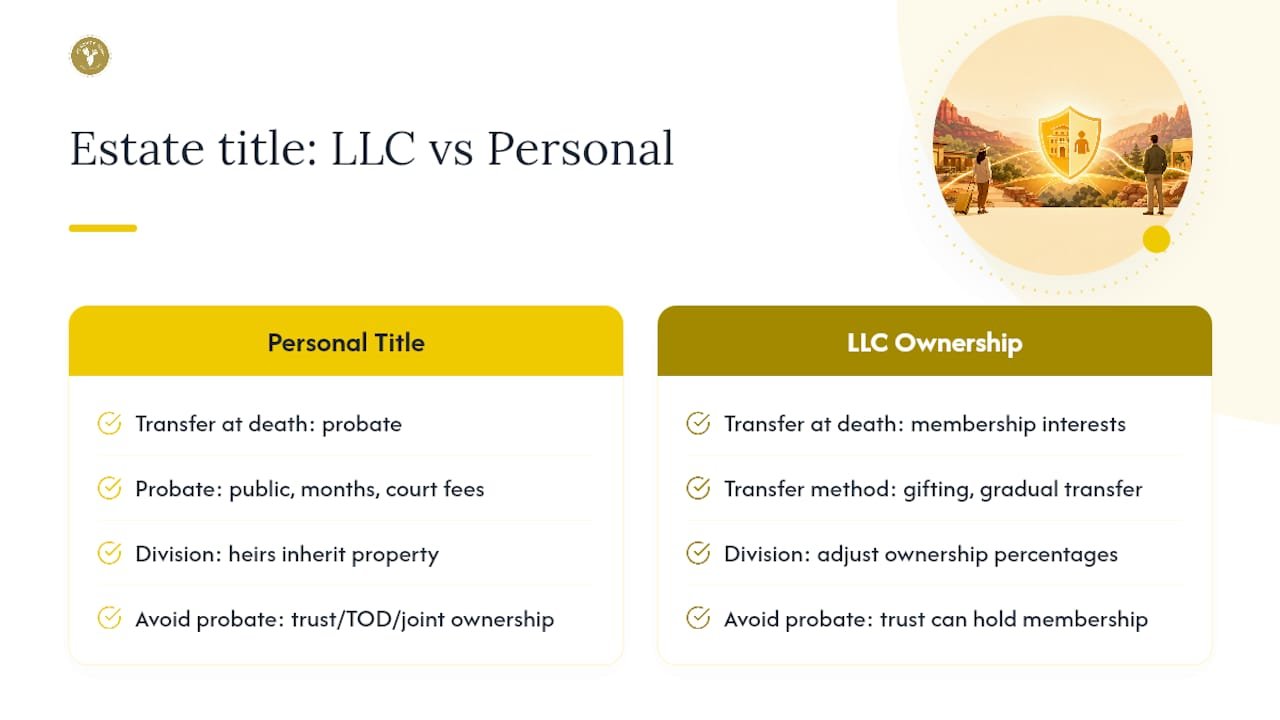
How you hold title affects what happens to a rental property after you’re gone, not just while you own it. A property titled in your personal name typically passes through probate unless you’ve used a trust, a transfer-on-death deed, or joint ownership with rights of survivorship. Probate is public, can take months, and often comes with court fees.
An LLC changes the mechanics. Instead of transferring real estate itself, an owner passing wealth to heirs can transfer membership interests in the LLC, which can happen gradually, often through gifting strategies that use annual exclusion amounts. Multiple properties under one or several LLCs can be split among heirs by adjusting ownership percentages rather than partitioning physical real estate, which sidesteps a lot of the disputes that arise when siblings inherit a single house together.
LLCs also pair naturally with revocable living trusts. Many estate plans have the trust hold the LLC membership interest, combining the liability separation of the entity with the probate avoidance of the trust. That layered structure isn’t necessary for every owner, but it becomes more attractive as the number of properties, or the number of heirs, grows.
None of this is a substitute for actual estate planning documents. An LLC without a will, trust, or updated operating agreement specifying what happens to a deceased member’s interest can create its own complications for surviving family members. Anyone holding rental property, in an LLC or personally, should loop in an estate attorney rather than assuming the entity alone handles succession.
Asset Protection Laws Vary More by State Than People Expect
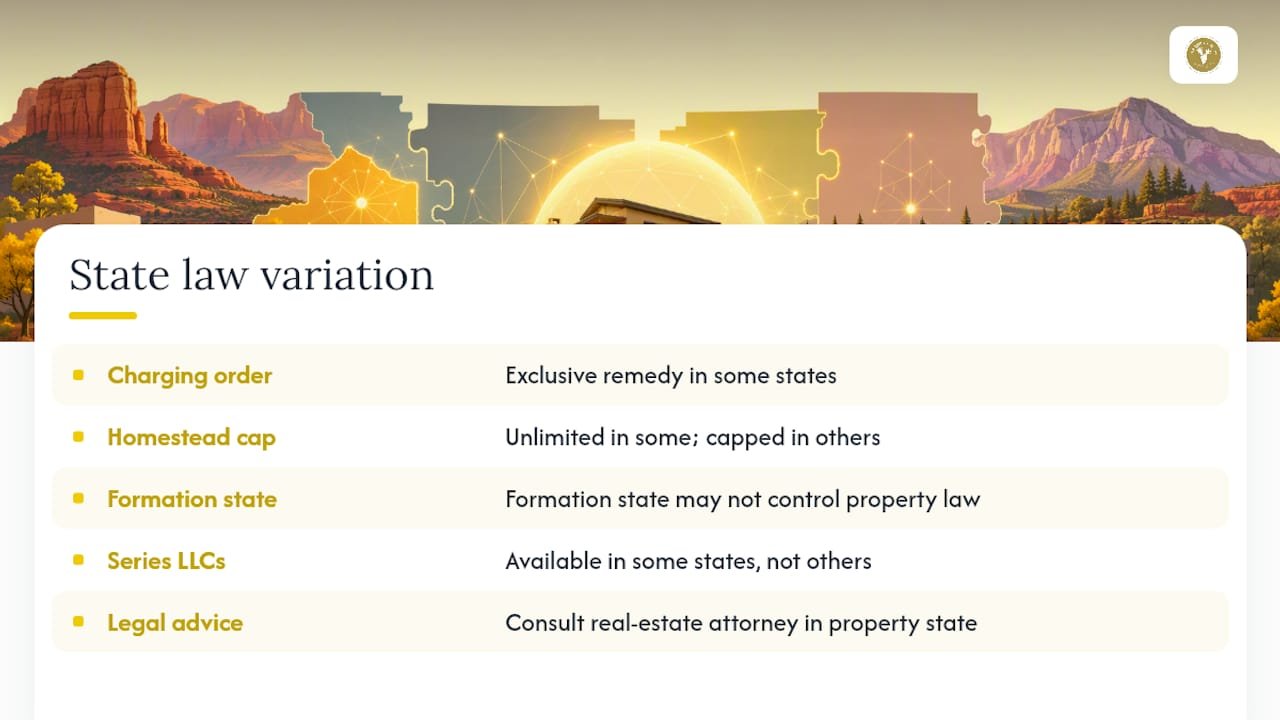
Not all LLCs offer equal protection, because state law, not federal law, governs how courts treat the entity. Some states have adopted charging order protection as the exclusive remedy against an LLC member’s interest, meaning a creditor can only claim distributions, not seize and sell the membership interest or force liquidation of the LLC’s property. Other states offer weaker charging order protections, making it easier for a creditor to reach the underlying assets.
Homestead exemptions add another layer of variation for personally owned property. Some states protect an unlimited amount of home equity from creditors; others cap the protected amount well below the value of an average rental-turned-primary-residence scenario. That gap matters most for owners who live in one property while renting others.
Where you form the LLC and where the property sits can also be two different states, and that mismatch has consequences. A property located in a weaker-protection state doesn’t automatically inherit the stronger protections of the state where the LLC was formed. Many investors register a “foreign LLC” in the property’s state anyway, since that’s usually where a lawsuit would actually be filed and where local law applies to the real estate itself.
This is squarely attorney territory. A real estate attorney licensed in the property’s state can tell you whether your state’s charging order rules, homestead exemption, and series LLC options (available in some states, not others) change the calculus for your specific portfolio.
Does an LLC Change How You Manage the Rental Day to Day?
Operationally, an LLC adds friction before it adds anything else. Every lease, every vendor invoice, every insurance renewal now needs to reference the LLC’s exact legal name instead of yours, and mixing that up on even one document is the kind of small mistake that undermines the liability separation you formed the LLC to get.
Property managers generally don’t care whether they’re collecting rent for an individual or an LLC, but the paperwork trail matters more once an entity is involved. Management agreements, security deposit accounts, and 1099 filings for contractors all need to route through the LLC consistently. A property management partner that already understands entity-owned properties can keep those handoffs clean, especially for owners managing several units across one or more LLCs.
On the flexibility side, personal ownership is simpler for a single, hands-on landlord who wants to sign a lease on a Tuesday without checking an operating agreement first. An LLC with multiple members usually requires some documented decision-making process for major moves, like refinancing or selling, which slows things down but also protects everyone involved from a single member acting alone. For a solo owner with one property, that governance overhead often isn’t worth adding until the portfolio, or the ownership group, actually grows.
The Equity Team Perspective: What This Looks Like in Sedona
Sedona short-term rentals live and die on occupancy, and that cash flow reality shapes the LLC decision differently than it does for a long-term rental. A strong STR month can carry six figures in bookings through one property, which raises the equity-at-risk question fast for owners who scale past one home. Local insurance premiums for STRs also run higher than standard landlord policies, which is exactly why we tell clients to price out umbrella and STR-specific coverage before they price out an attorney.
We work with buyers and sellers across the top tier of the Sedona STR market, and structuring questions like this come up constantly during acquisition planning. If you’re weighing entity formation against an upcoming purchase or sale, a Sedona-specific vacation rental valuation is a useful starting point before you talk to your attorney.
Chad’s Take: Stop Treating the LLC Like a Tax Strategy
The single biggest misconception I see repeated across investor forums and even some financial advisors is that forming an LLC lowers your tax bill. It doesn’t, and the IRS has never suggested otherwise. Rental income was already excluded from self-employment tax before you ever filed articles of organization. If someone is pitching you an LLC as a tax move, they’re selling you a solution to a problem you didn’t have.
Where the conventional wisdom actually gets it backward is on timing. Most first-time landlords ask “should I form an LLC?” the moment they buy their first rental, when a good landlord policy and an umbrella policy would cover nearly the same risk for a fraction of the administrative cost. The LLC conversation gets genuinely urgent later, once you’ve got two or three properties, a co-investor, or enough equity that a single lawsuit could realistically wipe out assets that have nothing to do with the rental in question.
The other blind spot: people file the LLC and think the work is done. It isn’t. The liability shield lives or dies on boring operational habits, separate accounts, contracts signed correctly, insurance updated to name the entity, not on the fact that a state accepted your filing fee. An LLC sitting on paper while its owner still pays the plumber from a personal checking account is a lawsuit waiting to prove the entity was never real to begin with.
— Chad
How The Equity Team Helps With Structuring and Sedona STR Purchases
There are real estate specialists who focus on Sedona short-term rentals and provide local acquisition expertise and market data to back it up. Whether you’re buying your first STR and deciding whether to close in an LLC’s name, or you already own one and want to know if your equity justifies restructuring before a sale, this is the conversation we have with clients every week.

If you’re actively shopping for a Sedona rental property, our guide on finding the right short-term rental investment walks through the acquisition side, including how ownership structure fits into your purchase contingencies. If you’re on the selling end and want to know what your property is worth before making any structural changes, request a Sedona vacation rental CMA and we’ll walk you through valuation, exit timing, and what a buyer will actually pay in today’s market. Reach out through Owninaz to start that conversation, whether you’re planning an acquisition, transferring title, or just trying to understand your current liability exposure before it becomes a problem.
Sources
For the numbers and rules behind this guide, go straight to the source: the Census RHFS release on ownership trends, the IRS page on single-member LLCs, and IRS Publication 527 for rental income specifics. Pair those with a CPA and a real estate attorney licensed in your property’s state before making any structural decision.
This article is general information, not a substitute for advice from a qualified financial advisor. Consult a qualified financial professional about your own circumstances before acting on anything here.
- IRS: Single-member limited liability companies
- InCorp: Rental property LLC — taxes, protection, and costs
FAQ
Is an LLC required to rent out a house in the U.S.?
No. Rental properties](https://www.census.gov/library/newsreleases/2026/20260219rhfs.html) are still individually owned rather than held in an entity.
Does forming an LLC lower my rental income taxes?
No. A single-member LLC is a disregarded entity, so rental income and deductions still flow to your personal Schedule E exactly as they would without the LLC.
Can I move my mortgaged rental into an LLC without lender approval?
You can face a due-on-sale clause if you transfer title without lender consent, so get written approval from your servicer first or consider a DSCR loan built for entity ownership.
Does Equity Team help with LLC formation for Sedona rentals?
Equity Team focuses on Sedona STR buyer and seller representation and valuation, and we regularly connect clients to attorneys and CPAs for the structuring side while guiding the real estate transaction itself.
Is one LLC enough for multiple rental properties?
A single LLC across several properties cuts administrative cost but shares liability between them, while a separate LLC per property isolates risk at the cost of more filings and bookkeeping.