
Most standard residential appraisals in Sedona value the house, not the hustle. A typical Fannie Mae 1004 or 1007 form captures what the real estate would rent for long-term, not what your Airbnb calendar actually earns, so short-term rental income rarely moves the needle on a conventional appraisal. Lenders may still look at your booking revenue to qualify you for a loan, but turning that income into appraised value requires a specialized, qualified appraiser working outside the standard residential playbook.
TL;DR:
- Standard residential appraisals in Sedona do not incorporate short-term rental income into property value calculations.
- Appraisers must separate real estate, personal property, and business income, making it unsuitable to include nightly revenue without a specialized, going-concern appraisal.
- Documented actual booking history and operating expenses are essential for an accurate valuation, not aggregated dashboard estimates from platforms like AirDNA or Rabbu.
- Owners operating a full-fledged rental business should seek a commercial or going-concern appraisal, which costs more and takes longer but accurately captures business value.
- Local Sedona market data and detailed, property-specific records strengthen an appraisal’s credibility and help owners avoid misleading estimates.
Table of Contents
- Why a Sedona Appraisal for Airbnb Works Differently Than You’d Expect
- Sedona’s Airbnb Numbers, and What They Tell an Appraiser
- Where Sales Comps and DIY Estimates Go Wrong
- When You Actually Need a Commercial or Going-Concern Appraisal
- The Checklist That Speeds Up Your Appraisal
- What to Expect on Cost, Timeline, and Lender Rules
- Sedona-Specific Data That Makes an Appraisal Defensible
- What Owners Get Wrong About Sedona STR Appraisals
- Consider Equity Team When You’re Ready to Sell or Buy in Sedona
- Sources
- FAQ
Why a Sedona Appraisal for Airbnb Works Differently Than You’d Expect
Residential appraisers work inside a rulebook called the Uniform Standards of Professional Appraisal Practice, or USPAP, and it draws a hard line between three separate things: the real estate, the personal property inside it, and the business operating on top of it. A red rock capital with a hot tub and a five-star Superhost badge is really three overlapping assets, and an appraiser who blends them into one number is stepping outside their lane. Appraisal Today’s Julie Friess has pointed out that residential appraisers commonly appraise only the real estate, precisely because USPAP requires that separation.
That separation matters because the standard forms simply were not built for nightly rates. The 1004, 1007, and URAR forms ask for market rent, meaning what a long-term tenant would pay monthly, not what a weekend guest would pay for three nights during Sedona’s Fourth of July rush. There is no field on those forms for occupancy percentage or seasonal ADR swings, and there is no GSE-approved form for short-term rental income at all, according to DataMaster’s guidance for appraisers. An appraiser who tries to force nightly revenue into that monthly-rent box is not just being creative. They are misusing the form.

The consequences are real. WorkingRE’s analysis of Airbnb and VRBO appraisal problems notes that appraisers who mix business income into a residential value opinion open themselves up to disciplinary action, because they are effectively appraising a going concern using a form and a competency level designed for something else entirely.
What this means for you as an owner:
- A standard residential appraisal on your Sedona property likely won’t reflect your Airbnb’s actual cash flow.
- Lenders may use your STR revenue for debt-to-income qualification without it ever touching the appraised value.
- If you need STR income reflected in value (for a refinance, an equity line, or a sale to an investor), you need an appraiser competent in going-concern or commercial-style valuation, not just a residential license.
Pro Tip: Ask any appraiser upfront whether they’ve completed a going-concern or business valuation assignment before. Not every state-licensed residential appraiser has, and that gap shows up fast once you need STR income reflected in the final number.
Sedona’s Airbnb Numbers, and What They Tell an Appraiser
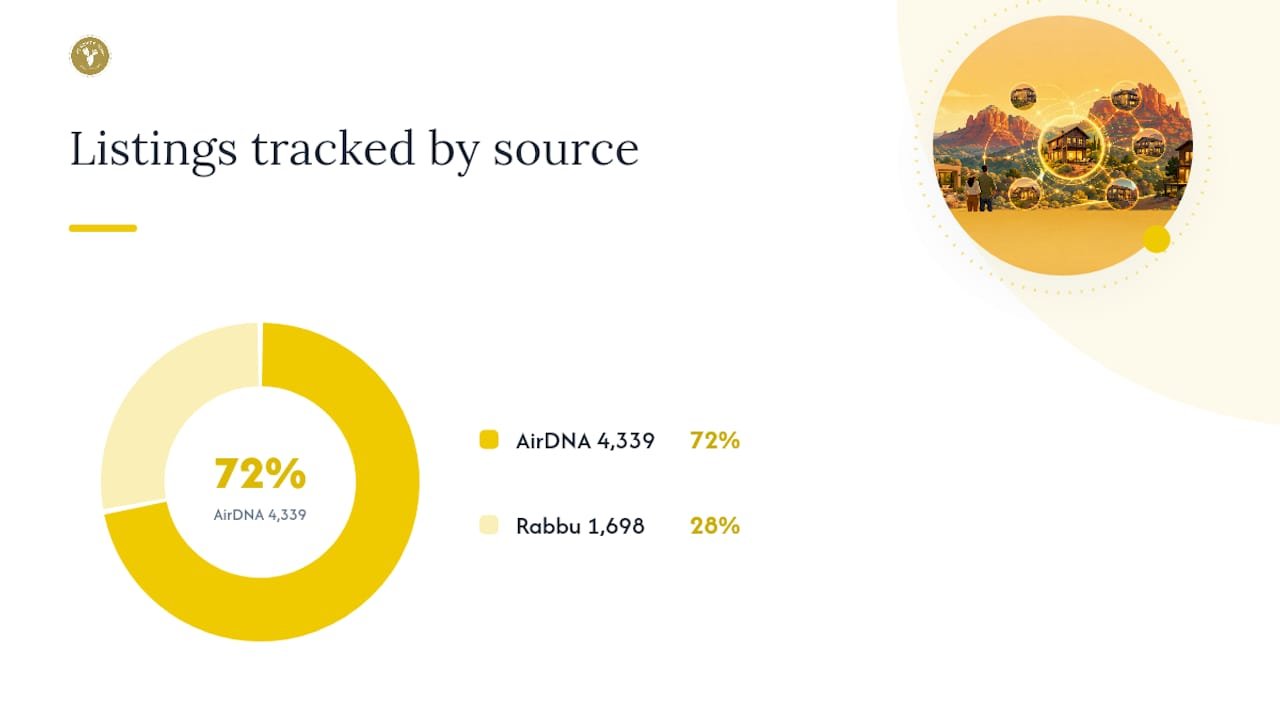
Sedona’s short-term rental market is active enough that data providers track it closely, and the two major sources don’t quite agree, which itself is a lesson for anyone leaning on a single dashboard. AirDNA reports 4,339 active listings in Sedona with average annual revenue of $47,600, 53% occupancy, and an average daily rate of $371 (RevPAR $197). Rabbu’s numbers from a similar period show 1,698 active listings, average annual revenue of $56,758, an ADR of $295, occupancy of 44%, and an ROI score of 61 out of 100.
| Metric | AirDNA | Rabbu |
|---|---|---|
| Active listings | 4,339 | 1,698 |
| Average annual revenue | $47,600 | $56,758 |
| Average daily rate (ADR) | $371 | $295 |
| Occupancy | 53% | 44% |
| RevPAR | $197 | Not listed |
Neither number is wrong. They simply track different listing sets and methodologies, which is exactly why a single automated estimate should never stand in for documented booking history in an actual appraisal.
Seasonality complicates the picture further. Rabbu notes that Sedona’s peak season runs March through August, and larger properties with four or more bedrooms consistently command higher ADRs than smaller units. A three-month snapshot of summer bookings will overstate annual performance, and an appraiser who annualizes peak-season revenue without smoothing for the shoulder season is building a case that falls apart under scrutiny. Per-bedroom revenue and seasonal occupancy patterns matter more here than they would in a market with flatter demand year-round.
The takeaway for owners: revenue-to-price ratios and RevPAR figures are useful context, but they only become persuasive evidence when tied to a specific property’s own trailing twelve months, not a market-wide average.
Where Sales Comps and DIY Estimates Go Wrong
Appraisers typically reach for three approaches: sales comparison, income, and cost. For Sedona short-term rentals, each one has a trap built in.
Sales comparison sounds straightforward until you realize that comparable sales of other Sedona STRs may already have going-concern value baked into their sale price. If a comp sold with an existing booking calendar, a management contract, and a furnishing package, the buyer paid for more than dirt and drywall. An appraiser pulling that comp without adjusting for the business premium is quietly importing STR income into a “residential” opinion of value, the exact conflation USPAP warns against.
The income approach, and specifically the gross rent multiplier (GRM), runs into a similar wall. GRM is built from long-term rental comparables, and applying a long-term GRM to short-term nightly rate data is comparing two different economic models.
Automated STR estimators create a third trap. AirDNA and Rabbu are genuinely useful for market context, but neither replaces audited booking statements or an owner’s actual expense records. Relying on a dashboard estimate instead of documented performance is a shortcut that unravels the moment a lender’s review appraiser or an underwriter asks for source data.
What actually holds up:
- A narrative STR market rent analysis, built by someone competent in operating-business valuation, that explains the adjustment logic in plain language.
- A separate going-concern appraisal when the STR’s business value genuinely needs to be captured, rather than forcing it into a residential form.
- Sales comps clearly labeled as either “sold as operating STR” or “sold vacant,” so the going-concern premium can be isolated instead of hidden.
Pro Tip: If your appraiser can’t explain, in one sentence, why they adjusted a comp’s price for its booking history, that adjustment probably won’t survive a lender’s review.
When You Actually Need a Commercial or Going-Concern Appraisal
Not every Sedona STR needs this level of scrutiny, but certain signals should push you toward it. If your property is fully furnished and marketed as a turnkey rental, if you have a documented booking history with a property manager or channel contracts in place, or if you’ve built a formal brand around the listing (a name, a dedicated website, repeat guests), you’re operating a business, not just owning a rental house. That distinction is exactly what triggers the need for a going-concern appraisal rather than a standard residential one.
A commercial-grade report adds several layers a residential appraisal skips entirely:
- Business operating statements covering revenue, expenses, and net operating income over a defined period, usually trailing twelve months.
- Furniture, fixtures, and personal property inventories, valued separately from the real estate itself.
- Intangible asset valuation, covering things like brand recognition, review history, and repeat booking relationships.
- A separate reconciliation that keeps real estate value, personal property value, and business value as three distinct, clearly labeled numbers.
Expect to pay for that extra work. WorkingRE notes that going-concern appraisals typically run two to four times the cost of a standard residential appraisal, and the timeline stretches accordingly since the appraiser is essentially underwriting a small business alongside a piece of real estate.
The Checklist That Speeds Up Your Appraisal
An appraiser who has to chase down your records is an appraiser who bills you more and takes longer. Hand over a complete package upfront, and you’ll get a faster, more defensible result.
Start with your revenue documentation:
- Trailing twelve months of channel statements from Airbnb, Vrbo, or your booking platform.
- Monthly ADR and occupancy breakdowns, not just an annual total.
- Direct booking records if you take reservations outside the major platforms.
Then move to operating costs, which matter just as much for a going-concern reconciliation:
- Cleaning and turnover invoices.
- Property management contracts, including fee structures.
- Maintenance logs, especially for high-wear amenities like a hot tub or pool.
Finally, gather your property condition and amenity evidence: current photos, permit records confirming legal short-term rental use under Sedona’s zoning rules, and a clear list of amenities that drive rate premiums. A detailed valuation guide for Sedona properties can help you understand which documentation typically carries the most weight before you sit down with an appraiser.
One more thing that trips owners up: comparable sales. If you’re presenting comps to support your case, note clearly whether each one sold as an active, operating STR with a booking history, or as a vacant investment property with no rental track record. Mixing the two without labeling them muddies exactly the distinction the appraiser is legally required to make. For a broader look at how income documentation should be organized before any valuation event, this rental income best practices guide covers the gross-versus-net distinctions that appraisers and lenders both care about.
Pro Tip: Organize your booking statements by month, not just by year. Appraisers need to see the seasonal curve, and a single annual total hides exactly the pattern they’re trying to evaluate.
What to Expect on Cost, Timeline, and Lender Rules
Fees scale with complexity. A standard residential appraisal in the Sedona area runs in line with typical market rates, while a narrative STR-market-rent addendum adds cost for the extra analysis, and a full commercial or going-concern appraisal can run two to four times the standard fee, per WorkingRE’s cost guidance referenced earlier. Turnaround stretches too. Standard residential reports often move faster than STR-specific or commercial assignments, which require gathering operating statements and building a defensible narrative from scratch.
One rule stays constant regardless of fee or timeline: lenders can use your STR revenue to help you qualify for a loan on a debt-to-income basis, but that is a separate question from what the appraisal says your property is worth. Qualification and valuation run on different tracks, and conflating them is one of the more common misunderstandings owners bring into a refinance conversation.
Sedona-Specific Data That Makes an Appraisal Defensible
National appraisal standards tell you what an appraiser can and can’t do. They don’t tell you what a Sedona listing with a hot tub, a Cathedral Rock view, and a documented five-year booking history is actually worth in this specific market. That’s where local data closes the gap. Local experts track average Sedona Airbnb revenue and publish video walkthroughs and property analyses of active local STRs, maintaining valuation resources built specifically around properties like the ones you’re trying to get appraised.
Local, agent-collected occupancy and amenity data does something a national dashboard can’t: it ties revenue performance to the specific micro-features Sedona buyers actually pay for, from proximity to trailhead access to red rock views. That kind of granular evidence is exactly what strengthens a narrative appraisal or supports a going-concern reconciliation when a generic market average would fall flat. Sedona’s average Airbnb revenue of $47,600 only becomes useful appraisal evidence once it’s broken down against your property’s actual bedroom count, amenities, and location.
What Owners Get Wrong About Sedona STR Appraisals
The conventional advice on this topic treats appraisal as a paperwork problem. Fill out the right form, hand over your booking screenshots, and hope the appraiser connects the dots. That approach fails constantly, and it fails for a structural reason: the forms genuinely were not designed to hold nightly-rate data, and no amount of owner enthusiasm changes what USPAP requires an appraiser to separate.
The bigger mistake I see is owners assuming a strong AirDNA or Rabbu number is the same thing as an appraisal-ready number. It isn’t. Those platforms are genuinely useful for shopping a market or sanity-checking a listing agent’s pitch, but they’re built on aggregated estimates, not your property’s audited records. An appraiser worth hiring will ask for your actual trailing twelve months before they ask what a dashboard says your neighborhood averages.
If you take one thing from this, prioritize documentation over data science. A messy but real booking history beats a clean but generic market estimate every time a lender’s reviewer starts asking questions. Get your records organized before you get an appraiser on the phone, not after.
— Chad
Consider Equity Team When You’re Ready to Sell or Buy in Sedona
This team offers a local alternative to guessing your way through a Sedona STR sale or purchase: instead of relying on national dashboards or a generic listing agent, you get data pulled from actual Sedona short-term rentals and agents who specialize in exactly this asset class.

Whether you’re preparing to sell a top-performing Airbnb and want it positioned to attract investor buyers, or you’re hunting for a property that will actually perform once you list it, valuation prep, market reports, and video walkthrough analysis built around Sedona’s specific STR data, not a national average, can provide local specificity. That local specificity is the whole point: a Sedona buyer evaluating your listing wants to see real occupancy and ADR figures for comparable properties, not a countrywide estimate.
If you’re weighing a purchase or a sale and want a clear-eyed read on what a Sedona short-term rental can actually earn, start by exploring how to find the right Sedona short-term rental investment and consider requesting a local data review before you talk to anyone else.
Sources
- Sedona, Arizona short-term rental market data | AirDNA
- Problems When Appraising Airbnb and VRBO Properties
- Residential Appraisals and AirBnb Income? – Appraisal Today
FAQ
Is Sedona a Good Airbnb Market?
Sedona shows strong revenue potential, with AirDNA reporting average annual revenue near $47,600 and Rabbu reporting figures closer to $56,758, though occupancy hovers in the 44% to 53% range depending on the data source and season.
What Is the 75-55 Rule in Airbnb?
There’s no established, standardized rule recognized in appraisal or STR industry guidance; definitions circulating online vary and aren’t backed by a consistent source, so treat any claim about it with skepticism.
Is There an Estimator for How Much a House Is Worth on Airbnb?
Platforms like AirDNA and Rabbu provide market-level revenue estimators, but these are useful for market context only. They should never replace an appraiser’s review of your property’s own documented booking history and expenses.
What Is the 80/20 Rule for Airbnb?
Like that rule, there’s no single industry-standard definition of a similar ratio for Airbnb that’s consistently sourced across appraisal or STR data providers, so any specific claim about it should be verified against a primary source before you rely on it.
Does Airbnb Income Increase My Home’s Appraised Value in Sedona?
Generally, no, not on a standard residential appraisal, since USPAP requires appraisers to separate real estate value from business income, per Appraisal Today’s guidance. A going-concern or commercial appraisal is typically required to reflect that income in a formal value opinion.