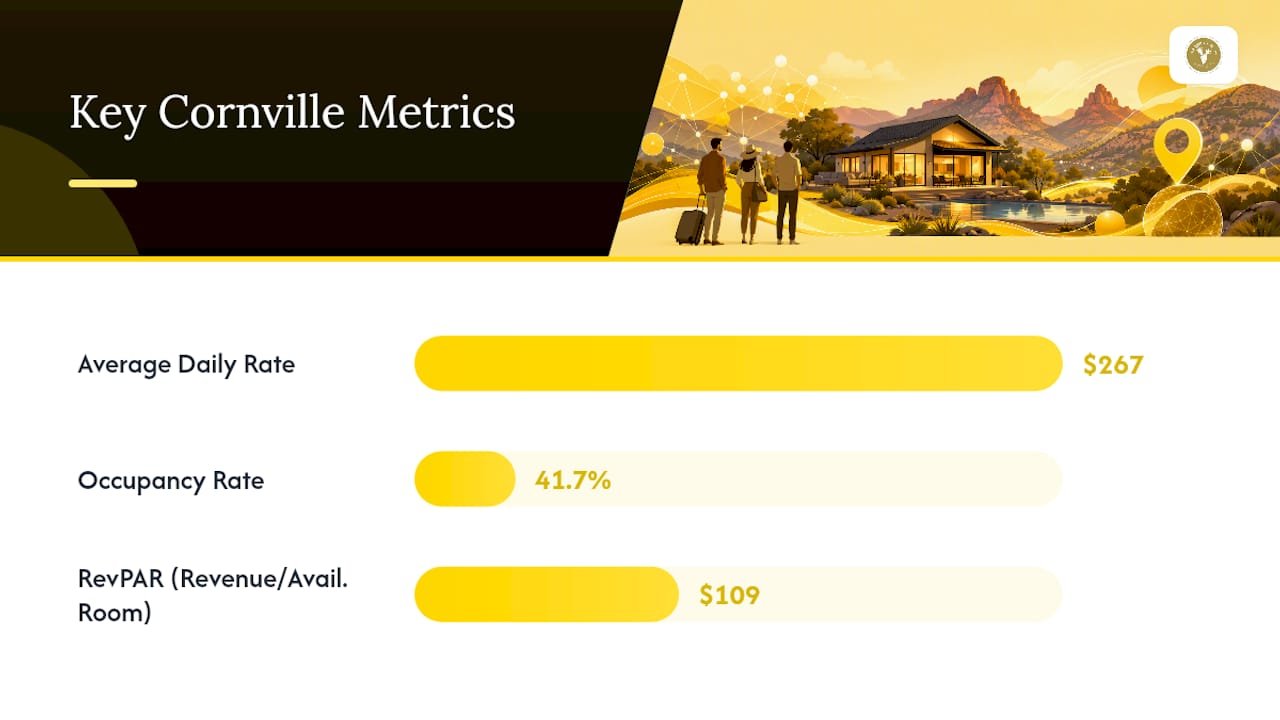
Cornville can work as an Airbnb investment, but only for buyers who underwrite it like a small hospitality business rather than a second home with a lockbox. With average daily rates near $267 and occupancy around 41.7%, the math is thinner than Sedona’s, and the single biggest variable is whether you pick a property close enough to the red rocks and the Wine Trail to actually pull those numbers.
TL;DR:
- Use multiple data sources to estimate revenue and occupancy, as single reports can vary significantly and affect underwriting accuracy.
- Focus on RevPAR, which combines rate and occupancy, to accurately compare property performance rather than relying solely on ADR.
- Confirm zoning, permits, HOA restrictions, and utility setups before purchasing, especially in unincorporated areas like Cornville.
- Expect operating expenses to range between 45 and 55 percent of gross revenue, with management method playing a major role in costs.
- Prioritize reliable local cleaning and maintenance vendors and adjust pricing strategies based on seasonal demand and booking lead times.
Table of Contents
- Cornville Airbnb Investment Metrics: The Numbers That Matter
- When Does Cornville See Its Busiest Booking Months?
- What’s Actually Driving Guests to Book in Cornville?
- How Do You Underwrite a Cornville Airbnb for Cash Flow?
- What Permits and Taxes Apply to Cornville Short-Term Rentals?
- Which Loans Work Best for a Cornville STR Purchase?
- What Do Cornville STRs Really Cost to Operate?
- Your Find-to-Close Checklist for a Cornville Deal
- Why Local Data Interpretation Beats Raw Numbers
- How Equity Team Helps You Buy the Right Cornville Property
- Where to Verify These Cornville Numbers Yourself
- Sources
Cornville Airbnb Investment Metrics: The Numbers That Matter
Start with what the data providers actually agree on, because they don’t always agree on much. AirROI’s 2026 report puts Cornville’s average annual revenue at roughly $32,181, built from an ADR of $267 and 41.7% occupancy, which nets out to a RevPAR of about $109. That’s the figure serious underwriters lean on, since RevPAR blends rate and occupancy into one number you can actually compare across listings.
Rabbu’s snapshot tells a slightly different story: a sample pull showed a moderate number of active listings, average daily rates slightly below the other data, and average annual revenue at a moderate level, though occupancy in that same snapshot ran lower. That gap matters. It’s not that one provider is wrong. Short-term rental data is scraped and modeled differently by every platform, and Cornville is small enough that a handful of high-performing or underperforming listings can swing the average.
AirDNA’s Cornville market page rounds out the picture with listing counts and the Rentalizer tool many investors used to run address-specific revenue projections before they ever make an offer. If you’re serious about a deal, pulling a Rentalizer estimate on the exact parcel, not just the zip code, is worth the subscription fee.
Here’s how the headline metrics stack up across sources:
A few takeaways from that spread:
- Treat any single-source number as a midpoint, not gospel. Cross-check at least two providers before you build a pro forma.
- Entire-home listings near the wine trail or with mountain views tend to command ADRs at the top of these bands. A studio or casita on a busier road pulls the average down.
- Occupancy is the metric with the widest variance between providers, which means it’s also the metric you should stress-test hardest in your own underwriting.
- Cornville’s numbers run meaningfully below Sedona’s short-term rental performance, which makes sense given Sedona’s tighter permit environment and stronger brand pull. Cornville plays the value role in the same demand shadow.
If you’re comparing markets, don’t just eyeball ADR. RevPAR is the more honest measure of a listing’s efficiency, since a property with a lower rate but higher occupancy can out-earn a flashier comp that sits empty half the month.
When Does Cornville See Its Busiest Booking Months?
Cornville’s peak season tends to land in March, when spring hikers, wine tourists, and snowbirds escaping colder states all converge on the Verde Valley at once. Booking lead time across the market averages around 39 days, which is short enough that late pricing adjustments still move the needle.

Revenue doesn’t stay flat the rest of the year. Expect a shoulder season in fall, when temperatures cool and wine harvest events pick up, and a summer lull once daytime heat pushes toward triple digits and hikers head elsewhere.
Pro Tip: Instead of dropping your rate across the board in slow months, shorten your minimum-stay requirement first. A two-night minimum in August can capture bookings a five-night minimum turns away, without you having to discount your best weekend dates.
A few seasonal moves worth building into your calendar:
- Raise rates and extend minimum stays around March and any major Verde Valley Wine Trail events.
- Loosen minimum-stay rules and lean on last-minute discounting tools in the low summer months to protect occupancy.
- Watch booking pace 30 to 45 days out, since that’s roughly the average lead time, and adjust pricing before a week goes empty rather than after.
Recent supply growth in the area also means differentiation matters more than it did a few years ago. A generic listing competing purely on price has less room to work with than one offering something distinct, whether that’s a hot tub, a view, or a genuinely fast host response time.
What’s Actually Driving Guests to Book in Cornville?
Nobody flies into Phoenix dreaming of Cornville specifically. They’re coming for Sedona’s red rocks, the Verde Valley Wine Trail, and the hiking and river access that surround both. Cornville just happens to sit close enough to soak up that demand at a lower buy-in cost than Sedona proper.

The guest mix breaks down into a few recognizable groups: weekend couples doing a wine-and-hike loop, remote workers stretching a long weekend into a week, and larger groups using Cornville as a quieter home base while they day-trip into Sedona. That last group tends to book bigger homes and stay longer, which is worth factoring into which property type you target.
For comps, don’t just pull Sedona numbers and call it a day. A smarter approach:
- Use Sedona as a ceiling comp, then discount its ADR and occupancy by 10 to 20 percent to reflect Cornville’s lower profile, in line with the conservative underwriting standard most investor guides recommend.
- Pull Cottonwood and Camp Verde as closer peer markets, since both share Cornville’s price point and proximity to the same attractions.
- Cross-reference Camp Verde’s internal performance data, which shows average annual revenue in the $14,500 to $16,300 range, as a useful floor for what a modestly performing Verde Valley property can still produce.
That range gives you real guardrails: Camp Verde on the low end, Sedona discounted 10 to 20 percent on the high end, with a well-positioned Cornville listing landing somewhere in between depending on how close it sits to the wine trail corridor.
How Do You Underwrite a Cornville Airbnb for Cash Flow?
RevPAR is the starting formula, and it’s simpler than it sounds: RevPAR equals ADR multiplied by occupancy.
Revenue is only half the picture. Investor guides consistently point out that short-term rentals carry operating costs well above a typical long-term rental, and skipping that reality is the fastest way to overpay for a property.
Here’s a conservative expense framework to run against any Cornville deal:
- Cleaning and turnover: typically 10 to 15 percent of gross revenue, higher if you’re running frequent short stays.
- Property management: 20 to 30 percent for full service, far less if you self-manage or use a co-host.
- Platform and payment processing fees: roughly 3 percent, mostly absorbed by guests but worth tracking.
- Utilities and supplies: 8 to 12 percent, higher for properties with a pool or hot tub.
- Insurance (short-term rental specific policy): 3 to 5 percent.
- Maintenance and capital reserves: 5 to 10 percent set aside for the inevitable water heater or HVAC surprise.
Stack those up and a realistic all-in expense ratio lands between 45 and 55 percent of gross revenue, before debt service.
Statistic Callout: On AirROI’s $32,181 average annual revenue figure, a 50 percent expense ratio leaves roughly $16,000 in net operating income before the mortgage payment. Run that against your actual purchase price and down payment to see what cash-on-cash return you’re really working with, not the number a listing agent quotes you.
Run the sensitivity both directions. A property purchased $50,000 cheaper than the area average, or one that lands closer to Rabbu’s higher $35,296 revenue snapshot, changes your cash-on-cash return meaningfully. Model both the conservative and optimistic case before you write an offer.
What Permits and Taxes Apply to Cornville Short-Term Rentals?
Before anything else, figure out whether the parcel sits inside an incorporated town or in unincorporated Yavapai County, since that determines which permit rules and short-term rental restrictions actually apply. Cornville itself is unincorporated, which shapes what oversight looks like compared to Sedona’s tighter incorporated permit system.
Arizona collects transaction privilege tax (TPT) on short-term rental income, and while platforms like Airbnb often collect and remit a portion of these taxes automatically, that arrangement doesn’t cover every local jurisdiction or guarantee full compliance on its own. Verify what Airbnb actually remits on your behalf versus what you’re still responsible for filing directly with the state and county.
Before you close, work through this checklist:
- Pull the parcel map and confirm zoning through Yavapai County planning, not just what a listing description claims.
- Check for an HOA and read the CC&Rs line by line, since short-term rental bans buried in HOA documents are more common than buyers expect.
- Confirm septic and well permitting where applicable, since Cornville’s more rural parcels often run on private systems rather than municipal utilities.
- Register for TPT and any required local lodging permit before your first guest checks in, not after.
Pro Tip: Call the Yavapai County planning department directly and ask about the specific parcel number, not the general area. Zoning and permit answers can vary block to block in unincorporated county land, and a verbal “it should be fine” from a neighbor is not a substitute for a written confirmation.
Which Loans Work Best for a Cornville STR Purchase?
Conventional financing works if you qualify on personal income, but most serious STR investors end up looking at DSCR loans, which qualify the property based on its own projected cash flow rather than your W2 income. Lenders typically want to see a debt service coverage ratio above 1.0, and often prefer 1.2 or higher, before they’ll approve the loan.
Expect lenders to apply a haircut to whatever revenue projection you hand them. If AirROI shows $32,181 in average annual revenue, don’t be surprised if the lender’s underwriting model discounts that by 15 to 25 percent before calculating your qualifying DSCR.
Before you apply, get these ready:
- A third-party market report (AirDNA Rentalizer, AirROI, or Rabbu) showing projected revenue for the specific address.
- A written pro forma with your own expense assumptions, not just the lender’s default template.
- Proof of cash reserves, typically six months of mortgage payments for STR-specific loan products.
- Documentation of any prior property management or hosting experience, which some lenders weigh in your favor.
Down payment requirements on DSCR products commonly run higher than a conventional owner-occupied loan, often in the 20 to 25 percent range, so factor that into your total cash-to-close before you fall in love with a listing.
What Do Cornville STRs Really Cost to Operate?
Run the numbers with a 45 to 55 percent expense ratio baked in, and don’t let a rosy listing description talk you out of it. That range covers cleaning, management, utilities, insurance, and the maintenance reserve every older Verde Valley property eventually needs.
Your management choice changes the math more than almost anything else. Self-managing can save the 20 to 30 percent a full-service manager charges, but it also means you’re the one fielding a 2 a.m. lockout call. A co-host model splits the difference, often for 10 to 15 percent, handling guest communication while you or a local vendor handle turnovers.
Pro Tip: Lock in your cleaning vendor before you close, not after. In a market as small as Cornville, reliable cleaning and maintenance crews are the scarcest resource, and a missed turnover is what tanks your rating faster than any pricing mistake.
A few ways to control turnover costs without cutting corners guests will notice:
- Standardize your restock list so cleaners aren’t guessing what needs replacing each visit.
- Batch maintenance visits (filter changes, hot tub checks) with cleaning days to cut trip fees.
- Build a buffer night between back-to-back bookings during peak season to avoid rushed, lower-quality turnovers.
Your Find-to-Close Checklist for a Cornville Deal
Filter your search first: set a price band, confirm well and septic status upfront, and check drive time to Sedona, since anything over 20 minutes starts to erode the demand advantage you’re paying for.
From there, work through due diligence in order:
- Verify parcel jurisdiction and zoning with Yavapai County before you write an offer.
- Pull HOA documents, if any exist, and confirm short-term rentals aren’t restricted.
- Get real quotes from a local property manager and a cleaning crew, not estimates pulled from a national average.
- Confirm short-term rental insurance is available and priced for the specific property before closing.
- If STR operation is ever restricted after purchase, have a long-term rental fallback plan modeled so the property still cash flows.
Why Local Data Interpretation Beats Raw Numbers
Anyone can pull an AirROI report. What separates a good Cornville deal from a mediocre one is knowing which streets actually deliver Wine Trail walkability and which just claim it in the listing description. Equity Team’s Verde Valley work, including internal Camp Verde revenue benchmarking, consistently shows that vetted cleaning and maintenance vendors matter as much as the purchase price itself.
— Chad
How Equity Team Helps You Buy the Right Cornville Property
Spreadsheets and AirROI reports get you halfway there. The other half is knowing which Cornville parcels actually deliver on paper promises, and Equity Team has spent years sorting exactly that in the Verde Valley market.

We built our practice around short-term rental buyers specifically, which means we’re not guessing at cap rates from a generic residential playbook. We source listings against real occupancy data, run conservative pro formas before you ever make an offer, walk you through the Yavapai County permit and TPT process, and introduce you to property managers and cleaning vendors we already trust in the area.
If you’re ready to see what a disciplined, data-backed Cornville or Verde Valley acquisition looks like, start with our guide on finding the right short-term rental investment property and reach out to walk through your specific numbers with our team.
Where to Verify These Cornville Numbers Yourself
Run your own diligence with AirROI’s Cornville market report for revenue and occupancy trends, AirDNA’s Rentalizer for address-level projections, and Rabbu’s market snapshot for a second data point. For regional context, browse Equity Team’s Cornville page directly.
Sources
- Cornville, Arizona Airbnb Market Data 2026: STR Report & Statistics — AirROI
- AirDNA: Cornville, Arizona vacation rental data — MarketMinder
- Cornville, AZ Airbnb Market Data, Statistics, and … — Rabbu
- Short-Term Rental and Airbnb Investing: The Full Guide — REI Prime