

If you’re self-employed, buying through an LLC, or trying to close fast on a Sedona short-term rental before another buyer beats you to it, a DSCR loan usually wins. If you’re a W-2 earner with just a property or two and you want the lowest possible rate, a conventional loan usually wins. That’s the whole verdict in two sentences. The rest comes down to four levers:
- How your income shows up on paper (personal tax returns vs. property rent)
- How many financed properties you already own
- How much of a rate premium you’re willing to pay for speed and flexibility
- How fast you actually need to close
Run both numbers on your specific deal using the checklist further down. The math changes with every property, so don’t take anyone’s rule of thumb as gospel, including this one.
Key Takeaways
DSCR loans qualify on property income and close faster, while conventional loans qualify on personal income and typically cost less over time.
| Point | Details |
|---|---|
| Qualification basis differs | DSCR uses rental income divided by PITIA; conventional uses personal tax returns and DTI. |
| Rate spread has narrowed | The DSCR premium now runs roughly 70 to 120 basis points, not the older 2 to 4 percent gap. |
| Closing speed favors DSCR | DSCR loans often fund in 14 to 30 days versus 30 to 60 for conventional financing. |
| LLC vesting is a DSCR advantage | Most DSCR programs allow LLC title; conventional loans typically require personal name. |
| Prepayment penalties need scrutiny | Step-down penalty structures can erase savings for short-hold or flip strategies. |
Table of Contents
- DSCR Loan vs Conventional: A Side-by-Side Comparison
- What Is a DSCR Loan and How Do Lenders Calculate It?
- What Is a Conventional Investment Loan and How Does Underwriting Work?
- The Real Cost Difference: Rate, Points, Penalties, and Speed
- Which Loan Fits Your Investor Profile?
- How to Run the Numbers on Your Own Deal
- What This Looks Like for Sedona Short-Term Rental Investors
- Why Execution Beats the Rate Sheet Every Time
- Sources
DSCR Loan vs Conventional: A Side-by-Side Comparison
Here’s how the two financing paths stack up on the criteria that actually move an investor’s decision, not the marketing bullet points.
| Factor | DSCR Loan | Conventional Loan |
|---|---|---|
| Qualification basis | Property cash flow (rent vs. debt) | Personal income, tax returns, DTI |
| Typical rate spread | Roughly 70 to 120 basis points above conventional | Baseline rate |
| Closing speed | 14 to 30 days | 30 to 60 days |
| LLC vesting | Commonly allowed | Rarely allowed |
| Property-count limit | No hard cap | Practical caps well below Fannie’s published max |
| Down payment / LTV | Generally larger down payments required | Often lower down payments possible, program dependent |
| Prepayment penalty | Common (step-down structures) | Rare |
The gap that matters most: the DSCR-to-conventional rate spread now sits around 70 to 120 basis points, a lot tighter than the 2 to 4 percent premium older articles still quote. Meanwhile, DSCR loans close in roughly half the time of conventional investor loans.
The trade-off is simple: conventional financing usually costs less per month, DSCR financing usually gets you to the closing table, and to more of them, faster.
What Is a DSCR Loan and How Do Lenders Calculate It?
A DSCR loan qualifies you based on what the property earns, not what you earn. Lenders divide the property’s rental income by its total housing payment, principal, interest, taxes, insurance, and association dues (PITIA), to get the debt service coverage ratio.

DSCR = Gross Rental Income ÷ PITIA
Say a Sedona short-term rental generates $4,200 a month in projected income and the full PITIA payment lands at $3,200. That’s a DSCR of 1.31, meaning the property earns 31% more than it costs to carry. Most lenders want to see 1.0 to 1.25 or higher, though some programs accept lower ratios if you bring a bigger down payment to the table.
Lenders typically accept several forms of rent evidence:
- Signed lease agreements for long-term rentals
- An appraiser’s market rent estimate (Fannie Mae Form 1007) for vacant or owner-occupied properties
- Short-term rental income history from platforms like Airbnb or Vrbo, though programs vary widely in how they count STR income
- Reserve statements showing three to six months of PITIA in the bank
Pro Tip: Before you fall in love with a listing, call your lender and ask exactly how they treat Airbnb income for that specific property type. Some DSCR programs discount STR revenue by 20% or more before running the ratio, and that discount can flip a “yes” into a “not quite.”
What Is a Conventional Investment Loan and How Does Underwriting Work?
Conventional investment loans run through Fannie Mae and Freddie Mac guidelines, and they qualify you, not the property. That means full income documentation: two years of tax returns, pay stubs, W-2s, and a debt-to-income ratio that typically needs to stay under 45 to 50%.
Underwriters also want to see reserves, often six months of payments for a second investment property, and the file gets a real look at every other debt on your credit report.
Here’s where conventional financing gets more expensive than the sticker rate suggests:
- Loan-level price adjustments (LLPAs) add cost specifically for investment occupancy, on top of adjustments for credit score and loan-to-value
- LLPAs stack, so a lower-credit-score investor buying at 75% LTV pays noticeably more than the advertised rate
- Fannie Mae publishes a maximum financed-property count, but most retail lenders cut off individual borrowers well before that ceiling
- Title almost always needs to sit in your personal name, not an LLC, to qualify for these programs
That last point trips up more investors than any rate quote. If asset protection through an LLC matters to your strategy, conventional financing puts you in an awkward spot before you even talk numbers.
The Real Cost Difference: Rate, Points, Penalties, and Speed
The headline rate gap between DSCR and conventional financing has narrowed to roughly 70 to 120 basis points in typical scenarios. On a $300,000 loan, a 1 percentage point difference can mean a significant monthly cost increase, depending on your rate and term. That’s real money, but it’s not the deal breaker it was a few years ago.
Points muddy the comparison further. A DSCR loan advertised at a lower rate might carry two points at closing, while a conventional loan at a slightly higher rate charges none. Always compare the full picture:
- All-in cost = rate impact + points paid + any prepayment penalty exposure
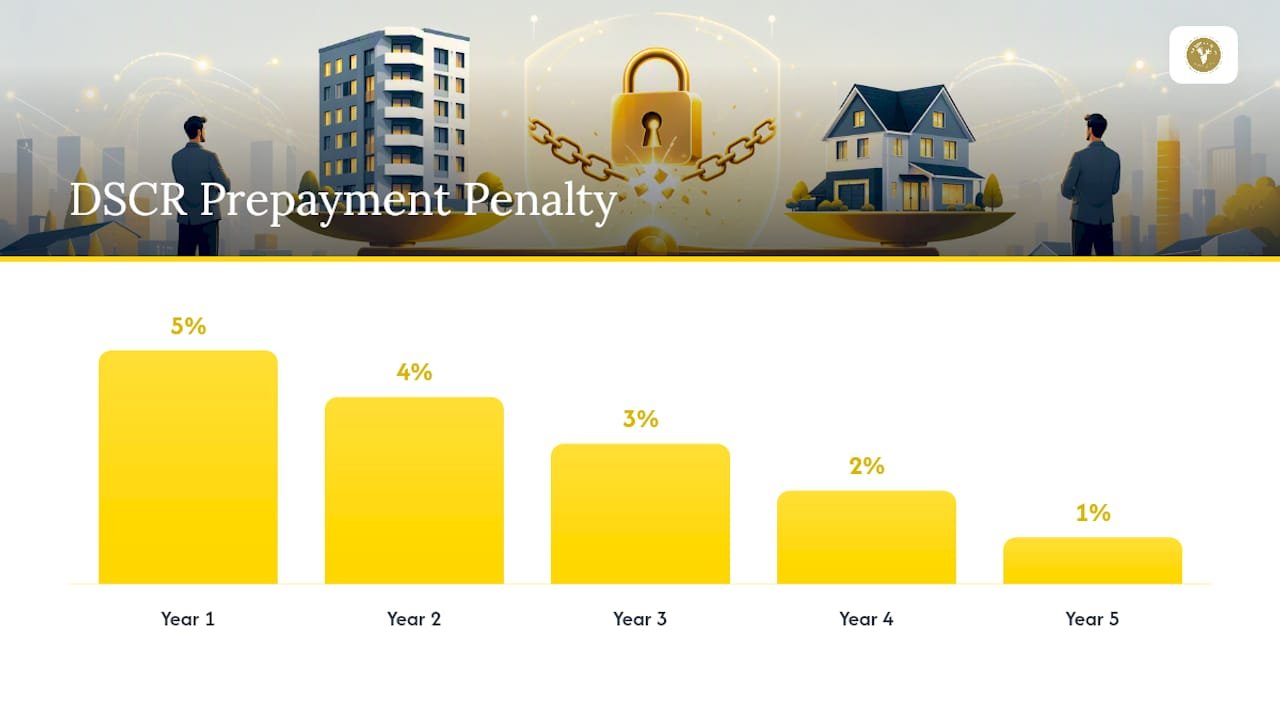
- DSCR loans commonly attach prepayment penalties using a 5-4-3-2-1 step-down structure, meaning selling or refinancing in year one costs 5% of the loan balance, dropping a point each year
- Conventional loans rarely carry prepayment penalties at all
Closing speed is the variable investors underrate. DSCR loans typically fund in 14 to 30 days versus 30 to 60 for conventional. In a BRRRR strategy or a competitive Sedona listing with multiple offers, that three-to-four-week head start can be the difference between winning the contract and watching it go to cash.
Which Loan Fits Your Investor Profile?
Not every investor faces the same trade-off. Here’s how the decision tends to shake out by profile:
- First-time investor with a W-2 job: Conventional financing almost always wins here. You have clean income documentation, you’re only buying one property, and you’ll get the better rate without giving up anything.
- Portfolio scaler with five-plus properties: DSCR loans become the practical choice once you bump against a lender’s property-count comfort zone, even if Fannie Mae’s technical maximum is higher.
- Self-employed buyer: DSCR sidesteps the tax-return gymnastics entirely, since the loan qualifies on rent, not your Schedule C.
- STR or BRRRR investor: Speed and LLC vesting usually outweigh the rate premium, especially when you’re refinancing out of a bridge loan on a tight timeline.
- Flipper or short-hold buyer: Think twice. A DSCR loan’s prepayment penalty can eat your profit if you sell within a year or two, so run the penalty math before signing.
Some investors mix both, using conventional financing for their first one or two properties, then shifting to DSCR once documentation friction or property-count limits start slowing them down.
How to Run the Numbers on Your Own Deal
Before you pick a lender or a loan type, work through these steps on paper.
- Pull the property’s realistic rent, using actual comps or your own STR revenue history, not the optimistic number from the listing agent.
- Calculate PITIA: principal, interest, taxes, insurance, and any HOA dues.
- Divide rent by PITIA to get your DSCR, then compare it against the 1.0 to 1.25 threshold most lenders use.
- Request rate quotes for both loan types and calculate the five-year total cost: rate impact, points, and any prepayment penalty exposure.
- Ask your lender directly about LLC vesting, exact prepayment penalty terms, reserve requirements, and seasoning rules on the title.
Example: on a $300,000 Sedona STR purchase with $2,600 monthly PITIA and $3,400 in projected rent, your DSCR comes out to 1.31, comfortably above most lender minimums.
| Input | Conventional | DSCR |
|---|---|---|
| Down payment | 20% | 25% |
| Documentation | Tax returns, DTI | Rent evidence only |
| Estimated closing | 45 days | 14 to 30 days |
Pro Tip: Ask lenders for their prepayment penalty terms in writing before you lock a rate. “Standard” varies enormously between DSCR programs, and a verbal answer isn’t binding.
What This Looks Like for Sedona Short-Term Rental Investors
Sedona’s STR market moves fast, and inventory in the top-performing zones doesn’t sit long. Financing speed and LLC vesting matter here more than in a typical slow-moving suburban market.
We’ve seen buyers lose out on strong-performing Sedona properties because their conventional pre-approval simply couldn’t close before a cash offer did. A DSCR loan, closing in three weeks instead of six, has been the difference for more than one client trying to secure a property in a high cap-rate pocket of the Verde Valley.
- Local zoning and STR permitting timelines add pressure that off-market conventional buyers don’t face
- LLC vesting matters more for STR owners carrying liability exposure from nightly guests
- Reserve requirements tend to be higher for STR-specific DSCR programs, so budget accordingly
Buyers who treat financing speed as a competitive advantage, not just a cost line, tend to land the better-performing Sedona properties before anyone else even schedules a showing.
Why Execution Beats the Rate Sheet Every Time
Most articles on this topic treat DSCR loans like a consolation prize for investors who can’t qualify conventionally. That framing is backward. The spread has compressed to 70 to 120 basis points, which means the old “DSCR costs you 2 to 4% more” argument barely holds up anymore. What used to be a painful trade-off is now closer to a rounding error for investors who value speed and structure.
The conventional wisdom that “lowest rate wins” ignores what actually kills deals: slow closings, personal-name title requirements, and property-count ceilings that quietly stop portfolio growth. In a market like Sedona, where good STR inventory doesn’t wait around, closing three weeks faster is worth more than saving a fraction of a point.
Prioritize execution first. Figure out whether you can even close fast enough and structure the deal the way you want, then compare rates. Getting the property beats getting the better rate on a property someone else bought.
— Chad
Sources
- Common DSCR underwriting conditions explained — Trulo Mortgage
- DSCR Loan vs Conventional Mortgage (2026): The Spread Is Only About 70-120 bps Now — CrowdfundedWealth
Ready to put this into action on an actual Sedona listing? Explore how to find the right short-term rental investment with a team that specializes in matching financing strategy to property performance.