

The Airbnb host service fee is the percentage Airbnb deducts directly from your payout before you ever see a dollar. Under the host-only model, that fee is a fixed percentage of the booking subtotal — nightly rate, cleaning fee, pet fees, and any extras you’ve added. For Sedona STR investors, that’s not a minor footnote. It’s a line item that reshapes your net revenue, your cap-rate math, and the price you need to list at to hit your target payout.
- Fee model: Single host-only fee, approximately 15.5% of the booking subtotal
- Who pays: The host, deducted automatically from the payout
- Investor bottom line: Every listing price you set must account for this deduction — or your net income is quietly lower than your model assumed
Table of Contents
- What does the Airbnb host service fee actually cover?
- What rate will you actually pay, and what changes it?
- How to calculate your Sedona payout — and a real example
- Where to find your exact fee in the Airbnb host dashboard
- What Sedona investors should do right now
- Buyer and seller checklist for Sedona STR transactions
- Key Takeaways
- The fee math is simple — the strategy around it isn’t
- Equity Team runs the numbers so you don’t have to
- Useful sources and tools
What does the Airbnb host service fee actually cover?
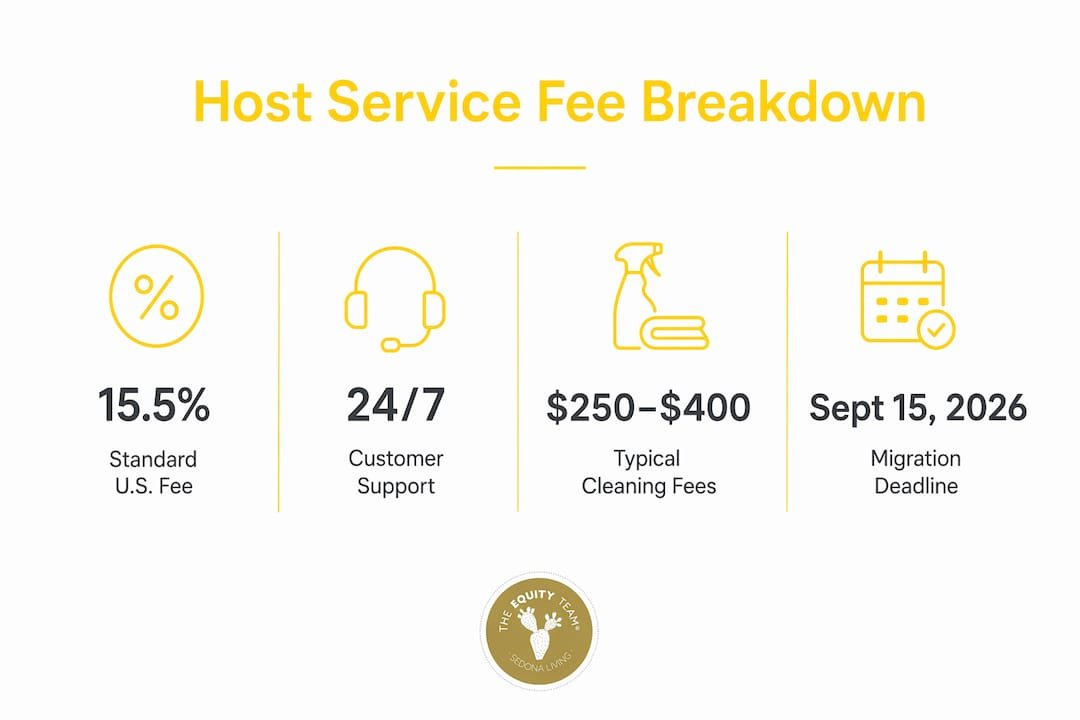
Airbnb states the fee funds payment processing, marketing your listing to guests, and 24/7 customer support. Think of it as the platform’s operating budget, billed to you as a percentage rather than a flat monthly charge.
The older split-fee model split the pain: hosts paid a small percentage and guests paid a larger fee on top of the list price. Guests saw a higher total than what the host set, which made competitive pricing feel like guesswork. Airbnb’s migration to a single fee consolidates both sides into one fixed host deduction, so guests see and pay exactly what you list. Cleaner for them, more expensive for you.
The migration deadline for most non-EU regions is September 15, 2026, with no opt-out. Hosts who don’t reprice before that date will simply earn less per booking.
Pro Tip: The platform shift improves guest-facing transparency, but the full cost of running on Airbnb now lives entirely in your operating budget. Model it that way from day one.
What rate will you actually pay, and what changes it?
The standard U.S. rate is approximately 15.5%, but a few variables can push that number around:
- Regional exceptions: Listings in Brazil and Mexico carry a 16% standard fee rather than 15.5%
- Listing type: Service reservations (think serviced apartments and some hotel-style listings) often fall into a higher fee tier, typically 15%–20%
- Fee-bearing line items: The 15.5% applies to the full booking subtotal — nightly rate plus cleaning fee, pet fees, and any extras you charge
- Account transition timing: Bookings made before your account switched keep the prior fee structure; only new reservations after the switch carry the single fee
For Sedona’s luxury tier, where cleaning fees often run $250–$400 and extras like hot tub access or concierge add-ons are common, the absolute dollar impact of that 15.5% is meaningfully larger than on a budget listing. A small percentage on a big subtotal is still real money.
How to calculate your Sedona payout — and a real example
The math trips up a lot of hosts. Multiplying your target net by 1.155 gives you the wrong answer. The correct formula is:
List Price = Target Net ÷ (1 − fee%)
At 15.5%, that divisor is 0.845. So if you want to net $400 per night, you list at $400 ÷ 0.845 = $473.37, not $400 × 1.155 = $462.

Here’s a worked Sedona luxury STR example, assuming a 3-night stay:
| Line Item | Amount |
|---|---|
| Nightly rate for 3 nights | Calculated amount |
| Cleaning fee | Entered amount |
| Pet fee | Entered amount |
| Booking subtotal | Calculated subtotal |
| Airbnb host fee | Calculated fee based on subtotal |
| Host payout | Calculated payout after fee |
At a moderate annual occupancy level, a property averaging typical nightly rates and cleaning fees generates a substantial annualized gross payout before other operating costs. Run that through a cash flow calculator to stress-test occupancy scenarios before you finalize underwriting.
Pro Tip: Build a quick spreadsheet with three occupancy columns — 55%, 65%, and 75% — and run the payout formula at each. Sedona’s STR pricing dynamics shift seasonally, and a single-scenario model will mislead you.
Where to find your exact fee in the Airbnb host dashboard
- Log into your Airbnb host account and go to Earnings (or Payouts in some account views).
- Open any completed booking from your calendar or transaction history.
- Look for the Price breakdown section — the service fee appears on its own labeled line.
- Cross-reference the fee percentage against your account’s transition date. Bookings before the switch show the old split-fee deduction; bookings after show the single 15.5% line.
- If the numbers look off, check whether your property management software (PMS) is pulling a cached or pre-transition rate. Reconnect the integration and refresh.
- Still confused? Contact Airbnb support directly and reference your account’s migration date — they can confirm which fee applied to any specific reservation.
Airbnb confirms that fees are deducted automatically and that earlier bookings keep the fee structure in place at the time of reservation, so don’t expect retroactive changes either direction.
What Sedona investors should do right now
- Reprice every listing using the correct formula (List = Net ÷ 0.845) before the September 15, 2026 deadline. Airbnb built a bulk-pricing tool for this — use it.
- Re-run your underwriting with updated net revenue figures. Pull your Sedona rental income potential estimates and rebuild cap-rate models at 55%, 65%, and 75% occupancy.
- Audit fee-bearing add-ons. Cleaning fees and pet fees increase the absolute fee Airbnb takes. Decide whether bundling extras into the nightly rate or keeping them separate better serves your net.
- Diversify booking channels. Direct bookings and other OTAs sidestep the Airbnb fee entirely. That requires marketing investment, but channel diversification can meaningfully protect margin on high-revenue properties.
- Update seller disclosures if you’re listing a property for sale. Historical earnings reports that mix split-fee and single-fee periods need a clear explanation for buyers.
Pro Tip: Sedona’s 24% drop in STR availability actually works in your favor here — tighter supply means you have more pricing power to absorb the fee increase without losing occupancy.
Buyer and seller checklist for Sedona STR transactions
Before signing anything, make sure these questions are answered:
- Which fee model applied to the property’s historical bookings — split fee or single fee — and on what date did the account transition?
- Does the seller’s earnings report show gross booking revenue or net payout? (They’re very different numbers post-fee.)
- What cleaning fee and extras has the host been charging, and how do those affect the fee-bearing subtotal?
- Has the seller already repriced listings to account for the single fee, or are current list prices still set for the split-fee world?
- Will the seller provide the full Airbnb earnings dashboard export, not just a summary spreadsheet?
- Are there any service reservations or specialty listing types on the account that carry a higher fee tier?
- Has the seller disclosed any shortfall in payout during the transition period, and are they willing to negotiate on that basis?
Key Takeaways
The Airbnb host service fee is deducted from the full booking subtotal, and Sedona investors must reprice using the correct formula before the upcoming September 2026 deadline to protect their payouts.
| Point | Details |
|---|---|
| Standard U.S. fee rate | Approximately 15.5% deducted from the full booking subtotal, including cleaning and extras |
| Correct pricing formula | Use List = Net ÷ 0.845, not Net × 1.155, to avoid chronic underpricing |
| Fee applies to all add-ons | Cleaning fees, pet fees, and extras all increase the absolute dollar amount Airbnb takes |
| September 2026 deadline | Non-EU hosts who don’t reprice before September 15, 2026 will earn less per booking automatically |
| Equity Team advantage | Equity Team runs updated Sedona P&L models and pricing audits so investors don’t leave money on the table |
The fee math is simple — the strategy around it isn’t
Here’s what most articles on this topic miss: the 15.5% fee isn’t the whole story for Sedona investors. The real question is whether your current list price was ever set correctly in the first place.
Sedona’s luxury STR market has always attracted buyers who underwrite on gross revenue — the number that looks great in a listing description — rather than net payout. The platform migration just made that habit more expensive. A property that appeared to generate $180,000 in gross bookings under the split-fee model may have been netting closer to $152,000 after the old host fee. Under the single-fee model, if the seller never repriced, that same gross figure now nets $152,100 — almost identical, but only if they ran the math. Many didn’t.
The smarter move for buyers is to request the full Airbnb earnings dashboard export, not a seller-prepared summary. The dashboard shows the fee deduction on every single booking. That’s the number that matters for valuation, and it’s the number Equity Team always starts with when advising clients on Sedona acquisitions.
Equity Team runs the numbers so you don’t have to
Sedona’s STR market rewards investors who get the fee math right before they buy or list, not after. Equity Team specializes exclusively in Sedona STR transactions, and the team works with buyers and sellers in the top 10% of the local rental market. That means every acquisition analysis includes an updated P&L with the correct 15.5% fee deduction, occupancy scenario modeling, and a pricing audit that uses the right formula from the start.

Whether you’re buying and need underwriting that reflects current Airbnb fee structures, or selling and want to present clean, credible net revenue numbers to buyers, Equity Team has the local data and the STR expertise to back it up. Find the right Sedona STR investment or book a pricing audit consultation with the team today.
Useful sources and tools
- Airbnb host service fee help article — official breakdown of what the fee covers and how it’s deducted
- Simplifying service fees on Airbnb (Resource Center) — migration deadlines, the 15.5% rationale, and the bulk repricing tool
- How Much Does Airbnb Take From Hosts and Guests? — third-party explainer with 2026 pricing examples
- Airbnb Host-Only Fee Explained (Hostaway) — correct pricing formula and fee-bearing subtotal breakdown
- Airbnb Host Fees (Hostfully) — strategic framing of the host-only model’s budget implications
- Investment Property Calculator — run cap rate, cash flow, and occupancy scenarios with updated net revenue figures
- Sedona Airbnb Market Trends 2026 — local occupancy patterns and luxury-tier earnings context
- Sedona Rental Property Cash Flow Examples — additional worked P&L examples for Sedona properties