

Furnishing a Sedona Airbnb at mid-range quality level typically increases with the number of bedrooms, reflecting a progressive budget increase aligned with guest expectations. The 8–12% of projected first-year gross revenue rule of thumb is the cleanest way to size your budget fast. Using Sedona market data for expected revenue, furnishing targets can be estimated proportionally, with lean to fuller setups calibrated accordingly.
- Next step: Pull a current Sedona ADR estimate for your property type, multiply gross revenue by 8–12%, and use that as your furnishing ceiling before you shop a single sofa.
- Financing note: Furnishing costs are a capital expense you can amortize over item lifespans, which meaningfully lowers the real annual cost and improves your underwriting math.
- Staging vs. full furnish: Full furnishing covers procurement, setup, and every item a guest needs; staging focuses on styling and photography. Most Sedona hosts launching a new listing need full furnishing, not just staging.
Table of Contents
- What do low, mid, and high budget tiers actually mean for Sedona STRs?
- Room-by-room furnishing cost estimates for Sedona Airbnbs
- What should your total furnishing budget be by bedroom count?
- How does spending break down across furnishing categories?
- How do Sedona’s unique conditions change your furnishing costs?
- What’s the realistic procurement timeline for a Sedona Airbnb?
- What should you splurge on and what can you skip?
- How can you source furnishings for less without hurting guest experience?
- Ready-to-use shopping checklist and sample budgets
- Key Takeaways
- The furnishing decision most Sedona hosts get wrong
- Equity Team knows Sedona STR investing from the inside out
- Useful sources and local Sedona resources
What do low, mid, and high budget tiers actually mean for Sedona STRs?
The three tiers aren’t just about price. They describe a completely different guest experience, durability expectation, and replacement cadence. Knowing which tier fits your property keeps you from over-investing in a low-ADR market or under-delivering in a high-demand one.
Low tier ($3,500–$8,000 for a studio or 1BR) means functional and clean, full stop. You’re buying recognizable entry-level brands, IKEA or Amazon basics, and keeping decor minimal. Lifespan on upholstered pieces runs 2–3 years under STR turnover. This tier works for hosts testing a market, furnishing a secondary bedroom, or operating in a lower-ADR zip code where guests aren’t paying $250+ per night.
Mid tier ($8,000–$20,000 depending on bedroom count) is the sweet spot for most Sedona properties. You’re buying quality mattresses ($700–$1,200 each), performance upholstery that survives weekly cleanings, and a fully stocked kitchen. Lifespan on key pieces stretches to 5–7 years with proper care. This is where mid-range Sedona 2BR setups cluster, and it’s the tier that balances durability, guest comfort, and cash-on-cash returns without requiring boutique-hotel finishes.
High tier ($25,000–$45,000+ for larger properties) means design-forward choices, premium mattresses, recognizable furniture brands, upgraded outdoor spaces, and finishes that compete with boutique hotels. Replacement cycles are longer, but the upfront spend is significant. This tier makes sense when your Sedona property commands $350+ per night and guests are comparing you to luxury cabin rentals.
- Low tier suits: budget markets, secondary bedrooms, first-time hosts stress-testing a concept
- Mid tier suits: most Sedona 1BR–3BR properties targeting the $200–$350/night range
- High tier suits: luxury Sedona properties with pools, hot tubs, or premium locations targeting $350+/night
Pro Tip: Sedona’s average nightly rate hovers around $295. That puts most Sedona properties firmly in mid-tier territory. If your ADR projection doesn’t support the interest payments on a high-tier furnishing budget, don’t let the red rocks seduce you into overspending on linen thread counts.
Room-by-room furnishing cost estimates for Sedona Airbnbs
Cost estimates per room for a typical Sedona vacation rental vary widely across low, mid, and high quality levels, reflecting differences in guest experience and local outdoor-living importance without specifying exact dollar ranges.
Primary bedroom itemized breakdown
The bedroom is where guests form their most lasting impression. A bad night’s sleep generates a review that follows your listing for months.
| Item | Low | Mid | High |
|---|---|---|---|
| Queen/King mattress | $300–$500 | $600–$1,200 | $1,200–$2,500 |
| Bed frame and headboard | $150–$350 | $350–$800 | $800–$2,000 |
| Nightstands (pair) | $100–$150 | $150–$400 | $400–$900 |
| Dresser | $100–$150 | $250–$600 | $600–$1,500 |
| Bedding set (sheets, duvet, pillows) | $80–$120 | $150–$350 | $350–$800 |
| Lamps (pair) | $30–$60 | $80–$150 | $200–$600 |
| Blackout curtains | $30–$60 | $80–$150 | $200–$500 |
| Mirror | $20–$50 | $60–$150 | $200–$500 |
| Wall art | $30–$60 | $80–$200 | $250–$700 |
| Primary bedroom total | $800–$1,200 | $1,800–$3,500 | $4,200–$9,000 |
Blackout curtains deserve a special mention in Sedona. The sun rises early, it’s relentlessly bright, and guests who drove up from Phoenix for a “serene getaway” do not want to be blasted awake at 5:30 AM. Budget for quality blackout curtains in every bedroom.
Lifespan matters as much as purchase price. A mid-range mattress at $700–$1,200 lasts 5–7 years with a waterproof encasement. Budget mattresses at $300–$400 typically need replacing after the first season of STR use. Linens cycle faster: plan for replacement every 1–2 years under weekly turnover. Bed frames and dressers, if solid wood or metal, can last the life of the property.
- Mattress: replace every 5–7 years (with encasement); budget mattresses often fail in year one
- Linens and bedding sets: replace every 1–2 years under STR turnover
- Upholstered pieces (sofas, headboards): 3–5 years at mid tier; 5–7 years at high tier with performance fabric
- Hard case goods (dressers, bed frames, dining tables): 7–10+ years if quality construction
Pro Tip: For Sedona’s high-turnover season, buy three sets of sheets per bed. It sounds like overkill until your cleaner is waiting on laundry between same-day turnovers during spring break. Three sets keeps the operation moving without a single frantic trip to Target.
What should your total furnishing budget be by bedroom count?
The table below gives you ready-made total budget targets you can plug directly into an underwriting model. These reflect full-property costs including all rooms, outdoor space, and utility/miscellaneous items.
| Property size | Low tier | Mid tier | High tier |
|---|---|---|---|
| Studio / 1BR | $3,500–$8,000 | $8,000–$15,000 | $18,000–$35,000 |
| 2BR | $12,000–$20,000 | $15,000–$28,000 | $25,000–$45,000 |
| 3BR | $15,000–$28,000 | $20,000–$35,000 | $35,000–$45,000+ |
| 4BR | $25,000–$45,000 | $30,000–$45,000 | $40,000–$55,000+ |
One thing that surprises most first-time STR investors: the living room and kitchen are the expensive rooms, not the bedrooms. Each additional bedroom adds roughly $3,000–$3,500 in marginal cost once the shared spaces are furnished. That’s why the jump from a studio to a 1BR is smaller than it looks, and why a 2BR is often the most cost-efficient first STR purchase in Sedona.
Sample budget: mid-range 2BR Sedona Airbnb
This template is built for a Sedona two-bedroom targeting $200–$300/night with a full kitchen and outdoor seating area.
- Living room (sofa, coffee table, TV, rug, lighting, decor): $2,500–$3,500
- Primary bedroom (mattress, frame, nightstands, linens, curtains): $2,000–$3,000
- Secondary bedroom (mattress, frame, linens, curtains): $1,500–$2,500
- Kitchen and dining (full cookware, appliances, table, chairs): $1,200–$2,000
- Bathrooms x2 (towels, mats, accessories): $500–$800
- Outdoor patio (table, chairs, lounge seating, fire pit): $1,500–$2,500
- Entry, utility, safety, and tech (smart lock, detectors, vacuum): $600–$1,000
- Total mid-range 2BR: $15,000–$20,000
Sample budget: low-budget studio
Built for a Sedona studio targeting $120–$180/night, functional and clean.
- Living/sleeping area (sofa bed or bed, basic seating, TV): $900–$1,400
- Kitchen (basic cookware, small appliances, dishes): $400–$600
- Bathroom (towels, mat, accessories): $150–$250
- Lighting and minimal decor: $300–$500
- Entry, utility, and safety basics: $300–$500
- Total low-budget studio: $2,050–$3,250
Pro Tip: The 2BR is the most common first STR purchase in Sedona for a reason. The furnishing-to-revenue ratio tends to be the most favorable at that size, and the marginal cost of the second bedroom is modest once you’ve already paid for the living room and kitchen.
How does spending break down across furnishing categories?
Understanding where the money actually goes helps you prioritize purchases and avoid the trap of over-spending on low-impact categories. For a mid-range Sedona setup, the budget typically distributes across six main categories.
| Category | Typical share of mid-range budget | Expected lifespan |
|---|---|---|
| Furniture (beds, sofas, tables, chairs) | 40–45% | 5–10 years |
| Appliances and kitchen equipment | 15–20% | 5–10 years |
| Linens and bedding | 10–15% | 1–2 years |
| Décor and lighting | 10–12% | 3–7 years |
| Tech and safety (WiFi, smart lock, detectors) | 5–8% | 3–5 years |
| Consumables and supplies | 8–12% | Ongoing |
Furniture and appliances together consume more than half the budget, which is exactly where they should. These are the items guests interact with every single day. Linens look like a small line item, but their replacement cadence makes them a meaningful annual cost. Amortizing furnishing CapEx over realistic lifespans produces an annual cost of roughly $1,455 for a one-bedroom setup, a figure that belongs in your per-night break-even calculation.
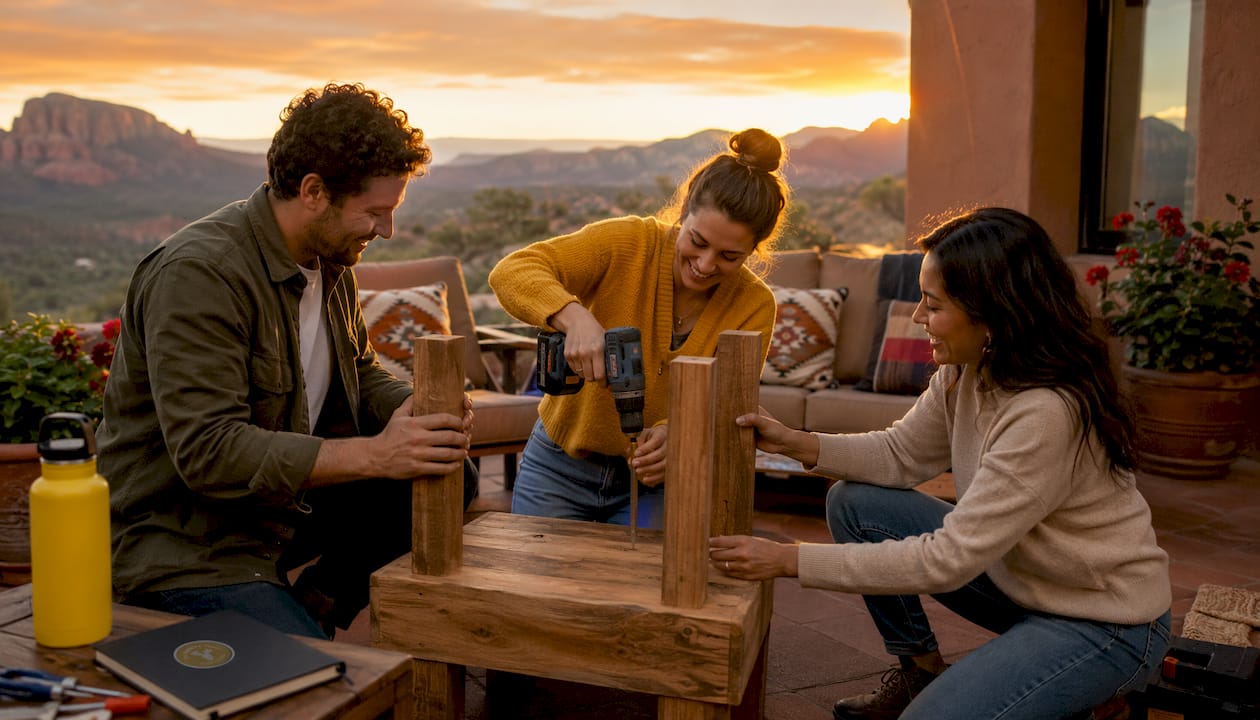
Décor and lighting together account for 10–12% of a mid-range budget. That’s not nothing, but it’s the category with the lowest direct ROI on guest reviews. Guests leave negative reviews about mattresses and kitchen gaps, not your gallery wall. Lighting does earn its keep indirectly because warm, layered lighting photographs dramatically better than overhead-only setups, which drives booking rate.
Tech and safety is a small category by dollar amount but a high-stakes one. A smart lock, smoke detectors, CO detectors, a fire extinguisher, and reliable WiFi are non-optional in Sedona’s STR market. Guests booking $250+ nights expect keyless entry and fast internet as baseline amenities.
Pro Tip: Cap your décor budget at 10–12% of total spend and resist the urge to go higher. Sedona’s red rock views do more decorating than any throw pillow ever could. Spend the savings on a better mattress or a fire pit for the patio.
How do Sedona’s unique conditions change your furnishing costs?
Sedona isn’t Phoenix, and it isn’t Scottsdale. The market has its own quirks, and they affect both what you spend and what you earn. Understanding them before you shop saves real money.
Seasonality and ADR patterns shape how much furnishing investment makes sense. Sedona’s peak season runs roughly October through May, with spring break and fall foliage driving the highest ADR. Summer brings heat and slower bookings, though the market doesn’t go quiet. A property that earns most of its revenue in a compressed 6–7 month window needs furnishings durable enough to handle intense turnover during those months, not just average annual use.
Guest expectations in Sedona skew upward. The Sedona STR market attracts guests who are paying for an experience, not just a bed. Outdoor living spaces, natural color palettes (warm terracottas, sage greens, earthy neutrals), and a connection to the landscape are what guests photograph and mention in reviews. A generic beige-and-gray IKEA setup that works fine in a suburban Phoenix rental will feel flat in Sedona.
HOA and design restrictions affect some Sedona properties, particularly in planned communities. Before purchasing outdoor furniture or making any exterior changes, verify whether your HOA has approved color palettes, furniture types, or restrictions on visible outdoor items. Some communities in the Village of Oak Creek and other Sedona-adjacent areas have specific guidelines that affect what you can put on a patio or deck.
Climate and material durability are a real consideration. Sedona’s sun is intense, dust is constant, and turnover is high during peak season. Materials that don’t account for this end up looking worn within a year.
- Use performance upholstery (Sunbrella or similar) for any indoor-outdoor or high-traffic seating
- Choose washable, commercial-grade bedding that holds up to frequent laundering
- Opt for resin or powder-coated aluminum for outdoor furniture rather than wood, which requires seasonal maintenance
- Sealed hardwood or engineered surfaces handle Sedona’s dry heat better than laminate, which can warp
Local shipping and delivery adds cost that national estimates don’t capture. Sedona’s winding roads and limited commercial access mean some delivery services charge premiums, and large furniture deliveries can be logistically tricky. Budget an extra $200–$500 for delivery complexity on large orders.
Pro Tip: Sedona’s dust is legendary. It gets into everything. Choose sealed surfaces, washable slipcovers, and avoid light-colored upholstery that shows every red-dust handprint. Your cleaner will thank you, and your reviews will reflect it.
What’s the realistic procurement timeline for a Sedona Airbnb?
Getting a Sedona vacation rental from empty to photo-ready takes longer than most first-time hosts expect, especially when you factor in local delivery logistics. Sedona staging firms recommend booking full vacation-rental design and furnishing 6–10 weeks before your target launch date.
Full-service furnishing timeline (6–10 weeks)
- Weeks 1–2: Finalize design direction, create itemized shopping list, confirm measurements, and place all major furniture orders. Order mattresses and large appliances first since they have the longest lead times.
- Weeks 3–4: Confirm delivery windows with all vendors. Order linens, décor, kitchen supplies, and tech items. Coordinate with local installer or staging firm if using one.
- Weeks 5–6: First wave of deliveries. Assemble furniture, install tech (smart lock, WiFi router, detectors). Address any damaged or incorrect items immediately.
- Weeks 7–8: Final deliveries and styling. Hang art, dress beds, stock kitchen, set up outdoor space.
- Weeks 9–10: Photo-ready staging, professional photography, and soft opening. Review the listing for any missing items before going live.
Streamlined staging (3–6 weeks)
This works when the property is partially furnished or when you’re using a staging-focused service rather than full procurement. The key milestones compress but don’t disappear.
- Order all items in a single purchase session to minimize staggered deliveries
- Use in-stock items only (no custom orders, no backorder items)
- Schedule delivery and install in a single 2–3 day window
- Stage for photography immediately after install
Expedited setup (2–3 weeks)
Possible, but it carries real risk. Expedited shipping costs more, backorders derail the timeline, and rushed installs produce the kind of photos that make guests scroll past your listing. Reserve this approach for partial refurnishing, not a full setup.
Staging vs. full furnishing is a distinction worth understanding clearly. Staging is styling and photography prep. Full vacation rental design covers procurement, delivery, assembly, and complete setup. Most Sedona hosts launching a new listing need full furnishing. Staging alone makes sense for an existing listing that needs a refresh before a new photo shoot.
Pro Tip: Order your mattresses and large appliances first, even before you’ve finalized the rest of the design. These have the longest lead times and the highest consequence if they’re delayed. Everything else can be expedited. A missing throw pillow won’t delay your launch. A missing mattress will.
What should you splurge on and what can you skip?
Not all furnishing dollars are equal. Some purchases move your ADR and review score. Others just fill space. Knowing the difference is the closest thing to a superpower in STR investing.
Splurge on these:
- Mattresses. Every guest sleeps on it. Mattress quality drives negative reviews more than almost any other single item. A commercial-grade STR mattress at $700–$1,200 lasts 5–7 years with a waterproof encasement. A $300 budget mattress generates bad reviews within the first season.
- Kitchen equipment. Missing kitchen gear is a frequent complaint for stays longer than two nights. A fully stocked kitchen isn’t a premium differentiator; it’s the baseline expectation. Skimping here doesn’t save money; it costs you reviews.
- WiFi and smart lock. Guests paying $250+ per night in Sedona expect fast, reliable internet and keyless entry. These are table stakes, not upgrades.
- Outdoor seating and a fire pit. Sedona guests come for the outdoors. A functional patio with comfortable seating and a fire pit is one of the highest-ROI investments for a Sedona-specific property. Check the hot tub revenue impact if your property and budget support it.
- Adequate seating. A 2BR that sleeps four needs seating for four in the living room and at the dining table. Guests who can’t all sit together leave reviews about it.
Economize here:
- Decorative throw pillows and accent pieces. Guests don’t review them.
- Designer kitchen gadgets guests won’t use (a $400 espresso machine sounds great until it breaks in week two).
- Upholstered dining chairs that absorb stains and show wear quickly. Opt for wipeable surfaces instead.
- Wall art beyond a few well-placed pieces. Sedona’s views through the windows are the real art.
Pro Tip: Amortize your CapEx into your per-night break-even math. A $1,200 mattress amortized over 6 years costs $200 per year, or roughly $0.55 per night at 365 nights. That’s not a luxury; it’s a rounding error. The budget mattress that generates a one-star review and costs you $50/night in lost ADR is the expensive choice.
How can you source furnishings for less without hurting guest experience?
Sedona’s location means you’re not walking into a furniture district on a Saturday morning. Smart sourcing requires a plan, some timing awareness, and a clear sense of what you can buy used and what you absolutely cannot.
Vendor types to consider:
- National retailers with delivery (Wayfair, Amazon, IKEA): Best for case goods, kitchen supplies, lighting, and décor. Flash sales on Wayfair and Amazon can cut 20–40% off list price. IKEA’s flat-pack ships reliably and assembles quickly.
- Hospitality suppliers: For mattresses and linens specifically, hospitality-grade suppliers offer commercial durability at prices competitive with retail. These items take the most abuse in STR use and benefit most from commercial-grade specs.
- Local Sedona and Verde Valley furniture shops: Worth a visit for unique pieces that reflect the local aesthetic. Local vendors also simplify delivery logistics and often offer installation.
- Rental furniture programs: Some hosts use furniture rental for a soft launch, then purchase once the property is generating revenue. This reduces upfront CapEx but costs more over time.
- Vetted secondhand for case goods: Solid wood dressers, dining tables, and bed frames from Facebook Marketplace or local estate sales can be excellent value. The rule is simple: hard surfaces only. Never buy used mattresses, upholstered sofas, or soft seating secondhand for an STR.
Three concrete cost-saving tactics
- Time your purchases around major sales events. Wayfair’s Way Day (spring) and Black Friday/Cyber Monday consistently offer the deepest discounts on furniture. If your launch timeline allows, planning purchases around these windows can reduce your total furnishing cost by 15–25%.
- Mix new and vetted used strategically. Buy new for anything guests touch directly (mattresses, linens, upholstered seating) and consider quality secondhand for case goods (dressers, dining tables, bed frames, bookshelves). This mix of new and vetted used is one of the primary levers experienced hosts use to lower CapEx without degrading guest experience.
- Bulk-source linens and consumables. Buying three sets of sheets per bed, a dozen bath towels per bathroom, and a full consumables kit in one order from a hospitality supplier is almost always cheaper per unit than buying piecemeal from retail.
Pro Tip: Keep your receipts and document warranties for every major purchase. In Sedona’s dry heat, some furniture items (particularly wood pieces and electronics) can experience accelerated wear. Warranty claims are easier when you have the original purchase documentation, and some retailers offer extended return windows on large orders.
Ready-to-use shopping checklist and sample budgets
The table below gives you a full mid-range itemized list for a 2BR Sedona Airbnb. Copy it into a spreadsheet, adjust quantities for your property, and use it as your procurement tracker.
| Item | Est. mid-range cost | Qty | Notes |
|---|---|---|---|
| Queen mattress | $700–$1,200 | 2 | Add waterproof encasement |
| Bed frame and headboard | $350–$800 | 2 | Metal or solid wood preferred |
| Nightstands | $150–$400 | 4 | One pair per bedroom |
| Dresser | $250–$600 | 2 | One per bedroom |
| Bedding set (sheets, duvet, pillows) | $150–$350 | 2 sets x 3 | Three sets per bed |
| Blackout curtains | $80–$150 | 4 panels | Critical for Sedona sun |
| Sofa | $700–$1,200 | 1 | Performance fabric strongly recommended |
| Coffee table | $150–$350 | 1 | |
| TV and mount | $400–$800 | 1 | |
| Area rug | $120–$250 | 1 | |
| Dining table and chairs (4–6) | $300–$600 | 1 set | |
| Full kitchen kit (cookware, dishes, utensils) | $500–$800 | 1 | Service for 6 minimum |
| Small appliances (coffee maker, toaster, blender) | $150–$400 | 1 set | |
| Bathroom towel sets (bath, hand, washcloth) | $80–$150 | 2 sets x 4 | |
| Bath mats and shower curtains | $30–$60 | 2 | |
| Outdoor patio set (table, chairs) | $400–$1,000 | 1 | Resin or powder-coated aluminum |
| Fire pit | $150–$500 | 1 | High ROI in Sedona |
| Smart lock | $150–$350 | 1 | |
| Smoke and CO detectors | $30–$60 | 2–3 | |
| Vacuum cleaner | $80–$200 | 1 | |
| Miscellaneous (hangers, laundry basket, first aid) | $100–$150 | 1 set | |
| Total estimated mid-range 2BR | $9,800–$15,300 |
Per-night break-even math
To bake furnishing cost into your underwriting, divide your total furnishing budget by the number of nights you expect to book in year one. A $15,000 furnishing budget at 180 booked nights per year equals $83.33 per night in amortized furnishing cost (year one). Spread over the item’s full lifespan, the annual cost drops significantly. For a one-bedroom setup, amortized annual furnishing cost runs roughly $1,455 when items are spread across their realistic lifespans.
Pro Tip: Build a simple spreadsheet with three columns: item, purchase price, and expected lifespan in years. Divide column two by column three to get annual cost per item. Sum the annual cost column and divide by your projected booked nights. That number is your furnishing cost per night, and it belongs in your underwriting model alongside cleaning fees and property management costs.
Key Takeaways
Mid-range Sedona Airbnb furnishing costs run $15,000–$20,000 for a two-bedroom, with the 8–12% of projected gross revenue rule as the most reliable way to size your budget before you shop.
| Point | Details |
|---|---|
| Mid-range 2BR target | Budget $15,000–$20,000 for a mid-range Sedona two-bedroom; this is where most setups cluster fully appointed. |
| 8–12% revenue rule | If projected first-year gross revenue is $36,000, budget $2,900–$4,300 for furnishings as a baseline. |
| Marginal bedroom cost | Each additional bedroom adds roughly $3,000–$3,500 once shared rooms are furnished; the living room and kitchen are the expensive rooms. |
| Splurge vs. save | Spend on mattresses ($700–$1,200), kitchen equipment, and outdoor seating; cap décor at 10–12% of total budget. |
| Equity Team advantage | Equity Team’s Sedona STR specialists help you align furnishing spend to real ADR data before you commit a dollar to procurement. |
The furnishing decision most Sedona hosts get wrong
There’s a pattern that shows up repeatedly in Sedona STR investing. A host buys a beautiful property, gets excited about the red rock views, and proceeds to spend $8,000 on décor and $400 on mattresses. The listing goes live, the photos look stunning, and then the first three reviews mention “uncomfortable beds” and “not enough pots and pans.” The ADR that looked achievable on paper stalls out $40/night below comparable listings.
The data is pretty clear on this. Guest reviews correlate with sleep quality and kitchen functionality far more than with decorative choices. Sedona’s guests are paying for an experience, and that experience starts with a good night’s sleep and the ability to cook a real meal. The red rocks handle the atmosphere. The host’s job is to handle the fundamentals.
What’s genuinely underestimated is the outdoor space. Sedona hosts who invest $1,500–$2,500 in a functional patio with comfortable seating and a fire pit consistently outperform comparable listings that treat outdoor space as an afterthought. Guests photograph the patio, mention it in reviews, and filter for it when searching. In a market where the landscape is the main attraction, giving guests a comfortable place to sit and watch the sunset is one of the highest-ROI furnishing decisions available.
The other thing worth saying plainly: over-investing in premium finishes without the ADR to support them is just as damaging as under-investing. A $40,000 furnishing budget on a property that realistically earns $45,000 per year in gross revenue produces terrible cash-on-cash returns. The Sedona STR investment math works when furnishing spend is calibrated to revenue potential, not to what looks impressive on Instagram.
Equity Team knows Sedona STR investing from the inside out
Sizing a furnishing budget correctly starts with knowing what your Sedona property can actually earn. That’s where most hosts get into trouble: they furnish to a revenue number they hope for rather than one grounded in real local data.

Equity Team is Sedona’s first STR-specialized real estate group, and the only local team that works exclusively with investors. When you’re ready to run the real numbers on a Sedona property, including ADR projections, occupancy benchmarks, and a furnishing budget calibrated to actual market performance, a Sedona vacation rental market analysis from Equity Team gives you the data to make that call with confidence. Whether you’re buying your first Sedona STR or optimizing an existing one, reach out to Equity Team to get the local market intelligence that turns a furnishing budget into a real investment decision.
Useful sources and local Sedona resources
These resources cover national furnishing benchmarks, Sedona-specific market data, and local staging and design services. Use them to research pricing, book staging, and find local vendors.
- StaySTRA Airbnb furnishing budget guide: The most thorough national benchmark for STR furnishing costs by bedroom count and tier. Use it to validate your budget ranges and apply the 8–12% revenue rule.
- STRNumbers Sedona Airbnb calculator: Sedona-specific ADR and occupancy data. Run your target property type here before setting a furnishing budget.
- Sabi Haus Design Labs staging guide: Sedona’s local vacation rental staging and design firm. Use this to understand the full-furnish vs. staging distinction and to book a Sedona-specific design service.
- RentTools furnishing cost math: Explains how to amortize furnishing CapEx over item lifespans and build per-night break-even calculations.
- Equity Team: Sedona STR investment overview: Local context on Sedona’s STR market, guest profiles, and what drives performance in the top 10% of listings.
- Equity Team: Sedona amenity must-haves: Practical checklist of amenities Sedona guests expect, useful for cross-referencing your furnishing list.
- Equity Team: Sedona architectural design options: Design and HOA considerations specific to Sedona properties that affect furnishing choices and compliance.
- Equity Team: how to find the right STR investment: Landing page for buyers ready to work with a Sedona STR specialist on acquisition and market underwriting.
- Equity Team: Sedona property walkthroughs: Video walkthroughs of real Sedona STR properties with expert analysis of furnishing choices and their booking impact.
This article is general information for planning purposes. Furnishing costs, ADR figures, and tax or regulatory details vary by property, location, and market conditions. Confirm current rules and figures with local professionals and primary sources before making investment decisions.