

A comparative market analysis (CMA) is a data-driven estimate of a property’s current market value, prepared by a real estate agent using recently sold homes, active listings, and pending contracts as benchmarks. Think of it as the agent’s educated answer to the question every seller and buyer is secretly asking: “What is this place actually worth right now?” The short verdict: sellers should use a CMA to set a defensible list price before going live, and buyers should use one to verify whether an asking price is fair before writing an offer.
A solid CMA draws on four core inputs including recently sold comps within a recent timeframe and close geographic area
- Active listings (current competition the subject property is priced against)
- Pending sales (contracts under way that signal where the market is heading)
- Dollar adjustments for feature differences between the subject property and each comp
Table of Contents
- Why does a CMA matter for sellers and buyers?
- How does a CMA differ from a professional appraisal?
- What does a professional CMA report actually include?
- How do agents actually prepare a CMA, step by step?
- How do you get a CMA, and what does it cost?
- What experienced agents wish every client understood about CMAs
- Key Takeaways
- A note from the field on why CMAs win listings
- Equity Team’s CMA services for Sedona investors and sellers
- Further reading and source notes
Why does a CMA matter for sellers and buyers?
A CMA is not just a formality agents run through before listing day. It is the foundation of every smart pricing and negotiation decision on both sides of a transaction.
For sellers, the stakes are immediate. Price too high and the property sits, accumulating days on market like a scarlet letter that signals something is wrong. Price too low and money walks out the door. A well-built CMA helps sellers justify their list price to skeptical buyers and gives agents the data to defend that number when offers come in low.
Buyers get just as much mileage from a CMA. Before writing an offer on a property listed at $850,000, a buyer who has seen the CMA knows whether that number is grounded in reality or wishful thinking. That knowledge shapes the offer strategy, the escalation clause, and the negotiation ceiling.
Here are the main use cases where a CMA earns its keep:
- Sellers: Setting a competitive list price, timing a listing for peak demand, deciding how much to invest in pre-sale improvements
- Buyers: Verifying asking prices, calibrating offer amounts, identifying overpriced listings worth skipping
- Investors: Underwriting short-term rental (STR) acquisitions, projecting resale value, comparing yield against purchase price
- Agents: Deciding whether a listing is worth representing at the seller’s desired price
That last point is worth sitting with. A CMA is not just a client tool. Experienced agents use it to decide whether they want the listing at all.
How does a CMA differ from a professional appraisal?
People mix these up constantly, and the confusion is understandable. Both produce a number tied to a property’s value. But the similarities end there.
A CMA is an informal pricing tool created by a licensed real estate agent. An appraisal is a formal, regulated valuation performed by a state-licensed or certified appraiser, and mortgage lenders require it before funding a loan. The agent’s CMA helps you decide what to list or offer; the appraiser’s report tells the bank whether the collateral is worth the loan amount.
Key distinctions at a glance:
- Who prepares it: Agent (CMA) vs. licensed appraiser (appraisal)
- Regulatory weight: No lender requirement (CMA) vs. required for mortgage underwriting (appraisal)
- Output: A defensible price range (CMA) vs. a single official value (appraisal)
- Cost: Often free from the agent (CMA) vs. typically $300–$600 for a residential appraisal
- Turnaround: Hours to a few days (CMA) vs. several days to two weeks (appraisal)
The role of appraisal in home buying becomes critical at the mortgage stage. If a buyer’s offer is accepted at $750,000 but the appraisal comes in at $700,000, the lender will only finance based on the lower number. That gap becomes a negotiation problem fast.
One more category worth mentioning: automated valuation models (AVMs) like the estimates you see on popular real estate portals. These pull public records and apply algorithms, but they cannot account for a freshly renovated kitchen, a quirky HOA restriction, or the fact that the property backs up to a noisy highway. They are a starting point for curiosity, not a substitute for a professional CMA.
What does a professional CMA report actually include?
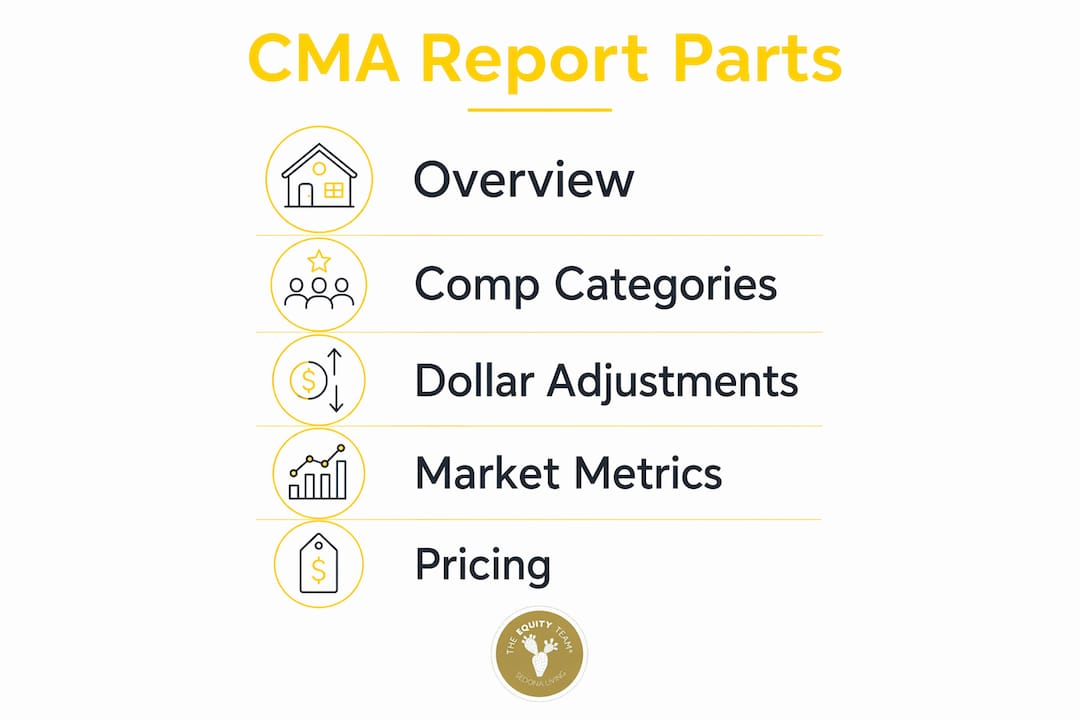
A comprehensive CMA can run 30–50 pages with charts, photos, and detailed comp breakdowns. Here is what goes inside.
Subject property overview
This section captures the basics: square footage, bedroom and bathroom count, lot size, year built, condition, and recent improvements. Photos matter here. An agent who skips the walkthrough and relies on tax records alone is working with incomplete data.

Comp categories and lookback window
| Comp Type | What It Reveals | Preferred Window |
|---|---|---|
| Sold comps | Actual market value buyers paid | Last 3–6 months |
| Pending sales | Where the market is heading now | Last 30–60 days |
| Active listings | Current competition for buyers | Present |
Agents examine sold, pending, and active listings and apply adjustments when features differ, creating an apples-to-apples comparison. Sold comps carry the most weight because they reflect what buyers actually paid, not what sellers hoped to get.
Dollar adjustments
This is where the technical skill lives. When a comp has a finished basement and the subject property does not, the agent subtracts value from the comp rather than trying to “add value” to the subject. Adjustments work by making the comp look more like the subject, not the other way around. Common adjustment categories include pools, garages, square footage differences, lot size, condition, and upgrades.

Market-condition metrics
Days on market and list-to-sale price ratios reveal whether the current environment favors buyers or sellers. A market where homes sell in 10 days at 102% of list price tells a very different pricing story than one where homes sit for 90 days and close at 94% of list. Equity Team tracks Sedona days-on-market benchmarks as a core input for every CMA in the area.
Price range and recommendation
A CMA delivers a defensible range, not a single magic number. That range reflects the spread of adjusted comp values and accounts for market momentum. A seller who insists on a number above the top of that range is pricing against the evidence.
Red flags to watch for in any CMA:
- Distressed sales (foreclosures, short sales) used as comps without explicit adjustments — they typically understate fair market value
- Non-arm’s-length transactions (sales between family members or related parties)
- Comps pulled from a different neighborhood or school district
- A lookback window longer than six months in a fast-moving market
How do agents actually prepare a CMA, step by step?
The process looks casual from the outside. Behind the scenes, it is methodical.
- Gather subject property data. Pull tax records, MLS history, permit records, and walk the property. Document every improvement the seller has made, with receipts if possible.
- Pull an initial comp pool. Start with 10–15 candidate properties that share similar location, size, age, and condition. Agents typically start with 10–15 candidates before narrowing down.
- Narrow to the best 3–5 comps. The top 3–5 closest matches carry the analysis. Proximity, sale recency, and similarity in size and condition are the primary filters. The “rule of three” is a useful heuristic: if you cannot find at least three closely matching sold comps, the analysis needs a wider radius or a longer lookback window, and you should note that caveat explicitly.
- Apply dollar adjustments. Convert feature differences into price adjustments for each comp. This step requires local knowledge — a pool adds different value in Phoenix than it does in Sedona.
- Analyze market metrics. Review days on market, list-to-sale ratios, and inventory trends. These tell you whether to price at the top, middle, or bottom of the adjusted range.
- Produce a price range and strategy. Present the range with the reasoning behind it. A good agent explains which comps anchored the low end and which pushed the high end.
Pro Tip: Document every improvement before the CMA walkthrough — new HVAC, updated bathrooms, fresh roof. Agents can only adjust for what they know about. An undocumented $40,000 kitchen remodel that never makes it into the CMA is money left on the table.
A basic CMA typically takes a few hours to a full day depending on market complexity. If the property sits on the market without activity, refresh the CMA when meaningful new comps appear or when local inventory shifts. Markets move, and a CMA from three months ago can be stale in a fast-changing environment.
How do you get a CMA, and what does it cost?
Most listing agents provide a basic CMA free as part of the listing conversation. It is how they demonstrate their market knowledge and earn the business. For buyers, a buyer’s agent will typically run one on any property of serious interest.
To get the most useful CMA, come prepared with:
- Property details: Deed, square footage, lot size, year built
- Recent improvements: Dates, costs, and scope of any renovations
- HOA information: Monthly dues, restrictions, and any pending assessments
- Utility costs: Relevant for investment properties and STR underwriting
Questions worth asking the agent before trusting their CMA:
- Which comps did you exclude, and why?
- How did you calculate the dollar adjustments?
- What do the current days-on-market numbers tell you about this market?
- When did you last update this CMA, and has anything changed since?
Online home valuation tools like the IDX home valuation on Equity Team’s site are a useful starting point for ballpark numbers, but they cannot replace an agent’s eyes on the property and knowledge of local nuance. For buyers navigating the process, tips for real estate buyers can help you know what to look for and what to ask.
What experienced agents wish every client understood about CMAs
The most common mistake sellers make is treating a CMA as a negotiation opening rather than a market signal. The data does not care about what the seller paid in 2019, what the neighbor listed for, or what a renovation “should” be worth. The market decides.
“A CMA is ultimately a tool for deciding whether a listing is worth representing at the seller’s desired price. When a seller insists on a number that contradicts the evidence, a good agent will decline the listing rather than take on a property that is set up to fail.” — Mass.gov, Comparative Market Analysis guidance
That is not an agent being difficult. That is an agent protecting both parties from a prolonged, demoralizing listing that ends in a price reduction anyway. Competitive bidding dynamics show that correctly priced homes attract multiple offers, which often push the final sale price above list. Overpriced homes attract silence.
CMAs are also living documents. Leading agents treat them as ongoing references and refresh them when new active or pending listings appear. In a market like Sedona, where STR demand, seasonal patterns, and limited inventory all interact, a CMA from even 60 days ago can tell a different story than today’s data. Equity Team tracks Sedona real estate market trends continuously to keep client CMAs current.
A well-executed CMA also blends quantitative metrics with qualitative context. Square footage and sale price per square foot are the skeleton. The flesh is local knowledge: which streets have the best red rock views, which HOAs restrict STR use, which renovations actually move the needle with buyers in this specific zip code.
Key Takeaways
A CMA gives buyers and sellers a data-backed price range built from real sold comps, market metrics, and dollar adjustments — making it the most practical pricing tool available before a listing goes live or an offer gets written.
| Point | Details |
|---|---|
| CMA vs. appraisal | A CMA is an agent’s informal pricing tool; an appraisal is a lender-required formal valuation by a licensed appraiser. |
| Rule of three for comps | Use at least three closely matching sold comps; agents typically start with 10–15 candidates and narrow to the best 3–5. |
| CMAs deliver a range | A CMA produces a defensible price range, not a single guaranteed value, reflecting the spread of adjusted comp values. |
| Living document | Refresh a CMA when the market shifts, new comps appear, or the property sits without offers. |
| Equity Team’s approach | Equity Team prepares Sedona-specific CMAs that incorporate STR demand, seasonal patterns, and local market metrics for investor clients. |
A note from the field on why CMAs win listings
There is a moment in almost every listing conversation where the seller names a number and the agent has to decide what to do with it. A CMA makes that moment honest. When the data is laid out — adjusted comps, days on market, list-to-sale ratios — the conversation shifts from opinion to evidence. Sellers who see the full picture make better decisions, and the listings that follow tend to perform.
At Equity Team, every CMA for a Sedona property factors in STR revenue potential, seasonal demand curves, and the quirky supply constraints that make this market unlike any other in Northern Arizona. The goal is not just a price. It is a strategy that holds up when a buyer’s agent pushes back.
Equity Team’s CMA services for Sedona investors and sellers
Pricing a Sedona property without a current, STR-aware CMA is a bit like hiking Cathedral Rock without checking the weather first — technically possible, but why would you?

Equity Team specializes in Sedona vacation rental CMAs that go beyond standard residential comps. Every report includes adjusted sold comps, active listing analysis, days-on-market benchmarks, list-to-sale ratios, and a recommended price range built around how the property actually performs as a short-term rental. Sellers get a defensible list price grounded in real data. Buyers and investors get a clear picture of whether the asking price reflects the property’s income potential. If you are ready to see what your Sedona property is worth in today’s market, find the right STR investment or reach out to Equity Team directly for a current CMA consultation.
Further reading and source notes
The following sources informed this guide and are worth bookmarking for deeper research:
- Mass.gov — Comparative Market Analysis: Primary regulatory guidance on CMA ethics, agent obligations, and the agent’s right to decline unrealistic listings.
- Rocket Mortgage — CMA Guide: Clear breakdown of the CMA vs. appraisal distinction and how lenders view each.
- HomeLight — How to Get a CMA: Practical overview of CMA report depth, comp types, and the blend of quantitative and qualitative inputs.
- Chase — Comparative Market Analysis Guide: Covers buyer and seller use cases and the living-document nature of CMAs.
- RealAnalytica — How to Do a CMA: Detailed methodology on dollar adjustments, market metrics, and the comp-selection process.
- AgentSuccessBuilder — Price Houses Like a Pro: Practitioner-level guidance on narrowing from a large comp pool to the top 3–5 matches.