

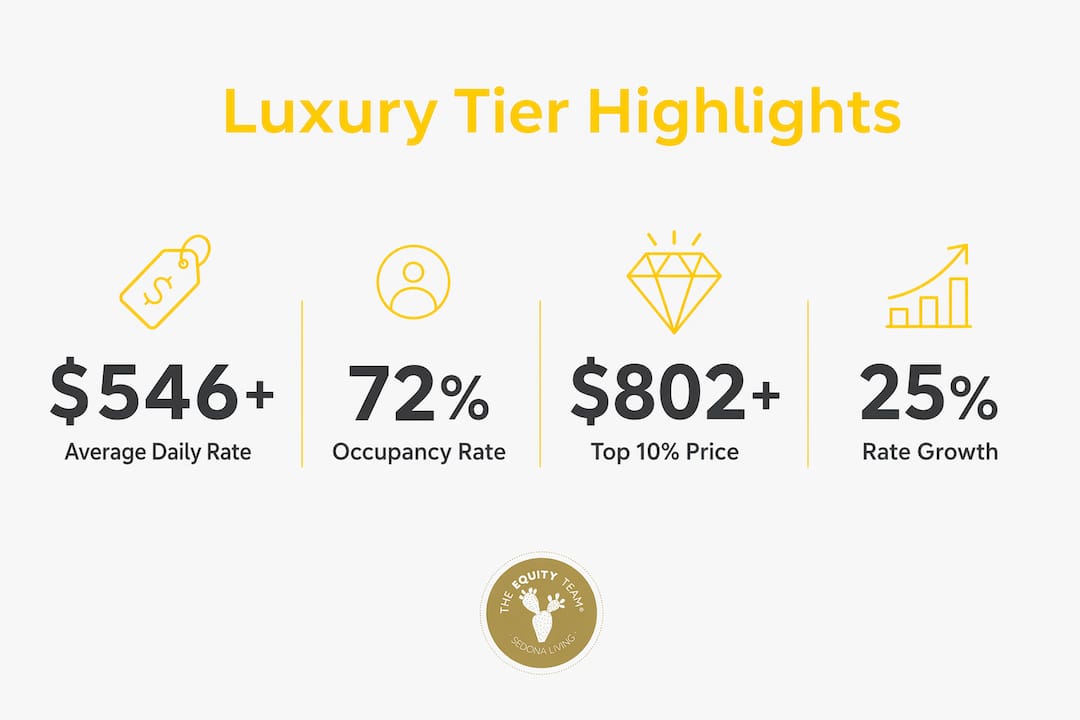
Sedona’s luxury Airbnb tier is defined by a measurable earnings gap that separates top-quartile performers from the rest of the market. Top-quartile properties achieve average daily rates of $546+ and occupancy rates of 72%, compared to the market average ADR of $440 and occupancy of just 49%. That gap translates to annual revenue of roughly $95,208 for luxury listings versus $83,895 for the average Sedona short-term rental. Understanding why Sedona’s Airbnb luxury tier earns more comes down to three converging forces: premium property features, superior operational management, and a unique dual-peak seasonal demand cycle that keeps bookings strong year-round.
Why does the Sedona Airbnb luxury tier earn more?
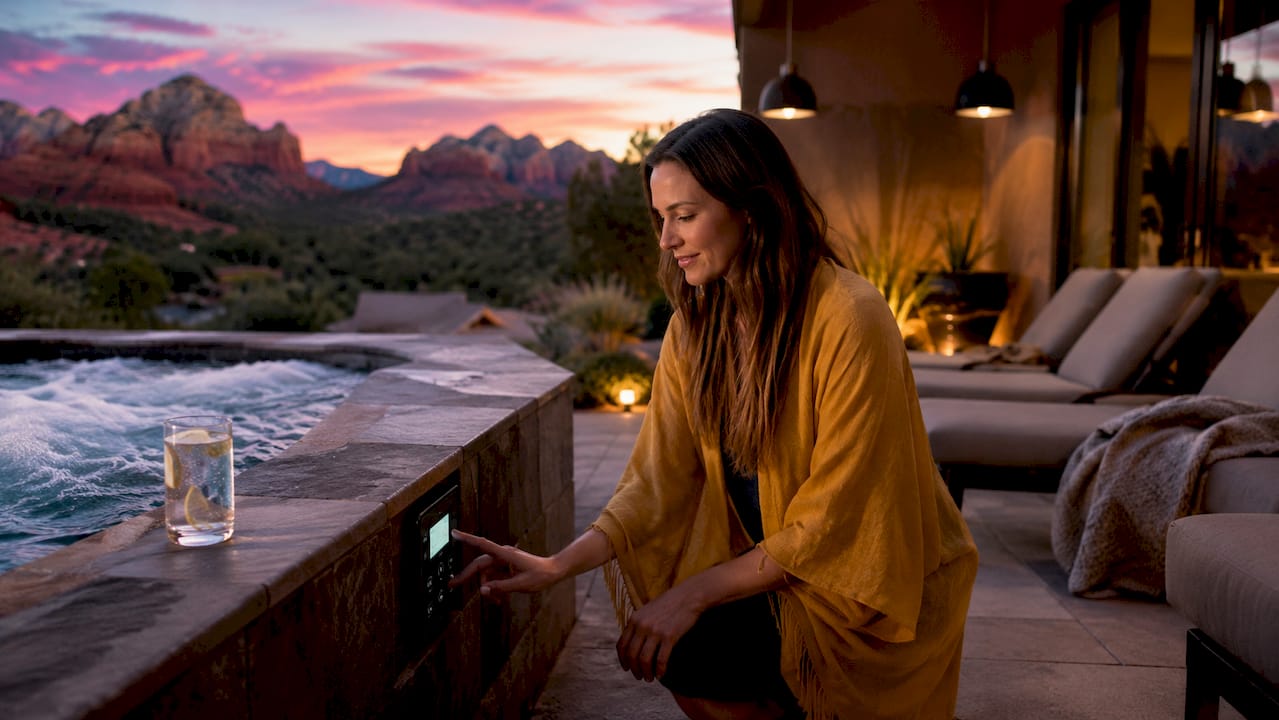
The short answer is that luxury properties in Sedona offer something guests genuinely cannot find elsewhere at a lower price point. Direct red rock views, resort-quality amenities, and large bedroom counts create an experience that justifies a premium nightly rate. Guests who travel to Sedona for its breathtaking scenery and serene energy are already primed to spend more. They want the full experience, not just a place to sleep.
The industry term for what drives this premium is “revenue per available night,” or RevPAN. Luxury listings in Sedona win on both sides of that equation. They charge more per night and fill more nights. That combination is rare in short-term rental markets, and Sedona’s geography and tourism profile make it possible. The red rock formations are not just pretty. They are a pricing mechanism.
High-end Airbnb Sedona properties also attract a guest profile that books further in advance, stays longer, and leaves fewer negative reviews. Longer stays reduce turnover costs. Advance bookings give owners more pricing leverage. These behavioral patterns compound the revenue advantage over time.
What premium features differentiate luxury Sedona Airbnbs?
Premium features are not decorative. They are the direct cause of higher nightly rates and stronger occupancy. Guests searching for a luxury Sedona experience filter by specific amenities, and properties that check those boxes appear at the top of search results and command the rates to match.
The features that separate luxury listings from the pack include:
- Direct red rock views from living areas, bedrooms, or outdoor spaces
- 3 to 5+ bedrooms accommodating groups and families willing to split a high nightly rate
- Heated pools and spas that extend usability into Sedona’s cooler shoulder seasons
- Professional staging and high-end finishes that photograph beautifully and set guest expectations correctly
- Outdoor entertainment areas with fire pits, dining setups, and unobstructed canyon views
- Resort-quality linens, kitchen equipment, and smart home technology
Elite luxury performers actively invest in professional photography, dynamic pricing tools, and resort-level amenities to justify nightly rates above $1,000. Simply owning a beautiful home without those operational investments results in median income returns, not luxury-tier returns. The property is the foundation. The management is the multiplier.
Pro Tip: A heated pool or spa is one of the highest-return amenity investments in Sedona. The hot tub revenue impact on nightly rates and occupancy during shoulder seasons is well documented in the local market.
How do occupancy and pricing dynamics drive luxury tier income?
The numbers tell a clear story. Luxury tier properties in Sedona run at 72%+ occupancy while the broader market sits at 49%. That 23-point occupancy gap, combined with a $106 ADR premium, produces a revenue outcome that compounds quickly across a full calendar year.
| Metric | Luxury Tier | Market Average |
|---|---|---|
| Average Daily Rate | $546+ | $440 |
| Occupancy Rate | 72%+ | 49% |
| Annual Revenue | ~$95,208 | ~$83,895 |
| Top 10% Nightly Rate | $802+ | N/A |
Sedona’s dual-peak seasonal demand in spring and fall is a structural advantage that single-season markets cannot replicate. Most vacation rental markets have one strong season and one slow one. Sedona has two strong seasons separated by a mild winter and a warm summer. Luxury properties with pools and spas stay booked through the shoulder periods when standard listings see occupancy drop sharply.
Booking lead time also favors luxury listings. Guests planning a high-spend trip to Sedona book weeks or months in advance. That advance booking window gives owners the ability to hold firm on pricing rather than discounting last-minute inventory. Sedona’s peak rental seasons reward owners who understand the calendar and price accordingly.
Sedona’s average nightly rate climbed 25% from $353 in 2021 to $440 in early 2026. That market-wide rate growth lifted the floor for all listings. Luxury properties, already priced above the floor, benefited disproportionately as the gap between median and top-tier rates widened.
What operational costs and management practices affect luxury profitability?
Luxury Airbnb Sedona profits do not arrive without real operating costs. Operating expenses for high-performing Sedona STRs typically run 25% to 35% of gross revenue. After a 25% expense deduction, top-quartile performers reach a net operating income of approximately $71,400. That NOI figure matters enormously for investors seeking DSCR financing.
The core operating expenses for a luxury listing include:
- Professional cleaning between every stay, often at premium rates for large homes
- Routine maintenance and landscaping to keep the property in photo-ready condition
- Dynamic pricing software that adjusts nightly rates based on demand signals
- Professional photography and listing management to maintain search visibility
- Guest experience investments such as welcome packages, local guides, and concierge-style communication
Professional management sustains the premium positioning that justifies high nightly rates. A poorly managed luxury property loses its pricing power fast. Guests who pay $600 a night expect a flawless experience. One bad review about a dirty hot tub or a broken appliance can suppress bookings for weeks.
Pro Tip: Track your net operating income monthly, not just gross revenue. Investors who watch only top-line revenue often miss margin erosion from rising cleaning costs and maintenance. NOI is the number that determines your financing options.
How do Sedona’s market conditions protect luxury rental earnings?
Sedona’s market structure actively protects luxury rental pricing power. Demand is outpacing new inventory despite 30.4% supply growth, pushing luxury rental rates and total revenue upward. More listings have entered the market, but traveler demand for high-end experiences is growing faster than the supply of premium listings. That imbalance keeps rates elevated.
The factors protecting Sedona’s luxury rental earnings include:
- Geographic constraints that limit new construction in and around the red rock areas
- Zoning and permitting environments that slow the addition of new STR inventory
- A high-end traveler profile that prioritizes experience over price and books premium properties first
- Sedona’s global brand as a wellness, spiritual, and adventure destination that attracts repeat visitors
Sedona’s limited STR inventory is not a temporary condition. The terrain and regulatory environment make it structurally difficult to add large numbers of new luxury properties. That scarcity is an investor’s friend. When demand grows and supply cannot keep pace, pricing power stays with existing owners.
The Sedona Airbnb market data for 2026 shows listings averaging $450 per night, with the top 10% commanding $802+. Strong performers hit $535+ nightly. Median properties charge about $352. The spread between median and top-tier is wide, and it is widening. That is the market telling investors exactly where the returns are.
What practical tips help investors maximize Sedona luxury Airbnb returns?
Investors who succeed in Sedona’s luxury tier treat it like a business, not a passive income stream. The properties that generate $95,000+ annually are actively managed, continuously improved, and priced with real market data.
- Base financing projections on top-quartile data. Top-quartile performers hit 72%+ occupancy and $546+ ADR, which is what clears DSCR loan thresholds above 1.11. Investors who use median market data in their loan applications often fail to qualify.
- Select properties with proven high-value features. Red rock views, large bedroom counts, and heated pools are not optional extras. They are the features that drive the ADR premium.
- Invest in active management from day one. Staging, dynamic pricing, and guest experience are not costs to minimize. They are the engine of luxury-tier revenue.
- Use Sedona’s dual-peak calendar in your pricing strategy. Spring and fall are peak seasons. Price aggressively during those windows and use shoulder-season amenities like heated pools to maintain occupancy.
- Review real property examples before buying. Local expert property analyses show exactly how top-performing listings are configured and priced, giving investors a realistic benchmark.
- Never rely on market averages for investment decisions. The average Sedona STR earns $83,895. The top quartile earns $95,208. Those are different businesses with different financing outcomes.
Pro Tip: Work with agents who specialize in STR investment, not general real estate. Equity Team focuses exclusively on short-term rental properties in Northern Arizona and represents clients in the top 10% of the Sedona rental market. That specialization changes the quality of advice you receive.
Key Takeaways
Sedona’s luxury Airbnb tier earns more because premium features, professional management, and dual-peak seasonal demand combine to produce ADRs of $546+ and occupancy rates of 72%, well above the market average.
| Point | Details |
|---|---|
| ADR and occupancy gap | Luxury listings earn $546+ ADR at 72% occupancy vs. $440 ADR at 49% for the market average. |
| Annual revenue premium | Top-quartile properties generate ~$95,208 annually compared to the market average of ~$83,895. |
| NOI and financing | After 25% operating expenses, luxury properties reach ~$71,400 NOI, clearing DSCR thresholds for financing. |
| Feature-driven pricing | Direct red rock views, heated pools, and large bedroom counts are the primary drivers of the ADR premium. |
| Market structure advantage | Demand outpacing supply and limited new inventory protect luxury pricing power through 2026 and beyond. |
What I’ve learned from watching Sedona’s luxury tier up close
The thing that surprises most investors when they first look at Sedona’s numbers is how wide the gap is between median and top-quartile performance. They expect a modest premium. What they find is a completely different business model.
Passive ownership does not work here. The investors who earn $95,000+ a year are not sitting back and collecting checks. They are actively managing guest experience, adjusting pricing weekly, and reinvesting in their properties. The ones who treat it like a passive asset drift toward median returns, and median returns do not clear DSCR thresholds.
Sedona’s dual-peak seasonal cycle is genuinely unusual. Most markets have a clear off-season where owners accept lower rates and higher vacancy. Sedona’s spring and fall peaks are separated by a mild winter and a warm summer, both of which a well-amenitized luxury property can monetize. That year-round demand curve is one of the strongest structural arguments for investing in the luxury tier here specifically.
The investor mindset shift required is simple but not easy. Stop thinking about what the average Sedona STR earns. Start thinking about what the top 10% earns and what it takes to get there. The features, the management, and the market data all point in the same direction. The luxury tier is not just more profitable. It is more financeable, more resilient, and more fun to own.
— Chad
Equity Team knows where the returns are in Sedona
Equity Team is the first STR-specialized real estate team in Northern Arizona, and the clients they represent operate in the top 10% of the Sedona rental market. That is not a coincidence. It is the result of working exclusively with investors who understand that luxury-tier returns require luxury-tier strategy.

Whether you are searching for your first Sedona short-term rental investment or looking to upgrade your current portfolio to the luxury tier, Equity Team brings the market data, local expertise, and STR-specific knowledge to help you find the right property. The gap between median and top-quartile performance is real, and the right guidance closes it faster than any amount of guesswork.
FAQ
What ADR do luxury Sedona Airbnbs typically earn?
Luxury tier Sedona Airbnbs achieve average daily rates of $546+, compared to the market average of $440. The top 10% of listings command nightly rates of $802 or more.
What occupancy rate should investors expect for a luxury Sedona STR?
Top-quartile Sedona short-term rentals run at 72%+ occupancy, significantly above the market average of 49%. That occupancy level, combined with premium ADR, drives the $95,000+ annual revenue figure.
Why does Sedona’s dual-peak season matter for luxury rentals?
Sedona’s spring and fall peak seasons create two high-demand windows per year instead of one. Luxury properties with heated pools and resort amenities maintain strong occupancy during shoulder periods, producing more consistent year-round revenue.
What operating expenses should luxury Sedona STR investors budget for?
Operating expenses for high-performing Sedona STRs typically run 25% to 35% of gross revenue. After a 25% deduction, top-quartile properties reach a net operating income of approximately $71,400.
Why do investors need top-quartile data for DSCR financing?
DSCR lenders require a debt service coverage ratio above 1.11, which median Sedona STR revenue often cannot support. Investors who base loan applications on top-quartile figures of $546+ ADR and 72% occupancy have a much stronger path to financing approval.