

A bridge loan is a short-term financing tool that lets real estate investors close on a property quickly while they arrange permanent financing or sell an existing asset. The sedona real estate bridge loan process moves fast, typically closing in 3 to 14 business days, which makes it a natural fit for Sedona’s competitive, high-value market. With red rock views, strict short-term rental regulations, and luxury properties that regularly exceed conforming loan limits, Sedona rewards investors who can act decisively. The industry term for this product is a “bridge loan” or “swing loan,” and both names capture the same idea: you are spanning a gap between where you are and where you want to be financially.
What are the Sedona real estate bridge loan requirements and prerequisites?
Lenders underwriting bridge loans in Sedona care far more about the property and the exit plan than about your credit score. That said, a minimum credit score of 640 is the standard floor, and lenders also expect liquidity to cover closing costs plus 3 to 6 months of PITIA reserves (principal, interest, taxes, insurance, and association dues). Meeting that reserve threshold signals to the lender that you can carry the loan without panic if the exit takes a little longer than planned.

Loan-to-value ratios typically cap at 80% of the as-is appraised value. Sedona properties with red rock views or custom architecture often exceed conforming loan limits, which means you may need a portfolio or jumbo bridge lender rather than a conventional shop. That distinction matters early, so identifying the right lender type before you make an offer saves real time.
Short-term rental compliance is a hard requirement, not a soft preference. Bridge lenders verify the property’s legal ability to operate as an STR, including proper licensing and zoning compliance given Sedona’s local caps and HOA restrictions. A property that cannot legally operate as an STR is a property with a broken exit strategy, and lenders know it.
Your documentation package should include:
- Signed purchase agreement or current appraisal
- Financial position statement and proof of liquidity
- 3 to 6 months of PITIA reserve documentation
- STR license or zoning confirmation letter
- Detailed, time-bound exit plan with contingencies
- Entity documents if purchasing through an LLC
Pro Tip: Order your preliminary title report the same day you open escrow. Title issues are one of the top reasons bridge loan closings get delayed, and catching a lien or open permit early gives you room to fix it without blowing your timeline.
| Requirement | Standard |
|---|---|
| Minimum credit score | 640 |
| Maximum LTV | 80% of as-is appraised value |
| Liquidity reserves | 3 to 6 months PITIA |
| STR compliance | Zoning and licensing documentation required |
| Exit plan | Documented, time-bound, with contingencies |
How does the Sedona bridge loan application and approval process work?
The process starts with a lender consultation, where you present the property, your experience as an investor, and your exit strategy. Lenders want to understand the deal before they touch the paperwork. Come prepared with your purchase agreement, a rough exit timeline, and a clear sense of the property’s current value.
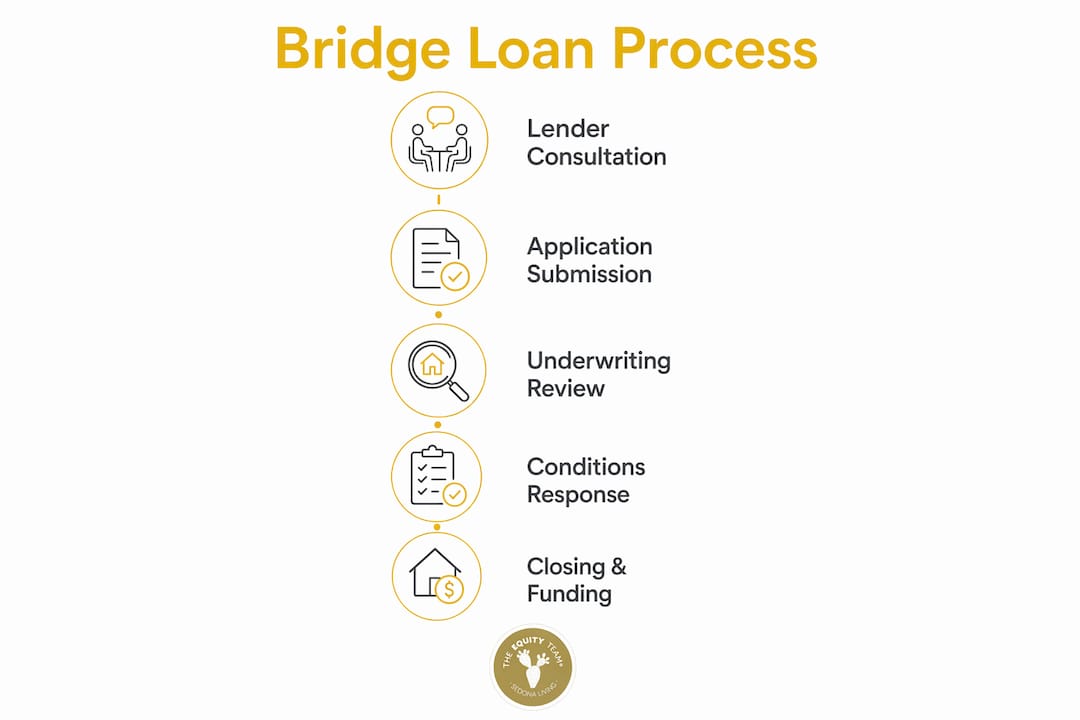
After the initial consultation, you submit a formal application along with your full documentation package. The lender then orders an appraisal and a preliminary title report. Preliminary title reports should be ordered immediately because unexpected title issues, such as liens, open permits, or ownership disputes, are a leading cause of closing delays. A 7 to 14 day closing window leaves almost no room for title surprises.
Underwriting focuses on four areas: the property’s value and condition, the viability of the exit strategy, the borrower’s capacity to carry the loan, and the title status. Personal income verification plays a smaller role here than it would in a conventional mortgage. The lender is betting on the asset and the plan, not just the person.
Here is the typical sequence from start to funded:
- Lender consultation. Present the deal, property details, and exit plan.
- Application submission. Submit the full documentation package.
- Appraisal and title report. Ordered simultaneously to save time.
- Underwriting review. Lender evaluates property, exit strategy, and borrower capacity.
- Conditional approval. Lender issues conditions; you respond quickly to keep momentum.
- Closing and funding. Funds wire, typically within 3 to 14 business days of application.
Comparing this to a traditional purchase timeline makes the speed advantage obvious. Conventional financing often takes 30 to 45 days. Bridge loans compress that window dramatically, which is exactly why they win in competitive Sedona situations.
“Bridge loans succeed or fail almost entirely based on the clarity and realism of the exit strategy. Lenders can spot a vague plan immediately, and a vague plan is a denial waiting to happen.”
Pro Tip: Respond to lender conditions within 24 hours. Underwriters move on to the next file when borrowers go quiet, and a slow response can push your closing date back by days.
Getting your documents signed faster with modern tools can shave meaningful time off the closing process, especially when you are coordinating multiple parties across a tight timeline.
What exit strategies work best for Sedona bridge loan repayment?
The exit strategy is the single most important element of any bridge loan application. Unclear exit plans are a primary cause of loan denials, and lenders require a specific, documented plan before they approve funding. Vague intentions do not qualify. A signed purchase agreement for a sale or a pre-approval letter for a refinance does.
Sedona’s market currently shows approximately 5.22 months of supply, which reflects balanced conditions. That means a sale-based exit is realistic but not guaranteed to be fast. Investors relying on a sale exit should have appraisal support for their asking price and a realistic read on days-on-market before committing to a tight loan term.
The two most common exit strategies for Sedona STR investors are:
- Sale of the property. Works best when the property is move-in ready, priced correctly, and the market is active. Sedona’s luxury market activity can shift seasonally, so timing the listing matters.
- Refinance into a DSCR loan. A Debt Service Coverage Ratio loan uses the property’s rental income to qualify rather than personal income. This works well for stabilized STRs generating consistent revenue. The property typically needs to be operating and producing income before a DSCR lender will underwrite it.
Contingency planning is not optional. Build a 3 to 6 month buffer into your timeline beyond your expected exit date. Appraisals can come in low, buyers can fall through, and DSCR lenders can request additional documentation. Investors who plan for delays rarely experience them as crises.
Statistic to know: Bridge loan terms typically run 6 to 24 months. A 12-month term sounds comfortable until a sale falls through in month 10. Plan your exit for month 6 and treat the remaining time as your cushion.
What are common mistakes in the Sedona bridge loan process?
The most expensive mistake investors make is treating a bridge loan like a long-term mortgage. Bridge loans are not a substitute for permanent financing, and investors who drift past their exit window face refinancing complications or, in the worst case, default. The short-term nature of these loans is a feature, not a flaw, but only if you respect the timeline.
Other frequent pitfalls include:
- Vague exit strategies. “I’ll sell it eventually” is not a plan. Lenders want a signed agreement or a pre-approval letter.
- Skipping the preliminary title report. Title issues discovered at closing can kill a deal. Order the report early.
- Ignoring STR zoning and HOA restrictions. Sedona’s strict STR regulations mean a property that looks perfect on paper may be legally prohibited from operating as a rental.
- Underestimating reserves. Arriving at closing with just enough to cover the down payment leaves no room for carrying costs during the hold period.
- Choosing the wrong lender. A lender unfamiliar with Sedona’s luxury property appraisal complexities may undervalue the asset, reducing your available loan amount.
Pro Tip: Before you make an offer on any Sedona property, confirm its STR status with the City of Sedona or Yavapai County. Discovering a zoning problem after you are under contract is a painful and expensive lesson.
Exploring alternative financing methods like seller carry financing can also reduce your reliance on bridge capital in situations where the seller is motivated and flexible.
A well-prepared closing checklist keeps every party accountable and prevents the small oversights that cause big delays in fast-moving bridge loan transactions.
Key Takeaways
The Sedona real estate bridge loan process requires a clear exit strategy, proper STR compliance documentation, and a lender experienced with Sedona’s luxury property market to succeed.
| Point | Details |
|---|---|
| Speed advantage | Bridge loans close in 3 to 14 business days, far faster than conventional financing. |
| Exit strategy is everything | Lenders require a documented, time-bound exit plan; vague plans cause denials. |
| STR compliance is mandatory | Zoning and licensing documentation must confirm legal STR operation before approval. |
| Reserves matter | Investors need 3 to 6 months of PITIA reserves plus closing cost liquidity. |
| Title report timing | Order the preliminary title report immediately to avoid last-minute closing delays. |
Chad’s take on navigating Sedona’s bridge loan world
After working with investors across Sedona’s quirky, breathtaking, and sometimes baffling real estate market, I have one consistent observation: the investors who succeed with bridge loans are the ones who treat the exit strategy like the main event, not an afterthought. Most people spend 90% of their energy on the acquisition and about 10% on how they are getting out. That ratio should be closer to 50/50.
Sedona’s market has its own personality. The red rocks are gorgeous, the STR regulations are strict, and the appraisal process for custom properties can feel like a cosmic puzzle. I have seen deals stall because a lender from outside the area had no framework for valuing a home with a Cathedral Rock view. Working with lenders who actually know this market is not a luxury. It is a necessity.
My honest advice: get your title report ordered on day one, confirm STR zoning before you fall in love with a property, and build a realistic exit timeline that assumes something will take longer than expected. Bridge loans are a genuinely powerful tool for investors who use them with discipline. They are a fast road to stress for investors who wing it.
The Sedona real estate market statistics shift seasonally, and your exit strategy should reflect current conditions, not the conditions you hope will exist in six months.
— Chad
Sedona STR investments and financing options with Equity Team
Equity Team specializes in Sedona short-term rental investments and works exclusively with investors who want to operate in the top tier of the market. If you are weighing a bridge loan to acquire your next STR property, the right starting point is understanding which properties actually perform.

Equity Team is the first STR-specialized real estate team in Northern Arizona, and that focus means real knowledge of which properties qualify for bridge financing, which neighborhoods have clean STR zoning, and which deals are worth moving fast on. Start by exploring how to find the right STR investment in Sedona, or check the current STR climate to calibrate your exit strategy before you apply for financing.
FAQ
What is a bridge loan in Sedona real estate?
A bridge loan is a short-term financing product that closes in 3 to 14 business days and covers the gap between purchasing a property and securing permanent financing or completing a sale. Sedona investors use them to move quickly in a competitive market.
How long does a Sedona bridge loan term last?
Bridge loan terms typically run 6 to 24 months. Investors should plan their exit well before the term ends and build in a 3 to 6 month buffer for unexpected delays.
What credit score do I need for a bridge loan in Sedona?
Most bridge lenders require a minimum credit score of 640. Underwriting places greater weight on property equity, exit strategy viability, and investor experience than on personal credit history.
Can I use a bridge loan to buy a Sedona short-term rental?
Yes, but the property must legally qualify as an STR under Sedona’s zoning rules and any applicable HOA restrictions. Lenders verify STR compliance as part of the underwriting process, so documentation must be in order before closing.
What happens if my exit strategy falls through?
If a sale falls through or a refinance is delayed, investors risk carrying costs beyond the loan term and potential default. Building a 3 to 6 month contingency buffer and having a secondary exit option, such as a DSCR refinance as a backup to a planned sale, protects against this scenario.