

Sedona is defined as North America’s premier luxury wellness destination, drawing affluent travelers through a rare combination of Forbes 5-Star resorts, spiritual vortex experiences, and a lodging market so supply-constrained that premium pricing holds firm year after year. Why Sedona attracts high-end guests comes down to three forces working in perfect harmony: breathtaking red rock scenery that no amount of money can replicate elsewhere, curated spiritual journeys rooted in Indigenous tradition, and upscale accommodations that justify every dollar spent. The result is a destination where the wind whistles through the canyons and somehow, guests leave feeling genuinely different.
Why sedona attracts high-end guests through luxury wellness resorts
Sedona’s luxury wellness properties do not simply offer a comfortable bed and a spa menu. They script entire multi-day arcs around the landscape, the light, and the guest’s personal intention. That is a fundamentally different product from what you find in Aspen or Palm Springs.
Mii amo is the clearest proof of this. Located inside Boynton Canyon, it became the first 5-Star wellness resort in North America according to Forbes Travel Guide’s 2026 Star Awards. That recognition followed a $40 million renovation and reflects a deliberate philosophy: every element of the guest experience, from the architecture to the daily schedule, connects back to the red rock environment surrounding the property.

The resort’s Journey program runs 3–10 nights and is adults-only and all-inclusive. That structure matters. Guests are not choosing from a menu of optional add-ons. They commit to an immersive stay where holistic well-being programming, tailored treatments, and guided landscape experiences are woven into each day. The Forbes 5-Star recognition reflects a broader luxury trend toward destination-embedded wellness rather than generic amenities. Mii amo simply executes that trend better than almost anyone.
Here is what a curated Sedona wellness stay typically includes at the top tier:
- Personalized wellness consultations on arrival, setting intentions for the full stay
- Guided vortex hikes timed to sunrise or golden hour for maximum visual and energetic impact
- Signature spa treatments incorporating local minerals, red clay, and Indigenous healing traditions
- Stargazing programs using Sedona’s dark skies, which sit above 4,000 feet elevation and away from major urban light pollution
- Farm-to-table dining sourced from the Verde Valley, keeping the sensory experience local from plate to trail
Pro Tip: If you are evaluating Sedona properties as a short-term rental investment, look for homes that can replicate at least two or three of these experiential elements through amenities like outdoor soaking tubs, fire pits with red rock views, and proximity to trailheads. Those features directly drive five-star guest reviews and repeat bookings.
Does sedona’s limited supply actually sustain premium pricing?
The short answer is yes, and the numbers back it up. Sedona’s terrain is not cooperating with developers who might want to flood the market with new inventory. Red rock formations, protected federal land, and strict local zoning create a natural ceiling on how many upscale properties can exist at any given time.
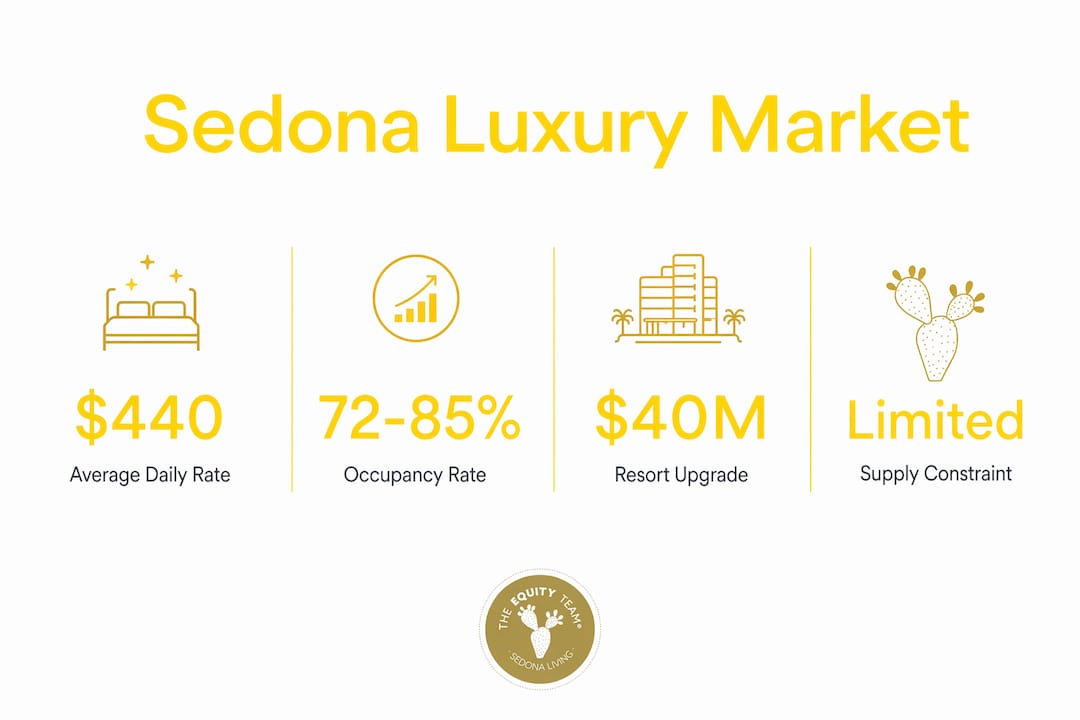
The result is a lodging market with genuine pricing power. Stabilized ADR around $440 for upscale stays in early 2026 reflects that constraint. Premium short-term rentals have seen a 25% ADR increase since 2021, with occupancy running between 72% and 85%. Those figures do not happen in oversupplied markets.
| Metric | Sedona 2026 | Typical Leisure Market |
|---|---|---|
| Average Daily Rate (upscale) | ~$440 | $180–$250 |
| Occupancy Range | 72%–85% | 55%–70% |
| ADR Growth Since 2021 | ~25% | 5%–10% |
| New Supply Constraints | High (terrain + zoning) | Low to moderate |
That pricing stability also explains why operators are willing to make big bets on renovation. Mii amo’s $40 million upgrade makes economic sense precisely because the market cannot be diluted by a wave of new competitors. When supply is capped, quality investments pay off.
Pro Tip: Sedona’s STR zoning regulations are worth understanding before you buy. The same constraints that protect pricing power also define where and how you can legally operate a short-term rental.
What makes sedona’s vortex sites a draw for affluent travelers?
Sedona’s four main vortex sites are Airport Mesa, Boynton Canyon, Bell Rock, and Cathedral Rock. Each carries a distinct energetic reputation. Airport Mesa is said to offer uplifting energy, while Boynton Canyon blends masculine and feminine forces. Bell Rock draws those seeking grounding, and Cathedral Rock is associated with feminine, nurturing energy. These are not marketing slogans. They are descriptions rooted in Hopi traditions that recognize these sites as sacred land with powerful spiritual significance.
Luxury travelers are not just curious about the vortexes. They want exclusive, curated access. That is where Sedona’s high-end properties turn spiritual lore into a genuine product differentiator.
- Pre-sunrise guided hikes to Airport Mesa, timed so guests arrive before the crowds and watch the red rocks ignite in the first light
- Private meditation sessions at Bell Rock led by certified guides who blend mindfulness practice with the site’s Indigenous context
- Concierge itineraries at properties like Mii amo that bundle vortex experiences into the overall Journey program
- Healing ceremonies drawing on local traditions, offered as optional but deeply popular additions to multi-night stays
- Photography and journaling workshops held at Cathedral Rock, combining creative expression with the spiritual setting
The demand for these experiences is not fringe. Affluent travelers increasingly seek transformation, not just relaxation. A weekend in a beautiful hotel is easy to find. A guided sunrise meditation at a sacred vortex site in a canyon that glows orange at dawn is not. That scarcity is exactly what high-end guests are paying for.
How does sedona compare to other luxury outdoor destinations?
Sedona sits in a category of its own when placed alongside Aspen, Colorado, or Palm Springs, California. All three offer stunning natural settings and upscale accommodations. But the nature of the luxury experience differs sharply.
Aspen delivers world-class skiing, celebrity culture, and high-end retail. Palm Springs offers desert modernism, golf, and pool culture. Both are genuinely luxurious. Neither offers a Forbes 5-Star wellness resort built around Indigenous sacred sites and multi-day spiritual transformation programs. That is Sedona’s specific lane, and it is a lane with very few competitors.
| Destination | Core Luxury Appeal | Spiritual/Wellness Depth | Supply Constraints |
|---|---|---|---|
| Sedona, AZ | Wellness, vortex, red rocks | Very high | Very high |
| Aspen, CO | Skiing, celebrity, dining | Low to moderate | Moderate |
| Palm Springs, CA | Modernist design, golf, pools | Low | Low to moderate |
| Scottsdale, AZ | Golf, spa, nightlife | Moderate | Low |
The luxury market in Sedona is also shaped by a guest profile that skews toward extended stays and repeat visits. Guests who come for a three-night Journey at Mii amo are not the same travelers booking a long weekend in Scottsdale. They are investing in an experience they expect to remember and return to. That repeat-visitor dynamic supports both occupancy rates and the premium pricing structure that makes Sedona so attractive to property investors.
The synergy between the red rocks, the vortex energy, and the upscale accommodations creates something that feels almost impossible to replicate. You cannot build a vortex. You cannot manufacture a landscape that turns crimson at sunset. You can only build around what already exists, and Sedona’s operators have learned to do that exceptionally well.
Key takeaways
Sedona’s high-end appeal is built on a combination of irreplaceable natural assets, constrained supply, and deeply curated spiritual experiences that no other luxury destination currently matches.
| Point | Details |
|---|---|
| Forbes 5-Star wellness leadership | Mii amo is the only 5-Star adults-only wellness resort in North America as of 2026. |
| Supply-driven pricing power | Terrain and zoning cap new inventory, holding ADR near $440 and occupancy at 72%–85%. |
| Vortex experiences as a product | Airport Mesa, Bell Rock, and Cathedral Rock are operationalized into exclusive concierge itineraries. |
| Transformation over comfort | High-end guests seek multi-day immersive stays, not just amenities, making Sedona distinct from Aspen or Palm Springs. |
| Investment rationale is strong | Constrained supply and sustained demand justify large renovation investments and support STR returns. |
What i’ve learned after years watching sedona’s luxury market
Most people assume Sedona’s appeal is just the views. The views are spectacular, no argument there. But the views alone do not explain why guests pay $440 a night, book 3–10 night stays, and come back year after year.
What I have observed working in this market is that Sedona sells something most luxury destinations cannot: the believable possibility of personal change. That sounds a little woo-woo until you watch a guest who arrived stressed and skeptical leave after five days looking genuinely lighter. The vortex sites, the guided experiences, the red rock sunrises at 5 a.m. with no one else around. It adds up to something real.
The operators who understand this are the ones investing heavily in programming, not just finishes. A beautiful kitchen is nice. A concierge who books you a private meditation at Bell Rock before breakfast is what gets you a five-star review and a return reservation. The Sedona real estate market rewards properties that deliver the full experience, not just the aesthetic.
My honest take is that the luxury travel world is moving toward Sedona’s model, not away from it. Personalized, destination-embedded, spiritually curious travel is the direction affluent guests are heading. Sedona has been doing it longer and better than almost anywhere else. That is not an accident. It is a structural advantage that will hold for a long time.
— Chad
Explore sedona’s short-term rental investment potential
Sedona’s combination of constrained supply, premium ADR, and high-end guest demand creates a genuinely compelling case for short-term rental investment. Properties in the right locations, with the right amenities, consistently perform in the top tier of the market.

Equity Team specializes in exactly this segment. As the first STR-specialized agents in Northern Arizona, Equity Team represents clients operating in the top 10% of Sedona’s rental market. Whether you are looking to buy a top-performing Sedona rental or want to understand how to find the right property for your goals, the team has the local expertise and market data to guide you. Sedona’s premium market does not wait around. The best opportunities move fast.
FAQ
What makes sedona a top luxury travel destination?
Sedona combines a Forbes 5-Star wellness resort, curated vortex experiences rooted in Hopi tradition, and a supply-constrained lodging market that sustains premium pricing. No other destination currently offers all three in one place.
How much do high-end sedona properties charge per night?
Upscale Sedona accommodations average around $440 per night in 2026, with occupancy rates running between 72% and 85% due to limited new supply.
What are sedona’s main spiritual vortex sites?
The four primary vortex sites are Airport Mesa, Boynton Canyon, Bell Rock, and Cathedral Rock. Luxury properties incorporate these into guided concierge itineraries for guests seeking transformative experiences.
Why does sedona rank as a top airbnb destination?
Sedona’s premium short-term rental market benefits from constrained supply, strong leisure demand, and a guest profile that prioritizes immersive wellness stays, all of which support high occupancy and above-average nightly rates.
How does mii amo differ from other luxury resorts?
Mii amo is the only adults-only, all-inclusive 5-Star wellness resort in North America, offering structured Journey stays of 3–10 nights built around Boynton Canyon’s red rock environment and holistic well-being programming.