

Days on market (DOM) is the industry-standard metric measuring how long a property sits listed before going under contract, and the Sedona agent days on market benchmark currently sits at a median of 77 days with an average of 140 days as of May 2026. Those two numbers tell very different stories, and understanding both is the difference between pricing a property with confidence and watching it collect digital dust on Realtor.com. Whether you are buying, selling, or holding a short-term rental in Sedona’s red-rock paradise, DOM data is your compass. Equity Team breaks it all down below.
What are the current Sedona agent days on market benchmarks?
The median DOM of 77 days and average DOM of 140 days are not interchangeable figures. They measure different things, and confusing them leads to bad decisions.
Median vs. average DOM explained:
- Median DOM (77 days) is the midpoint. Half of Sedona homes sell faster, half sell slower. It filters out the outliers sitting on the market for 400 days.
- Average DOM (140 days) is pulled upward by those stubborn overpriced listings that refuse to budge. It reflects the full spectrum of market activity, including the ones that probably should have been priced differently from day one.
The gap between 77 and 140 is significant. It tells you that a meaningful number of Sedona properties are sitting far longer than the typical home, skewing the average considerably. That is a signal of a market with real pricing discipline problems at the upper end.
Regional comparison: Sedona vs. Yavapai County
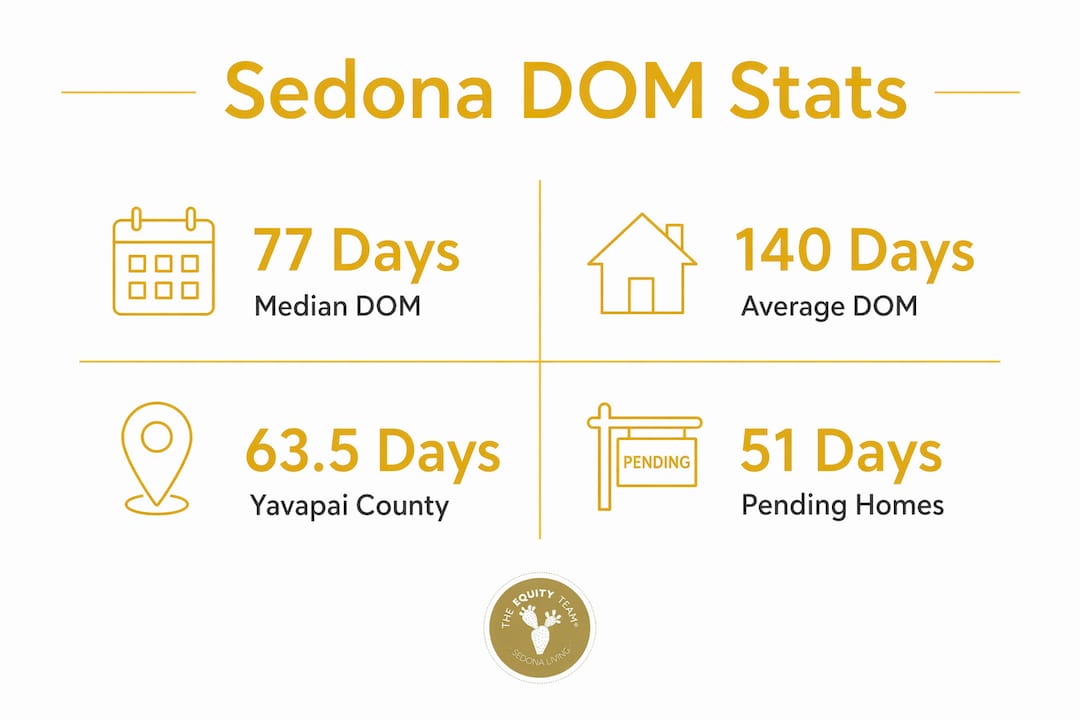
For context, Yavapai County reported a median DOM of 63.5 days in April 2026. Sedona’s median of 77 days runs higher than the broader county figure, which makes sense given Sedona’s higher price points and more specialized buyer pool. Not everyone shopping for a Sedona property is a local move-up buyer. Many are out-of-state investors or second-home buyers, and that audience takes longer to commit.
Interestingly, homes going pending in Sedona averaged roughly 51 days in February 2026. That pending DOM figure is notably shorter than the overall median, suggesting that the properties actually attracting serious buyers are moving faster than the headline number implies. The slower homes are dragging the median up.

Seasonal patterns also play a role. Sedona sees increased buyer activity in spring and early fall, when the weather shifts from “surface of the sun” to “actually pleasant.” Listings that hit the market in January or August tend to sit longer simply because fewer buyers are actively touring.
How do days on market trends affect pricing strategies in Sedona?
Pricing a Sedona property correctly from the start is not just good advice. It is the single biggest lever a seller controls.
Overpricing properties in Sedona leads directly to longer DOM and listing fatigue, which damages both buyer perception and final sale price. The logic is simple but painful to watch play out in real time. A buyer scrolling listings notices a home that has been sitting for 90 days and immediately wonders what is wrong with it. Nothing may be wrong. The seller just got greedy on the ask.
What listing fatigue actually looks like:
- A home lists at $1.2 million in a market where comparable properties are selling at $1.05 million.
- It sits for 60 days with minimal showings.
- The seller drops to $1.1 million. Buyers notice the reduction and smell blood.
- Another 45 days pass. A second reduction to $1.05 million finally attracts offers, but now buyers negotiate harder because the long DOM signals desperation.
- The final sale price ends up below what a correctly priced listing would have achieved on day one.
Listing fatigue occurs when buyers observe multiple price reductions, triggering suspicion that something is fundamentally wrong with the property. That suspicion is hard to shake even when the home is perfectly fine. The damage is psychological and real.
Pro Tip: Set your initial list price using a comparative market analysis (CMA) built on the last 90 days of closed sales in Sedona, not the last 12 months. The market has shifted enough in 2026 that older comps will mislead you.
Accurate pricing aligned with current Sedona market conditions consistently outperforms the “test the market” approach. Sellers who price correctly from the start attract more competing offers, spend fewer days on market, and net more per square foot. The math is not complicated.
For Sedona’s luxury segment, the picture is slightly different. Luxury homes in Sedona average around 62 days on market, with buyers typically making about two offers before closing. That shorter DOM in the luxury tier reflects a more decisive buyer profile, but it also means luxury sellers cannot afford to overprice and wait. Even motivated luxury buyers will walk if the number feels disconnected from reality.
You can explore specific Sedona pricing mistakes that inflate DOM and cost sellers real money.
How can buyers and investors use DOM data to make smarter offers?
DOM benchmarks are not just a seller’s tool. Buyers and investors who read them correctly gain a genuine negotiating edge.
Here is how to put DOM data to work on the buy side:
-
Flag properties above 90 days. Any listing sitting past the 77-day median in Sedona has likely already attracted and lost at least one interested buyer. That is worth investigating. Ask the agent why it is still active. The answer reveals a lot about seller motivation and pricing flexibility.
-
Compare average vs. median DOM for the neighborhood. If a specific Sedona neighborhood shows an average DOM of 110 days but a median of 55 days, one or two stubborn listings are skewing the data. The median is your real benchmark for that pocket of the market.
-
Cross-reference DOM with inventory levels. Rising DOM combined with growing active inventory is a classic market-softening signal. Market softening in Sedona as evidenced by rising DOMs means sellers need to be strategic, and buyers gain leverage. Watch both metrics together, not in isolation.
-
Use pending DOM as a timing guide. The roughly 51-day pending DOM figure from early 2026 tells buyers that well-priced homes are still moving in under two months. If you find a property that has been active for 100 days, you have room to negotiate. If it just listed, move quickly or expect competition.
-
Factor DOM into your investment underwriting. For short-term rental investors, a long DOM on a target property can indicate either a pricing problem or a genuine demand issue in that micro-location. Both matter for your revenue projections. A home that sat 180 days before selling may have sat for a reason that affects nightly booking rates too.
Pairing DOM data with the Sedona real estate trends tracked by Equity Team gives buyers a fuller picture of where the market is heading, not just where it has been.
What tools can you use to track Sedona DOM data effectively?
Tracking DOM in Sedona does not require a real estate license. Several platforms make it accessible, though each has its quirks.
| Tool | What it tracks | Best for |
|---|---|---|
| Altos Research | Weekly median and average DOM by city | Investors wanting real-time trend data |
| Realtor.com | Active listing DOM and price history | Buyers researching specific properties |
| FRED (St. Louis Fed) | County-level median DOM with historical charts | Macro trend analysis by county |
| Local MLS (ARMLS) | Granular DOM by neighborhood and price tier | Agents and serious investors |
| Zillow | Listing age and price change history | Quick buyer-side research |
Altos Research is the most granular tool for Sedona-specific weekly data. The FRED database covers Yavapai County and is excellent for spotting multi-year seasonal patterns. Realtor.com and Zillow are fine for property-level research but lack the market-wide trend depth that serious investors need.
Zillow Preview offers pre-market exposure before a listing goes live on the MLS, allowing sellers to gauge real buyer interest and build momentum before the official DOM clock starts ticking. Agents using this tool strategically can reduce effective market time by generating early offers.
Pro Tip: Set a weekly calendar reminder to check Altos Research for Sedona’s median DOM. A three-week trend of rising DOM is an early warning sign of market softening, giving you time to adjust pricing or offer strategy before the broader market catches on.
The local MLS, accessed through a licensed agent, remains the gold standard for neighborhood-level DOM breakdowns. Equity Team uses MLS data alongside Altos Research to give clients a layered view of market conditions that no single public tool can replicate.
Common mistakes when interpreting Sedona DOM benchmarks
DOM data is useful, but it is easy to misread. Here are the errors that show up most often.
Treating average DOM as the market standard. The 140-day average in Sedona is not what a well-priced home experiences. It reflects the full distribution, including properties that have been sitting for six months or more. Use the 77-day median as your baseline for realistic expectations.
Ignoring property-specific factors. A home on a busy Sedona road, with dated interiors, or lacking short-term rental permits will sit longer than the median regardless of pricing. DOM benchmarks describe the market broadly. They do not override property-specific realities.
Reacting to a single month’s DOM spike. The nearly 50% month-over-month increase in Sedona’s average DOM in March 2026 was notable, but one month does not make a trend. Look at three to six months of data before changing your strategy.
Cross-validate DOM data with median sale price, list-to-sale price ratios, and active inventory levels before drawing conclusions. DOM alone is a clue, not a verdict.
Making pricing adjustments based only on DOM spikes. If your listing hits 60 days without an offer, the instinct is to drop the price immediately. But first, check whether the broader Sedona market slowed down that month. If median DOM rose market-wide, your property may simply be caught in a seasonal lull rather than a pricing problem. Equity Team’s agents check market-wide DOM before recommending any price adjustment.
Key takeaways
The most reliable approach to Sedona real estate is pairing the 77-day median DOM benchmark with accurate initial pricing, because overpriced listings consistently underperform regardless of market conditions.
| Point | Details |
|---|---|
| Median DOM is your benchmark | Use 77 days as the realistic baseline, not the 140-day average skewed by outliers. |
| Pricing accuracy beats optimism | Overpriced listings trigger listing fatigue and net less than correctly priced homes. |
| Buyers gain leverage above 90 days | Properties past the median DOM signal seller motivation and negotiating room. |
| Seasonal timing matters | Spring and fall listings move faster in Sedona due to higher buyer activity. |
| Cross-validate with multiple metrics | Combine DOM with inventory levels and sale-to-list ratios for reliable market reads. |
Chad’s take on DOM benchmarks in Sedona
I have watched sellers in Sedona leave real money on the table by treating the listing price as a negotiating starting point rather than a market signal. The “we can always come down” mindset sounds reasonable until you see a home sit for 120 days, take two price cuts, and close below what a correctly priced listing would have fetched in week three.
The 77-day median is a healthy market. It is not a slow market. Sedona is not Phoenix, and it was never going to move like a suburban tract neighborhood. The buyer pool is smaller, more specific, and often out of state. That takes time. What it does not take is 140 days, and when a listing approaches that average, something went wrong early.
The March 2026 DOM spike was a useful reminder that Sedona is not immune to broader market softening. Rising interest rates and cautious buyer sentiment showed up in the data before most sellers felt it. That is exactly why tracking DOM weekly through Altos Research is worth the five minutes it takes. The market tells you what is happening before your inbox does.
My honest advice: price it right, list it in spring or early fall, and use pre-market tools like Zillow Preview to build early momentum. The sellers who do those three things consistently outperform the benchmark. The ones who skip steps one and two call me 90 days later asking what went wrong.
— Chad
Ready to sell or invest in Sedona with real data behind you?
Equity Team is Sedona’s only team of agents specializing in short-term rental investment, and the first STR-focused team in all of Northern Arizona. Whether you are buying your next top-performing property or selling and want every dollar the market will give you, the team brings current DOM data, pricing strategy, and local expertise to every transaction.

Equity Team represents clients operating STRs in the top 10% of the Sedona rental market. If you want to know exactly how DOM benchmarks affect your specific property’s value or investment potential, start with the Sedona STR investment guide built specifically for buyers and investors in this market. The guide covers property selection, pricing analysis, and the DOM factors that separate top-performing rentals from average ones.
FAQ
What is the average days on market in Sedona right now?
As of May 2026, the median DOM in Sedona is approximately 77 days, while the average DOM sits at 140 days. The median is the more reliable benchmark for typical seller expectations.
How does Sedona’s DOM compare to Yavapai County?
Sedona’s median DOM of 77 days runs higher than Yavapai County’s median of 63.5 days recorded in April 2026, reflecting Sedona’s higher price points and more specialized buyer pool.
Why do some Sedona homes sell much faster than the median?
Well-priced homes in desirable Sedona locations, particularly those with short-term rental potential, can go pending in around 51 days. Accurate initial pricing and pre-market exposure through tools like Zillow Preview are the primary drivers of faster sales.
Does a long DOM always mean a property is overpriced?
Not always. Property-specific factors like location, condition, and permit status affect DOM independently of price. Always cross-reference DOM with list-to-sale price ratios and comparable sales before concluding a property is overpriced.
How should STR investors use DOM data when evaluating a Sedona property?
A property with a long DOM history may signal a demand problem in that micro-location, which directly affects short-term rental booking potential. Investors should pair DOM data with short-term vs. long-term rental revenue analysis to fully evaluate whether a slow-selling property is also a slow-booking one.