

The Sedona Agent designation is a recognized professional credential identifying real estate agents with specialized expertise in Sedona’s market, particularly for short-term rental transactions. Investors and homeowners searching for what is sedona agent designation meaning often confuse it with Arizona’s legal concept of designated agency. These are two very different things, and mixing them up can cost you real money. Equity Team, the first STR-specialized agents in Northern Arizona, works exclusively within this niche, representing clients who operate in the top 10% of Sedona’s rental market.
What is the Sedona Agent designation meaning, and how does it differ from designated agency?
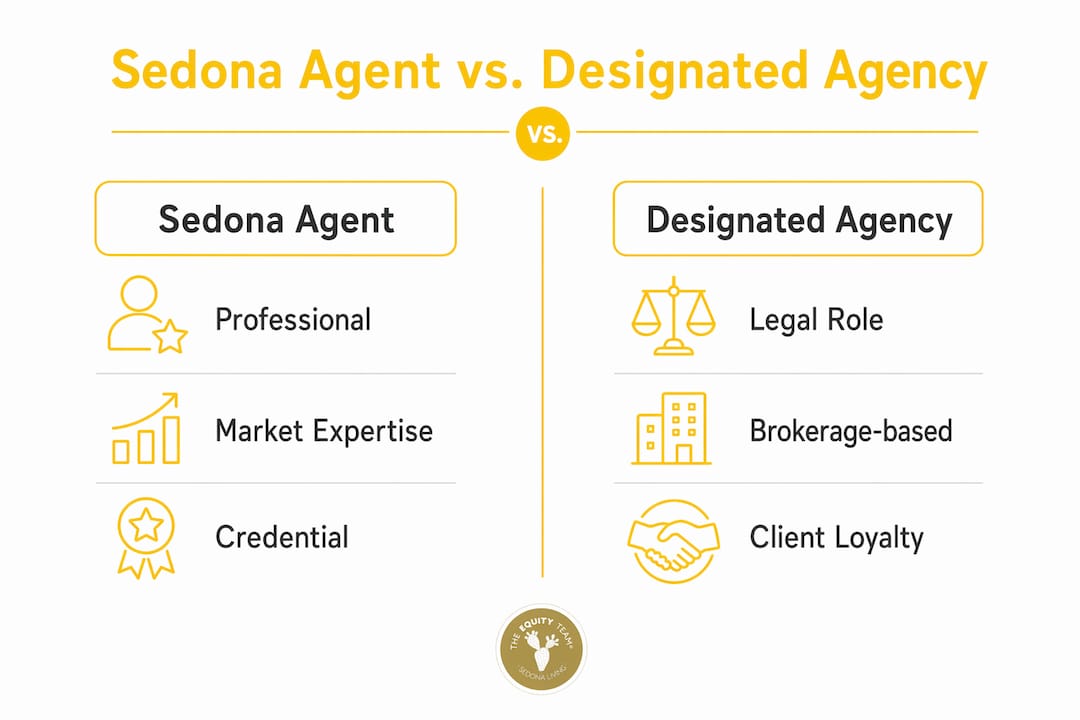
The Sedona Agent designation is a professional credential, not a legal agency type. It signals that an agent has earned specialized knowledge in Sedona’s real estate market, with a focus on short-term rental properties. Think of it like a sommelier certification at a restaurant. The title tells you this person knows their subject deeply, but it does not define the legal relationship between you and the restaurant.
Designated agency, by contrast, is a specific Arizona legal arrangement where two agents from the same brokerage each represent one party in a transaction. One agent advocates for the buyer, the other for the seller, even though they share the same broker. This structure exists to avoid the conflicts of interest that arise in dual agency, where a single agent tries to serve both sides at once.
Designated agency preserves loyalty and negotiation advocacy for each client, which is a meaningful protection in high-stakes STR deals. The supervising broker stays neutral and cannot share confidential information from one agent with the other. Approximately 20% of home sales involve designated agency as an alternative to dual agency.
Clients often confuse the Sedona Agent designation with these legal agency roles, but they serve entirely different purposes. One is professional credentialing that signals market expertise. The other is a legal status that defines representation rights and fiduciary duties.
| Concept | What it is | What it affects |
|---|---|---|
| Sedona Agent designation | Professional credential | Agent’s expertise and market knowledge |
| Designated agency | Arizona legal arrangement | Who the agent legally represents |
| Dual agency | One agent, two clients | Negotiation neutrality |
| Single agency | One agent, one client | Full fiduciary loyalty |
Pro Tip: Always ask your agent to clarify both their professional designation and their legal agency role before signing anything. They are separate questions with separate answers.
How does the Sedona Agent designation benefit STR investors and homeowners?
A Sedona Agent’s value shows up most clearly when a deal gets complicated. Sedona’s short-term rental market has quirks that general real estate agents simply do not encounter in Phoenix or Scottsdale. The red rock backdrop is gorgeous, but the regulatory terrain underneath it is anything but simple.

Sedona Agents have deeper insights into zoning, STR restrictions, and neighborhood trends that directly affect investment returns and compliance. That local specialization translates into real guidance on which properties will perform and which ones will cause headaches.
Here is what a qualified Sedona Agent brings to an STR transaction:
- Zoning and permit knowledge. Sedona has active STR restriction changes that affect which properties can legally operate as short-term rentals. A Sedona Agent tracks these updates in real time.
- Pricing strategy for STR properties. STR valuations differ from standard residential pricing. A Sedona Agent factors in occupancy rates, seasonal demand, and revenue potential, not just comparable sales.
- Access to relevant listings. Sedona’s STR inventory is limited, and the best properties move fast. Agents with deep local networks often know about opportunities before they hit public listings.
- Regulatory compliance guidance. Understanding permit caps, HOA restrictions, and municipal policies is not optional in Sedona. A Sedona Agent advises clients on compliance before a purchase closes.
- Negotiation tailored to STR value. A property’s STR revenue potential changes its negotiating position. A Sedona Agent knows how to use that data at the table.
Pro Tip: Ask any agent you interview to walk you through a recent STR deal they closed in Sedona. The specifics they mention will tell you immediately whether their knowledge is real or rehearsed.
How do agents earn the Sedona designation, and why does it matter?
The Sedona Agent designation is not handed out at a weekend seminar. Agents who carry it have typically combined formal certification, local association membership, and hands-on experience in Sedona’s specific market.
The most relevant professional path runs through two key pillars. First, membership in the Sedona Verde Valley Association of REALTORS® (SVVAR) gives agents access to real-time local data and keeps them current on municipal policies like permit caps that directly affect STR operations. Second, designations like the Resort and Second-Home Property Specialist (RSPS) certification validate expertise in vacation and second-home markets. The RSPS certification requires completion of specialized coursework and active membership in the National Association of REALTORS® (NAR).
A typical path to becoming a recognized Sedona Agent looks like this:
- Obtain an Arizona real estate license. This is the baseline. Without it, nothing else matters.
- Join SVVAR. Local association membership connects agents to Sedona-specific market data, policy updates, and professional networks.
- Complete STR-focused coursework. Designations like RSPS signal formal training in vacation property markets, including valuation, management, and compliance.
- Build a track record in Sedona STR transactions. Classroom knowledge is a starting point. Real experience closing STR deals in Sedona is what separates a credentialed agent from a genuinely capable one.
- Pursue continuing education. Sedona’s regulatory environment shifts. Agents who stay current through ongoing education protect their clients from costly surprises.
The distinction from a general real estate license matters because a standard Arizona license qualifies an agent to close any residential transaction. The Sedona Agent designation signals that this particular agent has gone further, specifically in the market and property type that STR investors care about most.
What should Sedona investors ask when working with a Sedona Agent?
Knowing the right questions separates a productive agent relationship from an expensive misunderstanding. Arizona brokerage law requires clear, written disclosure of agency relationships, including designated agency arrangements. Investors should not wait for an agent to volunteer this information.
- “Who do you legally represent in this transaction?” This question clarifies whether the agent works for the buyer, the seller, or both. Get the answer in writing before any negotiations begin.
- “What is your experience with Sedona STR zoning and permits?” A qualified Sedona Agent should be able to name specific zones, recent regulatory changes, and how they affected past clients.
- “Are you a member of SVVAR?” SVVAR membership is a practical signal of local engagement and access to current market data.
- “Do you hold any STR-specific designations, such as RSPS?” Formal credentials confirm that the agent’s vacation property knowledge has been tested and verified.
- “Have you closed STR transactions in the specific Sedona neighborhood I am targeting?” Sedona’s neighborhoods vary significantly in STR performance. West Sedona, the Village of Oak Creek, and Uptown each have different demand profiles and restriction environments.
- “How will you disclose any dual or designated agency situations that arise during this deal?” Clients must insist on clear agency disclosures in writing, especially in complex STR deals where multiple parties and regulations intersect.
A Sedona Agent who hesitates on any of these questions is telling you something important. Confidence and specificity in the answers signal genuine expertise. Vague generalities signal a general agent who has added “Sedona” to their marketing.
Key Takeaways
The Sedona Agent designation is a professional credential, not a legal agency type, and understanding the difference is the single most important thing STR investors can know before hiring representation.
| Point | Details |
|---|---|
| Designation vs. legal agency | The Sedona Agent designation signals expertise; designated agency defines legal representation rights. |
| STR-specific knowledge | Sedona Agents advise on zoning, permit caps, and STR restrictions that general agents typically miss. |
| Credentials to look for | SVVAR membership and RSPS certification are the clearest markers of a qualified Sedona Agent. |
| Written disclosures matter | Arizona law requires written agency disclosures; always request them before negotiations start. |
| Ask specific questions | Asking about past STR closings and neighborhood-level knowledge quickly separates specialists from generalists. |
Why the Sedona Agent designation changed how I think about representation
I have watched investors walk into Sedona STR deals with perfectly competent general agents and walk out with properties that looked great on paper but performed poorly in practice. The agent knew how to close a deal. They did not know that the neighborhood had a permit cap that was already at capacity, or that the HOA had quietly amended its rules six months earlier.
The Sedona Agent designation matters because Sedona is genuinely weird in the best possible way. The market does not behave like a standard residential market. Demand is seasonal and tourism-driven. Regulations shift faster than most markets. The gap between a top-performing STR and a mediocre one can be a single zoning line on a map.
What I have found is that the designation itself is less important than what it represents: an agent who chose to specialize, stayed current, and built real relationships in this specific market. The credential is the signal. The track record is the proof. When evaluating a Sedona Agent, ask for both.
The common misconception I see most often is investors treating the Sedona Agent designation as a guarantee of performance. It is not. It is a strong filter. Use it to build your shortlist, then dig into the specifics. The right Sedona Agent will welcome those questions. The wrong one will dodge them.
— Chad
Working with Equity Team on your Sedona STR investment
Equity Team is the first STR-specialized real estate team in Northern Arizona, and the Sedona market is the only market they work in. Every client they represent operates in the top 10% of Sedona’s rental market, which means the guidance investors receive is grounded in real, current performance data, not general market assumptions.

Whether you are buying your first Sedona STR or selling a property that has already proven its revenue potential, Equity Team brings the local expertise and designation-backed knowledge that this market demands. Start by exploring how to find the right STR property in Sedona, or browse current STR investment opportunities with agent-level analysis already built in. Sedona’s inventory is limited and moves fast. Having the right agent in your corner from day one makes a measurable difference.
FAQ
What is the Sedona Agent designation in real estate?
The Sedona Agent designation is a professional credential identifying agents with specialized knowledge in Sedona’s real estate market, particularly for short-term rental transactions. It is a marker of expertise, not a legal agency type.
How is the Sedona Agent designation different from designated agency?
The Sedona Agent designation is a professional credential focused on market expertise. Designated agency is an Arizona legal arrangement where two agents from the same brokerage each represent one party in a transaction to avoid conflicts of interest.
What qualifications does a Sedona Agent typically hold?
A qualified Sedona Agent typically holds an Arizona real estate license, membership in the Sedona Verde Valley Association of REALTORS® (SVVAR), and may hold the RSPS certification from the National Association of REALTORS® (NAR).
Why does the Sedona Agent designation matter for STR investors?
Sedona Agents have specific knowledge of local zoning, permit caps, and STR restrictions that directly affect investment returns and compliance. General agents without this specialization often miss details that significantly impact property performance.
Does Arizona law require written agency disclosures?
Arizona brokerage law requires clear, written disclosure of agency relationships, including designated agency arrangements. Investors should request these disclosures before any negotiations begin to fully understand who the agent legally represents.