

Short-term rentals are legal in Yavapai County, but only inside structures already permitted as habitable for overnight stays. Weddings, retreats, and other event uses are off the table entirely, and no property can legally host guests until it’s registered with the county assessor. Before you list a single night, pull the permit and occupancy record for the property and confirm the assessor filing is current.
TL;DR:
- Short-term rentals in Yavapai County must be in structures officially permitted as habitable for overnight stays, with proper certificate of occupancy and matching permits.
- You must register with the county assessor and update the filing within 10 days of any change to legally operate, especially if the property is outside Arizona and requires a statutory agent.
- County regulations prohibit hosting events, weddings, or parties and require proper permits, septic, and parking support for the advertised occupancy limits.
- State law prevents local governments from banning short-term rentals but allows regulation of safety, nuisance, and permit enforcement with strict timelines for permit decisions.
- Every rental needs a Transaction Privilege Tax license before bookings, and owners must comply with local noise, nuisance, and occupancy rules to avoid significant penalties.
Table of Contents
- Yavapai County Airbnb Rules: The County Checklist Before You List
- Arizona’s Preemption Law: What Counties Can and Can’t Touch
- Registering With the Assessor: Your Legal Starting Line
- What Counts as a Permitted, Habitable Structure
- TPT, Business Licenses, and Advertising Your Numbers
- Staying Compliant Day to Day: Emergency Contact, Noise, and Occupancy
- Penalties and How to Fix a Violation Fast
- The Equity Team Due-Diligence Checklist for Buyers and Sellers
- What I’ve Seen Go Wrong on Yavapai STR Deals
- How the Equity Team Helps You Buy or Sell With Compliance Already Handled
- Sources
- FAQ
Yavapai County Airbnb Rules: The County Checklist Before You List
Yavapai County drew a clear line back on January 1, 2017: short-term rentals are only allowed in structures permitted as habitable for overnight occupancy, according to the county’s own planning FAQ. That means the guest house, the garage-turned-studio, or the “bonus room” over the carport only counts if the county’s permit files say it counts. The same document is blunt about what a short-term rental cannot become: no weddings, no parties, no specialized retreats, no commercial activity dressed up as a vacation stay, and hosts can find useful operational house-rule examples in the checklist for preventing event use and parties.
This sounds simple until you’re standing in a listing that photographs beautifully but was never inspected as living space. Sedona and the Verde Valley are full of charming conversions that were never pulled through the permit process, and a gorgeous kitchen renovation means nothing to a code inspector if the structure itself was never approved for overnight occupancy.
Before you list, or before you make an offer on a property you plan to operate, work through this:
- Confirm the certificate of occupancy and the approved floor plan match what’s actually being rented out.
- Verify septic and building approvals cover every bedroom you plan to advertise.
- Complete assessor registration under Arizona Revised Statutes §33-1902 (more on this below).
- Check the deed and any HOA documents for rental restrictions that predate the county’s own rules.
- Confirm parking capacity and septic load can actually support your planned occupancy.
Pro Tip: Call the county’s Development Services / Planning Unit directly before you sign anything. A five-minute phone call about a parcel’s permit history can save you from buying a property you legally can’t rent the way you planned.
Arizona’s Preemption Law: What Counties Can and Can’t Touch
Arizona took the decision to ban short-term rentals away from local governments years ago, but that doesn’t mean cities and counties have no say. Under A.R.S. §11-269.17, counties and cities cannot prohibit vacation or short-term rentals outright. What they keep is authority over the things that actually protect neighbors and guests: health and safety standards, nuisance enforcement, emergency-contact requirements, and local permitting.
That last piece matters for timing. When a local permit is required, the statute forces a decision within seven business days of issuance or denial, so a jurisdiction can’t sit on your application indefinitely.
Practically, this creates a stacked compliance picture:
- State level: your right to operate exists and can’t be revoked wholesale.
- County level: habitable-structure rules, assessor registration, and event prohibitions still apply.
- Municipal level: if your property sits inside an incorporated town rather than unincorporated county land, additional local permits or licenses may layer on top.
Owners who assume “Arizona allows it” is the whole story are the ones who get surprised by a nuisance complaint or a missing local license months into operating.
Registering With the Assessor: Your Legal Starting Line
You cannot legally occupy a short-term rental in Yavapai County without first filing information with the county assessor. A.R.S. §33-1902 requires this for every residential rental property, and the county’s own registration form spells out exactly what’s needed.
Here’s the process in order:
- Complete the assessor’s residential rental registration form with the owner’s name, contact information, and the property’s parcel details.
- Return it to the assessor’s office at the address listed on the form itself.
- Update the filing within 10 days of any change, including a new property manager or a change of mailing address.
- If you live outside Arizona, designate a statutory agent inside the state who can legally accept service on your behalf.
That statutory-agent step trips up a lot of out-of-state buyers who assume a local property manager fills that role automatically. It doesn’t. It’s a distinct, recorded legal designation.
The stakes are real: the statute states plainly that a property may not be occupied if the required information isn’t on file with the assessor, and civil penalties can attach for noncompliance. This is not a paperwork suggestion. It’s a precondition to legally putting a guest in the door.
What Counts as a Permitted, Habitable Structure
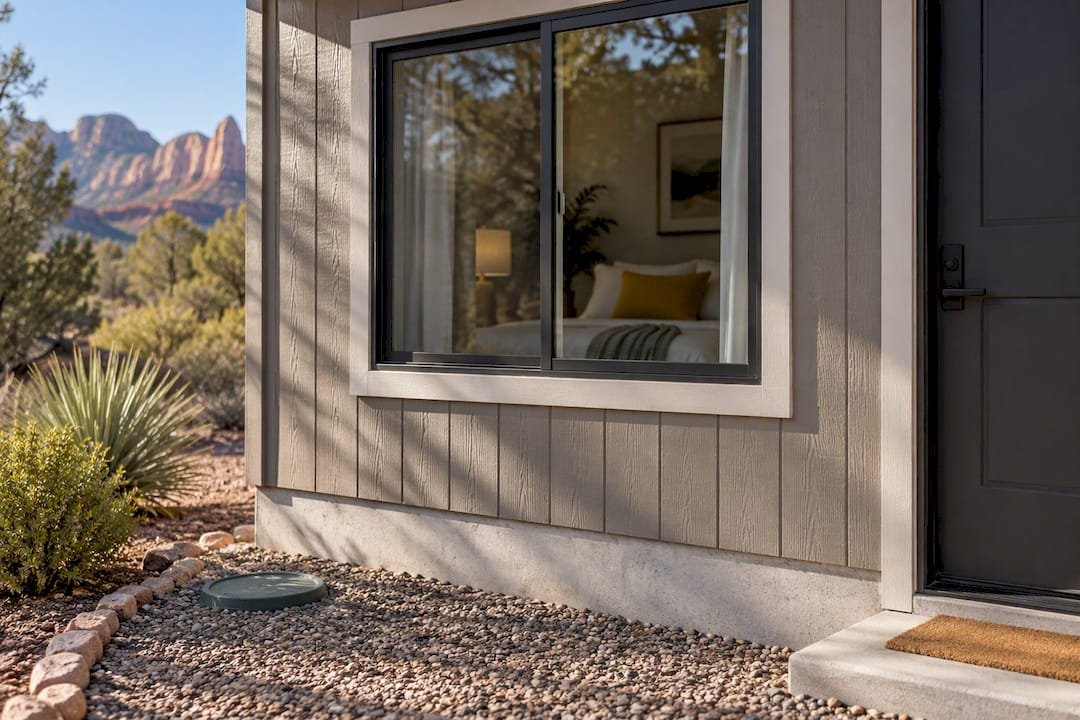
“Permitted as habitable” means three things line up: a certificate of occupancy, an approved floor plan, and the building permits that match what’s actually built. If any of those is missing, the space doesn’t qualify, no matter how nice the finishes look.
Structures that commonly fail this test:
- Detached garages converted into bedrooms or suites without a permit amendment.
- Sheds, casitas, or “she-sheds” never run through the building department.
- RVs, park models, or tiny homes without an approved occupancy designation.
- Additions built without inspection sign-off, even decades-old ones.
Photos never settle this question, and neither does a seller’s word. Pull the actual permit record through the county’s permit lookup or contact Development Services directly. If approvals are missing, you’re looking at either a permitting project before you can rent that space, or excluding it from the listing entirely.
TPT, Business Licenses, and Advertising Your Numbers
Every short-term rental in Arizona needs a Transaction Privilege Tax license before taking a single booking. You get one through AZTaxes.gov, using business code 025 for transient lodging, per Arizona Department of Revenue guidance. If your rental income is seasonal, the department allows seasonal filing rather than forcing year-round reporting.
Beyond state TPT, check whether your specific city or town layers on its own requirements:
- Some incorporated municipalities require a separate city business license.
- A handful apply their own hotel or bed tax on top of state TPT.
- Advertising rules often require displaying your TPT or local permit number directly on the listing.
Pro Tip: Skipping the license-number disclosure on your listing isn’t a minor oversight. It’s the kind of gap that shows up fast during a compliance sweep, and it’s an easy fix compared to the fine for ignoring it.
Staying Compliant Day to Day: Emergency Contact, Noise, and Occupancy
Getting permitted is the starting line, not the finish. Day-to-day operation carries its own obligations, and this is where a lot of otherwise-compliant hosts slip up.
- Emergency contact: you or a designated representative must be reachable and, when public safety requires it, able to respond in person. A phone number that rings to voicemail at 2 a.m. does not satisfy this, and noncompliance can carry a civil penalty.
- Noise and nuisance: state preemption doesn’t touch nuisance enforcement. If your property sits inside an incorporated town, check that town’s specific quiet hours, since they can be stricter than county norms.
- Occupancy limits: tie your posted maximum guest count to the actual permitted habitable space and septic capacity, not to how many beds you can physically squeeze in. There’s no single countywide occupancy number. It’s property-specific, driven by bedroom count, building-code status, and septic design.
Pro Tip: Write your house rules like a lawyer, not like a friendly note. “No events, weddings, or gatherings beyond registered guests” holds up in a dispute far better than a soft “please be respectful of neighbors.”
Penalties and How to Fix a Violation Fast
Verified violations carry real financial teeth. Civil penalties can run as high as several hundred dollars per 30-day period for some noncompliance categories, and a permit tied to a verified violation can be suspended for up to 12 months. That’s a full high season lost for a Sedona-area property.
Most enforcement follows a notice-and-cure structure rather than an instant shutdown, giving owners a window to fix the issue before penalties escalate. If you get a notice:
- Address the specific violation immediately and document what you changed.
- Keep records of corrective action, not just a verbal fix.
- Contact the relevant department directly if you believe the notice was issued in error, rather than letting an appeal deadline lapse.
Acting inside that cure window is almost always cheaper than fighting a suspension after the fact.
The Equity Team Due-Diligence Checklist for Buyers and Sellers
Whether you’re buying a Sedona-area STR or preparing to sell one, compliance should be a closing condition, not an afterthought discovered after money has changed hands.
- Confirm the exact jurisdiction: unincorporated county, or a specific incorporated town with its own overlay rules.
- Pull the permit and certificate-of-occupancy record for every space marketed as a bedroom.
- Verify current assessor registration and request the receipt or confirmation.
- Confirm active TPT license status and any required city business license.
- Inspect septic design records against advertised occupancy.
- Review HOA or deed restrictions independently of what the listing agent tells you.
- Confirm an emergency-contact plan exists and ask for proof of responsiveness, not just a name on paper.
Pro Tip: Turn every one of these into a contract contingency. Require the seller to produce the assessor receipt, permit documents, and septic records before you remove your inspection period, the same way you’d require a clear title. A property that pencils out on paper but can’t legally operate as advertised is not the deal you thought you were buying, and this kind of due diligence pairs naturally with a full Sedona short-term rental investment review before you commit.
What I’ve Seen Go Wrong on Yavapai STR Deals
The single most common mistake I see is buyers underwriting a property from listing photos instead of permit records. A guest house that looks rentable and a guest house that’s legally rentable are two different questions, and only the county’s files answer the second one. I’ve watched a sale nearly stall because the “extra suite” driving half the projected revenue had never been permitted as habitable. It got resolved, but only because the issue surfaced before closing, not after. If you want a property-specific compliance review before you buy or list, that conversation is worth having early.
— Chad
How the Equity Team Helps You Buy or Sell With Compliance Already Handled
Some real estate teams specialize exclusively in Sedona-area short-term rental transactions, including compliance checks as part of their representation of buyers and sellers from the start, rather than adding them after an offer is accepted.

If you’re buying, our buyer representation includes pulling permit and occupancy records before you ever write an offer, so you’re not discovering a habitable-structure problem during your inspection period. If you’re selling, a Sedona vacation rental CMA pairs market valuation with a seller prep consultation that flags any compliance gaps early, while they’re still cheap to fix. And if you’re weighing whether to sell an existing STR at all, a rental exit strategy conversation can walk through the numbers with your actual permit status factored in, not assumed. Reach out through Owninaz to start with a property-specific compliance and valuation review.
Sources
- Yavapai County planning FAQ (Planning Unit) — planning-faq-2025.pdf
- A.R.S. §11-269.17 — Limits on regulation of vacation rentals and short-term rentals
- Short-Term Lodging | Arizona Department of Revenue
FAQ
Are Tiny Homes Allowed as Airbnb Rentals in Yavapai County?
Only if the structure is permitted as habitable for overnight occupancy, the same standard applied to any other building. A tiny home without an approved occupancy designation, certificate of occupancy, and matching building permits does not qualify, regardless of how it’s marketed.
What Are the Rules and Regulations for Short-Term Rentals in Arizona?
State law under A.R.S. §11-269.17 prevents cities and counties from banning short-term rentals but allows them to regulate health and safety, nuisance behavior, emergency contacts, and local permits. On top of that, A.R.S. §33-1902 requires every residential rental property, including short-term rentals, to be registered with the county assessor before occupancy.
What Are the Noise Ordinance Hours in Yavapai County?
Noise and nuisance enforcement stays a local authority even under state preemption, and specific quiet hours depend on whether the property sits in unincorporated county land or inside an incorporated town with its own ordinance. Check with the specific municipality if the property falls inside city or town limits, since incorporated areas often set stricter hours than the surrounding county.
Why Does Arizona Law Prohibit Cities From Restricting the Use of Vacation Rentals?
State lawmakers passed A.R.S. §11-269.17 to prevent a patchwork of local bans across Arizona’s cities and counties, protecting property owners’ right to operate short-term rentals statewide. The law still leaves room for local governments to regulate the details around safety, nuisance, and permitting, so it limits outright bans without eliminating local oversight entirely.
Do I Need a TPT License to Operate an Airbnb in Yavapai County?
Yes. Every short-term rental operator needs a Transaction Privilege Tax license from the Arizona Department of Revenue, filed under business code 025 for transient lodging, before accepting bookings.