

Sedona is a place where the red rocks glow at sunset and the junipers grow right up to the back deck. That is the postcard. It is also the reason wildfire mitigation belongs on every Sedona rental owner’s to-do list. A rental that is scored, hardened, insured and explained to guests holds its income and its resale value better than one that was never looked at. As Sedona’s short-term rental specialists at the Equity Team, we treat wildfire readiness as part of the investment, not an afterthought.
This guide walks through how to read a property’s exposure, what the local fire district actually requires, which fixes matter most, how to handle guests when smoke shows up, and what it all means when it is time to buy or sell.
TL;DR
- The whole Sedona Fire District is classed as high fire hazard, so new construction faces strict ignition-resistant rules, and older rentals are judged against them by buyers and insurers.
- A free-to-use scoring checklist from University of Arizona Extension turns a gut feeling about a property into a Low, Moderate or High hazard number.
- The big wins are a Class A roof, screened vents, a clean first five feet around the house, and thinned vegetation out to 30 feet and beyond.
- Fire restrictions change by season, and guest cancellation rights depend on the booking contract and platform policy, so both need a plan before the smoke arrives.
- Documented mitigation supports insurability and resale, which is where a specialist agent earns the commission.
Table of Contents
- Why wildfire is a rental-income question, not only a safety one
- Step one: score the property before buying or listing
- What the Sedona Fire District requires
- The fixes that matter most
- A quick budget reality check
- Guests, smoke and cancellations
- Insurance and value: where mitigation pays back
- Buying or selling a rental with wildfire in mind
- We think wildfire readiness is part of the deal
- Working with the Equity Team
- FAQ
- Sources
Why wildfire is a rental-income question, not only a safety one
A vacation rental makes money on nights booked. Smoke, road closures and evacuation notices cost nights, even when no flame ever touches the property. A house with a wood-shake roof and juniper hugging the eaves can also cost an owner something quieter: a harder time getting coverage and a longer conversation with every buyer.
That is why the useful question is not whether Sedona has wildfire risk (it does, the red-rock scenery comes with a forest next door). The useful question is how much risk one particular address carries, and what it takes to bring that number down.
Step one: score the property before buying or listing
University of Arizona Extension publishes a Wildfire Hazard Severity Rating Checklist for Arizona homes that does exactly this. It assigns points for community design, vegetation, defensible space, slope and water availability. Some examples of how the points fall:
- Two primary roads in and out scores 1 point, while a single way in and out scores 5.
- Heavy brush or timber fuels score 10 points.
- A home with 100 feet of treated space scores 1, while one with none scores 10.
- A slope over 41% scores 10.
Totals under 49 points rate Low, 49 to 68 Moderate, and 69 to 83 High hazard.
Here is a worked example. Picture a hillside rental at the end of a dead-end road. The road scores 5, the surrounding juniper and manzanita score 10, an untouched lot scores 10, and a steep slope scores 10. That is already 35 points before water availability and the other rows, and it is easy to see how such a home slides toward the High band. The same house with 100 feet of treatment, trimmed trees and a gentler approach road lands far lower. The checklist shows an owner which rows are fixable (defensible space, fuels) and which are baked in (slope, road layout). That distinction matters most to buyers, because the fixable points are a to-do list and the fixed ones are part of the price.
Yavapai County residents also have local help: the University of Arizona’s Firewise FAQ points to grants for Firewise landscape work, free risk assessments and a county list of defensible-space contractors.
What the Sedona Fire District requires
The local rulebook is the Sedona Fire District’s Policy 1333 on building in the Wildland Urban Interface, revised in 2023. The wildland urban interface (WUI) is simply the zone where homes meet wildland vegetation, which describes most of Sedona. The policy deems the entire district high fire hazard severity and requires new WUI construction to meet Class 1 ignition-resistant standards. In plain terms, that means:
- Automatic fire sprinklers
- Class A roof coverings (the most fire-resistant rating)
- One-hour fire-rated eaves, soffits and exterior walls
- Noncombustible gutters
- Tempered or 20-minute-rated exterior glazing
- Vents no larger than 144 square inches each, covered with noncombustible mesh
- Exterior doors that are noncombustible, solid-core wood at least 1 3/4 inches thick, or rated for 20 minutes
There is also a detail that surprises owners with casitas and studios. A new detached accessory building within 30 feet of a habitable building must meet fire-resistant wall standards, and an existing nonconforming home within 30 feet of a new accessory building must be retrofitted to Class 1 standards. A guesthouse addition can therefore trigger upgrades to the main house. Anyone planning one should read the policy before drawing plans.
The rental-specific alarm side has its own rulebook, covered in our guide to the Sedona Airbnb fire code and supervised alarm requirements.
Seasonal fire restrictions
Restrictions come in stages during the dry season. In 2026, the district moved to Stage II Fire Restrictions on June 30, which prohibited solid-fueled open fires, fire pits and campfires, suspended burn permits, and barred outdoor spark- or flame-generating equipment without a hot-work permit. Power equipment for fuel mitigation on private property was allowed under stated conditions.
The lesson for owners: the fire pit in the listing photos may be off-limits for part of the year, and the listing and house manual should say so. The district’s page carries the current stage, so check it before each season rather than trusting last year’s memory.
The fixes that matter most
Not every upgrade costs the same or protects the same. A sensible order, working from the house outward:
1. The roof and the openings
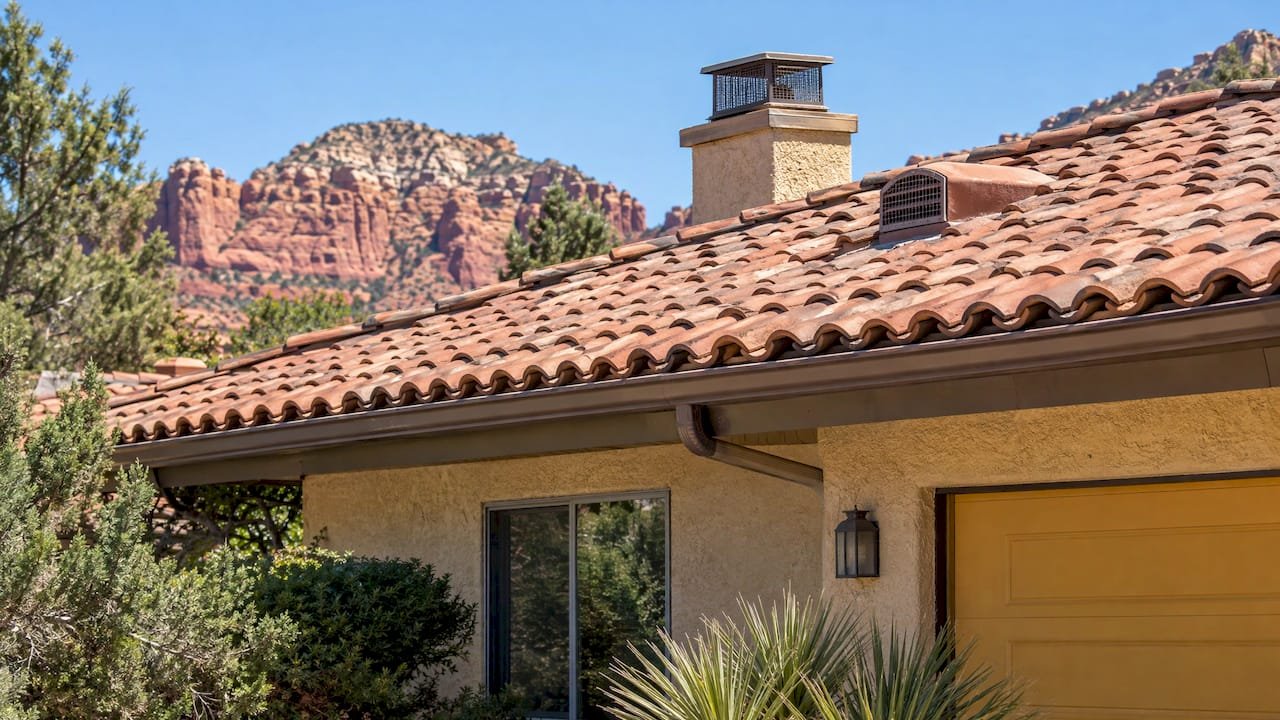
Embers are the usual way homes ignite, and they love roofs, gutters and vents. FEMA’s wildfire preparation guide on Ready.gov recommends Class A roofing such as tile, slate or asphalt with underlayment, fire-retardant-treated wood, and chimney spark arrestors that get inspected regularly. A roof, gutter and vent upgrade lines up neatly with what the fire district already asks of new builds.
2. The first five feet
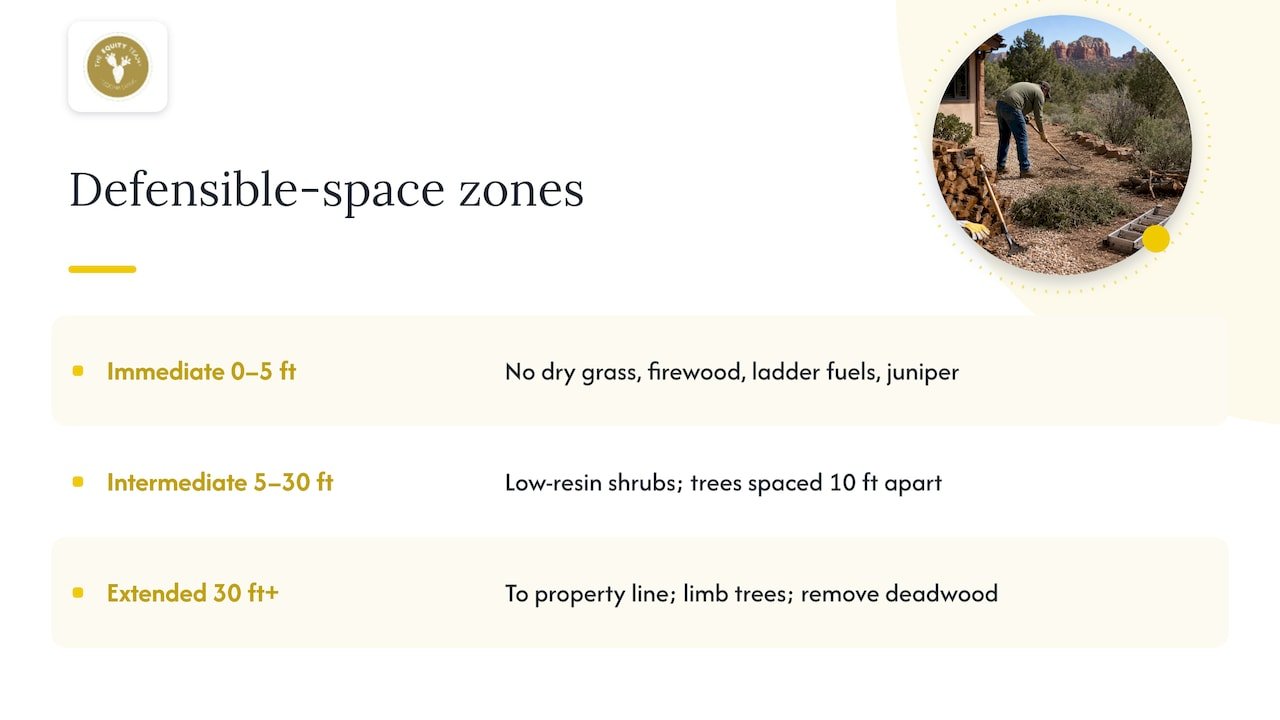
UA Cooperative Extension divides defensible space into three zones. The Immediate Zone covers 0 to 5 feet and should have no dry grass, stacked firewood, ladder fuels or fire-prone plants such as juniper. The Intermediate Zone runs 5 to 30 feet (further on a slope), with low-resin shrubs and trees spaced 10 feet apart. The Extended Zone runs from 30 feet to the property line, where trees are limbed up and dead material is removed. These zones are laid out in the Firewise FAQ.
For a rental, the first five feet are where guests unknowingly make trouble: a stack of firewood by the patio, a doormat, a propane grill under the eaves. A simple house manual line and a tidy exterior handle most of it.
3. Landscaping that works with the desert
The good news is that fire-wise yards and low-water yards overlap. UA’s Firewise Landscapes publication lists hardscaping such as driveways, patios and rock or concrete walls, along with water features, irrigated lawns and boulder fields, as fuel breaks. It also offers a maintenance checklist: clear roofs and gutters, remove overhanging branches, screen chimneys and vents, mow grass low, and keep a hose that reaches every part of the house. Owners comparing yard options can look at a drought-tolerant landscaping plan for the maintenance side of the same idea.
4. Access and signage
FEMA also advises driveways wide enough for emergency vehicles and clear of flammable vegetation, plus clearly visible address signs. In a canyon neighborhood with winding roads, a firefighter who cannot find the address quickly is a problem no landscaping solves. A reflective, readable address sign is cheap and sensible.
5. Detectors and extinguishers
The same FEMA guide calls for dual-sensor smoke alarms on each level, tested monthly, and fire sprinklers where possible. Guests cannot test the alarms, so the owner or the property manager has to.
A quick budget reality check
Costs swing widely with lot size, slope and how overgrown the place is, and the published per-acre figures come mostly from contractor-side guides rather than official price lists. The honest approach is to get written bids from licensed local contractors, ask Yavapai County for its contractor list and free assessment, and check whether a grant covers part of the work. Treat the work as an annual routine, not a one-time project: vegetation grows back, and the buyer’s inspector will notice.
Guests, smoke and cancellations
The fastest way to turn a wildfire into a review problem is to say nothing until it happens. A few habits help.
- Put it in the listing. A wildfire disclosure that says smoke, restrictions, road closures and evacuation notices can occur unpredictably, and points guests to official local sources, sets expectations before the booking.
- Know the contract. As AZ Family reported in 2026, a guest’s cancellation rights depend on the signed contract. Airbnb’s Major Disruptive Events policy and VRBO’s Extenuating Circumstances Policy may cover wildfires, and Airbnb activated its policy for some Oak Creek Canyon bookings, letting eligible guests cancel without penalty and receive refunds for affected nights.
- Tell guests to sign up for alerts. The same report advises signing up for local emergency alerts before check-in. Yavapai County residents can use Smart911 or text alertYAVAPAI to 78015, per the UA Firewise FAQ.
- Post an evacuation card. Two routes out, a meeting point and the alert sign-up fit on one page by the front door.
Owners who want the amenity side of guest safety can see our Sedona vacation rental amenity must-haves.
Insurance and value: where mitigation pays back
Insurance is the part of wildfire planning that most surprises new investors. Coverage for a rental is a different product from a homeowner policy, and an address’s wildfire score, roof age and defensible space can shape what is available. Our guide to wildfire insurance for Arizona rentals explains what Sedona owners should ask about, including loss-of-rents coverage. UA Extension adds that Firewise USA community status may affect homeowners’ insurance rates, and owners should confirm that directly with their insurer.
On the value side, buyers and appraisers read wildfire exposure into price, and we explain how in why Sedona wildfire risk affects home value. The practical takeaway is to keep paperwork: dated photos of cleared zones, receipts for roof and vent work, contractor invoices. A rental with a paper trail is easier to insure, easier to inspect and easier to sell.
Buying or selling a rental with wildfire in mind
Buyers. Score the property with the UA checklist before the offer, not after the inspection period starts burning. Ask what the roof is made of, whether vents are screened, how far the vegetation sits from the walls, and whether the insurance quote came back clean. Wildfire fixes can be a negotiation item, and our six wildfire steps for buyers and sellers in escrow lay out the timing.
Sellers. Mitigation done before listing reads as a well-kept property. Cleared zones, a new roof or screened vents are things a buyer can see on a showing walk. Selling an STR also means pricing the income, which is why a vacation rental CMA (comparative market analysis, the price study agents use to set a list price) matters.
We think wildfire readiness is part of the deal
We are the first agents in Northern Arizona to specialize in short-term rentals, and wildfire comes up in nearly every conversation about a Sedona STR. Not because it should scare anyone off, but because the best-performing rentals are the ones whose owners treat the property like a business.
Our view is simple. A Sedona rental that shows its roof, its cleared yard and its paperwork gives a buyer confidence, and confidence is what supports a top-dollar sale. For buyers, we think the smart move is to look at wildfire exposure as an input to the offer, the same way you look at occupancy and nightly rates. For sellers, we think a short prep list before listing is worth the effort.
That is the reason we pair local knowledge with STR market data: so a client can see the whole picture of a property before deciding.
Chad
Working with the Equity Team
The Equity Team is a team of Sedona real estate agents focused on short-term rental investment. For sellers, we offer a Sedona vacation rental CMA and seller prep consultation, and owners weighing a sale can start with a rental exit strategy and valuation conversation. Buyers hunting for a top-performing Sedona STR can find us at owninaz.com.

Whether the goal is buying, selling or simply understanding what a property is worth with its wildfire profile included, we start with the numbers and the specific address.
FAQ
Does the whole Sedona area count as high wildfire hazard?
For the Sedona Fire District, yes. Policy 1333 deems the entire district high fire hazard severity and applies WUI construction rules to new building. Individual properties still vary widely by slope, vegetation and road access, which is why a property-level score is useful.
What is the first thing to fix on a rental?
Start with the roof, vents and the first five feet around the house, because embers target those spots. A Class A roof, mesh-covered vents and no combustibles against the walls are the priorities in Extension and FEMA guidance. Then work outward through the 30-foot zone.
Can guests cancel if a wildfire is nearby?
It depends on the booking contract and the platform policy. Airbnb’s Major Disruptive Events policy and VRBO’s Extenuating Circumstances Policy may apply, and Airbnb activated its policy for some Oak Creek Canyon bookings in 2026. Owners should read the terms for their own listings.
Are fire pits allowed at Sedona rentals?
Not always. Under Stage II Fire Restrictions, as in 2026, solid-fueled open fires and fire pits were prohibited. The restriction stage changes with conditions, so check the Sedona Fire District’s page before each season and update the listing.
Sources
- Wildfire Hazard Severity Rating Checklist for Arizona Homes (UA Extension)
- CRR Policy 1333: Building in the Wildland Urban Interface (Sedona Fire District)
- Stage II Fire Restrictions Implemented (Sedona Fire District, 2026)
- How to Prepare for a Wildfire (Ready.gov)
- Firewise / Defensible Space Frequently Asked Questions (UA Cooperative Extension)
- Firewise Landscapes (UA Cooperative Extension)
- There’s a wildfire burning near my Airbnb. Can I cancel? (AZ Family)