

Sedona does not hand short-term rental owners a single “occupancy permit” with a ribbon-cutting inspection attached. The city code asks for a valid Arizona transaction privilege tax (TPT) license, a posted notice at the door, and a home that meets the city’s minimum standards for habitable structures. The city may inspect when it has a reason to doubt compliance. The real occupancy paperwork shows up in a different place: the certificate of occupancy on an accessory dwelling unit (ADU) or guest house, where its date can decide whether a rental is legal at all.
That is the quirky part of Sedona rentals. The red rocks hold still, but the paperwork keeps moving. Here is what an owner, buyer or seller needs to know, in plain words.
TL;DR
- Sedona’s code has no routine pre-permit inspection for a short-term rental. It says the city may require an inspection if it has reason for concern about compliance.
- A valid Arizona TPT license is required before a rental can be rented or offered for rent.
- A certificate of occupancy matters most for ADUs and guest quarters: the date it was issued, and whether the structure was modified without a permit, can change whether short-term renting is allowed.
- A posted notice with fire/life-safety equipment locations, a 24/7 emergency contact and the city permit number is required near the front door.
- Buyers should verify permit, tax license and certificate of occupancy history before closing, not after.
Table of Contents
- “Occupancy permit” means three different things in Sedona
- What the city code actually requires
- The posted notice: the one “inspection” every guest sees
- Where certificates of occupancy really matter: ADUs and guest quarters
- What changes could be coming
- A buyer’s pre-closing check
- Selling a rental: get ahead of the questions
- Our perspective
- Working with an agent who reads the paperwork
- FAQ
- Sources
“Occupancy permit” means three different things in Sedona
Search for this phrase and you will land on home inspector licensing pages, certificate fee tables and state care-facility notices. None of them is the Sedona rental rule. In practice, three separate things get mixed together:
- The short-term rental permit and tax license. This is the right to operate the rental at all. We cover it in our guide to Sedona Airbnb permits.
- A certificate of occupancy. This is the building record that says a structure was finished and approved for people to live in. It follows the building, not the guest.
- A compliance inspection. This is the city checking a rental against its minimum standards for habitable structures. It is not a scheduled rite of passage.
- A home inspection. This is the private inspection a buyer orders during escrow. It is a due diligence tool and has nothing to do with city permits.
Once you separate those, most of the confusion disappears. An owner who asks “did my rental pass inspection?” is usually asking whether the city ever looked, and in most cases the code does not require it to.
What the city code actually requires
Sedona’s short-term rental rules live in Chapter 5.25 of the city code. Three pieces matter for this topic.
Zoning comes first
Section 5.25.050 applies the Sedona Land Development Code district rules to a short-term rental in the same manner as other property, within what state law allows. A rental in a single-family district is limited to the uses the code allows in that district. So the first question about any property is not about inspection. It is whether the zoning supports the use. Our explainer on Sedona STR zoning for investors and the guide to what a Sedona vacation rental zone is walk through that step.
The tax license is a hard gate
The same section says a rental without a valid Arizona TPT license shall not be rented or offered for rent. That includes listing it. A property that looks perfect on a photo shoot day but has no valid license is not ready for guests. Taxes also bite on the buy side, which is why we wrote about Sedona rental property taxes and the 30-day rule.
Health, safety and the “may inspect” clause
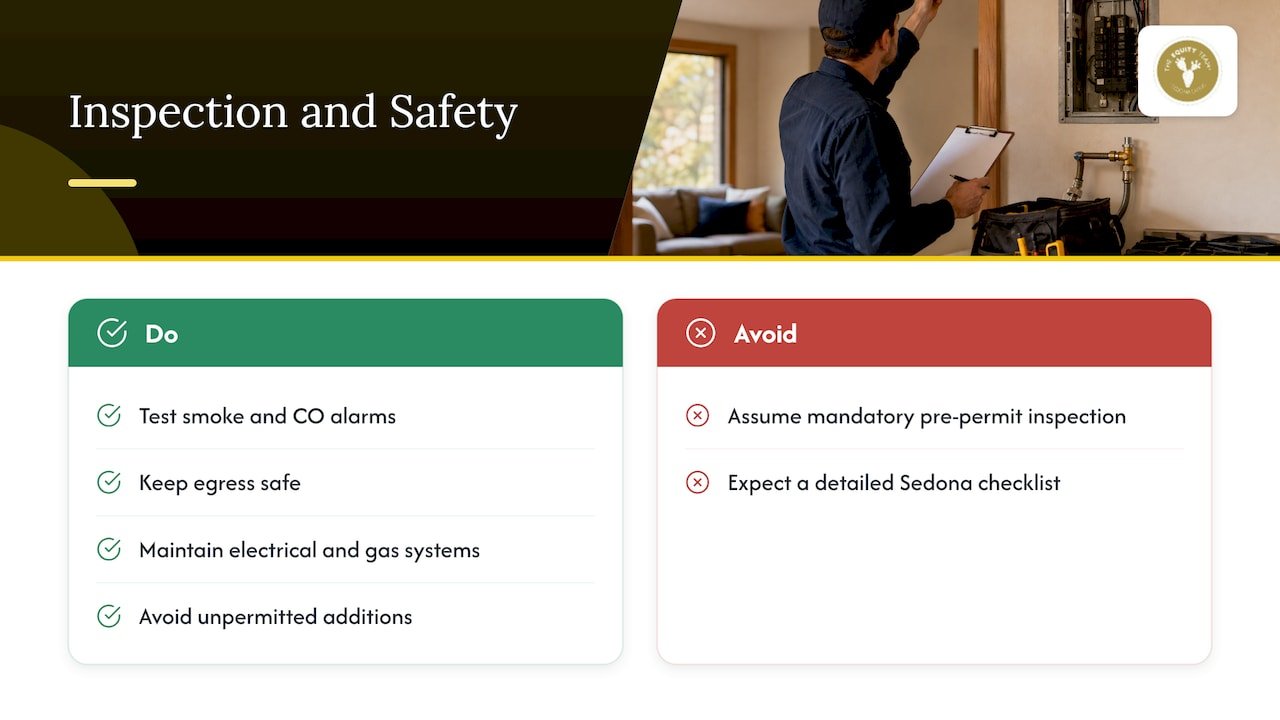
The code also says rentals must meet the city’s minimum standards for habitable structures, and that the city may require inspection if it has a reason for concern about compliance. Read that closely. It is a trigger-based inspection. A complaint, a safety issue or a visible code problem can start one. The code text we reviewed does not lay out a routine mandatory inspection before the permit, and it does not publish a detailed Sedona checklist.
So what should an owner do with that? Treat the habitable-structure standard as the checklist. Working smoke and carbon monoxide alarms, safe egress, sound electrical and gas systems, and no unpermitted additions are the things a reasonable inspector would look at first. Fire rules also tightened for rentals, and our page on the Sedona Airbnb fire code and supervised alarms covers that part in detail.
The posted notice: the one “inspection” every guest sees
While there is no routine walk-through, there is a document that anyone, including a city staff member, can check in five seconds. Section 5.25.080 requires a notice that is laminated or similarly shielded, in bold type of at least 14 points, displayed conspicuously within 10 feet of the primary entrance. It has to include:
- Locations of fire and life-safety equipment.
- The city’s noise and waste rules.
- The local emergency contact’s name and a 24/7 phone number.
- The city short-term rental permit number.
It is a small thing, but it is the first thing a neighbor, a guest or a compliance officer notices. A missing or faded notice is also a clue for buyers: if the owner skipped the easy item, ask about the harder ones.
Where certificates of occupancy really matter: ADUs and guest quarters
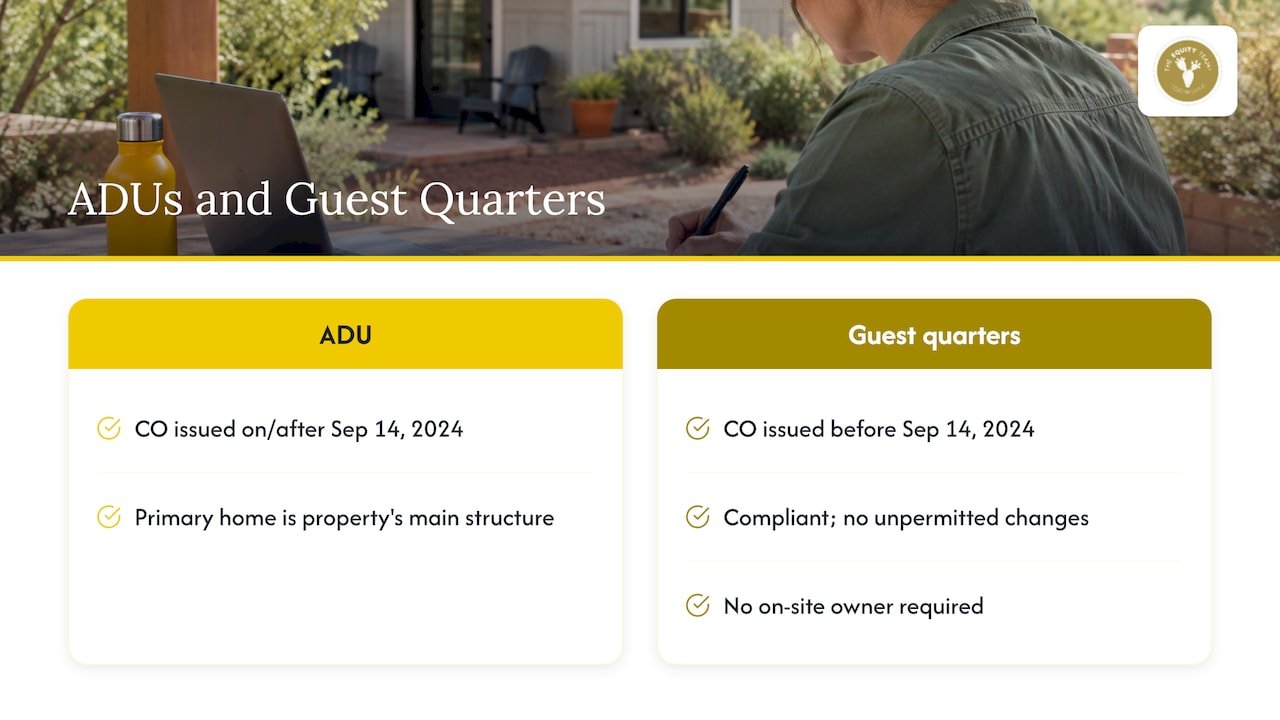
Here is the catch that surprises people. Under section 5.25.050, an ADU that is issued a certificate of occupancy on or after September 14, 2024 cannot be a short-term rental unless the owner’s primary residence is the main structure on the same property.
Guest quarters that received a certificate of occupancy before that date, in compliance with all requirements and never modified without a required permit, are treated as a legal, nonconforming use. They can be rented short term whether or not the owner lives on site. The words “never modified without a required permit” are doing heavy lifting. A garage conversion or an enclosed patio done years ago without a permit can undo the protection.
That is why the certificate of occupancy date and the permit history of a casita are worth more than a pretty patio. If you are planning to build or finish a guest structure, a licensed builder that does custom casita construction can explain what the build involves, but the Sedona rental question still turns on the city’s date rule and the owner-occupancy test. We cover the whole topic in Can You Airbnb an ADU in Sedona?.
What changes could be coming
Rules for rentals keep shifting at the state level. The House engrossed text of HB2429 states that its proposed amendments would be effective from and after December 31, 2026. A bill is not law until it passes, so before you buy or list, confirm its status on the Arizona Legislature site and check how the final text affects Sedona. We track local shifts on our page about Sedona short-term rental restriction changes.
A buyer’s pre-closing check
A seller’s listing may say “permitted STR” in cheerful capital letters. That is a claim, not a record. Before the due diligence period ends, a buyer should gather:
- The city short-term rental permit number and confirmation that it is current for that address. Permits are tied to the unit, as covered in our one permit per unit guide.
- The Arizona TPT license and its status, since the rental cannot be offered without it.
- Certificate of occupancy records for any ADU, guest house or converted space, including the date issued.
- Permit history for remodels, additions and garage or patio conversions.
- Fire and life-safety equipment that matches the notice posted at the door and current fire rules.
- HOA and zoning confirmation. Even a perfect permit file does not override HOA rules. See running an Airbnb in a Sedona HOA.
- Occupancy limits that match the bedrooms and the permit. Our page on Sedona Airbnb occupancy limits explains why this protects income.
Our short-term rental due diligence checklist for Sedona buyers puts all of this in order, and the Sedona home purchase timeline shows when each item has to land so the contract deadlines do not beat you.
A worked example
Say a buyer loves a two-bedroom main house with a detached casita that books well. The listing says the casita sleeps four. The buyer’s agent asks for the casita’s certificate of occupancy. It shows the casita was finished and approved before September 14, 2024, and the permit history shows no unpermitted changes. That casita sits in the legal nonconforming category, so the owner does not need to live on the property for it to be rented short term.
Now flip it. The casita was a garage converted without a permit, or it received its certificate on or after that date and the buyer will not live on the property. Same photos, same nightly rate on paper, a very different asset. That gap is the entire reason to read the paper before you fall in love with the view.
Selling a rental: get ahead of the questions
Sellers get the same questions in reverse. A buyer’s agent will ask for the permit number, the tax license, the certificate of occupancy for any extra structure and a record of what has been built. Pulling those together before listing means fewer surprises during escrow and fewer reasons to renegotiate. If something is out of order, it is far better to know before photos go live. A seller prep consultation is the place to sort that out, and the guide to exit strategies for a Sedona rental helps when the question is whether to sell at all.
Our perspective
We get asked about “the occupancy inspection” all the time, and the honest answer is a little funny: there is rarely a single inspection to pass. There is a stack of small records, and the value of a rental hides in whether that stack is clean.
Sedona is a place where a casita with the right certificate of occupancy date can be worth meaningfully more than a casita that looks identical but lacks one. The code draws that line, and buyers who find it before closing are the ones who sleep well.
We specialize in short-term rental investment in Sedona, so a permit, a tax license and a certificate of occupancy are part of how we read a property alongside its income. Our job is to put the paperwork next to the numbers, so a buyer sees the whole picture and a seller shows it with confidence.
Chad
Working with an agent who reads the paperwork
If you are buying, selling or sizing up a Sedona rental, we represent buyers and sellers who focus on short-term rental investment in Sedona. For sellers, a Sedona vacation rental CMA looks at what the home can earn as a rental, and a seller prep consultation is available on the same page.

Buyers can start with buyer representation and our Sedona buyer due diligence checklist, so the permit questions are asked early and in the right order.
FAQ
Does Sedona require an inspection before I can run a short-term rental?
The code sections we reviewed do not describe a routine pre-permit inspection. They say the rental must meet the city’s minimum standards for habitable structures, and that the city may require an inspection if it has reason for concern about compliance. A valid Arizona TPT license is also required before the property is rented or offered for rent.
Do I need a certificate of occupancy to rent my Sedona home?
The certificate of occupancy question is sharpest for ADUs and guest quarters. An ADU certified on or after September 14, 2024 generally needs the owner’s primary residence on the same property to be rented short term, while older, properly certified and unmodified guest quarters can qualify as legal nonconforming use. Check the city code text and the structure’s permit history.
What has to be posted at a Sedona short-term rental?
A laminated or shielded notice in bold type of 14 points or larger, within 10 feet of the main entrance. It needs fire and life-safety equipment locations, noise and waste rules, a 24/7 local emergency contact and the city permit number.
How can a buyer check a rental’s status before closing?
Ask for the city permit number, the Arizona TPT license, certificate of occupancy records for any extra structure and the permit history for remodels. Match the posted notice to the fire safety equipment in the home. Our Sedona buyer checklist lays out the order.
Will new Arizona legislation change these rules?
It might. The House engrossed text of HB2429 says its proposed amendments take effect from and after December 31, 2026, if enacted. Confirm the bill’s current status and read our page on Sedona rental restriction changes before you act.
Sources
- 5.25.050 Use regulations, Sedona City Code
- 5.25.080 Posting on the property required, Sedona City Code
- HB2429, House engrossed version, Arizona Legislature