

Listing timing is the single most controllable factor that determines whether a Sedona short-term rental sells at a premium or a discount. When sellers list at the right moment, buyers see a calendar full of forward bookings and pay accordingly. List at the wrong moment, and that same property looks like a struggling asset. Understanding why Sedona STR timing affects sale price means understanding how buyers read income evidence, and Sedona’s quirky dual-peak calendar makes that timing more specific than almost any other market in Arizona.
Why Sedona STR timing affects sale price
The sale price of a Sedona STR is not just a function of square footage or red rock views. Buyers price these properties like income-producing assets, which means they pay for future cash flow, not past performance. A property listed with three months of confirmed spring bookings visible on Airbnb or Vrbo tells a buyer exactly what they are buying. A property listed in august with a half-empty calendar tells a very different story.
Sedona’s dual-peak STR season creates two windows where forward income evidence is strongest. Spring runs march through april with occupancy hitting 72% and monthly revenue exceeding $10,000. Fall runs october through november with the year’s highest average daily rate, reaching $471 in october. Buyers who close during or just before these peaks can step into a property already generating strong cash flow. That visibility commands a price premium.

The summer trough tells the opposite story. August occupancy drops to 39% with monthly revenue falling to roughly $4,610. A seller listing in july or august is essentially asking a buyer to trust that things will get better. Most buyers discount heavily for that uncertainty.
What are Sedona’s seasonal STR patterns and their income impact?
Sedona does not follow a simple summer-high, winter-low pattern like a beach town. The red rocks draw visitors in waves, and each wave has its own financial fingerprint.
| Season | Months | Occupancy | Avg. Daily Rate | Monthly Revenue |
|---|---|---|---|---|
| Spring peak | March–April | 72% | Strong | $10,000+ |
| Summer trough | July–August | 39%–41% | Moderate | ~$4,610 |
| Fall peak | October–November | High | $471 (Oct.) | Strong |
| Holiday bump | December | Moderate | Elevated | Moderate |
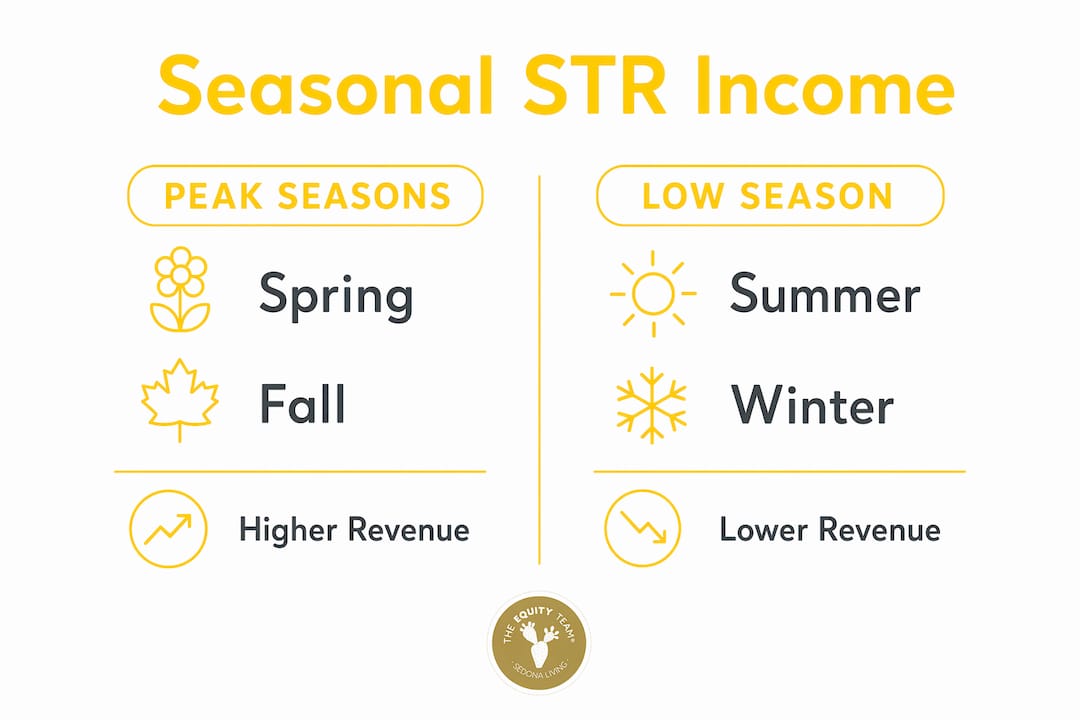
A few things stand out in that table. First, the ADR in october is the highest of the year, which means fall is not just a secondary season. It is a premium pricing window. Second, the gap between spring revenue and summer revenue is dramatic. That gap is what makes listing timing so consequential for sellers.
Here is how the seasonal cycle affects a seller’s position:
- Spring (march–april): Peak occupancy, strong revenue, and buyers can see a full summer and fall booking pipeline ahead.
- Summer (july–august): Lowest occupancy, lowest revenue, and buyers see a calendar that looks thin.
- Fall (october–november): High ADR, strong bookings, but the next peak is still months away.
- December: A modest holiday bump with elevated rates, but occupancy is not as strong as spring or fall.
Sedona’s typical booking lead time is 56 days, with an average stay of 4.3 nights. That lead time matters because it means a property listed in late february will already have march and april bookings confirmed. Buyers can see real money on the calendar, not just projections.
How does listing timing influence buyers’ willingness to pay a premium?
Buyers of income properties think like investors, not homeowners. They want to see proof that the property earns what the seller claims. Forward bookings are that proof.
When a buyer views a Sedona STR listed in late february or early march, the Airbnb or Vrbo calendar shows confirmed reservations for the spring peak. That visibility does three things:
- Reduces perceived risk. Confirmed bookings are not speculative. They are contracts.
- Validates the asking price. A seller can point to $10,000+ monthly revenue with real data, not just historical averages.
- Creates urgency. A buyer who waits loses those bookings to the seller, which motivates faster offers at stronger prices.
Listing during peak season sounds appealing but actually works against sellers. Buyers who close mid-peak cannot capture the current season’s income because the closing timeline pushes them past it. They end up relying on future income evidence anyway, but with less of it visible. The shoulder period before peak season gives buyers the best of both worlds: confirmed near-term bookings and a full peak season ahead.
Listing in the summer trough creates the opposite psychology. Buyers see weak occupancy, thin revenue, and no compelling reason to pay a premium. They bid accordingly, and sellers leave real money on the table.
Pro Tip: Before listing, pull your forward booking report from Airbnb or Vrbo and include it in your listing package. Buyers respond to visible, confirmed income far more than to trailing twelve-month averages.
Visible forward bookings provide credible income evidence that boosts buyer confidence and directly supports a higher sale price. This is not a soft psychological effect. It is the mechanism by which timing translates into dollars.
What are the best strategies for timing Sedona STR sales?
The best Sedona STR listing timing strategy follows a clear sequence. Sellers who work the calendar intentionally consistently outperform those who list when it feels convenient.
-
Target late february through mid-april. This is the optimal listing window for Sedona STR sellers. Spring bookings are already confirmed, summer and fall pipelines are filling, and buyers can see strong forward income across multiple seasons.
-
Avoid the summer trough. Listing in july or august means presenting a property at its weakest income moment. Even strong trailing revenue cannot fully offset the visual impact of a sparse calendar.
-
Build your forward booking case before listing. With a 56-day average lead time, a seller who starts accepting spring bookings in january will have a compelling calendar by the time they list in late february. Do not block dates in anticipation of selling. Fill them.
-
Do not wait for interest rate cycles. Waiting for rate decreases is a trap. When rates drop, inventory surges and competition increases. A property with strong forward bookings sells well in any rate environment because buyers are buying income, not just real estate.
-
Account for local factors. Sedona’s STR zoning regulations and limited inventory affect buyer demand independent of season. A property in a compliant zone with a clean permit history commands a premium regardless of timing. Make sure your documentation is current before listing.
-
Consider the fall window as a secondary option. If the spring window passes, october through early november offers a second strong listing period. ADRs are at their peak, and buyers can see holiday and early spring bookings ahead.
Pro Tip: Sedona’s average home price sits near $888,808, which means financing timelines matter. List early enough that buyers have time to complete due diligence and close before the peak season ends. A rushed close benefits no one.
How do Sedona’s STR timing effects compare to other vacation markets?
Sedona’s timing logic is genuinely different from most vacation rental markets. Understanding why helps sellers appreciate why generic STR sale advice often misses the mark here.
| Market type | Peak structure | Best listing window | Key timing risk |
|---|---|---|---|
| Sedona, AZ | Dual peak (spring + fall) | Late February–mid-April | Missing spring forward bookings |
| Ski markets (e.g., Park City) | Single winter peak | October–November | Listing after ski season starts |
| Urban STR markets | Low seasonality | Year-round, rate-dependent | Interest rate cycles |
| Beach markets | Single summer peak | March–April | Listing after summer bookings fill |
Ski markets concentrate nearly all revenue in winter. A seller in Park City needs to list before ski season to show forward bookings. Miss that window and the next opportunity is almost a year away. Sedona sellers get two shots per year, which is a genuine advantage. Sedona’s dual-peak structure provides more consistent cash flow than single-season markets, and that consistency makes income valuation more reliable for buyers.
Urban STR markets like Phoenix or Scottsdale have flatter seasonality. Timing still matters, but the income swings are less dramatic. A seller in those markets can list almost any month without the same penalty that a Sedona summer listing carries. Sedona’s extreme summer trough makes timing a higher-stakes decision here than almost anywhere else in Arizona.
Key Takeaways
Sedona STR sale prices are directly tied to listing timing because buyers pay for visible future income, and Sedona’s dual-peak calendar makes the late-february-to-mid-april window the clearest path to a premium sale price.
| Point | Details |
|---|---|
| Optimal listing window | List in late february through mid-april to show confirmed spring bookings and a full peak pipeline. |
| Summer trough penalty | Listing in july or august exposes weak occupancy and thin revenue, reducing buyer bids. |
| Forward bookings drive price | Confirmed reservations reduce buyer risk and directly support a higher asking price. |
| Avoid peak-season listing | Listing during peak season limits buyer ability to capture that income, weakening their offer. |
| Rate timing is a trap | Waiting for interest rate drops increases competition and does not reliably improve net sale outcomes. |
What I’ve learned about timing Sedona STR sales
Most sellers focus on what their property has earned. The buyers I work with at Equity Team focus on what it will earn. That shift in perspective is the whole game.
The sellers who get the best prices are the ones who treat their listing date like a product launch. They fill the calendar first, then list. They do not block dates hoping to sell quickly. They build the income case before the first showing. When a buyer walks through a Sedona property in march and sees a confirmed calendar through june, the conversation about price is almost over before it starts.
The sellers who struggle are the ones who wait. They wait for rates to drop. They wait for the market to shift. They wait until summer when life gets busy and they finally decide to list. By then, the calendar is thin, the revenue looks weak, and buyers sense it immediately. I have seen properties that would have sold at a strong premium in march sit on the market through august at a reduced price.
One thing I want to flag specifically: Sedona’s limited STR inventory means demand from buyers is real and persistent. The market is not soft. Sellers who time poorly are not losing to a bad market. They are losing to their own calendar. That is a fixable problem, and it starts with understanding that the sale price is set the moment you decide when to list.
— Chad
Equity Team can help you time your Sedona STR sale
Timing a Sedona STR sale for maximum price is not guesswork. It requires knowing the seasonal income calendar, understanding what buyers look for in forward bookings, and positioning the property at exactly the right moment.

Equity Team specializes in Sedona short-term rental investments and represents sellers who want top dollar, not just a quick close. If you are thinking about selling or want to understand what your property is worth in the current market, the right STR investment guidance makes a measurable difference. Equity Team is the first STR-specialized real estate team in Northern Arizona, and the Sedona Airbnb market insights they bring to every transaction are built from real data, not generic advice.
FAQ
Why does listing timing affect Sedona STR sale price?
Buyers price Sedona STRs as income assets, so they pay more when they can see confirmed forward bookings. Listing before peak season shows a full revenue pipeline, which directly supports a higher sale price.
What is the best time to list a Sedona short-term rental for sale?
The optimal listing window is late february through mid-april. This period captures confirmed spring bookings and gives buyers visibility into summer and fall income ahead.
Why is summer a bad time to list a Sedona STR?
Sedona’s summer trough runs july through august with occupancy dropping to 39% and monthly revenue falling to roughly $4,610. Buyers see weak income evidence and bid lower as a result.
Does listing during peak season maximize sale price?
Listing during peak season actually reduces buyer willingness to pay a premium. Buyers who close mid-peak cannot capture that season’s income, so they rely on future income evidence anyway, with less of it visible on the calendar.
Should Sedona STR sellers wait for interest rates to drop before listing?
Waiting for rate decreases is a documented trap. When rates fall, inventory surges and competition increases, which offsets any financing advantage. A property with strong forward bookings sells well regardless of the rate environment.