

Sedona is defined as one of the most geographically constrained and visually dramatic real estate markets in the American Southwest, and that combination is exactly why out-of-state buyers keep showing up with serious money. The red rocks don’t just look good on Instagram. They create a scarcity that drives prices up and keeps demand from cooling off. Why Sedona sells to out-of-state buyers comes down to three forces working together: limited land, a lifestyle that retirees and remote workers genuinely want, and a buyer pool flush with equity from coastal markets. Understanding those forces tells you everything about where this market is headed.
Why sedona sells to out-of-state buyers: who’s actually buying
The Sedona real estate market is not a typical relocation market. There is no major employer pulling workers in from Phoenix or Flagstaff. Sedona’s population sits under 10,000, and the buyer pool is driven almost entirely by lifestyle choices rather than job transfers. That quirky little detail shapes everything about how the market behaves.
The buyer breakdown looks like this:
- Arizona residents account for 54% of Sedona property purchases, with many of those being Phoenix and Scottsdale residents buying second homes or investment properties.
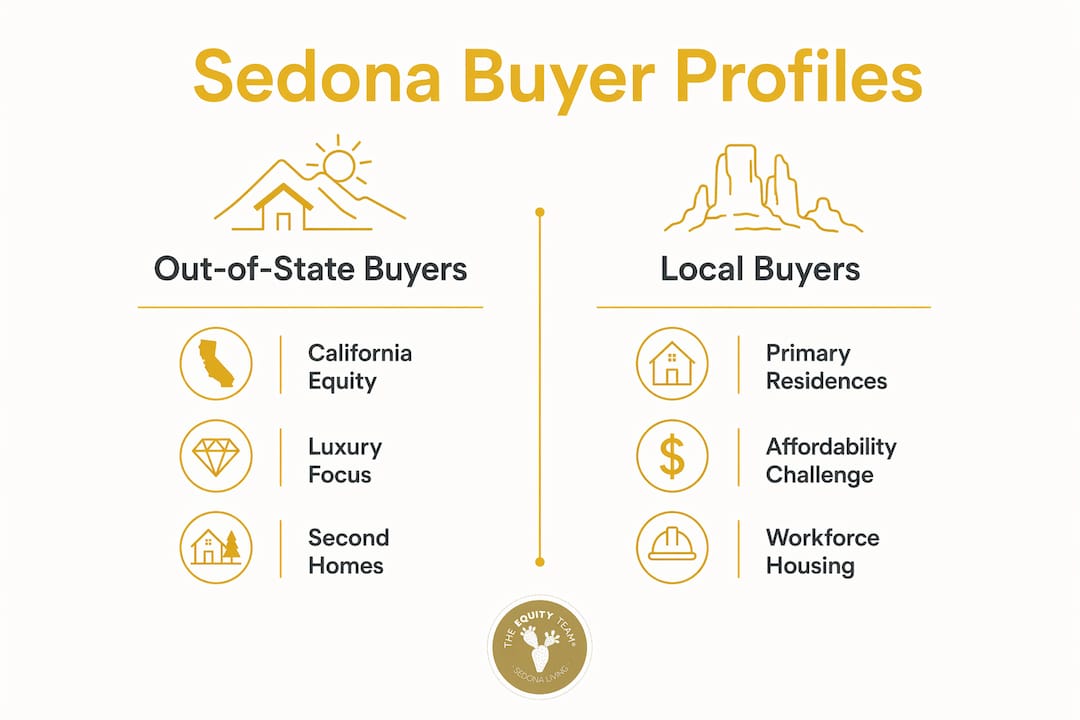
- California buyers form the second largest group at 15%, typically arriving with equity from Bay Area or Los Angeles home sales.
- Northeast buyers from states like New York, Connecticut, and Massachusetts make up a meaningful share, drawn by the climate contrast and lower tax burden.
- Remote professionals have grown into a real buyer segment since 2020. Post-pandemic remote work expanded primary residence demand from out-of-state buyers who want quality of life over a commute.
- Retirees remain the most consistent buyer group, cashing out equity from high-cost states and trading urban density for red rock views and serene trails.
The motivations vary, but the pattern is consistent. Out-of-state buyers Sedona attracts are not looking for a starter home near a job. They are looking for a specific feeling, and they are willing to pay for it. That psychological driver is what makes this market so resilient even when national housing trends wobble.
Pro Tip: If you are evaluating Sedona as an investment, track California housing market conditions. When Bay Area equity rises, Sedona buyer demand typically follows within six to twelve months.
How scarce land shapes sedona property appeal
Sedona is surrounded by Coconino National Forest, and that is not a minor detail. It is the single biggest structural reason why Sedona property appeal stays strong year after year. When the forest service owns the land around your town, nobody is building a new subdivision on the edge of it. Supply stays tight, and prices stay high.

The numbers reflect that reality clearly. Median home prices range from approximately $900,000 to over $1.5 million, with luxury properties exceeding $3 million in some neighborhoods as of 2026. That is not a fluke. It is the predictable result of breathtaking scenery combined with a hard ceiling on new construction.
Here is a quick look at how Sedona’s price tiers break down by property type:
| Property Type | Typical Price Range | Primary Buyer Profile |
|---|---|---|
| Entry-level homes | $600,000–$900,000 | Remote workers, first-time Sedona buyers |
| Mid-tier homes | $900,000–$1.5 million | Retirees, second-home buyers |
| Luxury properties | $1.5 million–$3 million+ | Coastal equity buyers, investors |
| Ultra-luxury estates | $3 million+ | High-net-worth out-of-state buyers |
Neighborhoods with direct red rock views command the steepest premiums. Areas like West Sedona and the Village of Oak Creek attract buyers who want that cinematic backdrop visible from the kitchen window. Proximity to trailheads adds another layer of value, especially for the active retiree crowd who treat hiking as a daily ritual rather than a weekend hobby.
Pro Tip: When comparing Sedona listings, check the Sedona real estate market trends data before making an offer. View-premium properties hold value better during corrections than comparable homes without that visual anchor.
Why out-of-state buyers pay a premium in sedona
The reasons to buy in Sedona are compelling on their own, but the premium pricing requires a separate explanation. Sedona’s luxury market runs on what analysts call “imported wealth,” a concept where out-of-state buyers bring equity cash from coastal home sales and set prices that have no relationship to local incomes. A Sedona schoolteacher cannot compete with a retired San Francisco tech executive who just cleared $2 million on a home sale. That is not a criticism. It is just how the math works.
“Sedona’s real estate prices are driven largely by imported wealth from equity sales in coastal markets like California, setting property values independent of local incomes.” — Sedona.biz
This dynamic creates a market that is genuinely vulnerable to external conditions. Sedona’s luxury segment is especially sensitive to fluctuations in coastal equity markets, meaning a slowdown in California home sales can cool Sedona buyer activity faster than any local economic shift. That is a real risk worth understanding before you commit.
The luxury market has seen price corrections recently, with notable reductions on high-end listings in West Sedona. Those corrections signal a recalibration rather than a collapse. Sellers who priced aggressively during the 2021–2022 frenzy are adjusting to a more discerning buyer pool. For out-of-state buyers with cash and patience, that creates a genuine window. You can explore the latest luxury market activity to see where those adjustments are landing.
The affordability gap for local workers is a real social tension in Sedona. Price reductions in luxury homes do not improve workforce housing shortages. A $200,000 reduction on a $2.5 million home does not help a nurse or a restaurant manager find a place to live. That tension shapes local politics and could eventually influence zoning and short-term rental regulations, which is something every investor should watch closely.
How lifestyle trends drive sedona housing demand
The benefits of buying in Sedona go well beyond the scenery, though the scenery is genuinely hard to beat. The climate delivers over 300 days of sunshine annually. The wind whistles through the canyons in a way that makes city noise feel like a distant memory. For retirees and second-home buyers, that sensory shift is the whole point.
Active retirees seek neighborhoods emphasizing walkability, energy efficiency, and proximity to trails and community amenities. Sedona delivers all three in abundance. The Sedona Red Rock Trail System offers over 200 miles of trails accessible from residential neighborhoods. That is not a selling point buried in a brochure. It is a daily reality that buyers from Chicago or Seattle find genuinely transformative.
Current Sedona housing trends show a few clear patterns worth noting:
- Smaller, low-maintenance homes are gaining favor among retirees who want the Sedona lifestyle without the burden of a sprawling estate.
- Short-term rental investment is a major motivator for second-home buyers. Many buyers offset ownership costs by listing on Airbnb or VRBO when they are not in residence. The Sedona Airbnb market trends for 2026 show strong demand from visitors year-round.
- Remote work flexibility continues to push some buyers toward making Sedona a primary residence rather than a vacation stop. That shift increases competition in the mid-tier price range.
- Market resilience holds even during national downturns because lifestyle-driven demand does not evaporate the way employment-driven demand does.
The second-home angle deserves special attention. Buyers who purchase in Sedona with the intention of renting short-term are essentially buying a vibrant income stream alongside a vacation property. That dual-purpose appeal is a big reason why people move to Sedona or at least buy there, even when they are not ready to leave their primary city behind. You can dig deeper into owning a second home in Sedona to see how that math typically plays out.
Pro Tip: Remote workers considering Sedona as a primary residence should factor in the limited healthcare infrastructure. The nearest major hospital is in Cottonwood, about 20 minutes away. That is a real consideration, not a dealbreaker, but worth knowing before you commit.
Key takeaways
Sedona’s out-of-state buyer demand is structural, not cyclical, rooted in land scarcity, imported coastal wealth, and a lifestyle that retirees and remote workers actively seek out.
| Point | Details |
|---|---|
| Buyer origins are concentrated | California buyers lead out-of-state demand at 15%, with Northeast buyers also significant. |
| Land scarcity drives prices | Coconino National Forest surrounds Sedona, capping supply and keeping median prices above $900,000. |
| Imported wealth sets the market | Coastal equity sales fund most luxury purchases, disconnecting prices from local incomes. |
| Lifestyle demand is durable | Retirement and second-home motivations hold steady even when employment-driven markets cool. |
| Luxury corrections create opportunity | Recent price reductions in West Sedona signal recalibration, not collapse, for patient buyers. |
What i’ve learned watching out-of-state buyers in sedona
After working this market, the pattern that surprises most out-of-state buyers is how fast things move when the right property hits. Buyers who fly in expecting a leisurely weekend of open houses often find themselves in a competitive situation by Saturday afternoon. Sedona is a small town with a big reputation, and that combination means inventory is always tighter than it looks from a distance.
The buyers who do best here come in with a clear answer to one question: is this a lifestyle purchase, an investment, or both? Those two motivations require different strategies. A lifestyle buyer can afford to wait for the right view and the right neighborhood. An investment buyer needs to run the short-term rental numbers before falling in love with the fireplace. Mixing those motivations without a clear priority is the most common mistake I see.
The affordability gap is also something out-of-state buyers tend to underestimate. Sedona feels accessible compared to San Francisco or Manhattan, and it is. But the local workforce that keeps the restaurants, trails, and shops running cannot afford to live here. That creates staffing pressures that affect the quality of services buyers enjoy. It is a quirky and uncomfortable irony that the very buyers driving prices up are also making the town harder to staff.
My honest advice: work with a local agent who knows the short-term rental data cold. The difference between a property that performs in the top 10% of the rental market and one that sits idle half the year often comes down to details that only show up in local transaction history.
— Chad
How equity team helps out-of-state buyers win in sedona
Sedona’s market rewards buyers who show up prepared, and that is exactly what Equity Team is built for. As the first STR-specialized agents in Northern Arizona, Equity Team represents buyers and sellers in the top 10% of the rental market. Whether you are hunting for a short-term rental investment property that actually performs or trying to understand where the luxury market is heading, the team brings data and local knowledge that generic agents simply do not have.

Out-of-state buyers face real logistical challenges: limited travel windows, remote due diligence, and a market that moves faster than it looks. Equity Team handles the ground-level work so you can make confident decisions from wherever you are. Reach out through owninaz.com to connect with an agent who knows Sedona’s STR market inside and out.
FAQ
Why do out-of-state buyers pay more for sedona homes?
Out-of-state buyers, especially from California, arrive with equity from coastal home sales and set prices independent of local incomes. That imported wealth dynamic pushes Sedona prices well above what local salaries could support.
What percentage of sedona buyers come from out of state?
Arizona residents account for 54% of Sedona purchases, meaning roughly 46% of buyers come from outside the state. California alone represents 15% of total buyers, making it the dominant out-of-state source market.
Is sedona a good real estate investment in 2026?
Sedona remains a strong market for lifestyle and short-term rental investment due to its limited land supply and year-round visitor demand. Recent luxury price corrections have created entry points for buyers who were priced out during the 2021–2022 peak.
What types of buyers are most active in sedona right now?
Retirees, second-home buyers, and remote professionals drive the current buyer pool. Each group brings different motivations, but all three are drawn by Sedona’s climate, outdoor access, and the ability to offset ownership costs through short-term rentals.
How does coconino national forest affect sedona property values?
The forest surrounds Sedona and restricts development, creating a hard cap on new housing supply. That scarcity keeps prices elevated and makes existing properties with red rock views especially competitive.