

Sedona luxury homes take longer to sell because the market runs on a smaller, more selective buyer pool and demands precise pricing alignment that most sellers underestimate. The term “extended days on market” is the industry standard for what buyers and investors notice when browsing Sedona listings that seem to linger. Why sedona luxury homes take longer to sell comes down to a quirky mix of coastal wealth dependency, post-2022 seller psychology, and a red-rock backdrop that attracts dreamers but filters out impulse buyers. Sedona is breathtaking, serene, and genuinely one-of-a-kind. That same uniqueness is exactly what slows the clock on a sale.
Why does pricing accuracy drive luxury home sales timing in Sedona?
Pricing is the single biggest lever in the Sedona luxury real estate market, and most sellers pull it the wrong way. Well-priced homes achieve a sale-to-list ratio near 96.8%, meaning buyers and sellers land within a few percentage points of each other with minimal drama. That is a healthy, efficient transaction. The moment a home is overpriced, the math flips hard.
Sellers anchored to 2022 peak prices routinely watch their listings sit for months before accepting 10 to 20% price reductions. That gap is not just a number. It represents months of carrying costs, stale listing syndrome, and buyers who quietly wonder what is wrong with the property. A home that starts at $3.5 million and eventually sells at $2.9 million after 180 days on market did not fail because of the red rocks. It failed because of the original price tag.

The valuation gap is a real psychological phenomenon in this market. Many sellers bought or built during the 2021 to 2022 frenzy and genuinely believe those prices are the baseline. They are not. Learning how to set asking price based on current comparable sales rather than peak nostalgia is the fastest way to shrink days on market.
Pro Tip: Before listing a luxury property in Sedona, pull the last six months of closed sales in the same price band, not active listings. Active listings reflect seller wishes. Closed sales reflect market reality.
| Pricing scenario | Typical outcome |
|---|---|
| Priced within 3% of market value | Sells near 96.8% sale-to-list ratio with shorter market time |
| Overpriced by 10% or more | Requires price reductions of 10 to 20%, extends listing by months |
| Anchored to 2022 peak values | Extended listing periods before market realities set in |
How does the buyer pool size affect luxury home sale duration?
The Sedona luxury market does not draw from a deep local well. Imported wealth from California and other coastal states disproportionately drives demand here, which creates a funny cosmic contrast. The health of a Sedona luxury listing can depend more on what is happening in San Francisco or Los Angeles than on anything occurring in Yavapai County.
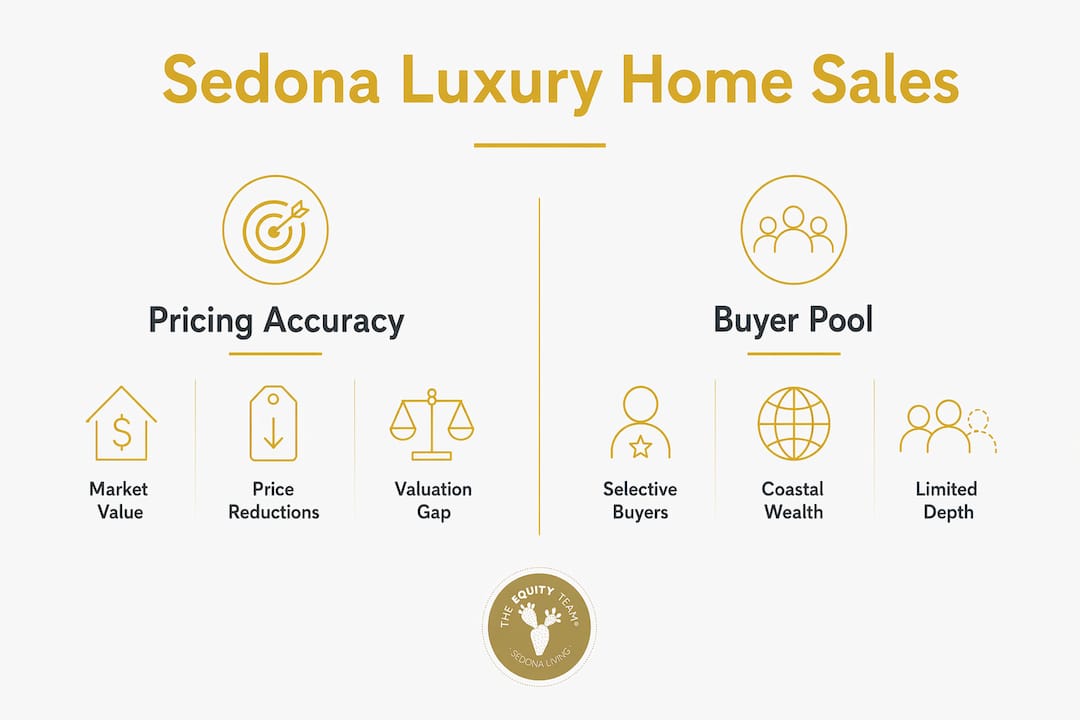
When coastal equity markets wobble, Sedona luxury demand wobbles with them. A tech executive in the Bay Area who watched their portfolio drop 20% is not flying to Sedona to tour a $2.8 million home that weekend. That hesitation ripples through the entire market, stalling transactions even when local inventory levels look perfectly normal. Economic uncertainty in feeder markets causes demand fluctuations that local sellers often misread as a pricing problem when it is actually a buyer availability problem.
Here is what that smaller buyer pool looks like in practice:
- Fewer qualified buyers are actively searching at any given time compared to larger metros like Phoenix or Scottsdale.
- Buyers often require longer decision timelines because a Sedona luxury purchase is typically a second home or lifestyle investment, not a primary necessity.
- Seasonal patterns concentrate buyer activity into specific windows, usually spring and fall, leaving summer and winter listings with thinner traffic.
- A single buyer hesitating or backing out can meaningfully shift a month’s sales data in a market this size.
- External financial uncertainty, like rising long-term Treasury yields, directly reduces buyer urgency even among cash-heavy purchasers.
The Sedona luxury home market is not broken. It is just operating on a narrower frequency than buyers and sellers sometimes expect.
How does Sedona compare to other luxury real estate markets?
Sedona’s extended sale timelines make more sense when you hold them next to other markets. Homes priced above $2 million in mid-size metros often sit for 90 to 150 or more days on market, driven by limited buyer pools at that price band. That pattern holds across Charlotte, parts of Scottsdale, and similar lifestyle markets. Sedona fits squarely in that category, with the added wrinkle of being a destination market rather than a primary residential hub.
Miami and Manhattan operate differently. Those markets attract international buyers, institutional investors, and a far broader spectrum of wealth. A $3 million condo in Miami competes for a global buyer pool. A $3 million home on a Sedona canyon rim competes for a regional one. That is not a flaw in Sedona. It is just the geometry of the market.
Sedona’s luxury dynamics are more influenced by local factors than national trends, particularly the reliance on external buyers and pricing accuracy. Scottsdale, by contrast, benefits from a larger permanent population, a stronger corporate relocation market, and year-round buyer activity that smooths out seasonal dips. Sedona’s serene, off-the-grid appeal is its greatest asset and its most honest constraint.
| Market | Buyer pool depth | Primary buyer origin | Typical days on market above $2M |
|---|---|---|---|
| Sedona, AZ | Narrow, lifestyle-driven | California, coastal states | 90 to 150+ days |
| Scottsdale, AZ | Moderate, mixed primary and second home | Regional and national | 60 to 90 days |
| Charlotte, NC | Moderate, growing metro | Regional and corporate relocation | 90 to 150+ days |
| Miami, FL | Deep, international | Global | 45 to 75 days |
What regional and environmental factors slow Sedona luxury sales?
Sedona’s quirks go beyond buyer psychology. The physical and economic environment creates its own set of selling challenges that even experienced investors sometimes overlook. Water supply and infrastructure constraints create sustainability concerns that limit new luxury development and keep supply growth in check. That sounds like it would help sellers, and sometimes it does. But it also signals to cautious buyers that long-term infrastructure risk is real.
Here is a clear picture of the regional factors at play:
- Higher borrowing costs and tighter financing availability slow buyer urgency in the luxury segment, even for buyers who could theoretically pay cash.
- Workforce housing shortages create tension between luxury development and community sustainability, which affects how buyers perceive the long-term livability of the area.
- Seasonal visitor traffic inflates perceived demand during peak tourism months, leading some sellers to list at optimistic prices that the actual buyer pool does not support.
- The structural gap between luxury demand and workforce housing affects inventory patterns and sale timelines in ways that are easy to miss if you are only watching price trends.
Pro Tip: If you are timing a Sedona luxury purchase or sale, watch long-term Treasury yield movements alongside local listing activity. When yields rise sharply, buyer urgency drops even in cash-heavy markets like Sedona. That window can be a negotiating opportunity for buyers.
Practical tips for buyers and sellers navigating Sedona’s luxury timeline
Understanding why Sedona luxury homes take longer to sell is useful. Knowing what to do about it is better. Whether you are buying or selling high-end homes in Sedona, the market rewards patience and preparation in equal measure.
- Price from closed sales, not wishful thinking. Pull the last 90 to 180 days of closed transactions in your price band. Active listings are not comps. They are competition.
- Evaluate the buyer pool before listing. Check Sedona real estate trends and coastal market conditions. If California tech stocks are down and mortgage rates are up, expect thinner buyer traffic for the next quarter.
- Build contingency flexibility into seller negotiations. Buyers in this price range often have complex financial situations. Rigid terms on inspection periods or closing timelines can kill deals that were otherwise solid.
- Buyers should use market slowdowns strategically. When days on market stretch past 90 days on a well-located property, sellers become more flexible. That is the moment to make a serious offer with reasonable contingencies.
- Review real examples of Sedona luxury sales to calibrate expectations. Real transaction data beats abstract market theory every time.
Key takeaways
Sedona luxury homes take longer to sell because of a narrow buyer pool, coastal wealth dependency, and pricing misalignments that sellers must correct before the market responds.
| Point | Details |
|---|---|
| Pricing accuracy is decisive | Well-priced homes hit a 96.8% sale-to-list ratio; overpriced homes need 10 to 20% cuts. |
| Coastal wealth drives demand | California and coastal feeder markets control buyer flow more than local conditions do. |
| Buyer pool is structurally small | Fewer active buyers at any time means longer average days on market for luxury listings. |
| Environmental factors add friction | Water constraints and infrastructure limits create buyer hesitation around long-term value. |
| Market comparisons provide context | Sedona’s 90 to 150+ day timelines are normal for lifestyle markets with regional buyer bases. |
What I have learned watching Sedona luxury listings sit and sell
I have watched sellers price a breathtaking canyon-view home at $3.8 million in January, hold firm through spring, and finally accept $3.1 million in September. That is not bad luck. That is a predictable outcome when the list price ignores what the buyer pool can actually absorb. The 2022 market was real, but it was also a once-in-a-generation anomaly fueled by pandemic-era migration and near-zero interest rates. Treating those prices as a permanent floor is the most expensive mistake a Sedona seller can make.
What surprises me most is how often buyers underestimate their own leverage in this market. A listing that has been sitting for 120 days is not a red flag. It is often a well-located property with a seller who has finally done the math. The questions to ask before buying a Sedona luxury home matter enormously here, because the right questions reveal whether a long days-on-market number reflects a property problem or a pricing problem. Those are very different situations.
The sustainability angle is one I think gets underreported. Water supply constraints in the Verde Valley are not a distant concern. They are an active factor that sophisticated buyers are already researching. Sellers who proactively address infrastructure questions in their disclosures tend to move faster than those who leave buyers to discover concerns during due diligence.
— Chad
Ready to move smarter in Sedona’s luxury market?
Sedona’s luxury real estate market rewards people who understand its quirks before they make a move. The Equity Team specializes in exactly this kind of market intelligence, from pricing strategy to short-term rental investment opportunities that perform in the top tier of the Sedona market.

Whether you are a buyer looking to time the market well or a seller who wants to avoid the 10 to 20% price cut trap, the Equity Team has the data and the local expertise to guide you. Explore Sedona short-term rental investments or get a current read on luxury market activity before your next move. Sedona is too good a market to navigate without the right team in your corner.
FAQ
Why do Sedona luxury homes take so long to sell?
Sedona luxury homes take longer to sell because of a small, selective buyer pool that depends heavily on coastal wealth from California and other states. Pricing misalignment is the second major factor, with overpriced homes requiring 10 to 20% reductions before closing.
What is a normal days-on-market range for Sedona luxury homes?
Homes priced above $2 million in lifestyle markets like Sedona typically sit for 90 to 150 or more days on market, which aligns with similar mid-size metros where buyer pools are narrow and decision timelines are longer.
How does pricing affect how fast a Sedona luxury home sells?
Well-priced Sedona luxury homes achieve a sale-to-list ratio near 96.8%, meaning they sell close to asking price with less time on market. Overpriced homes often require significant reductions and can sit for months before attracting serious offers.
Do economic conditions outside Sedona affect local luxury sales?
Yes. Sedona’s luxury demand is sensitive to economic conditions in feeder markets like California, where many buyers originate. When coastal equity markets decline or Treasury yields rise, buyer urgency in Sedona drops noticeably even if local inventory looks stable.
Is Sedona’s luxury market worth investing in despite longer sale times?
Longer sale durations reflect market selectivity, not a broken market. Buyers who understand the pricing dynamics and timing windows can find strong value, particularly in properties suited for short-term rental income that perform well in Sedona’s vibrant tourism economy.