

An exclusive listing agreement is a contract between a property owner and a real estate broker that gives the broker the sole right to market and sell the property for a defined period. The bottom line for sellers: exclusivity usually means a more motivated agent and a focused marketing push, but it also limits your flexibility and, depending on the type you sign, may mean you owe commission even if you find the buyer yourself. Before you sign anything, check the termination clause and the protection period.
Pro Tip: Read the protection period language before anything else. That clause determines whether you owe commission after the agreement expires, and it’s the clause sellers most often overlook.
Table of Contents
- What is an exclusive listing agreement, exactly?
- How do the main listing types compare?
- How do exclusive listings actually work in practice?
- What are the real pros and cons of exclusive listings?
- What should you check before signing?
- What legal disputes come up most often, and how do you avoid them?
- What do key contract clauses actually mean in plain English?
- How Equity Team handles exclusive listing agreements
- Key Takeaways
- When exclusive listings actually make sense
- Thinking about listing your Sedona property?
- Authoritative sources and further reading
What is an exclusive listing agreement, exactly?
A listing agreement is an employment contract between a seller and a licensed real estate broker. It creates a formal agency relationship, which means the broker takes on fiduciary duties: loyalty, disclosure, confidentiality, and a genuine obligation to market the property. The broker isn’t just a vendor you hired to put a sign in the yard. They are your legal representative in the transaction.
Key broker obligations under a listing agreement typically include:
- Marketing the property with reasonable diligence (open houses, MLS entry, photography, digital advertising)
- Disclosing material facts that could affect the sale price or a buyer’s decision
- Presenting all offers to the seller promptly
- Maintaining confidentiality about the seller’s motivation and financial position
Commission is almost always expressed as a percentage of the sale price, though flat-fee arrangements exist. Clarity on the commission formula matters because vague language like “customary commission” has triggered real disputes. A valid listing contract should identify all legal owners, the brokerage, the listing price, the property’s legal description, start and end dates, and explicit commission terms.
How do the main listing types compare?
Not all exclusive agreements are the same animal. Here’s how the five most common types stack up:
| Listing Type | Who owes commission | Seller can sell independently? | MLS/marketing exposure | Broker marketing obligation | Typical term | Key risk |
|---|---|---|---|---|---|---|
| Exclusive Right-to-Sell | Seller owes commission regardless of who finds the buyer | No (unless a named exemption is written in) | Full MLS distribution standard | Highest — broker’s fee is guaranteed | 3–6 months | Seller owes commission even on self-found buyer |
| Exclusive Agency | Seller owes commission only if broker or cooperating agent finds buyer | Yes — seller can sell without paying commission | Full MLS distribution possible | Moderate — broker’s fee is not guaranteed | 3–6 months | Reduced agent motivation; procuring-cause disputes |
| Open Listing | Only the procuring broker earns commission | Yes | Minimal — no MLS obligation | Low — multiple brokers compete | Varies | Agents invest little effort; chaotic negotiation |
| Net Listing | Broker keeps everything above a seller-set “net” price | Varies | Varies | Varies | Varies | Ethical conflicts; illegal in some states |
| Office Exclusive | Depends on underlying contract type | Depends on contract | No wider MLS — brokerage only | Brokerage network only | Varies | Severely limited buyer pool |
The Exclusive Right-to-Sell is the most common listing type for residential sales, and for good reason: it gives the broker the clearest incentive to work hard because their commission is guaranteed no matter who produces the buyer. The National Association of REALTORS® defines Exclusive Agency as the arrangement where the broker earns commission only if the broker or a cooperating agent procures the buyer, leaving the seller free to sell independently without paying. That seller-sold exception sounds appealing, but it comes with real trade-offs (more on those below).

Net listings deserve a special caution. Because the broker’s profit is whatever exceeds the seller’s minimum, the incentive structure can work directly against the seller’s interest. Net listings are discouraged or outright illegal in several U.S. jurisdictions. Check your state law before agreeing to one.
The Office Exclusive is a different kind of beast. It’s not a commission structure at all. As Bright MLS clarifies, an Office Exclusive is a marketing and MLS distribution decision that keeps the listing within the brokerage’s own network rather than broadcasting it to the wider MLS. A seller can have an Exclusive Right-to-Sell contract and still choose Office Exclusive distribution. The two concepts operate on separate tracks.
How do exclusive listings actually work in practice?
Understanding the mechanics helps sellers avoid surprises at closing. Here’s how the three most common transaction scenarios play out:
-
The broker finds the buyer. This is the straightforward case. The broker markets the property, a buyer makes an offer, and the seller pays the agreed commission at closing. Under both Exclusive Right-to-Sell and Exclusive Agency, the broker earns the full commission.
-
The seller finds the buyer independently. Under an Exclusive Right-to-Sell, the seller still owes the commission. Under an Exclusive Agency, the seller owes nothing, provided no cooperating agent was involved. This is the key practical difference between the two types.
-
A cooperating agent from another brokerage finds the buyer. The listing broker typically splits the commission with the cooperating agent through the MLS co-brokerage system. The seller pays one total commission; the brokers divide it. A strong agent network expands buyer reach without adding cost to the seller.
MLS distribution is what makes co-brokerage work. When a listing goes into the MLS, every participating agent can show it and submit offers. An Office Exclusive skips that broadcast, which limits the buyer pool to whoever the listing brokerage can reach on its own.
Procuring-cause disputes are the most common source of friction under Exclusive Agency agreements. If a buyer first learned about the property through the broker’s marketing but then circled back to the seller directly, who “procured” the buyer? The answer isn’t always obvious, and agents frequently caution that these disputes can be expensive and slow. Sellers can reduce the risk by requiring the broker to maintain a written log of buyer contacts and by defining “procuring cause” explicitly in the contract.
What are the real pros and cons of exclusive listings?
| Exclusive Right-to-Sell | Exclusive Agency | |
|---|---|---|
| Agent motivation | High — commission guaranteed | Moderate — commission at risk if seller sells |
| Marketing intensity | Typically strongest | Can be weaker; broker may hedge effort |
| Seller flexibility | Low — commission owed regardless | Higher — seller can sell without commission |
| Procuring-cause risk | Low | High |
| Best for | Sellers who want maximum agent effort | Sellers with a likely buyer already in mind |
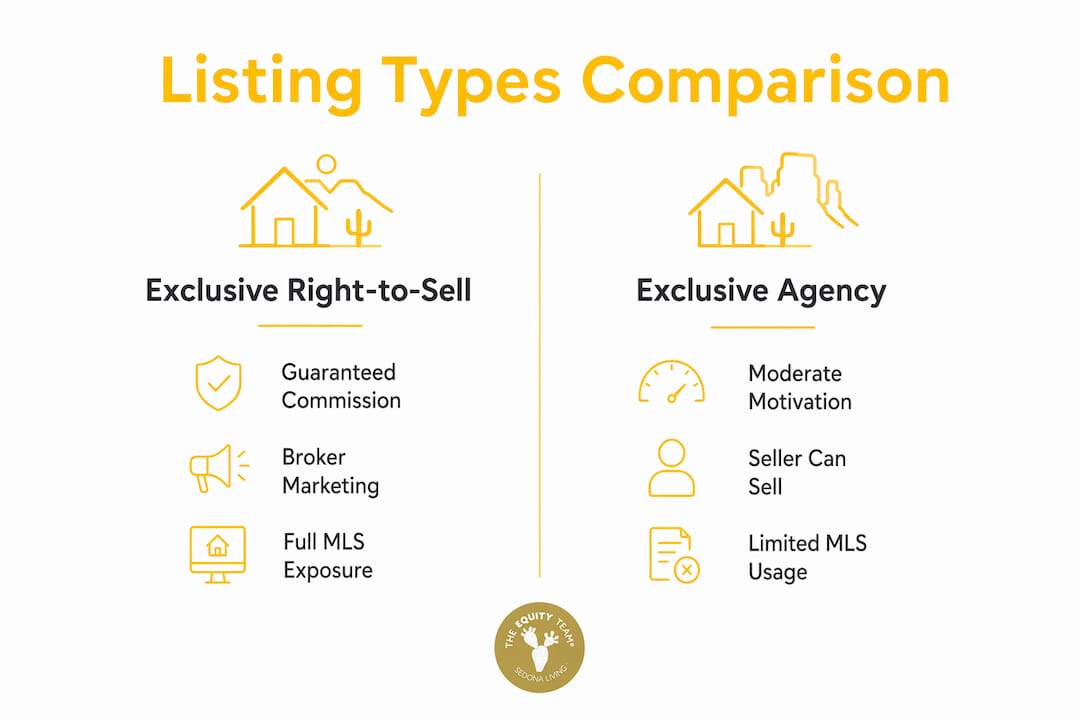
The core trade-off is simple: guaranteed commission creates guaranteed effort. When a broker knows they’ll be paid regardless of who finds the buyer, they have every reason to spend on photography, staging, digital ads, and open houses. Exclusive Agency can reduce marketing intensity because the broker’s compensation is not guaranteed when the seller finds a buyer, which can mean slower sales or lower final prices.
For Sedona short-term rental sellers, where luxury home marketing requires targeted outreach to investor buyers, that marketing intensity difference is especially meaningful. A half-hearted campaign on an STR property can cost far more in lost price than the commission savings from an Exclusive Agency arrangement.
What should you check before signing?
Sellers who read the contract carefully before signing avoid most of the headaches that come later. Work through this checklist:
- Commission terms. Confirm the exact percentage or flat fee, when it is earned, and whether it applies if the seller finds the buyer.
- Contract duration. Most residential listings run 3–6 months. Shorter initial terms (30–90 days) give sellers an exit ramp if the relationship isn’t working.
- Protection/tail clause. Well-drafted agreements include a protection period of 30–45 days after expiration. Know how long yours runs and what triggers it.
- Termination rights. Consumer guides recommend confirming whether you can exit early, what notice is required, and whether a buy-out fee or marketing expense reimbursement applies.
- Named buyer exemptions. If you already have a friend, neighbor, or prior contact who might buy, get their name written into the contract as an exemption before you sign.
- MLS distribution instructions. Confirm whether the listing will go into the full MLS or be held as an Office Exclusive, and understand the exposure trade-off.
- Marketing plan. Ask the agent to put their specific marketing commitments in writing: budget, channels, timeline, and open-house schedule.
Pro Tip: Ask the agent to provide a written list of buyer prospects at the end of the listing term. That list is what triggers the protection period, and having it documented protects both sides.
What legal disputes come up most often, and how do you avoid them?
A few recurring conflict triggers show up in exclusive listing disputes:
- Vague commission language. “Standard commission” or “customary fee” without a defined percentage is an invitation to argue. Insist on a specific number.
- Undocumented buyer leads. If the broker claims a buyer was “introduced” during the listing period but has no written record, the seller is in a gray zone. Require the broker to maintain a running written log of buyer contacts.
- Protection period disputes. The protection clause typically requires the broker to deliver a written prospect list before the listing expires. If that list never arrives, the protection period may not apply. Know the trigger condition in your contract.
- Buy-out and expense reimbursement clauses. Some contracts allow the broker to bill for marketing expenses on early termination. Read this language carefully before signing.
- Procuring-cause ambiguity. Under Exclusive Agency, define “procuring cause” in writing. A buyer who attended an open house and then contacted the seller directly is a classic gray-area case.
When in doubt, confirm state-specific rules with a licensed real estate attorney. Laws governing listing agreements, net listings, and commission disputes vary by state, and a one-hour consultation is cheap compared to a commission dispute at closing.
What do key contract clauses actually mean in plain English?
Here are four clauses sellers commonly encounter, translated out of legalese:
-
Commission clause. “Seller agrees to pay Broker a commission of X% of the gross sale price at closing.” Plain English: you pay that percentage no matter what the final price is, and it comes out of your proceeds at closing. Red flag: any language that leaves the percentage blank or says “to be determined.”
-
Protection/tail clause. “If the property is sold within 30 days after expiration of this agreement to a buyer introduced to the property during the listing period, Seller shall pay the commission set forth herein, provided Broker delivers a written list of such buyers to Seller prior to expiration.” Plain English: the broker can still earn commission after the agreement ends, but only for buyers on a list they hand you before the contract expires. Named exemptions avoid commission if a pre-listed person buys, but they must be explicit in the contract.
-
Termination clause. “Either party may terminate this agreement upon 10 days’ written notice, subject to reimbursement of documented marketing expenses not to exceed $X.” Plain English: you can exit, but you may owe money for ads and photography already paid. Know the cap before you sign.
-
MLS distribution clause. “Seller instructs Broker to submit this listing to the Multiple Listing Service within 24 hours of execution.” Plain English: your property goes into the MLS fast, maximizing buyer exposure. If this line is missing or says “Office Exclusive,” your listing stays inside one brokerage’s network only.
For sellers who want to preserve the right to sell to a specific person without paying commission, the named-buyer exemption must appear in the contract by name and address before signing. A handshake agreement won’t hold up.
How Equity Team handles exclusive listing agreements
Equity Team approaches exclusive listings with a few non-negotiables that protect Sedona sellers from the most common pitfalls:
- Explicit commission language in every contract, with the percentage spelled out and the trigger conditions defined.
- Short initial terms for sellers who want flexibility, with clear renewal options if the market calls for more time.
- Written buyer-prospect logs maintained throughout the listing period, delivered to the seller before expiration so the protection period is never ambiguous.
- Full MLS distribution as the default for Sedona STR and high-performing home listings, with Office Exclusive available only when the seller specifically requests it and understands the exposure trade-off.
- Named-buyer exemptions documented at signing for any seller who has a known potential buyer.
Sedona’s short-term rental market moves differently from a standard residential market. Buyers are investors who run revenue models, not just families looking for a home. That means the marketing plan for an STR listing needs to speak to occupancy rates, revenue history, and permit status, not just square footage and curb appeal. Equity Team’s listings for STR properties reflect that reality from day one.
Sellers who want a contract review or a listing consultation can reach the team directly through the contact page at owninaz.com.
Key Takeaways
An exclusive listing agreement gives one broker the sole right to market your property, and which type you sign determines whether you owe commission even if you find the buyer yourself.
| Point | Details |
|---|---|
| Exclusive Right-to-Sell vs. Exclusive Agency | Exclusive Right-to-Sell means commission is owed regardless of who finds the buyer; Exclusive Agency lets sellers sell independently without paying. |
| Protection period runs 30–45 days | The broker must deliver a written prospect list before expiration to trigger the tail clause. |
| Three must-check clauses | Confirm the commission percentage, termination rights, and named-buyer exemptions before signing any exclusive agreement. |
| Net listings carry real risk | Net listings are discouraged or illegal in several states due to the conflict of interest they create for brokers. |
| Equity Team’s approach | Equity Team uses explicit commission terms, short initial terms, and written buyer logs to protect Sedona sellers in every exclusive listing. |
When exclusive listings actually make sense
The conventional wisdom says Exclusive Right-to-Sell is always the safest choice for sellers, and most of the time that’s true. But the reasoning behind it matters more than the label.
The real question isn’t which listing type sounds best. It’s whether the broker you’re working with has a genuine reason to hustle. An Exclusive Right-to-Sell with a mediocre agent who does the bare minimum is worse than an Exclusive Agency with a motivated agent who has a buyer already lined up. The contract type sets the incentive structure, but it doesn’t manufacture effort.
For Sedona STR sellers specifically, the calculus tilts strongly toward Exclusive Right-to-Sell with full MLS distribution. The buyer pool for a high-performing vacation rental is narrower than for a primary residence, which means the broker needs to reach every possible investor buyer, not just the ones who happen to walk through an open house. Limiting distribution to an Office Exclusive in that context is almost always a mistake unless there’s a compelling privacy reason.
The one scenario where Equity Team might consider Exclusive Agency is when a seller has a credible, named potential buyer who hasn’t committed yet. In that case, a short-term Exclusive Agency with a named exemption for that specific buyer gives the broker a reason to market actively while preserving the seller’s right to close the deal they already have in the works. Short terms, clear exemptions, and a written prospect log make that arrangement workable.
Thinking about listing your Sedona property?
Sedona’s STR market rewards sellers who go in prepared, and that preparation starts with the listing agreement itself. Equity Team works exclusively with investors and high-performing property owners, which means every listing contract is built around the specifics of the STR market: revenue history, permit documentation, investor-focused marketing, and commission terms that don’t leave sellers guessing.

Whether you want a contract review before signing with any agent, a full listing appraisal, or guidance on how to handle a named buyer you already have in mind, the team is set up to help. Sellers can also browse current Sedona STR investment opportunities to understand what the buyer pool looks like right now. For a direct conversation about your property and what an exclusive listing could realistically achieve, reach out through owninaz.com.
Authoritative sources and further reading
- Consumer guide: listing agreements (NAR) — NAR’s official consumer-facing definitions of Exclusive Right-to-Sell and Exclusive Agency, including the seller-sold exception.
- Exclusive Right to Sell/Exclusive Agency (Bright MLS support) — Regional MLS guidance distinguishing commission contract types from MLS distribution choices, including the Office Exclusive definition.
- What does an exclusive listing mean in real estate? (LegalClarity) — Analysis of contract elements, protection/tail clauses, and the written prospect-list requirement.
- What Is an Exclusive Agency Listing? (Realtor.com) — Consumer explainer on Exclusive Right-to-Sell vs. Exclusive Agency, with practical advice on named exemptions and short listing terms.
- Types of listing agreements in real estate (Colibri Real Estate) — Overview of all four common listing types, including net listing risks and state-law variability.
- Termination of listing agreement: understanding your options (Orchard) — Practical guidance on termination clauses, buy-out fees, and expense reimbursement obligations.
- Exclusive listing explained: unlock privacy and power in luxury real estate — External perspective on how exclusive listings function in luxury and off-market contexts.
This article is general information, not legal advice. Listing agreement rules, commission regulations, and net listing legality vary by state. Confirm the current rules with a licensed real estate attorney or your state’s real estate commission before signing any contract.