

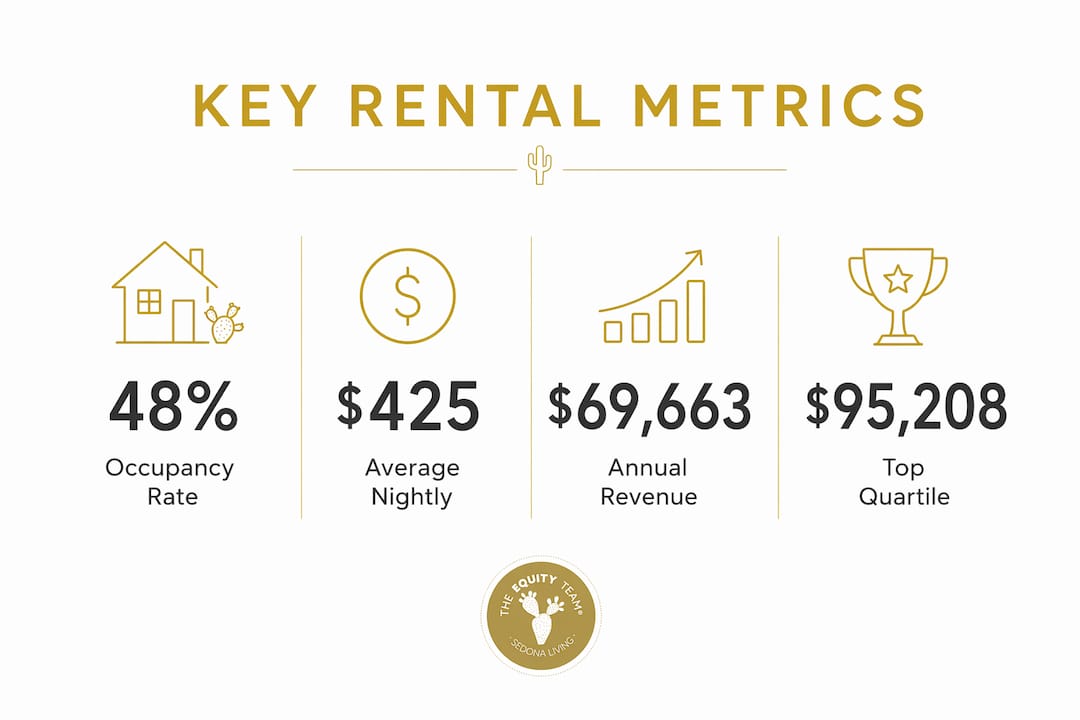
A Sedona vacation rental comparative market analysis is the process of evaluating short-term rental properties by comparing occupancy rates, average daily rates, and annual revenue to determine investment value and pricing potential. In the real estate industry, this process is formally called a comparative market analysis, or CMA. Sedona’s short-term rental market is one of the most vibrant in Arizona, and the numbers back that up. Average annual STR revenue sits around $69,663 with a $425 nightly rate and 48% occupancy. For investors and property owners who want to buy smart or sell at peak value, running a rigorous vacation rental analysis in Sedona is not optional. It is the whole game.
What data and metrics are essential for a Sedona vacation rental CMA?
Four core metrics drive every credible Sedona vacation rental comparative market analysis: occupancy rate, average daily rate (ADR), revenue per available rental (RevPAR), and annual gross revenue. Each one tells a different part of the story. Occupancy rate shows demand. ADR shows pricing power. RevPAR combines both into a single efficiency score. Annual gross revenue is the bottom line that lenders, buyers, and sellers all care about most.

Sedona’s market has a quirky seasonal rhythm that you must account for. The city runs on a dual-peak seasonal cycle with spring and fall surges and a summer trough caused by scorching temperatures. Monthly revenue can top $10,000 in March and drop to around $4,610 in August. That is nearly a 55% swing between peak and trough months. Any CMA that uses annual averages without adjusting for this cycle will produce a distorted picture of a property’s true earning potential.
The most reliable data sources for Sedona-specific analysis include:
- AirDNA: Tracks active listings, occupancy trends, and ADR across Sedona ZIP codes and neighborhoods
- AirROI: Provides city-level and submarket-level revenue benchmarks updated monthly
- StaySTRA: Delivers supply growth data, ADR trends, and seasonal revenue breakdowns specific to Sedona
- Gemhaus: Compares short-term versus long-term rental income at the ZIP code level
Pro Tip: Pull data from at least two platforms before drawing conclusions. AirDNA and AirROI often show slightly different occupancy figures for the same market, and cross-referencing them gives you a more reliable baseline.
How to run a step-by-step Sedona vacation rental market analysis
A well-executed Sedona rental investment analysis follows a clear sequence. Skipping steps is how investors end up overpaying or underselling.
-
Define your comparable set. Pull listings from AirDNA or AirROI that match your subject property by bedroom count, property type, and location. Entire home listings dominate Sedona, representing 83.5% of active inventory within city limits. Comparing a private room to a whole-home listing will wreck your numbers.
-
Filter by amenities and features. A property with a private pool, hot tub, or red rock views commands a meaningfully higher ADR than a comparable home without those features. Outdoor spaces in Sedona STRs are a documented revenue driver, so filter your comps accordingly.
-
Adjust for seasonality. Normalize your comparable data by calculating trailing 12-month revenue rather than relying on peak-month snapshots. Effective comparative market analysis in Sedona requires adjusting for seasonal revenue cycles to avoid inflated projections.
-
Benchmark against market tiers. The Sedona market has a wide performance spread. The median performer generates around $69,663 annually, while top-quartile properties reach $95,208. Knowing where a property sits in that range tells you whether you are buying a fixer-upper or a top performer.
-
Layer in regulatory and operational costs. Sedona requires state TPT licenses, city permits, and compliance with strict STR regulations including a ban on special events. These costs and restrictions directly affect net operating income and must be included in any honest valuation.
| Metric | Market median | Top quartile |
|---|---|---|
| Annual gross revenue | $69,663 | $95,208 |
| Average daily rate | $425 | Higher ADR typical |
| Occupancy rate | 48% | Above 55% typical |
| Monthly revenue (August) | $4,610 | Lower floor, higher ceiling |
Pro Tip: When comparing Sedona rentals against top performers, look at their review scores and listing quality alongside revenue data. High-earning properties almost always have professional photography, detailed descriptions, and 4.8+ star ratings. Those are features you can replicate.
How do Sedona submarkets affect vacation rental property valuation?
Location within Sedona creates real performance differences that a citywide average will never reveal. The Sedona real estate market shows meaningful occupancy and ADR variation across neighborhoods, and those differences translate directly into property valuation gaps.
Properties inside Sedona city limits average $57,085 in annual revenue with a $342 nightly rate and 49.4% occupancy. Properties in the greater Sedona region, which includes areas like the Village of Oak Creek and unincorporated Yavapai County, often outperform city-limit properties on ADR because they face fewer regulatory constraints and sometimes offer more dramatic views.
| Submarket | Avg. annual revenue | Avg. nightly rate | Occupancy |
|---|---|---|---|
| Sedona city limits | $57,085 | $342 | 49.4% |
| Greater Sedona region | $69,663 | $425 | 48% |
| Top-quartile performers (region) | $95,208 | Above $425 | Above 55% |
The practical takeaway is straightforward. A property just outside city limits may generate $12,000 more per year than a comparable home inside them, simply because of permit flexibility and pricing power. When comparing Sedona rentals for investment purposes, always run separate CMAs for city-limit and non-city-limit properties. Mixing them together produces a blurry average that serves no one.
What are the biggest mistakes in Sedona vacation rental market analysis?
Even experienced investors stumble on a few recurring errors when analyzing the Sedona short-term rental market. Knowing them in advance is worth more than any single data point.
- Ignoring seasonality in revenue projections. Using peak-month revenue to project annual income is the most common and costly mistake. Sedona’s summer trough is real and predictable. Build it into your model.
- Underestimating regulatory risk. Sedona’s STR compliance requirements include state TPT licenses, city permits, and a hard ban on special events. Regulatory changes create moderate-to-high investment risk that must be priced into any acquisition.
- Overlooking the special events ban. Some investors model revenue based on festivals, weddings, or retreats hosted at the property. Sedona prohibits these. Any revenue model that includes special event income is built on sand.
- Relying on stale data. The Sedona STR market has seen 62% supply growth since 2021. A CMA built on 2022 data will miss significant shifts in competition and pricing dynamics.
- Skipping the STR vs. long-term rental comparison. In ZIP code 86336, median Airbnb revenue runs about $4,460 per month versus roughly $2,300 for long-term rental. That gap justifies the STR premium, but only if you have verified it with current data.
“The Sedona STR market rewards operators who do their homework. The gap between median and top-quartile performers is not luck. It is preparation, positioning, and knowing exactly what the numbers say before you sign anything.”
Pro Tip: Check the recent STR inventory shifts in Sedona before finalizing any analysis. Supply changes affect occupancy projections more than most investors expect.
Key takeaways
A Sedona vacation rental comparative market analysis is most accurate when it combines seasonal adjustments, submarket filtering, regulatory cost modeling, and benchmarking against top-quartile performers rather than market medians.
| Point | Details |
|---|---|
| Use four core metrics | Occupancy rate, ADR, RevPAR, and annual revenue together tell the full investment story. |
| Adjust for Sedona’s dual-peak season | Monthly revenue swings nearly 55% between March peaks and August troughs. |
| Separate city-limit from regional comps | City-limit properties average $12,578 less annually than the broader Sedona region. |
| Benchmark against top quartile | Top performers earn $95,208 annually, giving you a realistic ceiling to target. |
| Price in regulatory costs | STR permits, TPT licenses, and the special events ban all affect net operating income. |
What I have learned running CMAs in Sedona’s STR market
The data tells a clear story, but the story has some fine print that most analysis tools will not flag for you. I have seen investors buy properties based on AirDNA revenue estimates and then discover that the comparable listings they were benchmarked against had red rock views, private pools, and five years of glowing reviews. Their new property had none of those things. The numbers looked similar on paper. The actual performance was not.
The most underrated part of a Sedona rental investment analysis is the qualitative layer. What does the listing look like? What is the guest experience like? Does the property have a feature that creates genuine demand, like a hot tub under the stars or a patio that frames Cathedral Rock? Premium features drive premium revenue, and no spreadsheet will tell you whether a property has that magic or not.
I also think most investors underweight regulatory risk. Sedona’s STR rules have shifted meaningfully in recent years, and they will likely shift again. A property that pencils out beautifully today could look very different if permit caps tighten or new restrictions pass. The investors I have seen succeed long-term are the ones who buy properties with strong fundamentals, not just strong current revenue. They also stay connected to what is happening at city hall.
Despite the supply growth since 2021, Sedona’s rising ADR has kept revenue stable for skilled operators. That is genuinely good news. It means the market rewards quality. If you bring a well-positioned, well-managed property to Sedona, the demand is there. The CMA just helps you make sure you are not overpaying to get there.
— Chad
Ready to put your Sedona analysis to work?
Running the numbers is one thing. Knowing what to do with them is another. Equity Team specializes in Sedona short-term rental investments and represents clients who operate in the top 10% of the market. Whether you are buying your first STR or selling a property you have built up over years, having an agent who understands the data makes a real difference.

Equity Team is the first STR-specialized real estate team in Northern Arizona. If you want to skip the guesswork and work with agents who live and breathe Sedona vacation rental data, the next step is simple. Explore how to find the right STR investment for your goals, or browse current Sedona investment opportunities to see what the market looks like right now.
FAQ
What is a vacation rental comparative market analysis in Sedona?
A vacation rental CMA in Sedona is a structured comparison of short-term rental properties using metrics like occupancy rate, ADR, and annual revenue to determine a property’s market value and income potential. It is the standard method real estate investors use to evaluate whether a Sedona STR is priced fairly and performing at market level.
What is the average revenue for a Sedona short-term rental?
Average annual STR revenue in Sedona is approximately $69,663 at a $425 nightly rate and 48% occupancy, while top-quartile properties reach $95,208 annually.
How does Sedona’s seasonality affect a rental market analysis?
Sedona runs a dual-peak cycle with strong spring and fall demand and a summer trough. Monthly revenue can drop from over $10,000 in March to around $4,610 in August, so any accurate analysis must use trailing 12-month data rather than peak-season snapshots.
Do Sedona STR regulations affect property valuation?
Yes. Sedona requires state TPT licenses, city permits, and enforces a ban on special events. These compliance requirements add costs and restrict certain revenue strategies, which must be factored into any honest property valuation or investment model.
Is Sedona a good market for short-term rental investment in 2026?
Sedona remains a strong STR market. Despite 62% supply growth since 2021, rising ADR has kept per-listing revenue stable, and the gap between short-term and long-term rental income remains significant at roughly $4,460 versus $2,300 per month in ZIP code 86336.