

Sedona short-term rental zoning laws require every property owner to secure a city-issued permit for each individual rental unit before listing on Airbnb, Vrbo, or any other platform. These are not blanket property permits. A main house and a casita on the same parcel each need their own permit number, their own insurance documentation, and their own compliance trail. Layer in private HOA restrictions, Arizona Transaction Privilege Tax obligations, and the recent 2026 VOCA court ruling, and you have a regulatory picture that rewards the prepared and punishes the casual. Here is what every owner and investor needs to know.
What are the specific zoning and permitting requirements for Sedona STRs?
Sedona’s STR zoning regulations guide starts with one non-negotiable rule: each rental unit must have its own city-issued permit number displayed on every listing. That means a property with a main house and a detached casita requires two separate permits, two separate applications, and two separate compliance reviews. This is one of the most common surprises for new investors who assume one permit covers the whole parcel.
The permit application itself has several moving parts. You will need to submit property information, owner contact details, proof of an Arizona Transaction Privilege Tax license, and documentation of neighbor notification. The city wants to know that the people living next door are aware a short-term rental is operating nearby. That notification requirement is not optional, and skipping it is one of the fastest ways to trigger a complaint.

Once approved, the permit number must appear on every advertising platform where the property is listed. Owners must also carry minimum $500,000 liability insurance per unit, with higher coverage often required for properties featuring pools, hot tubs, or direct trail access. Permits are renewed annually, and the city may conduct inspections to verify ongoing compliance with safety codes and operational rules.
Pro Tip: If you are buying a property that already operates as an STR, do not assume the existing permit transfers to you. Permits do not transfer with property sales in Sedona. New owners must apply fresh, and the clock resets on compliance history.
- Confirm the number of rentable units on the parcel before applying.
- Obtain your Arizona TPT license before submitting the permit application.
- Notify adjacent neighbors in writing and keep documentation of that notification.
- Post the permit number on Airbnb, Vrbo, and any other listing platform you use.
- Renew annually and schedule any required inspections proactively.
How do HOAs affect Sedona short-term rental zoning laws?
Arizona state law prevents cities from banning short-term rentals outright, but it does something that catches many investors off guard. Arizona law permits HOAs to impose their own restrictions or outright bans through CC&Rs under the Arizona Planned Community Act and Condominium Act. That means a property can be fully compliant with every city rule and still be legally prohibited from operating as an STR because of a private HOA agreement.
The most dramatic recent example of this dynamic is the Village of Oak Creek. In April 2026, VOCA’s 2016 STR ban was declared legally unenforceable by the courts, opening the door for property owners in that community to operate short-term rentals for the first time in a decade. That ruling is a significant opportunity for investors eyeing VOCA properties.
However, the story does not end with the court ruling. Property owners in VOCA still must register with Yavapai County and meet all applicable tax obligations. Sub-associations within larger planned communities may also have their own separate rules that were not addressed by the ruling. Checking the STR restriction changes at the sub-association level is a step that many buyers skip, sometimes at great cost.
“Legal distinctions between public city regulations and private HOA restrictions mean investors must conduct thorough due diligence beyond municipal permits.” This is not a one-time check. HOA boards can amend CC&Rs, and what is permitted today may be restricted tomorrow.
- Review the full CC&R document, not just a summary, before purchasing any HOA-governed property.
- Ask specifically about STR amendments passed in the last five years.
- Confirm whether sub-associations within the community have separate governing documents.
- Verify that any HOA-permitted STR operation still requires city or county registration.
What are the tax, safety, and operational compliance requirements?
Sedona short-term rental regulations require operators to obtain an Arizona Transaction Privilege Tax license before accepting a single booking. The combined tax rate includes roughly 5.5% at the state level, 3.5% from the city, plus county portions that vary depending on which side of Sedona your property sits on. That total can land between 11% and 13% of gross rental revenue, which is a meaningful line item in any investment analysis.
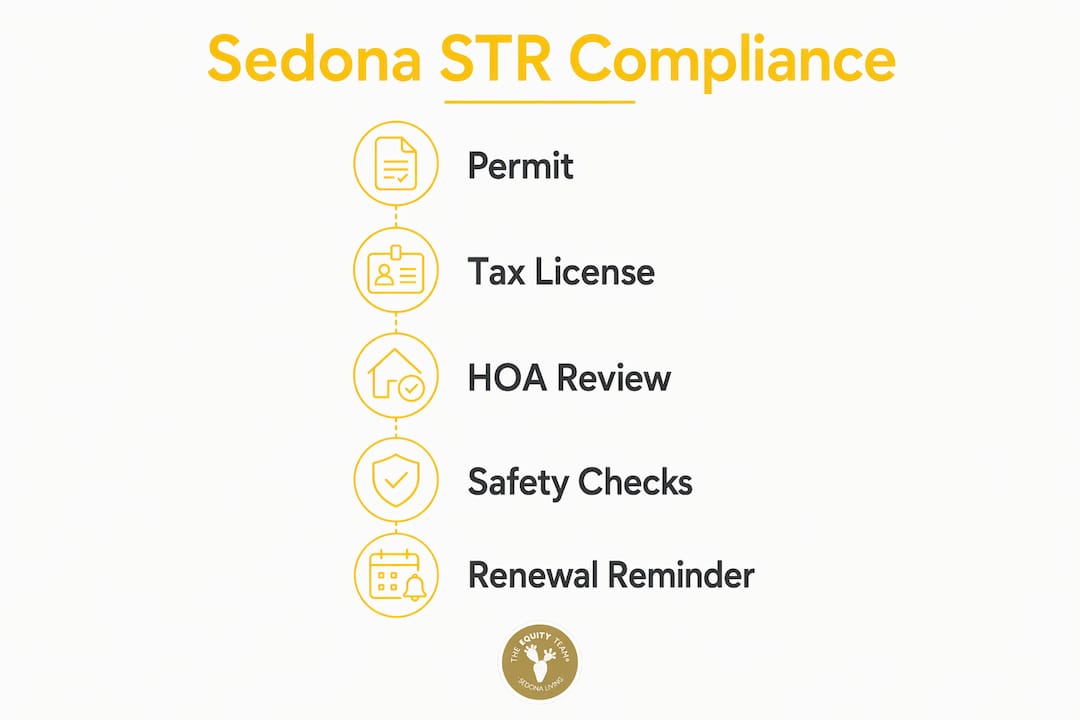
Beyond taxes, the operational requirements are specific and enforced. Owners must designate a 24/7 emergency contact who can respond within 60 minutes to any property incident. That contact must be reachable by phone or physically present within that window. A property manager in Phoenix who cannot make it to Sedona in an hour does not meet this standard.
| Requirement | Details |
|---|---|
| Arizona TPT license | Required before first booking; covers state, city, and county tax obligations |
| Liability insurance | Minimum $500,000 per unit; higher for pools or trail-access properties |
| Emergency contact | Available 24/7, must respond within 60 minutes by phone or in person |
| Safety equipment | Smoke detectors, CO detectors, pool fencing, and posted occupancy limits required |
| Guest background checks | Arizona law requires STR operators to screen guests per state statutes |
Safety standards include functioning smoke detectors, carbon monoxide detectors, pool fencing that meets code, clearly posted occupancy limits, and designated parking that does not spill onto neighboring properties. Arizona law also requires operators to conduct guest background checks, which is a detail that surprises many first-time STR owners who assume that platform screening is sufficient.
Pro Tip: Platforms like Airbnb and Vrbo offer their own guest verification, but Arizona’s legal requirement for background checks sits with the property owner, not the platform. Document your screening process and keep records in case of a compliance audit.
How do Sedona STR rules vary by jurisdiction?
Sedona straddles two counties, Coconino and Yavapai, and that geographic quirk creates real regulatory differences for property owners. Properties in different counties face different tax rates and, in some cases, different permit frameworks depending on which side of the city line they fall on. An investor comparing two seemingly similar properties in Sedona may be looking at meaningfully different total tax burdens without realizing it.
The Village of Oak Creek sits within Yavapai County and is not part of the incorporated City of Sedona. That distinction matters enormously. Properties there are governed by county rules rather than city ordinances, which means the City of Sedona’s permit system does not apply. Instead, owners must register with Yavapai County and comply with county-level tax and operational requirements. The vacation rental zone guide from Equity Team breaks down these jurisdictional boundaries in detail.
| Location | Governing Authority | Permit Type | Key Notes |
|---|---|---|---|
| City of Sedona (Coconino side) | City of Sedona + Coconino County | City STR permit | City ordinance applies; HOA rules may also apply |
| City of Sedona (Yavapai side) | City of Sedona + Yavapai County | City STR permit | Different county tax rate than Coconino side |
| Village of Oak Creek | Yavapai County | County registration | City of Sedona rules do not apply; VOCA HOA rules apply |
Confirming the exact jurisdiction of a property before purchase is not a formality. It determines which permit you need, which tax rates apply, and which regulatory body has enforcement authority over your operation. Equity Team recommends verifying jurisdiction with the county assessor’s office and the City of Sedona planning department before closing on any STR investment.
What are the consequences of violating Sedona STR zoning laws?
The most common compliance mistake in Sedona is assuming that a permit transfers when a property changes hands. Existing permits terminate at sale, and new owners who continue operating without applying for fresh permits are technically running an unlicensed STR from day one of ownership. That is a fast path to fines and permit denial.
Other frequent violations include:
- Advertising on Airbnb or Vrbo without displaying the city-issued permit number in the listing.
- Hosting events that require a separate city permit, which Sedona City Code 5.25.050 explicitly prohibits for STRs.
- Failing to maintain a reachable emergency contact, especially during peak seasons when owners travel.
- Exceeding posted occupancy limits or allowing unauthorized parking that affects neighbors.
The consequences are real. First-offense fines start at $500, and repeat violations can result in permit suspension for up to one year. A suspended permit means zero rental income during one of Sedona’s most lucrative tourism periods. Private HOA enforcement adds another layer, with associations able to pursue legal action independently of city enforcement.
Pro Tip: Set a calendar reminder 90 days before your permit renewal date. Use that window to audit your listing for permit number display, verify your insurance is current, and confirm your emergency contact is still available and local.
Key takeaways
Sedona STR zoning laws require per-unit city permits, active tax licensing, HOA due diligence, and jurisdiction confirmation before any rental operation can legally begin.
| Point | Details |
|---|---|
| Per-unit permits required | Each rentable structure needs its own city permit; permits do not transfer at sale. |
| HOA rules override city permissions | Private CC&Rs can ban STRs even where city law allows them; always review HOA documents. |
| VOCA ban overturned in 2026 | VOCA’s STR ban is unenforceable, but county registration and taxes still apply. |
| Tax compliance is multi-layered | Arizona TPT, city, and county taxes combine for an 11 to 13% total rate on gross revenue. |
| Jurisdiction determines your rules | Coconino County, Yavapai County, and City of Sedona each have distinct requirements. |
Why I treat Sedona STR compliance like a second business
Here is something I have seen play out more times than I can count. A buyer falls in love with a Sedona property, runs the numbers on rental income, and closes the deal. Then they discover the HOA bans STRs, or the permit they thought transferred actually expired at closing, or the property sits in Yavapai County and needs county registration instead of a city permit. The deal that looked great on paper turns into a compliance scramble.
Sedona’s regulatory environment rewards people who treat their STR like a professional business from day one. That means reading the full CC&R document before making an offer, not after. It means budgeting for liability insurance, TPT licensing, and permit fees as fixed operating costs. It means knowing your emergency contact can actually get to the property in under an hour.
The VOCA ruling in 2026 is genuinely exciting. It opens up a community that was locked out of the STR market for nearly a decade, and the properties there are worth a serious look. But the investors who will do well in VOCA are the ones who verify sub-association rules, register with Yavapai County promptly, and stay current as the regulatory picture continues to evolve. The STR investment climate in Sedona is strong, but it is not forgiving of shortcuts.
— Chad
Find your compliant Sedona STR investment with Equity Team
Equity Team specializes in Sedona short-term rental investments and represents clients operating in the top 10% of the rental market. Whether you are searching for a property that clears every zoning and HOA hurdle or trying to understand how the VOCA ruling affects your current holdings, Equity Team brings the local knowledge that generic real estate searches simply cannot provide.

Equity Team’s guides walk through real properties, real compliance steps, and real revenue projections so you can invest with confidence. Start with the right STR investment guide to identify properties that are already positioned for top-tier performance. For a deeper look at what makes Sedona’s market tick, explore profitable STR investments and see why the right property in the right zone makes all the difference.
FAQ
Does a Sedona STR permit transfer when I buy a property?
No. STR permits in Sedona are tied to the owner, not the property. New owners must apply for a fresh permit after closing, and the property may require a new compliance inspection before the permit is issued.
Can an HOA ban short-term rentals in Sedona even if the city allows them?
Yes. Arizona law allows HOAs to restrict or ban STRs through CC&Rs under the Arizona Planned Community Act, even in areas where city ordinances permit short-term rental operations.
What happened with the VOCA short-term rental ban?
In April 2026, VOCA’s 2016 STR ban was declared legally unenforceable. Property owners in the Village of Oak Creek can now operate STRs, but must still register with Yavapai County and pay applicable taxes.
What tax rate applies to Sedona short-term rentals?
The combined rate includes roughly 5.5% in Arizona state TPT, 3.5% from the City of Sedona, plus county-level taxes that vary by location. Total effective rates typically fall between 11% and 13% of gross rental revenue.
What is the penalty for operating a Sedona STR without a permit?
Fines start at $500 for first offenses under Sedona City Code 5.25.050, and repeat violations can result in permit suspension for up to one year, effectively shutting down rental income during that period.