

A nonconforming use is something a property did legally before the rules changed, and the city lets it carry on even though today’s code would not allow it. In Sedona, that matters to short-term rental owners because the city code treats some guest quarters issued a certificate of occupancy before September 14, 2024 as a legal, nonconforming use that can be used as an STR. It is a real right. It is also a fragile one, and it can be lost by a six-month pause or the wrong remodel. We are Sedona STR specialists, and this is the version we would tell a buyer or seller over coffee, with a red rock view and, ideally, fewer legal footnotes.
TL;DR
- A nonconforming use is a legal use that predates a rule change. Sedona lets it continue, but the property owner carries the burden of proving it.
- Guest quarters with a certificate of occupancy issued before September 14, 2024, built and modified in compliance with the rules, can be a legal, nonconforming STR use whether or not the owner lives there.
- The right can end: a six-month discontinuation generally means future use must comply, and a change to a less nonconforming use cannot be reversed.
- Buyers should confirm status before writing an offer. Sellers should gather the records before listing.
- Arizona’s STR rules are in motion. Check the current statute and city code before you rely on any summary, including this one.
Table of Contents
- What “nonconforming use” means in Sedona
- How a Sedona short-term rental can qualify
- What you can and cannot do with a nonconforming use
- How the right ends
- Nonconforming use versus a legal STR in general
- The state layer is still moving
- If you are buying: due diligence for nonconforming status
- If you are selling: make the status easy to see
- Our perspective
- Working with an STR specialist
- FAQ
- Sources
What “nonconforming use” means in Sedona
Picture a zoning map as a set of house rules for each neighborhood. When the city updates the rules, some properties already doing something the new rules forbid are suddenly offside. Instead of ordering them to stop, zoning law usually lets them continue as long as they stay within limits. That is the nonconforming use.
Sedona writes those limits into Section 1.6 of its Land Development Code (LDC), the document that governs zoning, building and site design. It separates three things:
- Nonconforming uses: what is done on the land or in the building (renting it nightly, for example).
- Nonconforming structures: the building itself, such as one that no longer meets today’s setbacks or height limits.
- Nonconformities in general: the shared rules that apply to all of them.
The distinction matters. A house can be a perfectly fine structure and still have a nonconforming use. Or the reverse. The rules for each are different, and the section on structures is where fire and storm damage get handled, which we will come to.
How a Sedona short-term rental can qualify
Sedona’s city code on short-term rentals, Section 5.25.050, says the LDC’s district rules apply to an STR the same way they apply to other property under Arizona’s tax classification statutes, except where state law says otherwise. In a single-family residential district, an STR is limited to the uses the LDC allows in that district.
Then comes the grandfathering language. Guest quarters qualify as a legal, nonconforming use when they meet all of these conditions:
- A certificate of occupancy was issued before September 14, 2024.
- The quarters complied with all applicable requirements.
- They have not been modified without a required permit.
If those are true, the code says the quarters may be used as an STR regardless of owner occupancy. That last phrase is the valuable part. Newer accessory dwelling units (ADUs) can face an owner-residency condition, which is why the September 14, 2024 date does so much work. If you are weighing a casita or guest house, our guide on whether you can Airbnb an ADU in Sedona walks through how those rules play out.
The papers that prove it
Here is the catch that surprises people. Under LDC 1.6.B, the burden of establishing a nonconformity rests solely on the property owner. The city does not have to prove you are grandfathered. You have to show you are.
So the file you want looks like this:
- The certificate of occupancy, with its issue date.
- Permits for every addition, conversion or remodel of the quarters.
- Evidence of continuous use, such as city tax and license records and booking history.
- Any written correspondence with the city about how the property is classified.
A gap in that file is not fatal by itself, but it is a problem you want to find before a contract deadline, not after.
What you can and cannot do with a nonconforming use
The general rule in Sedona: keep what you have, do not make the nonconformity bigger. The LDC spells out the details.
Allowed
Under LDC 1.6.B, these are permitted:
- Ordinary maintenance and repairs.
- Hazard mitigation and repair of unsafe conditions.
- Repairs needed to meet building code.
- Repainting less than 50% of a structure’s exterior.
- Changes in ownership, tenancy or management. The nonconformity stays, still subject to Section 1.6 standards.
Under LDC 1.6.C, a nonconforming use may be extended throughout the same building, provided there is no structural alteration, no added dwelling units, no added nonresidential units or uses, and no additional required parking. An occupied single-family dwelling that is a nonconforming use may improve its main and accessory structures, as long as the improvements do not increase the degree of nonconformity, height or building footprint.
Not allowed
- Any modification that increases the degree of nonconformity.
- Building a new structure that does not conform to the code in connection with the nonconforming use.
- Changing to a less nonconforming or conforming use and then changing back to a more nonconforming one. That door closes behind you.
A quick example. Suppose a guesthouse is a legal nonconforming STR. The owner wants to add a bathroom by enlarging the footprint. That is a structural change and an increase in the footprint, so it falls on the wrong side of 1.6.C. Refreshing the interior, replacing worn fixtures, or fixing the roof is a different story: that is maintenance. Which side a particular project lands on is a call for the city’s Community Development staff, so ask before you pull a contractor in.
How the right ends
There are three common ways to lose it.
1. Six months of discontinuation. If the use stops for six months, future use must comply with the current code. There is one relief valve: the Director can grant an extension where improvements are being diligently pursued. Owners who take a property off the market for a long renovation, or who sit on a vacant listing during a sale, should watch the calendar.
2. Changing the use downward. Once a use becomes less nonconforming or conforming, it cannot return to the more nonconforming one.
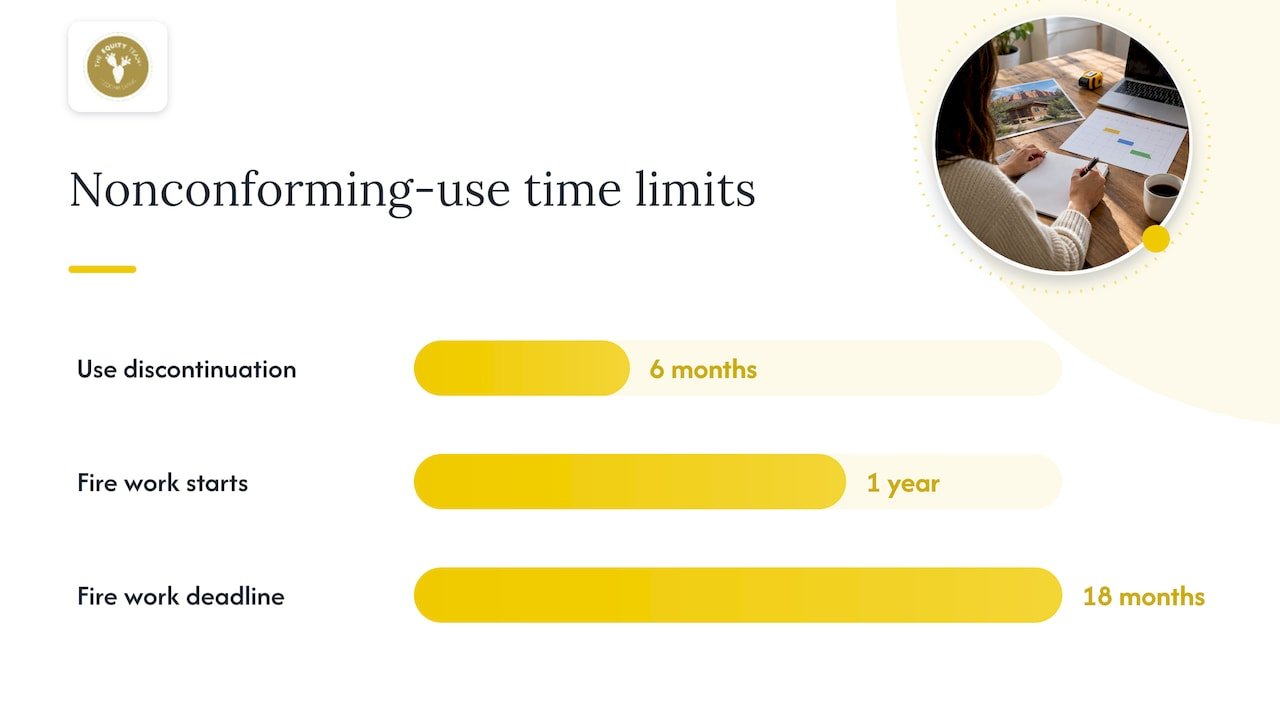
3. Damage to the structure. The structures section, LDC 1.6.D, allows a nonconforming structure damaged or destroyed by fire or another cause to be restored only if work begins within one year and is completed or diligently pursued within 18 months, with one possible Director extension. In wildfire country that is not an abstract timeline. Our note on wildfire steps for buyers and sellers covers the escrow side of that risk.
A small table helps keep it straight:
| Event | What the code says | What it means for an owner |
|---|---|---|
| Maintenance, repairs, code-required fixes | Allowed | Keep the property in shape without losing status |
| Added structure, units or footprint | Not allowed if it increases the nonconformity | Plan projects before permits, not after |
| Use stops for six months | Future use must comply, absent a Director extension | Keep the rental active or document diligent work |
| Change to a more conforming use | Cannot be changed back | Treat any conversion as permanent |
| Fire or other damage | Restore only if work starts within one year and finishes or is diligently pursued within 18 months | Start rebuilding paperwork early |
Nonconforming use versus a legal STR in general
The two ideas get mixed up, and it costs people money. Not every Sedona STR is a nonconforming use. Many are simply allowed where they sit, under the district rules and the state framework. Nonconforming status matters when the current code would not permit the use, and the grandfathering is what saves it.
That is why zoning is the first place we send investors. Our primer on Sedona STR zoning laws for investors and the explainer on the Sedona vacation rental zone cover the districts, and the rundown of short-term rental restriction changes shows how the rules arrived at today’s version. Occupancy and fire rules sit on top of zoning, so see also the occupancy limits for owners and the Sedona Airbnb fire code pages.
The state layer is still moving
Sedona does not write STR rules in a vacuum. Arizona law limits what cities can do, and the legislature keeps revisiting it. A 2026 bill, HB 2429, would amend A.R.S. 9-500.39 to bar cities from prohibiting STRs while allowing certain regulation: health and safety rules, zoning applied the same as for comparable property, emergency contacts, and local permits with fees capped at the lesser of actual cost or $250. It would also require $500,000 in liability coverage, and it would allow owner-residency requirements for qualifying ADUs.
The same bill would set overnight occupancy at two adults per sleeping area plus up to two additional persons, excluding minors, and set tiered civil penalties of up to $500 or one night’s rent, $1,000 or two nights’ rent, and $3,500 or three nights’ rent. Three verified violations in 24 months could allow permit suspension for up to 12 months.
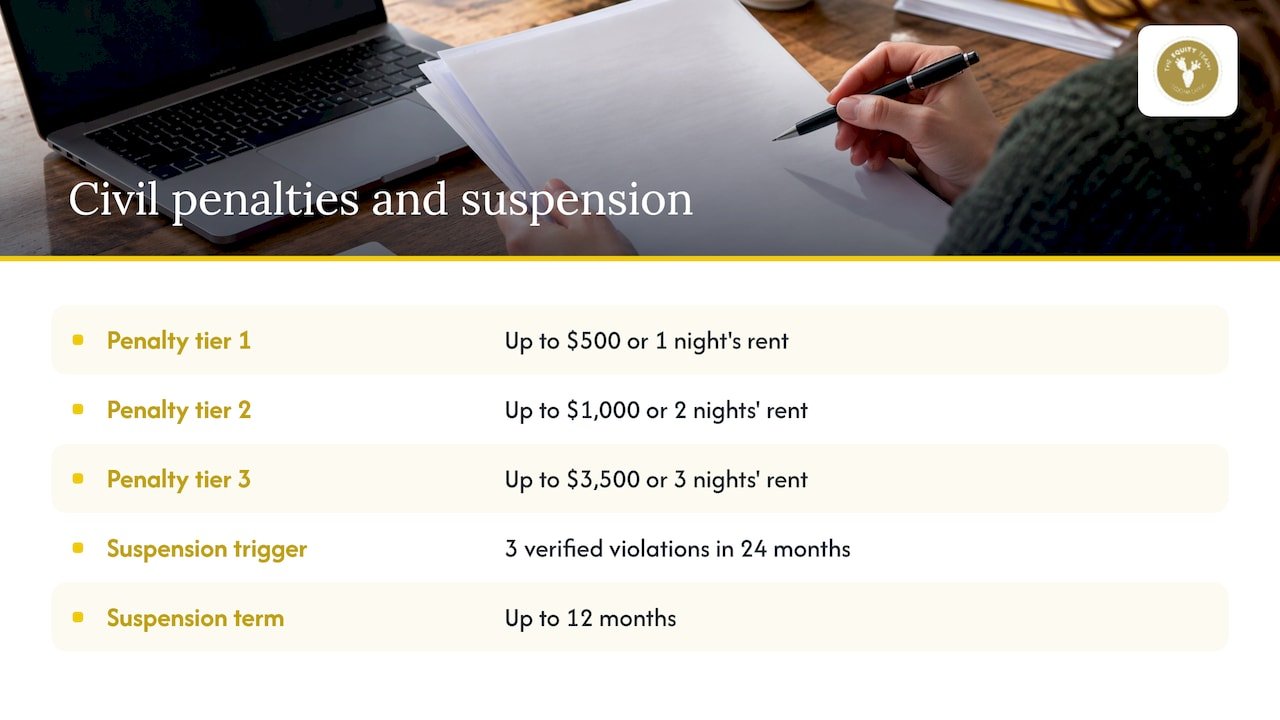
A bill is not a law until it passes and is signed, so read that as a direction of travel and look up the current status of the bill and of the city code before making a decision. Tax is the other trap: our page on Sedona rental property taxes and the 30 day rule explains how a retroactive bill happens.
If you are buying: due diligence for nonconforming status
A nonconforming STR can be a great buy, since the right can be worth more than the house. It is also the thing a listing photo cannot show. Here is a sensible order of operations.
- Ask the seller for the certificate of occupancy and the permit history. The burden of proof sits with whoever owns the property, which will be you after closing.
- Check the date. Was the certificate issued before September 14, 2024? If not, the owner-occupancy question may apply.
- Compare the building to the paperwork. An unpermitted conversion can break the “not modified without a required permit” condition.
- Look for gaps in use. A rental that sat dark for six months is a different asset.
- Run the numbers on the real use, not the best-case one. Our Sedona vacation rental CMA approach prices the property as an operating rental.
- Build contingency time into the contract. The purchase contract guide and the Sedona home purchase timeline show where that time fits.
If the file is murky, a land-use attorney is the right person to read it, and the city’s Community Development staff are the right people to ask how the property is classified.
If you are selling: make the status easy to see
A buyer who has to guess about nonconforming status will either walk or discount. A seller who hands over a clean file gets to talk about income instead. Before listing:
- Pull the certificate of occupancy and every permit.
- Keep the property operating through the sale so the six-month clock does not start.
- Hold off on remodels that touch structure, footprint or unit count.
- Confirm tax accounts are in order. The Sedona rental prep steps cover the tax traps.
It also helps to know what the rental is worth as a rental, and what it is worth if buyers cannot count on the STR use. The rental exit strategy conversation is built for that.
Our perspective
We are the agents in Northern Arizona who built our practice around short-term rentals, and nonconforming use is the topic where that focus pays for itself.
Most buyers fall in love with the view and the booking calendar. The zoning file is the unglamorous part, yet it decides whether the calendar keeps working after closing. We would rather read the certificate of occupancy before the offer than explain a problem after it.
For sellers, the same logic runs in reverse. A property whose status is documented is a property that shows its income with confidence, and that is how an STR gets top dollar. We represent clients who operate in the top 10% of the rental market, and the ones who do best treat their paperwork as part of the asset.
If you are buying, we will help you read the property as an operating rental. If you are selling, we will help you assemble the file and price it as one.
Chad
Working with an STR specialist
If you own or want a Sedona rental where nonconforming status could matter, start with an agent who spends the day on STRs. The Equity Team represents buyers and sellers of Sedona short-term rentals. Sellers can request a Sedona vacation rental CMA and a seller prep consultation, and buyers can start from our home page to talk through a purchase.

We will tell you what the property is worth as a rental and which records to gather. Pricing for these services is not published on our site.
FAQ
Is every Sedona short-term rental a nonconforming use?
No. Many STRs are simply permitted under the district rules where they sit. Nonconforming status applies when the current code would not allow the use but the property was legally doing it before the rules changed. Confirm which applies with the city’s Community Development staff.
Does nonconforming status transfer when I sell?
Ownership changes do not by themselves end it. LDC 1.6.B says changes in ownership, tenancy or management may occur, but the nonconformity remains subject to Section 1.6 standards. The new owner takes on the burden of proving it, so the paperwork needs to travel with the sale.
How long can an STR sit empty before the right is lost?
Under LDC 1.6.C, discontinuing the use for six months means future use must comply with the code. The Director may grant an extension when improvements are being diligently pursued. Document any renovation timeline in writing.
Can I remodel a nonconforming STR?
Maintenance, repairs and code-required work are allowed. Anything that increases the degree of nonconformity is not, and extending the use in the same building cannot involve structural alteration, added units or added required parking. Ask the city before a project that touches footprint or structure.
Do the September 14, 2024 rules apply to every property?
They apply to guest quarters under Sedona City Code 5.25.050: those with a certificate of occupancy issued before that date, in compliance and unmodified without permits. Properties outside that description fall under other parts of the code, so check the specific property.
Sources
- 5.25.050 Use regulations, Sedona City Code
- 1.6.B Regulations Applicable to All Nonconformities, Sedona Land Development Code
- 1.6.C Nonconforming Uses, Sedona Land Development Code
- 1.6.D Nonconforming Structures, Sedona Land Development Code
- HB 2429, Arizona Legislature